Monday, 10 January 2022

"We want our films to have soul, to be memorable" - an interview with Babitha Mathew, award-winning film director

"I never thought or believed I would make a movie" said Babitha Mathew, director of the upcoming Malayalam language movie Pyali, when we spoke recently via zoom. 

Pyali will be the Kerala born and based director's first full length feature film. It tells the story of two Kashmiri street children and their daily struggles living alone in a Kerala slum. Older brother Ziyah, aged 14, takes responsibility for the care of his little sister, five year old Piyali as he attempts to make a living, keep her safe and realise her dreams. In India (and elsewhere) many unaccompanied children are drawn or forced into organised begging and at one point Pyali asks her brother "...who are beggars?" Ziyah, determined they won't beg, answers "beggars are those who take money and food from people without doing any work, but we aren't like that. I go to work, right?" The story was written by the director's husband, Rinn AX.

"I had to coach her in the correct expression and pronunciation of every word"

The film took five years to complete. Babitha explained "we spent two to three years to find a producer before Sofia Varghese of NF Varghese Pictures came forward. There was also an extensive search to fill the lead roles. We needed actors who both looked, and could act like, Kashmiris, who are often a little shy and reserved". Pyali is played by six year old Barbie (also known as Arravya Sharma). Despite her age she is an experienced actress and has been in more than 100 ads and a Hindi language TV serial. I was astonished when I learned that Barbie does not speak Malayalam. Babitha explained "I had to coach her in the correct expression and pronunciation of every word. She grasped things very quickly. Barbie is a born artist and extremely professional. She understands continuity, different camera angles and many other technical matters".

George Jacob plays Ziyah and is new to the film industry. He was born and grew up in Dubai and was unfamiliar with the lives of street people.  Before filming began he was given training in how his character would speak, behave and respond to his surroundings. Babitha recounted how he was sent to buy a pair of chappals, the open sandals worn by many Indians. "He had only ever worn shoes and came back with a very nice pair that cost 6,000 rupees (almost £60). I took him back to the shop and bought some for 200 rupees. He wore them from then until filming was complete". 

I asked her about the difficulties or special responsibilities of working with children. She explained "this is not a children's film, but the lead actors are children. That means we had special responsibilities which we took very seriously, ensuring that they had proper breaks and enough rest time".

"I wanted to give myself to movies, to learn more"

I asked her how she came to be involved in the film industry. "I always loved movies," she said "I studied Business Management and then worked for various corporates for six years, but film was always my main interest, and I spent most of my free time watching movies. I was curious about how films are made and began to do my own research. I taught myself about everything to do with film, such as script writing, directing and camera work". She continued "I never had the chance to help on a film or to do a course - I learned film-making by doing it". In 2016 she decided to quit her corporate job - "I wanted to give myself to movies, to learn more. I couldn't do anything while working"

Her story is unusual as is the fact that she is a female film director. Even today, few women are found behind the camera in the film industry. Babitha said "many people have been surprised to see a female director".  She is also a mother. Her daughter was born five years ago, but this did not mean taking time off. "I started making Pyali when she was just a few months old. I held her with one arm whilst directing with the other. I called action whilst feeding her". She acknowledges the support both her and her husband's families give, how proud they are of her achievements and how difficult it would be to manage without them.  

"All creative discussions begin and end with an argument"

Her husband, writer and interior designer, Rinn, is also passionate about film. Babitha said "He has written stories since childhood but had never showed them to anyone. When I read them I realised that they would make  good movies". They also worked together on Kiss, an award winning short-film which they made in 2014. It considers inter-generational relationships, the passage of time and loss. Kiss was shown at various festivals, including the prestigious Pune Film Festival  and introduced the couple's work to a much wider audience.

I asked how it is, living and working together, and if artistic differences cause problems between them. She laughed and said "we talk about film all the time. We often disagree on how to do things and all creative discussions begin and end with an argument. But we complement each other and this helps us to do our best work". She also says that being married to and living with her creative partner means they can talk about their work at any time - "there's no real division between work and home life". 

They are currently working on another full-length film featuring just one character. In the meantime, Pyali has already won two Kerala State Film Awards and is generating much interest both in India and overseas. Due to Covid it is not yet on general release, but the world premier may take place next month. The trailer indicates a beautifully shot film, sensitive portrayals of the main characters and an engaging storyline. I asked Babitha what she wants to achieve with her work. She said "We want our films to have soul, to be memorable". Initial responses indicate that Pyali fulfils both of these ambitions.

Please note all images in this post were provided by Babitha Mathew.

You can see the trailer for Pyali here.

You might also like A city that has a bit of everywhere, but is not like anywhere

Thursday, 6 January 2022

"A city that has a bit of everywhere but is not like anywhere"

I first met Manjit Singh Hoonjan, owner of Calcutta Photo Tours, in 2017. I booked his early morning Mesmerising Markets tour and for three hours I experienced the crowds, colours, sounds and smells of Kolkata's vegetable and fish markets. He helped me engage with people, gave me the back story to the markets' activities and I came away with some great pictures. Since then I've made a point of repeating the experience whenever I've been in India. We spoke recently on zoom and I took the opportunity to get the full story of Calcutta Photo Tours.

"Her pictures were in colour and attracted more attention than mine"

Manjit started taking pictures at a young age and was given his first camera for his eighth birthday. "It was an Agfa click 4 with a plastic body and took black and white pictures" he said. He was delighted with it but recalls "I went on a school picnic and took several photographs. One of my classmates also had a camera. Her pictures were in colour and attracted more attention than mine". 

He did not have a colour camera until the age of 17 but by that time his work was already attracting  attention. College Street is the centre of the book trade in Kolkata and like many other students Manjit went there to buy textbooks. On one visit he saw a notice bearing the word "Silence" on the street lamp post, close to the exterior wall of a hospital, under a poster for the film "Kab Tak Chup Rahungi" which means "how much longer will we remain quiet". He wanted to photograph the two notices together and to enter The Telegraph newspaper's regular photo competition. His father borrowed a camera from a friend, bought film for it and Manjit took two shots before returning it. He then had to  wait for the friend to use the rest of the film and have it developed. The pictures were chosen for publication and he won a prize of 250 rupees which he used to open his first bank account.

After completing his studies he spent some time working in, and then managing, the family print and graphic design business. In his spare time, he continued with photography and an American friend suggested he start running photo walks in Kolkata. At the time most photo tours tended to concentrate on whole regions and lasted at least a couple of weeks. After a few years of running the walks in his spare time he decided to close the family business and to concentrate on photography. When I asked him about his family's reaction to this he said "at first they were worried and pointed out that tourism, the main source of business for the walks, is seasonal, but when my work started getting a lot of media attention, they became very proud". 

"I am booking this tour and I hope you will be there"

He recalls his first ever client "A Dutch woman sent me a message saying 'I am booking this tour and I hope you will be there'". He too had concerns and remembers thinking "I'm getting up at 5 a.m. will she even be there?". They both turned up and since then his decision to concentrate on photography has brought great success. Trip Advisor lists the tours as one of the most popular things to do in Kolkata and his work has been featured in National Geographic, The Wall Street Journal, The Telegraph,  the Guardian and other high-profile publications. In 2018 his Durga Puja pictures were seen by millions when they were exhibited outdoors on London's South Bank as part of the Thames Festival.


The Hoonjan family have been in West Bengal for three generations and have a strong connection to Kolkata. Despite his Sikh heritage and religion Manjit considers himself to be deeply connected with Bengal. He said "When I started some people queried how a Sikh could really know Kolkata but more recently a Bengali friend said that I am more Bengali than he is". I asked him what inspires his desire to show Kolkata to others. He explained "It is a city that has a bit of everywhere but is not like anywhere". This is reflected in the range of tours he offers. The Culture Kaleidoscope tour reveals the religious diversity of Kolkata and also includes a visit to India's only China Town. European Calcutta concentrates on the colonial legacy of the city and Mesmerising Markets shows the day to day life of some of Kolkata's key workers. All include short breaks for chai and snacks - important elements of any day in India - and the telling of stories related to the tours. 

I asked Manjit about how people respond to the tours. He said "Sometimes they become emotional, particularly people who have not previously left the tourist trail and who are having their first glimpse of real, day to day life in the city. A Chinese family who came on the Cultural Kaleidoscope tour were delighted to be able to speak to locals in their own language. One member of the family said they felt so happy they had goosebumps". My own favourite comment came from a group who had begun their tour of India in Kolkata with Manjit ."They told me I had spoiled their trip because later guides had not been able to equal their time with me". In my case, that first early morning walk in the markets led to Kolkata becoming my favourite Indian city and one of the places I've missed most in the last two years of being unable to travel. 

Please note all photographs in this post were provided by Manjit Singh Hoonjan.

You can follow Calcutta Photo Tours on instagram and on Facebook

For more details of the tours and booking see Calcutta Photo Tours

Sunday, 17 October 2021

More Travels With My Camera

American photographer Alfred Eisenstaedt famously said, “it is more important to click with people than to click with the shutter”. I agree with him. For me, a photograph is often the culmination of a longer exchange with a stranger who initially interests me because of their face, clothing or activity. This exchange may be short or can develop into a more sustained connection. There are people in Kolkata, Mumbai, and Delhi that I clicked with on my first visit who I now seek out each time I return. 

This could be because I am a lover of stories. Some of my best pictures have been taken after or while hearing about the lives of others. People will often reveal intimate things about themselves if someone shows interest, even a complete stranger. In return the photographer may be asked to share their story and when traveling I am often questioned about my family, work, and financial and marital status. 


My curiosity has led to unexpected experiences. I’ve been asked to sing in Hindi in a barber shop in Lucknow and also by a group of sweepers in a Mumbai street. I’ve been quizzed on Premier League football and the British Royal Family by tipsy agricultural workers in a remote part of Myanmar. In a Kolkata street quite a crowd gathered when a vendor refused to believe that I don’t have a car. His parting shot was: “if you don’t have a car then you are not from London”. 


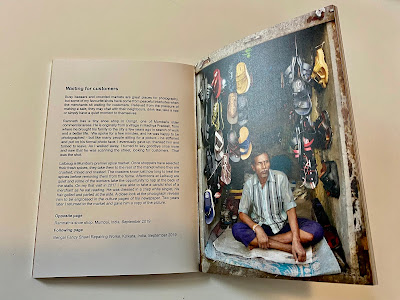
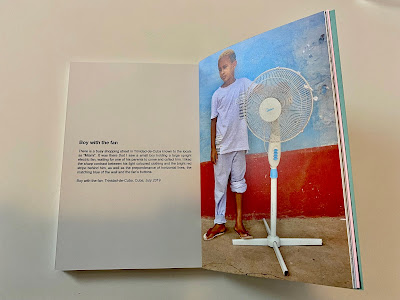
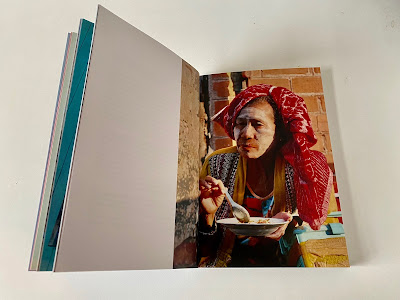
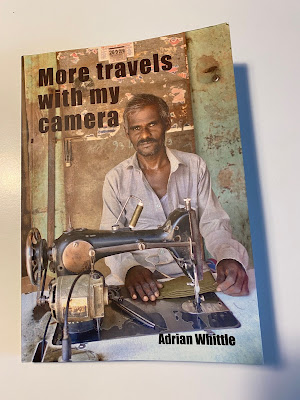
Next week, my new exhibition, More Travels With My Camera, opens at the Jeannie Avent Gallery in East Dulwich, London.  It includes photographs taken in Cuba, India, Myanmar and Peru between 2017 and early 2020. In early 2020 international travel became almost impossible and is only now, beginning to recover. Myanmar has seen violent and ongoing political upheaval and in Cuba there have been the first anti-government demonstrations for thirty years. It may still be some time before it is possible to revisit some of the people pictured in More Travels With My Camera. Until then I hope my photographs will bring their stories to a wider audience.


More Travels With My Camera opens at the Jeannie Avent Gallery, East Dulwich, London SE22 9EU on October 21st and runs until November 2nd. The gallery will be open every day from 10-5 and 10-6 on Fridays. 


The images featured in this post are from a book produced to accompany the exhibition, also entitled "More Travels With My Camera". It contains 36 full colour pictures and the stories behind some of them. Copies will be available for purchase at the gallery during the period of the exhibition or by emailing adrianpwhittle@outlook.com 


Tuesday, 31 August 2021

The Delineator - Art Deco Fashion Magazines of 1929

I recently became the proud owner of two, 1929 editions of the Delineator Magazine, a women's monthly fashion-focused publication, that ran from the late 19th century until 1939. During the 1920's the magazine adopted several Art Deco design features, especially on the front cover. Most of these were designed by American artist and industrial designer Helen Dryden, and it was her work that led me to my purchases. 


The emphasis on fashion was due in part to the sewing pattern company, Butterick being the publisher. The latest fashions received in-depth coverage every month with enough information for a competent dressmaker to be able to reproduce them. Many of Butterick's sewing patterns were featured in the magazine. Although fashion was the main focus, there were also articles on health, cookery, childcare, travel and social issues. The editorial team also took a strong interest in women's rights and from the beginning of the 20th century advocated for votes for women. There was also original fiction by prominent authors including Frank L. Baum author of The Wonderful Wizard of Oz and articles on the lives of public figures. The advertising included health, beauty and personal hygiene products as well as brands still popular today such as Heinz, Wrigley's and Campbell's.

The August edition demonstrates the magazine's interest in social issues. There is a lengthy article by Vera L. Connelly, promoting the idea of aviation as a career for women, whilst Anne Carol Moore of the New York Public Library contributed a piece on encouraging children to read. Moore emphasised the importance of parents reading with their children and recommended several authors for the very young, amongst them, Randolph Caldecott, Kate Greenaway and Walter Crane. The advertising includes Sal Heptica, touted as "a laxative for loveliness," Ponds cosmetics, hair removal products, corn preparations and Heinz Spaghetti.

The December edition carries several articles relating to the festive season including "What Christmas Means To Me" by Mrs. Calvin Coolidge, wife of the then President of the USA. The Christmas recipes section has various sweet treats - marshmallow mint sauce, tutti-frutti fudge and chocolate fruit patties. This may explain why elsewhere in the magazine there is a full page advert for Phillips Milk of Magnesia, useful for "...the gentle correction of digestive disorders and sluggish bowel action". Camay soap has a full page advert, asserting that it has the approval of "...73 of the most eminent dermatologists in America". For those who wanted a good read over the holidays, there is a serialised biography of Frances Parkinson Keyes and original fiction from Edith Wharton and Konrad Bercovici. 

Helen Dryden designed several of the Delineator's covers during the 1920's and 1930's. She was born in Baltimore in 1882 and displayed artistic talent at an early age, designing and selling clothes for paper dolls. Her customers included a newspaper that used them to illustrate its fashion pages. She later studied landscape painting at the Pennsylvania Academy of Fine Arts but on graduation chose to work in fashion design and illustration. She was initially rejected by Vogue but later produced several covers for that publication as well as for Vanity Fair and House & Garden. 

The 1925 Paris International Exhibition of Modern Decorative  and Industrial Arts inspired her to begin working in industrial design, especially lamps and tableware. By 1932 she had all but retired from illustration to concentrate on this new field and by 1936 she is said to have been earning $100,000 a year from her work. The New York Times claimed she was the highest paid woman in the USA at the time. In 1935, Raymond Loewy approached her and asked for her help in designing the interior of the 1936 Studebaker Director and President cars. Loewy designed the Coca-Cola fountain dispenser,  the Greyhound bus logo, the Gestetner duplicating machine and Concorde's interiors. Dryden was one of very few women working in this field at the time and attracted much media attention for her work. Her fame was such that the marketing materials for the cars included the phrase "It's styled by Helen Dryden". She worked with Loewy until 1940 but by 1956, things had changed and she was living on welfare. She died in 1972. The Delineator continued until 1937 when it was merged with the Pictorial Review. Two years later it ceased publication and disappeared from the news stands.

You might also like The Illustrated Weekly of India - 15th March 1936

Tuesday, 22 June 2021

Close To Home - a new album from Ari Erev

"Close to Home tells the story of family members, close friends and familiar places to whom we relate and feel deep emotions towards" says Ari Erev of his fourth, recently released album.

His latest recording combines jazz with strong Latin influences and occasional classical hints, creating a soundtrack for a musical exploration on the subject of home. The music communicates a range of emotions including optimism, hope, melancholy and nostalgia. I am very familiar with the place that Erev calls home and from the opening notes of the first track I can almost see the Mediterranean sunset, taste the coffee in my favourite Tel-Aviv cafe and imagine myself walking the streets of that city.

An impressive group of musicians have been assembled for this album. Yuval Cohen plays soprano sax, Assaf Hakimi double bass, Gaspar Betoncelj drums and Gilad Dobrecky percussion. Flautist Hadar Noiberg guests on two tracks. They are a very tight ensemble as demonstrated on the opening track, Israeli Story. It features a musical conversation between Erev's super cool piano and Noiberg's flute, setting the tone for the rest of the album. One of eight original compositions, it builds slowly from an understated opening, culminating in some delightful exchanges between the musicians towards the climax. 

My other favourites include Afar, which Erev wrote for his daughter, Tal and Po (Hebrew for here). Afar is a mellow piece led by the composer with some impressive sax from Cohen and flute from Noiberg. Po, the final track sees Erev again joined by Cohen and by Assaf Hakimi on bass guitar rather than his usual double bass.

In addition to the original compositions there are five works by other writers. I often wonder how musicians choose non-original material for their albums and recently had the chance to ask Ari about his choices for Closer To Home. He began with a short answer "I like them a lot" before explaining that there is no specific reason for their inclusion. As part of his normal repertoire building he will play a song, experiment with different approaches and arrangements and if it works he will include it in performances or recordings. He said that Debora Gurgel's Para Sempre was included almost by chance. He recalled discovering the piece a few years ago, printing the charts and then forgetting about them until coming across them again a few weeks before recording Close To Home. He played the piece again and felt "an immediate click" hence its inclusion. Whatever the reasons for their inclusion, these tracks complement the original works and help carry the story being told by this album.

In addition to his having released four superb albums, Ari Erev is also a great and very engaging live artist. The first time I saw him play he performed several works of Bill Evans, who he lists as an important influence on him. That influence can be seen in Close To Home but he also has his own warm and engaging style, exemplified on each one of its tracks.  I hope to enjoy a live performance of this new work somewhere closer to Ari's home before too much longer. 

 You can hear clips from and buy Closer To Home here.

Sunday, 30 May 2021

How To Be A Travel Writer

"Only describe something as breath-taking if you are writing at high altitude or interviewing someone with emphysema" warned Peter Carty. It was the first session of his online travel writing course and he wanted to demonstrate how the genre lends itself to cliche. He's asked us to identify examples of this and several other clunkers were put forward. I laughed along with my course mates but realised that in ten years of blogging and occasional contributions to magazines, I'd used many of these words and phrases myself.

I enrolled on the course during the most recent lockdown hoping to sharpen my writing skills and to improve my chances of getting published more widely. The course is designed to meet both of these objectives, has a very practical focus and offers continuing support at no extra charge. It consists of four sessions of two hours. They are spread across four evenings and combine information-giving, discussion and  short writing exercises to practise the skills being covered. The sessions are well structured, relaxed and thoroughly enjoyable and I quickly felt very comfortable speaking and sharing my work. Handouts of case studies and resource lists are provided to support the work done in the sessions.

The first two weeks concentrated specifically on writing, including choosing and researching subject matter, style and structure. Each of these areas was covered in depth and was accompanied by a short exercise. This led up to an assignment completed between the second and third weeks - a 500 word piece on a subject of our choice. It had to be focused, interesting and meet Peter's style and punctuation guide. This exercise replicates the requirements of potential publishers as well as Peter's strong emphasis on good writing. "If you want to torture me tie me up and make me read badly punctuated articles" he said. 

I wrote about a marzipan shop in Tel-Aviv. Sharing it with the rest of the group was a bit nerve wracking and of course, as my name begins with letter A, I ended up going first. Peter gave an initial response on ways of  improving our work, before providing more detailed written feedback. I enjoyed sharing my piece and it was helpful to hear the approach classmates had taken and to learn about places I didn't know, such as an historic pub in Saint Albans, a cafe in a working class neighbourhood of Warsaw and a river walk in north London.

The third and fourth sessions focus on getting into print, how and when to pitch to different types of publication, both hard-copy and online, marketing one's work and general advice on communicating with the travel industry. Again Peter emphasised the need for detailed research before approaching a publication. 

I completed the course feeling that my objectives had been fulfilled. I learned a lot about sharpening my writing and have been looking back on some of my earlier work and seeing how it could be improved. It has also made me feel more confident about pitching to a wider range of publications. I just hope there aren't any cliches or too many adjectives in this post.

More information

Peter Carty runs regular travel writing workshops. He also offers the course I took as a single day workshop. There is also the option of a six module distance learning course conducted over email with zoom meetings on request. Unlimited post course feedback and support is offered with each course. My course cost £115.

Thursday, 13 May 2021

Do You Know Where Dhaka Is? - Adventures in Zakaria Street, Kolkata

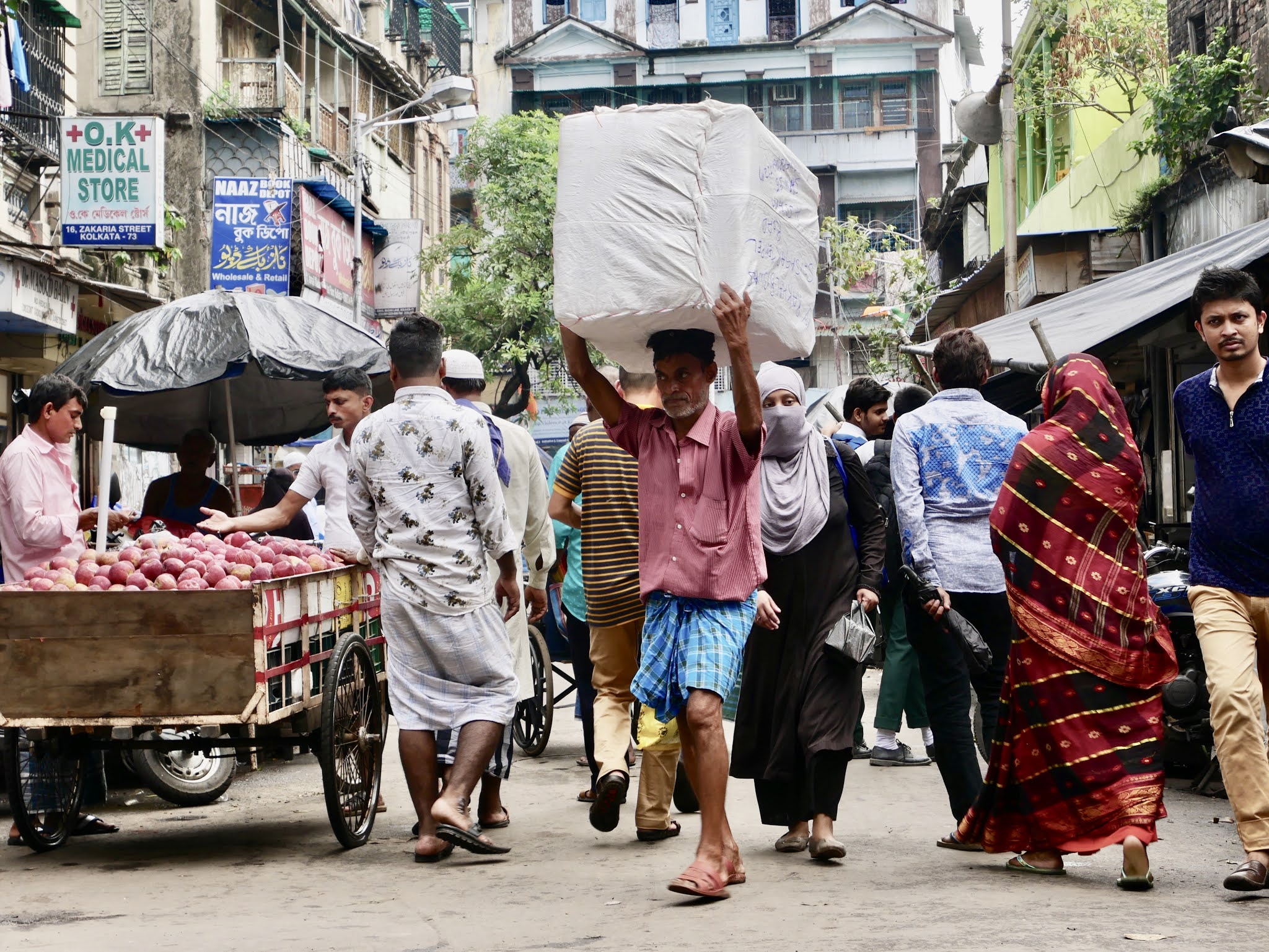
The first time I visited Kolkata, I dumped my bags at the hotel and headed for Zakaria Street. The Kolkata Heritage Photo Project’s book “Calcutta Chitpur Road Neighbourhoods” had inspired me to explore North Kolkata and this busy street and the lanes leading off it seemed like a good place to start. 

Zakaria Street is at the centre of a predominantly Muslim area, famed for the magnificent Nekhoda mosque that stands at the junction with Chitpur Road. The mosque was built in 1926, can accommodate 10,000 worshippers and is intended as a replica of the Mughal Emperor Akhbar’s tomb in Agra. It is the city’s largest mosque and dominates the skyline of this part of Chitpur Road. The street is also known for its many food vendors, most of whom offer meat dishes. Although not suitable for a vegetarian like me, the stalls are immensely popular with locals and also attract a few tourists.


Mohammed Ishmail

Zakaria Street is relatively narrow and very crowded. Despite this all kinds of vehicles manoeuvre their way along it, delivering goods to the traders or picking up items to take elsewhere. Crossing the road can be a bit of a challenge as trucks, hand pulled rickshaws, tuk-tuks, humans and the occasional animal compete for space. It is a great place to observe and photograph Kolkata’s street life. I soon discovered that approaching people for portraits can result in a lengthy exchange, involving my answering many questions in what I now know to be a standard Indian style interview about where I’m from, what I’m doing in India, what my marital status is, how much do I earn and what do I think of the city. This is almost always accompanied by an invitation to drink tea purchased from a chaiwallah, one of whom is to be found on almost every street .


One such invitation came in a lane leading from Zakaria Street to Tarachand Dutta Street. I noticed a sign for a drycleaner’s bearing the service legend “Ordinary 4 days, semi-urgent 2 days”. No urgent service. A group of men were sitting in front of the sign and I asked if they wouldn’t stepping aside for a moment so that I could photograph it. “No problem” came the reply as Javed Uddin stepped forward, introduced himself as the owner of a nearby delivery business and offered me the obligatory chai. His friend’s daughter had been married the day before and he insisted that I also eat some sweets, left from the wedding. He asked me the routine questions and then said “do you know where Dhaka is?”. “Yes, it’s the capital of Bangladesh”. I replied. He seemed surprised and said “It is exactly that. It is also the name of that building. Dhaka House. This also belongs to me”, indicating said premises with a flourish. I sat for a while, drank my tea, ate some sweets and then got up to go. He insisted I drink water before leaving “it is a very hot day, you must drink” he said. He handed me a large bottle of water that he and his friends had been passing between them. Not wanting to appear rude I decided I would take a sip and managed to drink a little without putting my lips to the bottle and without pouring the contents over myself. A good technique and a steady hand is vital in order to do this.


After shaking my hand and checking I had his name, Javed advised me to be careful and said that if I had any problems, or if anyone gave me trouble in Kolkata, I was to come and see him. “I can help. I know people” he said. I photographed him standing beside a motorbike in the doorway to Dhaka House.  I was able to give him a copy of the picture a year later. It wasn’t my best work, but he seemed pleased with it.


Making my way into Tarachand Dutta Street I soon realised that the thing I was looking for was no longer there. I had wanted to see the art deco Krishna Cinema, a photograph of which appears in the Kolkata Heritage Photo Project book. It had been demolished. For a moment I wondered if I was in the wrong street. I checked with a sweet vendor who confirmed I was indeed in Tarachand Dutta Street and when I asked about the cinema, he very cheerfully said “that old thing has been demolished”.


On a subsequent visit I came across a covered arcade accessed by a narrow alley leading from the main street. An impressive gentleman wearing kurtha pyjama and an embroidered topi was sitting in the doorway of a tailoring shop. This was Mohammed Ishmail. He nodded a welcome to me and said that the shop belonged to him. He introduced a young man working over a sewing machine as Gulab, which is the Urdu word for rose. Mister Ishmael went on to explain that this was a family business and then seemed anxious to make it clear that Gulab was not a relative, saying in English “he is my servant”. Gulab clearly understand this and looked up from his work, affronted. Mister Ishmail noticed this and corrected himself, saying, in very formal English “that is to say, he is my employee”. The placated employee resumed his labour. I photographed them both and showed them the results. Gulab merely nodded but his boss laughed and said “look at me. I could be in Pakistan”. 


This part of Kolkata is home to other industries too. In one of the adjoining streets, dozens of workers sit surrounded by piles of discarded metal, wood and cardboard goods. All of these waste items, collected from across the city are dismantled and used to create tools, furniture and other items. There is the constant sound of hammering as old nails are straightened and made ready for re-use. Sparks fly from welding and huge coils of recycled wire are stacked outside workshops ready for despatch and a second life. 

It was in the midst of this noise and industry that I met Feroz. He was employed as a delivery man using a cyclo-rickshaw adapted to carry large loads to and from the recycling businesses. He had a shaved head, a dazzling smile and a sense of humour. He saw my camera and asked me to take his picture. Once done, he pointed at my head, laughed and said in English “you and me same to same” before laughing again and riding off before there was a chance to hear his story. I found him again a year later, but I hardly recognised him. He was sleeping on a charpoy at the side of the road. I only knew it was him because I showed his picture to a couple of porters who recognised him and took me to him. His hair had grown back but the smile was absent, and his eyes were dull. He smelt strongly of alcohol. Alcohol dependancy is a widespread problem amongst day labourers, many of whom come from other parts of India and live alone in the city without the support of their family. He managed a half smile and a “thank-you” as I handed him his picture before he returned to his charpoy and went back to sleep.


Gulab


Recycling metal


Street vendor, Zakaria Street


The mosque is not the only interesting building here. There are several once elegant mansions, built by wealthy Marwari merchants after 1911 on land purchased from the Calcutta Improvement Trust. The mansions replaced slums inhabited mainly by poor Muslims, many of whom had come from East Bengal towards the end of the previous century. Today the Marwaris are long gone, relocated to smarter addresses in the south of the city or to other parts of India. Their former homes are rented out for both residential and commercial purposes and although there are hints of former glory, there is a general shabbiness to what remains. There are several hotels here, some of them sporting impressive names, such as the De Luxe Guest House and the Rajasthan Guest House. In Keith Humphrey’s excellent book “Calcutta Revisited”, he suggests that they are suitable only for “…the adventurous, desperate or impecunious”.  


Zakaria Street and some of the neglected mansions feature in Kunal Basu’s book “Kalkatta”. The hero lives in one of the old apartment buildings. The book tells the story of a Muslim family with a complicated background. The parents fled Bihar during partition and settled in the former East Pakistan, present day Bangladesh. In order to escape poverty, they obtain forged papers and return to India to make a new life in Kolkata. The son, Jamshed is the focus of the story as he struggles to fulfil his parents’ ambitions for success. Basu captures perfectly the atmosphere of the street with its overcrowded, once grandiose tenement buildings, the daily struggles to make ends meet and the city’s complicated politics.


I was last in Kolkata in September 2019. At the time there was no way of knowing that it would be impossible to return a year, or even two years later. Until the world changes again the only way to visit this, my favourite Indian city, is through the pages of books. For those who want to explore for themselves, some suggestions are listed below.


You might also like A Case of Mistaken Identity - The Story Behind A Photograph


Suggested reading


Kalkatta - Kanal Basu


A Strange And Sublime Address - Amit Chaudhuri


Calcutta, Two Years In The City - Amit Chaudhuri


The Epic City - Kushnava Chowdhury


Calcutta Revisited: Exploring Calcutta Through Backstreets And Byways - Keith Humphrey


Calcutta (Cities of the Imagination series) - Krishna Dutta


Calcutta Chitpur Road Neighbourhoods - Kolkata Heritage Photo Project


Kolkata Calcutta - Fionn Reilly

Monday, 19 April 2021

A Case Of Mistaken Identity - The Story Behind A Photograph

I first met the man I now know as Dilip Ghosh in September 2017. As I walked along Beadon Street in North Kolkata I noticed a chaiwallah serving tea to a long line of customers. Those who had already been served stood chatting in groups or sat squeezed onto a long bench busy with tea drinkers. The chaiwallah was an impressive figure with his neat black moustache and hair and off-white shirt. His stall was in front of a bright green building. A deep red garland hung on the shutters behind him matching the colour of the cloth wrapped around the kettle's hot handle. I caught his attention, indicated the camera and received the slightest nod of approval. He continued working whilst I took several shots and then showed him the best of them. He nodded again and continued pouring tea.

I ordered a chai and stood to one side whilst he prepared it. Whilst I waited a neatly dressed man, perhaps in his sixties, stepped forward and insisted on paying for my drink before asking me the usual questions about work and family. He said that he had worked for a British company before retiring on what he described as a comfortable pension. He invited me to sit with him and told me that the chaiwallah, who did not speak English, was one Mohan Lal and that like many other people in Kolkata, he was originally from Bihar. I scribbled these details into my notebook and referred to them shortly after whilst blogging about my time in Kolkata. 


I returned to the city a year later and looked for Mohan so that I could give him the picture. It took three days to find him. On this occasion, I was accompanied by a guide who told him we’d been looking for him and that no-one in Beadon Street had heard of him. The reason for this soon became clear. His name is not Mohan Lal and he is not from Bihar. He is Dilip Ghosh and he was born in Kolkata. Not only this, he had lived all his life there and had no idea why my erstwhile friend thought otherwise. I handed him the picture which he admired for a moment  before calling to his wife and son to come and look at it. Mrs. Ghosh was very excited and took it to show to customers and neighbours before requesting a picture of her and her husband.


Between my second and third visits to the city, I staged a small exhibition of my photographs in a series of London venues and used Dilip’s picture on the promotional poster. He now displays it behind his stall beside the calendar he produces annually and gives to his regular customers.


There is an odd coda to this case of mistaken identity. In early 2021 I posted the picture on my Instagram account. It received a positive response with many likes and new followers, but I soon noticed a series of laughing emojis in the comments box, some of them posted alongside Dilip’s name. I began to worry that I’d made a mistake of some kind or that I still had the wrong name. I googled “Dilip Ghosh” to try to understand what was going on. It seems that my favourite Kolkata chaiwallah has a namesake, a prominent West Bengal politician. The thought of him selling cups of tea had amused many of his constituents.


You might also like Travels With My Camera 2020 - The Best Pictures

Monday, 22 March 2021

A Mumbai Icon And A Disappearing World


It is thought that the first Parsees came to India between the eighth and tenth centuries, fleeing persecution in what is now Iran. Together with the Iranis, they are one of two groups practising the Zoroastrian faith. They have been extremely successful in India, particularly during the period of British rule when several members of the community achieved positions of prominence including in science, industry and the military. In recent decades their numbers have declined due to emigration and an extremely low birth rate.  However, their presence is still felt through their historical achievements, the remaining Parsi temples and the work of internationally renowned writers including Rohinton Mistry, Thrity Umrigar and Bapsi Sidhwa. They are also known for their famous cuisine. 


During the middle years of the 20th century, Mumbai was home to several hundred Parsee and Irani cafes serving authentic dishes including salti boti (mutton pieces cooked in a special gravy), fish patra, berry pulav and Parsee chapatis. Sadly, most have now disappeared, some have reinvented themselves as places to enjoy beer and snacks and a few have clung on to their roots. Café Britannia in the Fort neighbourhood falls into the latter category. Founded in 1923 by Rashid Kohinoor, a Zoroastrian immigrant from Iran, it was originally established to serve continental dishes to British officers during the colonial period. Rashid’s son, Boman eventually took over responsibility for the café and was an iconic presence there until his death in 2019 at the age of 97.


The name of the café was chosen because eating places needed to be licensed by the British and Rashid thought the name might encourage them to deal quickly and positively with the application. He was proved right and the café has been operating since then. Although not as elegant as it must once have been, it retains a certain charm with its peeling paint and beautiful bent wood chairs imported from Poland decades ago. Less charming although somehow endearing are the idiosyncratic rules and regulations displayed on the walls and on the menu. These include sensible stuff such as not allowing outside food to be brought in and a requirement to vacate seats as soon as you have paid to allow others to sit down. Others assume a more authoritarian tone. My favourite notice reads “Do not argue with the management”. I wish I’d thought of that when I worked with the public. It goes nicely with a favourite sign of mine seen in another Mumbai café that says “This place is for eating not meeting. Eat and go”. These notices can be found in most of Mumbai's Parsi and Irani cafes and as well as directing the behaviour of customers they have inspired at least one prominent Mumbai writer. The Bene Israel Jewish writer Nissim Ezekiel wrote the following after spending time in Bastani, another (now sadly closed) Irani cafe in south Mumbai. 


Please

Do not spit

Do not sit more

Pay promptly, time is invaluable

Do not write letter

Without order refreshment

Do not comb

Hair is spoiling floor

Do not make mischief's in cabin

Our waiter is reporting

Come again

All are welcome whatever caste

If not satisfied tell us

Otherwise tell others

God is great


I met Boman Kohinoor twice, the first time in 2017 when I enjoyed a plate of his famous vegetable biryani accompanied by a sweet lime soda. He took my order, asked me where I am from and said, “I’ll be back”. A few minutes later he returned to the table saying “I’m back” before proceeding to show me a number of laminated press cuttings picturing him with Prince William and Kate Middleton as well as other articles about the café. He was a devoted royalist and received extensive media coverage when he was invited to meet the royal couple when they visited the city. The invitation came following his making a video appeal explaining how thrilled he would be at the opportunity to meet them. He continued to come and go from my table to speak to other customers, always saying “I’ll be back” and “I’m back” at the appropriate point before telling me a little more or teasing me about where I come from. “So are you from England, Britain, Great Britain, the British Isles or the United Kingdom” he asked me. I told him “London” and he agreed that this was a good answer.


Before I left, he asked me for three favours. I was to ask the Queen to visit Mumbai, to kiss the children of William and Kate next time I saw them and to come back and eat there again. The first two were beyond my ability and at least one would probably have got me into serious trouble should I have tried to do it. However, I did manage to return and to enjoy his food a second time. I was also able to give him a large copy of the photograph I had taken of him, proudly holding the laminated news clipping featuring the picture of him with the royals. His death was a sad day for Mumbai and for India, the end of an era and the loss of one of the few remaining links with old Bombay.

Saturday, 13 March 2021

The Language of Thieves

London's Jewish Book Week (JBW) is one of the highlights of the literary calendar. Every year it attracts huge audiences who come to hear authors talking about their latest books and current issues of Jewish (and wider) interest. This year, for the first time, and for obvious reasons JBW took place online before a virtual audience. Whilst I missed the excitement of the live appearances and the chance to browse in the pop-up book shop I welcomed the chance to attend the festival from the comfort of my armchair whilst enjoying coffee and cake!

I watched several sessions but was so interested in Martin Puchner's book The Language of Thieves that I ordered a copy online whilst listening to him speak and then read it within two days of receipt. It tells two stories. Primarily a history and examination of Rotwelsch, a language spoken in Europe from the Middle Ages to the mid twentieth century, mainly by vagrants and members of the criminal class, it also tells a parallel story of his uncovering an uncomfortable truth about his family.

The author describes Rotwelsch as more of a sociolect than a language, that is a variety of language used by a distinct social group, in this case mainly homeless people. It enabled communication between its users who cam from different parts of Europe and also allowed its speakers to disguise their conversation and on occasion to evade the police. Puchner relates early childhood memories of men coming to the door of his family home, his mother giving them food and his being unable to understand much of what they said. His parents explained that these people lived on the road and spoke their own language. More than this, his father was able to explain some of the words to him, sparking a lifelong interest and eventual academic research into the subject. 

Although Rotwelsch was primarily a spoken and not a written language, its speakers left pictoral codes, carved into the foundation stones, fences and gateposts of houses. These signs, known as zinken, provided information for other people of the road about the possibility of receiving food from a particular house, places to avoid or advice on the kind of behaviour that might secure some help, such as religious piety or offering to work for food. Others can best be described as tags, symbols identifying particular characters a bit like those used by modern graffiti artists. I especially liked the idea of an image of a parrot being used by a man able to speak several languages. 

Rotwelsch borrows words from various sources, primarily Yiddish and Hebrew but also Romani, Czech and elsewhere. Hebrew speakers will recognise the words lechem (bread) ganeff (ganav in Hebrew meaning thief) and mackum (makom in Hebrew, meaning place) as well as many others. Examples of this are given throughout the book and there is a nice touch at the end of each chapter where the author gives a short lesson on different themes, enabling us to talk about the police, prison, making an escape or to take the American Oath of Allegiance in Rotwelsch. Through detailed research he discovers that although the language has almost disappeared today, there is perhaps a successor version called Yenish which is spoken in Switzerland and has a degree of official recognition there. 

Puchner is a Professor of Comparative Literature at Harvard University. He was born and grew up in Nuremburg, the site of the enactment of the notorious Nuremburg Laws, Nazi rallies and of course the war crimes trials at the end of the Second World War. It may come as no surprise that the Nazis were not big fans of either Rotwelsch or the people who spoke it. This was partly because of its use of Yiddish and Hebrew words but also because of the lifestyle and non-conformist behaviour of its speakers. What did come as a surprise to the author was finding out about his paternal grandfather's had involvement with the Nazi Party and his authoring of an anti-semitic tract about the use of names as racial markers. This unwelcome surprise, which turns out to have direct links to Rotwelsch instigates a painful search for more details of his grandfather's story and its impact on the family. 

Whilst listening to the author speak, I was reminded of other languages or sociolects that have served similar purposes. Both Polari, a kind of slang spoken mainly by gay men (but also by others) until at least the 1970's and Cockney rhyming slang have been used to disguise the conversation of its speakers and on occasion to evade the police. Both are in danger of disappearing.  

The Language of Thieves is a fascinating work that not only tells the story of the language and its speakers but also the context in which it grew, developed and eventually disappeared. The book is an important and eminently readable work of social history. It deserves a wide audience.

You might also like Best Reads of 2020 Part One Indian Contemporary Fiction   Best Reads of 2020 Part Two