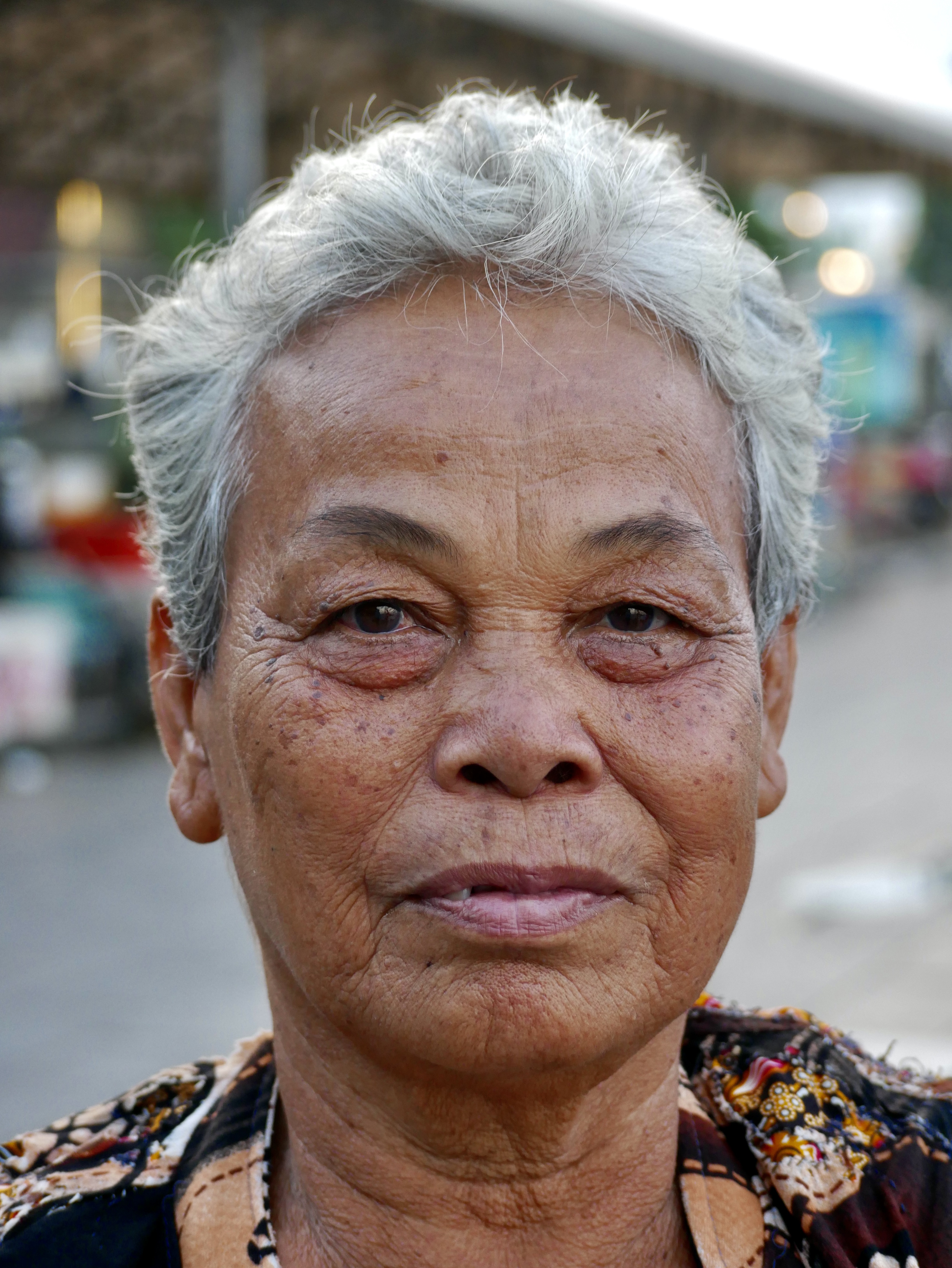
“I smoke three packs of cigarettes a day and take two energy drinks. I go to Bangkok once a year for a health check and they say I am fine,” said Lim Seng as he took another drag on one of the 60 cigarettes he smokes each day.
I have to admit he looked strong and healthy despite the unorthodox diet. I first met and photographed him two years ago, while exploring the narrow alleys near Phnom Penh’s sprawling Orussey Market which teems with customers from early morning. The narrow, shady alleys leading off the market, are home to thousands of small businesses. It is here that many shoppers, workers and local residents come to eat their breakfast and drink their morning coffee (iced to provide some relief from the heat and humidity.) The alleys are also home to many stories waiting to be told.
Lim Seng likes to sit at his small table, watching the comings and goings in the street. Earlier this year, I returned to Phnom Penh and took a large format copy of the picture to give to him. He invited me to sit, sent for coffee from the shop opposite, and began to talk about his life. “I am not from Phnom Penh,” he said, “I was born in Guangdong in China 82 years ago. When I was seven months old, the Japanese invaded and my family fled. We moved from place to place and finally settled in this neighbourhood. My parents opened a cake shop, selling our goods to local restaurants.”
“Hard work is good for us."
He paused to take another drag on his cigarette and then gave an instruction to his grandson who disappeared into the shop. “He is 40 years old, but he looks younger doesn’t he? Hard work is good for us,” said Lim Seng. I confirmed that he did indeed look much younger. Despite the heat, he had been carrying huge, heavy looking boxes in and out of the shop and had not broken sweat. After a few minutes the grandson re-emerged carrying a photo album which Lim Seng opened and began to leaf through, using the pictures to illustrate his story. “I first went back to China in 1966 when I managed to get a visa to go and see my grandmother. I went again in 2008. This time my wife came with me. We visited Beijing, Shanghai and five provinces in all.” He proudly showed me pictures from the trip and pointed out various family members. “That’s my aunty. She died last year. She was 100 years old. These are my children - I have four, two boys and two girls. I also have eleven grandchildren and one great grandchild,” he said. I asked him what happened to the family during the Khmer Rouge period. “We were sent to work near Battambang,” he said, “my sister did not survive."
Neighbours and passers-by began stopping, curious to know what we were talking about. Lim Seng showed them the photograph I’d brought, propping it up and displaying it on the table. His wife had died a year earlier and he spends much of his time sitting outside the shop, talking to passers-by, playing online games and watching Chinese films and TV shows on his I-pad. We had a photograph taken together and I resumed my walk. I saw him again the following day. He called me over and showed me that he’d posted on Facebook that he has a friend from England. The photograph I brought for him had been laminated and was prominently displayed on his table so that friends and neighbours could admire it.

“We don’t use fish sauce in our cooking.”
“We don’t use fish sauce in our cooking,” said Tay Lang Kang, joint owner, with his wife, of a small noodle shop, a few steps from Lim Seng’s table. All dishes in this restaurant are made without the pungent fish sauce, ubiquitous to the cooking of this region.“I think the smell is too strong so I persuaded my wife to use palm vinegar instead. She listened and took my advice,” Tay Lang explained. It seems to have been a good decision as there are continuous queues either for takeaway, or to sit and eat at one of the shop’s few tables. I liked the slightly sharp taste of the palm vinegar on my vegetable noodles. Beef and pork versions are also available and very popular. For customers who want extra palm vinegar, there is a bottle on each table, as well as soy sauce, hot chilli sauce and a sweeter variety of chilli.
Tay Lang sat with my friend, Vanarith, of Urban Eats Phnom Penh, and I, and told us a little about his family and the history of the business. “I grew up in Svay Rieng province in south-east Cambodia but our ancestors arrived here from China about 100 years ago. We don’t know which part of the country they came from. My wife’s family opened this business in 1982,” he said. "During the 1990s, I worked in a Cambodian restaurant in Germany. I had a four year visa but was single and alone, so my parents encouraged me to find a wife. When I met Yeung Chan, I fell in love immediately. When we got married, she didn’t want to move to Germany and so we now run the business here.”
The shop attracts a variety of customers, mainly locals but also some tourists and people who work in the area. Mornings are especially busy and it was interesting to see families with small children crowded onto one motorcycle, waiting for their food, alongside occasional Buddhist monks who stood outside waiting to collect alms and give blessings. There is a small Buddhist shrine inside the shop at which the owners make a daily offering. At the time of my visit, like many other business in Phnom Penh, Chinese New Year decorations were still on display despite the celebrations having passed.
Tay Lang and Yeung Chan prepare the food themselves and everything is freshly cooked at a table facing the street, making service quick and convenient. The shop is open every day and everything is freshly cooked to order. “We open from seven until five or five-thirty and are busy all day. We work very hard - we didn’t even have a honeymoon,” said Tay Lang.

“I was a beautiful baby. Everyone wanted to adopt me."
After enjoying my vegetarian noodles, I wandered off into another narrow, but very busy alley. A line of vendors offering sweet or spicy treats lined one side. At each stall, families waited patiently for their orders to be satisfied. I bought some sweets from one vendor and while eating them, I noticed an elegantly dressed woman washing dishes on the opposite side of the alley.
Somart Wah was born in Phnom Penh and is in her late 60s. She told me her story. “I am the oldest of nine siblings. In the 1970s, my family became increasingly worried about the deteriorating situation in Cambodia and in 1972 we fled to Vietnam. We had to work very hard there and we often didn’t have enough to eat,” she said. She paused for a moment and then added: “We had it hard in Vietnam, but I know what the Khmer Rouge did here and it was much worse than anything we went through. I returned to Cambodia in 1979, shortly after Pol Pot was defeated. Later, I had a chance to leave but I decided to stay.”
She spoke about her work. "I started my business in 1981,” she said, “at first, my nieces and nephews helped me but later on they moved away. One young family member helps out now. I cook eight to ten dishes each day for lunch and then I clear up and go home. A different trader has this spot in the late afternoon and evening.” I asked her what dishes are most popular. She replied: “Common food, like braised pork with duck eggs and bamboo shoots.”
Somart is not married: “I had to look after my parents and siblings, my nephews and nieces, so I never got married.” She paused for a moment before saying: “But I was a beautiful baby. Everyone wanted to adopt me.” As I left she resumed washing the dishes, white bowls, decorated with floral motifs that matched her dress.

You might also like Urban Eats Phnom Penh: From hunger to food tours or I was so happy I couldn’t sleep
Tay Lang and Yuen Chan’s noodle shop is in an un-named and un-numbered alley between alleys 168 and 170 near the Orussey Market. It is sometimes referred to as the Kemara Guesthouse alley.