Showing posts with label Calcutta. Show all posts

Thursday, 6 January 2022

"A city that has a bit of everywhere but is not like anywhere"

I first met Manjit Singh Hoonjan, owner of Calcutta Photo Tours, in 2017. I booked his early morning Mesmerising Markets tour and for three hours I experienced the crowds, colours, sounds and smells of Kolkata's vegetable and fish markets. He helped me engage with people, gave me the back story to the markets' activities and I came away with some great pictures. Since then I've made a point of repeating the experience whenever I've been in India. We spoke recently on zoom and I took the opportunity to get the full story of Calcutta Photo Tours.

"Her pictures were in colour and attracted more attention than mine"

Manjit started taking pictures at a young age and was given his first camera for his eighth birthday. "It was an Agfa click 4 with a plastic body and took black and white pictures" he said. He was delighted with it but recalls "I went on a school picnic and took several photographs. One of my classmates also had a camera. Her pictures were in colour and attracted more attention than mine". 

He did not have a colour camera until the age of 17 but by that time his work was already attracting  attention. College Street is the centre of the book trade in Kolkata and like many other students Manjit went there to buy textbooks. On one visit he saw a notice bearing the word "Silence" on the street lamp post, close to the exterior wall of a hospital, under a poster for the film "Kab Tak Chup Rahungi" which means "how much longer will we remain quiet". He wanted to photograph the two notices together and to enter The Telegraph newspaper's regular photo competition. His father borrowed a camera from a friend, bought film for it and Manjit took two shots before returning it. He then had to  wait for the friend to use the rest of the film and have it developed. The pictures were chosen for publication and he won a prize of 250 rupees which he used to open his first bank account.

After completing his studies he spent some time working in, and then managing, the family print and graphic design business. In his spare time, he continued with photography and an American friend suggested he start running photo walks in Kolkata. At the time most photo tours tended to concentrate on whole regions and lasted at least a couple of weeks. After a few years of running the walks in his spare time he decided to close the family business and to concentrate on photography. When I asked him about his family's reaction to this he said "at first they were worried and pointed out that tourism, the main source of business for the walks, is seasonal, but when my work started getting a lot of media attention, they became very proud". 

"I am booking this tour and I hope you will be there"

He recalls his first ever client "A Dutch woman sent me a message saying 'I am booking this tour and I hope you will be there'". He too had concerns and remembers thinking "I'm getting up at 5 a.m. will she even be there?". They both turned up and since then his decision to concentrate on photography has brought great success. Trip Advisor lists the tours as one of the most popular things to do in Kolkata and his work has been featured in National Geographic, The Wall Street Journal, The Telegraph,  the Guardian and other high-profile publications. In 2018 his Durga Puja pictures were seen by millions when they were exhibited outdoors on London's South Bank as part of the Thames Festival.


The Hoonjan family have been in West Bengal for three generations and have a strong connection to Kolkata. Despite his Sikh heritage and religion Manjit considers himself to be deeply connected with Bengal. He said "When I started some people queried how a Sikh could really know Kolkata but more recently a Bengali friend said that I am more Bengali than he is". I asked him what inspires his desire to show Kolkata to others. He explained "It is a city that has a bit of everywhere but is not like anywhere". This is reflected in the range of tours he offers. The Culture Kaleidoscope tour reveals the religious diversity of Kolkata and also includes a visit to India's only China Town. European Calcutta concentrates on the colonial legacy of the city and Mesmerising Markets shows the day to day life of some of Kolkata's key workers. All include short breaks for chai and snacks - important elements of any day in India - and the telling of stories related to the tours. 

I asked Manjit about how people respond to the tours. He said "Sometimes they become emotional, particularly people who have not previously left the tourist trail and who are having their first glimpse of real, day to day life in the city. A Chinese family who came on the Cultural Kaleidoscope tour were delighted to be able to speak to locals in their own language. One member of the family said they felt so happy they had goosebumps". My own favourite comment came from a group who had begun their tour of India in Kolkata with Manjit ."They told me I had spoiled their trip because later guides had not been able to equal their time with me". In my case, that first early morning walk in the markets led to Kolkata becoming my favourite Indian city and one of the places I've missed most in the last two years of being unable to travel. 

Please note all photographs in this post were provided by Manjit Singh Hoonjan.

You can follow Calcutta Photo Tours on instagram and on Facebook

For more details of the tours and booking see Calcutta Photo Tours

Thursday, 13 May 2021

Do You Know Where Dhaka Is? - Adventures in Zakaria Street, Kolkata

The first time I visited Kolkata, I dumped my bags at the hotel and headed for Zakaria Street. The Kolkata Heritage Photo Project’s book “Calcutta Chitpur Road Neighbourhoods” had inspired me to explore North Kolkata and this busy street and the lanes leading off it seemed like a good place to start. 

Zakaria Street is at the centre of a predominantly Muslim area, famed for the magnificent Nekhoda mosque that stands at the junction with Chitpur Road. The mosque was built in 1926, can accommodate 10,000 worshippers and is intended as a replica of the Mughal Emperor Akhbar’s tomb in Agra. It is the city’s largest mosque and dominates the skyline of this part of Chitpur Road. The street is also known for its many food vendors, most of whom offer meat dishes. Although not suitable for a vegetarian like me, the stalls are immensely popular with locals and also attract a few tourists.


Mohammed Ishmail

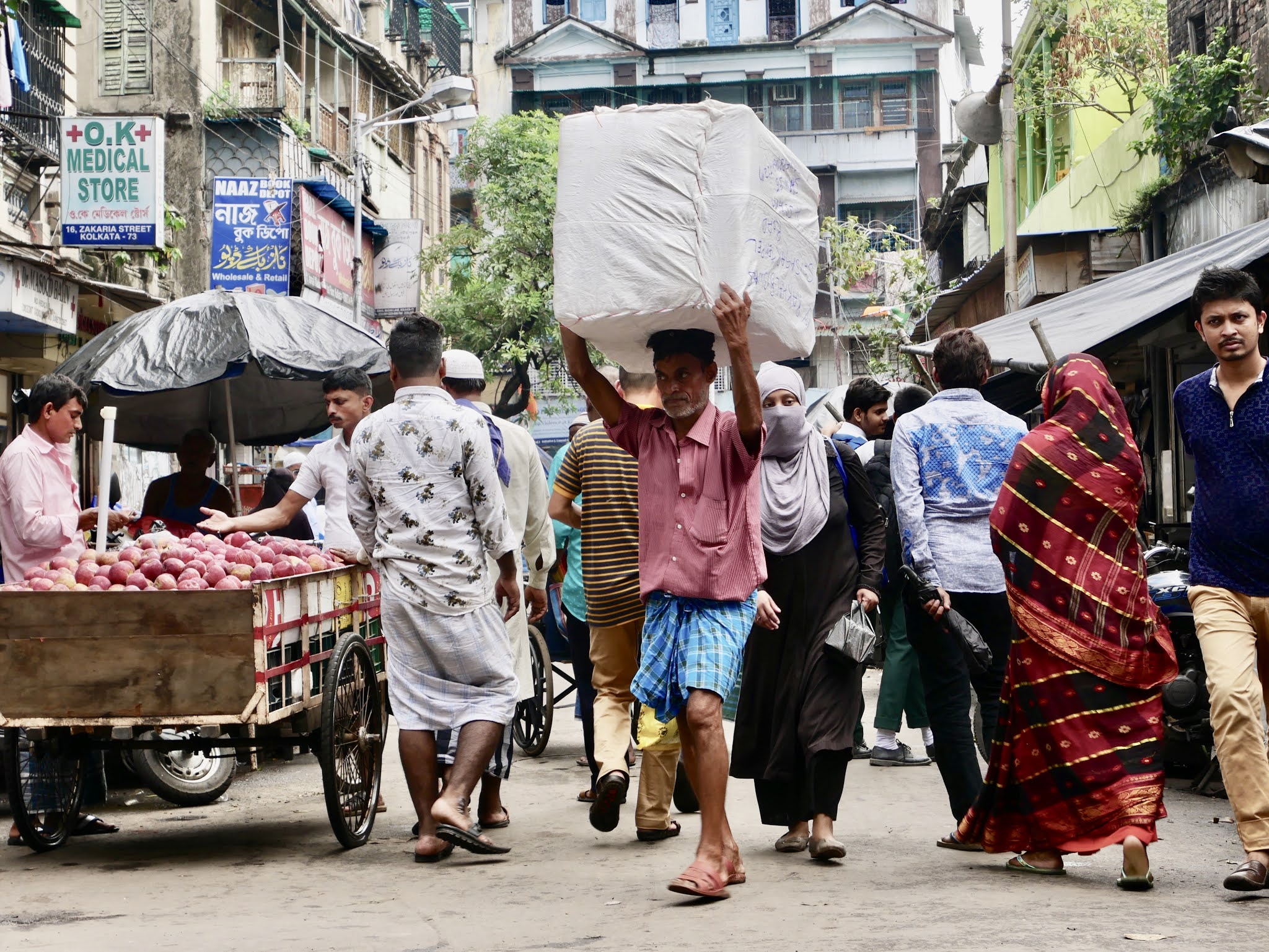
Zakaria Street is relatively narrow and very crowded. Despite this all kinds of vehicles manoeuvre their way along it, delivering goods to the traders or picking up items to take elsewhere. Crossing the road can be a bit of a challenge as trucks, hand pulled rickshaws, tuk-tuks, humans and the occasional animal compete for space. It is a great place to observe and photograph Kolkata’s street life. I soon discovered that approaching people for portraits can result in a lengthy exchange, involving my answering many questions in what I now know to be a standard Indian style interview about where I’m from, what I’m doing in India, what my marital status is, how much do I earn and what do I think of the city. This is almost always accompanied by an invitation to drink tea purchased from a chaiwallah, one of whom is to be found on almost every street .


One such invitation came in a lane leading from Zakaria Street to Tarachand Dutta Street. I noticed a sign for a drycleaner’s bearing the service legend “Ordinary 4 days, semi-urgent 2 days”. No urgent service. A group of men were sitting in front of the sign and I asked if they wouldn’t stepping aside for a moment so that I could photograph it. “No problem” came the reply as Javed Uddin stepped forward, introduced himself as the owner of a nearby delivery business and offered me the obligatory chai. His friend’s daughter had been married the day before and he insisted that I also eat some sweets, left from the wedding. He asked me the routine questions and then said “do you know where Dhaka is?”. “Yes, it’s the capital of Bangladesh”. I replied. He seemed surprised and said “It is exactly that. It is also the name of that building. Dhaka House. This also belongs to me”, indicating said premises with a flourish. I sat for a while, drank my tea, ate some sweets and then got up to go. He insisted I drink water before leaving “it is a very hot day, you must drink” he said. He handed me a large bottle of water that he and his friends had been passing between them. Not wanting to appear rude I decided I would take a sip and managed to drink a little without putting my lips to the bottle and without pouring the contents over myself. A good technique and a steady hand is vital in order to do this.


After shaking my hand and checking I had his name, Javed advised me to be careful and said that if I had any problems, or if anyone gave me trouble in Kolkata, I was to come and see him. “I can help. I know people” he said. I photographed him standing beside a motorbike in the doorway to Dhaka House.  I was able to give him a copy of the picture a year later. It wasn’t my best work, but he seemed pleased with it.


Making my way into Tarachand Dutta Street I soon realised that the thing I was looking for was no longer there. I had wanted to see the art deco Krishna Cinema, a photograph of which appears in the Kolkata Heritage Photo Project book. It had been demolished. For a moment I wondered if I was in the wrong street. I checked with a sweet vendor who confirmed I was indeed in Tarachand Dutta Street and when I asked about the cinema, he very cheerfully said “that old thing has been demolished”.


On a subsequent visit I came across a covered arcade accessed by a narrow alley leading from the main street. An impressive gentleman wearing kurtha pyjama and an embroidered topi was sitting in the doorway of a tailoring shop. This was Mohammed Ishmail. He nodded a welcome to me and said that the shop belonged to him. He introduced a young man working over a sewing machine as Gulab, which is the Urdu word for rose. Mister Ishmael went on to explain that this was a family business and then seemed anxious to make it clear that Gulab was not a relative, saying in English “he is my servant”. Gulab clearly understand this and looked up from his work, affronted. Mister Ishmail noticed this and corrected himself, saying, in very formal English “that is to say, he is my employee”. The placated employee resumed his labour. I photographed them both and showed them the results. Gulab merely nodded but his boss laughed and said “look at me. I could be in Pakistan”. 


This part of Kolkata is home to other industries too. In one of the adjoining streets, dozens of workers sit surrounded by piles of discarded metal, wood and cardboard goods. All of these waste items, collected from across the city are dismantled and used to create tools, furniture and other items. There is the constant sound of hammering as old nails are straightened and made ready for re-use. Sparks fly from welding and huge coils of recycled wire are stacked outside workshops ready for despatch and a second life. 

It was in the midst of this noise and industry that I met Feroz. He was employed as a delivery man using a cyclo-rickshaw adapted to carry large loads to and from the recycling businesses. He had a shaved head, a dazzling smile and a sense of humour. He saw my camera and asked me to take his picture. Once done, he pointed at my head, laughed and said in English “you and me same to same” before laughing again and riding off before there was a chance to hear his story. I found him again a year later, but I hardly recognised him. He was sleeping on a charpoy at the side of the road. I only knew it was him because I showed his picture to a couple of porters who recognised him and took me to him. His hair had grown back but the smile was absent, and his eyes were dull. He smelt strongly of alcohol. Alcohol dependancy is a widespread problem amongst day labourers, many of whom come from other parts of India and live alone in the city without the support of their family. He managed a half smile and a “thank-you” as I handed him his picture before he returned to his charpoy and went back to sleep.


Gulab


Recycling metal


Street vendor, Zakaria Street


The mosque is not the only interesting building here. There are several once elegant mansions, built by wealthy Marwari merchants after 1911 on land purchased from the Calcutta Improvement Trust. The mansions replaced slums inhabited mainly by poor Muslims, many of whom had come from East Bengal towards the end of the previous century. Today the Marwaris are long gone, relocated to smarter addresses in the south of the city or to other parts of India. Their former homes are rented out for both residential and commercial purposes and although there are hints of former glory, there is a general shabbiness to what remains. There are several hotels here, some of them sporting impressive names, such as the De Luxe Guest House and the Rajasthan Guest House. In Keith Humphrey’s excellent book “Calcutta Revisited”, he suggests that they are suitable only for “…the adventurous, desperate or impecunious”.  


Zakaria Street and some of the neglected mansions feature in Kunal Basu’s book “Kalkatta”. The hero lives in one of the old apartment buildings. The book tells the story of a Muslim family with a complicated background. The parents fled Bihar during partition and settled in the former East Pakistan, present day Bangladesh. In order to escape poverty, they obtain forged papers and return to India to make a new life in Kolkata. The son, Jamshed is the focus of the story as he struggles to fulfil his parents’ ambitions for success. Basu captures perfectly the atmosphere of the street with its overcrowded, once grandiose tenement buildings, the daily struggles to make ends meet and the city’s complicated politics.


I was last in Kolkata in September 2019. At the time there was no way of knowing that it would be impossible to return a year, or even two years later. Until the world changes again the only way to visit this, my favourite Indian city, is through the pages of books. For those who want to explore for themselves, some suggestions are listed below.


You might also like A Case of Mistaken Identity - The Story Behind A Photograph


Suggested reading


Kalkatta - Kanal Basu


A Strange And Sublime Address - Amit Chaudhuri


Calcutta, Two Years In The City - Amit Chaudhuri


The Epic City - Kushnava Chowdhury


Calcutta Revisited: Exploring Calcutta Through Backstreets And Byways - Keith Humphrey


Calcutta (Cities of the Imagination series) - Krishna Dutta


Calcutta Chitpur Road Neighbourhoods - Kolkata Heritage Photo Project


Kolkata Calcutta - Fionn Reilly

Monday, 19 April 2021

A Case Of Mistaken Identity - The Story Behind A Photograph

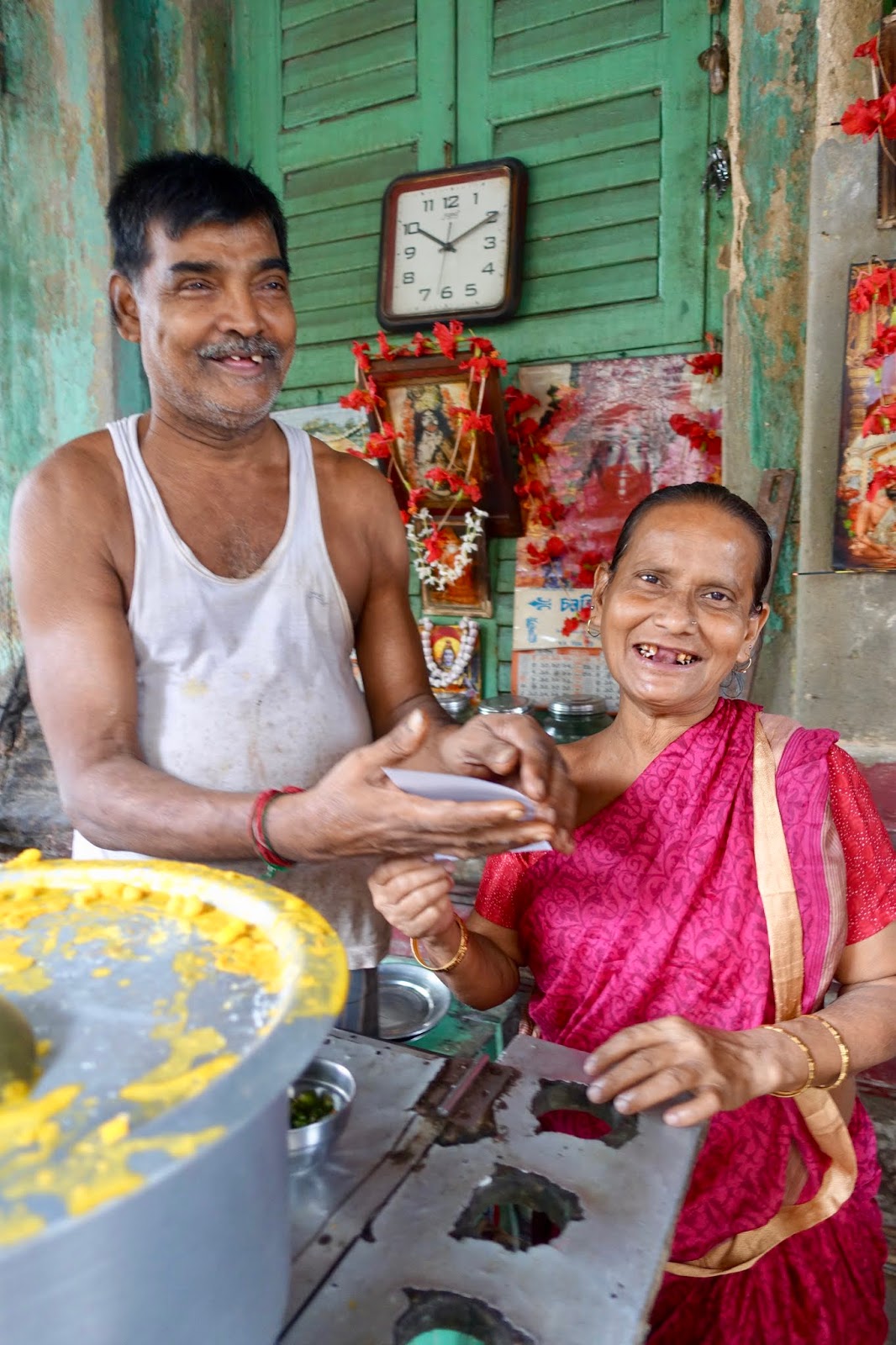
I first met the man I now know as Dilip Ghosh in September 2017. As I walked along Beadon Street in North Kolkata I noticed a chaiwallah serving tea to a long line of customers. Those who had already been served stood chatting in groups or sat squeezed onto a long bench busy with tea drinkers. The chaiwallah was an impressive figure with his neat black moustache and hair and off-white shirt. His stall was in front of a bright green building. A deep red garland hung on the shutters behind him matching the colour of the cloth wrapped around the kettle's hot handle. I caught his attention, indicated the camera and received the slightest nod of approval. He continued working whilst I took several shots and then showed him the best of them. He nodded again and continued pouring tea.

I ordered a chai and stood to one side whilst he prepared it. Whilst I waited a neatly dressed man, perhaps in his sixties, stepped forward and insisted on paying for my drink before asking me the usual questions about work and family. He said that he had worked for a British company before retiring on what he described as a comfortable pension. He invited me to sit with him and told me that the chaiwallah, who did not speak English, was one Mohan Lal and that like many other people in Kolkata, he was originally from Bihar. I scribbled these details into my notebook and referred to them shortly after whilst blogging about my time in Kolkata. 


I returned to the city a year later and looked for Mohan so that I could give him the picture. It took three days to find him. On this occasion, I was accompanied by a guide who told him we’d been looking for him and that no-one in Beadon Street had heard of him. The reason for this soon became clear. His name is not Mohan Lal and he is not from Bihar. He is Dilip Ghosh and he was born in Kolkata. Not only this, he had lived all his life there and had no idea why my erstwhile friend thought otherwise. I handed him the picture which he admired for a moment  before calling to his wife and son to come and look at it. Mrs. Ghosh was very excited and took it to show to customers and neighbours before requesting a picture of her and her husband.


Between my second and third visits to the city, I staged a small exhibition of my photographs in a series of London venues and used Dilip’s picture on the promotional poster. He now displays it behind his stall beside the calendar he produces annually and gives to his regular customers.


There is an odd coda to this case of mistaken identity. In early 2021 I posted the picture on my Instagram account. It received a positive response with many likes and new followers, but I soon noticed a series of laughing emojis in the comments box, some of them posted alongside Dilip’s name. I began to worry that I’d made a mistake of some kind or that I still had the wrong name. I googled “Dilip Ghosh” to try to understand what was going on. It seems that my favourite Kolkata chaiwallah has a namesake, a prominent West Bengal politician. The thought of him selling cups of tea had amused many of his constituents.


You might also like Travels With My Camera 2020 - The Best Pictures

Tuesday, 11 September 2018

Scenes From The City Of Joy 2 - Pay Me In Dollars, I Want To Buy A House

Kolkata is surely one of the most visually inspiring cities in the world. Its streets are filled with people working and idling, buying and selling, eating, drinking and transporting goods from one place to another. But despite the constant activity the citizens of Kolkata are almost always ready to spend a few minutes talking to a visitor who is interested in them, their lives and their story. And this is a city of stories, many of them written on the faces of the people in its streets, set against a unique architectural background. I came here for the first time last year and since then have been longing to return, to renew my acquaintance with India's former capital city, to meet more of her people and to record their stories with my camera.

Chaiwalli, Chitpur Road
If Kolkata is my one of my favourite cities, then Chitpur Road is one of my favourite streets. This long, long street is chaotic with commerce of all kinds being carried out from early morning to late at night, much of it in buildings that date back up to 200 years. It is badly dilapidated in parts but this does not seem to affect its importance and it is still possible to see crafts being carried out here that have disappeared elsewhere. One craft that is certainly not dying out is that of the chaiwallah or tea seller, offering steaming hot chai to thirsty passers by often from a roadside stall or a tiny "hole in the wall". Strolling along Chitpur I noticed an elegant woman in a green and white sari working as a chaiwalli. I wondered if the man sitting near her was her husband. When asked if this was the case she said "Him? No, he is a customer". Then she laughed. Quite a lot. He didn't. A case of mistaken identity.

The smoker, Zakaria Street
Mohammed Ishmail, businessman
Running off Chitpur, Zakaria Street is in a predominantly Muslim area and home to the magnificent Nekoda mosque. It is full of small shops selling food, paan, jewellery and clothes. It is also a rich source of interesting pictures. The people are generally open to being photographed and are genuinely curious about visitors. The man pictured smoking spotted me taking pictures, lit up a bidi and began playing up to the camera. I loved the results. He looks directly at the camera, takes a drag and blows the smoke down in a cloud around his throat whilst his yellow kurta and checked lunghi contrast  with the colourful backdrop.

Walking into an alley off the main part of the street I found myself in a small tailors owned by one Mohammed Ishmail who sat near Gulab, a much younger man working at a sewing machine. Mister Ishmail explained that his was a long established family business. When I enquired what relation the tailor was to him, he replied in English "he is my servant". The tailor looked a little surprised as must have I because Mohammed corrected himself saying "that is, he is my staff". Another case of mistaken identity I fear.

Gulab, tailor on Zakaria Street
Metal recycling near Zakaria Street
There is an enormous recycling bazaar in one of the side streets off Zakaria. This is not recycling as many people in the west would know it. This is the real thing. Metal, wood and cardboard goods are collected from various place around the city, brought here, dismantled and used to create new tools, furniture and other items. Workers sit surrounded by piles of materials using Indian ingenuity to give new life to discarded belongings. Sparks fly from welding and there is the constant sound of hammering as old nails are straightened in order to be used again. The man pictured above was winding thick lengths of wire ready to be sold and used again.

I like a joke, including a joke at my expense if the intention is not malicious.  I often meet a joker on my travels and on this occasion it was delivery man Feroz Khan of the sparkling smile and bald head who asked me to take his picture before pointing at my head and announcing in English "you and me same to same hahaha". I'm sure I don't know what he means. Cheeky chap.

Feroz Khan, my long lost and significantly younger twin
Ginger vendor, vegetable market
If Kolkata is one of my favourite cities, its 24 hour vegetable market is one of my favourite quarters. Full of life, colour and activity it is a photographer's dream. The market's management allows a small number of people to collect vegetables that have been dropped on the floor or are less than perfect but still edible and to sell them from small patches outside the main wholesale hall. These people are extremely poor and this is a way to help them earn a little extra money to support their families. One of them, an older woman selling ginger and wearing brightly coloured clothing smiled at me and wished me good morning. She seemed different to the other vendors, comfortable in her self and of her lot and I felt sure she would agree to be photographed. She did and is pictured above.

As well as the hundreds of wholesalers who have shops here, there are many small scale vendors on the periphery of the market who sell items directly to the public. I noticed one such vendor - a young woman slicing the tops off coconuts and then selling the juice to thirsty customers. I indicated that I wanted three coconuts, one each for me and my two friends and asked her how many rupees. She threw her hands up in the air and in a surprisingly husky voice replied "Rupees? Pay me in dollars, I want to buy a house". I happened to have two dollars in my pocket and was tempted to call her bluff but her expertise in slicing the tops off coconuts dissuaded me from attempts at humour. Her six year old daughter Jazmina sat behind her smiling and then poking her tongue out at the camera. I hope they get their house one day.

Pay me in dollars, I want to buy a house
Not shy at all, the vegetable market
Some of the vendors are now used to being photographed, due in large part to the tours organised by Calcutta Photo Walks.  Not only that, some of the vendors are now pretty clued up themselves about what makes a good shot or who is particularly photogenic. A herb seller called me over and told me to photograph two of the young women working for him. At first they seemed reluctant, laughing a little and feigning shyness. I was on the point of giving up when they stood beside each other and offered the camera two fabulous smiles. Perseverance works.

Less shy were what I assume to be a married couple who were brushing their teeth with liquorice roots. It is not uncommon to see men and children do this in public but never an adult woman. And I've certainly never seen a woman come close to the camera and demonstrate her teeth brushing technique  alongside the man who might have been her husband. Note I said "might" - hoping to avoid another case of mistaken identity.

Demonstration of teeth brushing, the vegetable market
But perhaps the most interesting person I met in the market was a man who makes and sells essential oils. The oils are sold in tiny bottles kept in a small, lovingly cared for wooden box which houses a series of drawers. Used for aromatherapy the mixtures include differing quantities of bark, leaves, flowers, resins, peel, seeds and other natural materials. The vendor's explanation attracted a small crowd of young people, interested to hear. In the past there were many such vendors but this is now a dying art. Less and less of these oils are being produced by traditional practitioners. He was very happy to be photographed and proudly displayed his collection for the camera.

I have been advised that when in India I should expect the unexpected. Turning into a side street off Chitpur Road I was struck by the fashion model elegance of a couple of young men stood talking to each other. Both delivery men, they seemed unaware of their good looks and were surprised that I wanted to photograph them. I had a similar moment last year in Haryana when I saw a Rajasthani farmer walking with his cattle. He would not have been out of place on the cover of Vogue.

Maker and seller of essential oils, vegetable market
Elegant young men near Chitpur Road
Dilip and Mrs Ghosh, Beadon Street
Last year I photographed a chaiwallah in Beadon Street, North Kolkata. He first caught my attention due to the brightly coloured backdrop of his stall. I then secured his permission for a portrait through a customer since he did not speak English. My volunteer interpreter told me the chaiwallah's name was Mohan Lal and that he came from Bihar. It turned out to be one of the best pictures of my first trip to India and keen to present him with a copy, I spent three days looking for him along Beadon Street before eventually finding him. He was both surprised and delighted as was his wife who after a little persuasion joined him in another picture. And something strange. Not only is he not called Mohan Lal, he is not from Bihar either. He is Dilip Ghosh, a Bengali, born in Kolkata. Despite the confusion he told me that business is good - so good that he produces a calendar every year to give to his regular customers. Fabulous. I hope to meet the Ghosh family again one day.

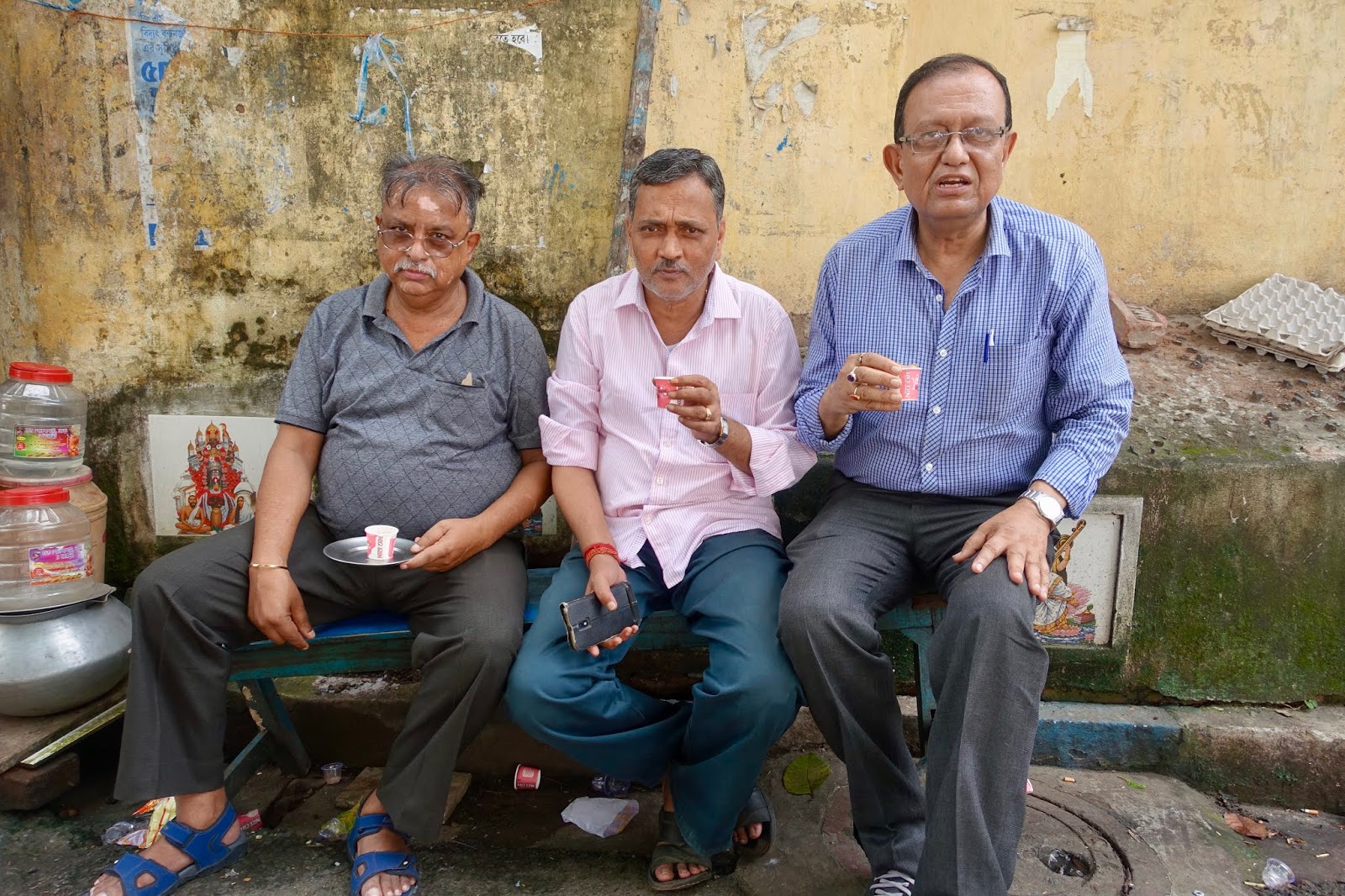
Still on the subject of tea, when walking through the lanes of the Bhawanipur neighbourhood I passed three men of a certain age who were sitting on a bench and enjoying a cup of chai. They waved to me and wished me "good afternoon". I can't resist a chat and they insisted I drink a cup with them. Mr. Mitra, Mr. Das and Mr. Sarkar turned out to be real gentlemen, speaking a very formal English and enquiring about my family, health and the weather. Now what was that about expecting the unexpected?  

Tea drinkers of Bhawanipur


You can see more pictures from Kolkata here.

Manjit of Calcutta Photo Walks again accompanied me at the market, leading me to some great shots, explaining how the market works, interpreting and generally making things fun. he can also advise on technique. His tours are highly recommended.

Saturday, 8 September 2018

Scenes From The City Of Joy - 1, The Rickshaw Pullers of Kolkata

Kolkata (Calcutta) is sometimes referred to as the city of joy. The hand pulled rickshaw is one of its iconic images. It is the only city in India that still has this mode of transport introduced during the period of British rule. Almost all of the men involved in this work come from other parts of India, predominantly Bihar, one of the poorer states. 

Dorik Jadab, rickshaw puller from Bihar
Navin Das, rickshaw puller from Bihar
I became interested in the rickshaw pullers last year when I visited Kolkata for the first time. These men are often of small stature, very lean and yet somehow manage to transport passengers of all shapes and sizes, sometimes two or three at the same time. The passengers often have enormous piles of shopping from the many bazaars and this too is loaded onto the rickshaw which then has to be maneuvered through narrow lanes and main thoroughfares most of which are clogged with trucks, cars, trams, buses and myriad other forms of transport. In recent years there have been state government proposals to outlaw this kind of work on grounds of it being inhumane. The rickshaw pullers protested that having no other qualifications or training they would not be able to find alternative work and so the ban was not enacted. Further proposals were developed to replace the rickshaws with a battery powered model. To date this has not happened.

Someone I spoke to told me that this work does not require strength but is all about balance. That person has a nice office job, so I am not sure how he would know. I wanted to know more about the lives of these men, where they come from, how they live and what they think of the work. On my more recent visit, with the help of an interpreter, I spoke to two of the rickshaw pullers, randomly encountered in Chitpur Road and Beadon Street in the northern part of the city.

Navin
Rickshaw puller with customer, North Kolkata
Navin Das is 65 years old. He told me that he has been doing this work for 33 years, ever since he came to Kolkata. Shortly after arriving from his village in Bihar he saw the rickshaws and decided it was something that he could do to earn money. His wife, two sons, three daughters and five grandchildren remain in Bihar. He works for two months at a time and then goes home for one month. His working hours are from 5am until 8pm. He does not own the rickshaw but rents it for 30 rupees per day. The rental charge includes an element for repairs for which he does not have to pay extra. Most rickshaw owners will have between 75 and 100 vehicles in their possession so quite an earner if you are receiving 30 rupees per day seven days per week for their hire. Navin can earn up to 300 rupees on a good day and about 200 rupees at less busy times. 

I was curious to know where he lives when he is in Kolkata. He pointed to the rickshaw and explained that each evening, he pulls it to the side of the road and sleeps on it and has done so since he started working. This is to maximise the value of his earnings and to be able to take back as much money as possible to his family. Whilst he was speaking I realised that in the 33 years he has been in this city, he has probably never, or very rarely, slept indoors. 

I asked him about the customers. He said that most of them are polite and respectful. There are fixed tariffs so there are no arguments over fares. The only people he does not like to take are those who are drunk who sometimes try to avoid paying at all or occasionally offer many times the fixed amount. He dislikes both. 

Dorik Jadab is 36 and is also from Bihar. He has been a rickshaw puller for ten years. He is a striking figure with a yellow headscarf and an impressive moustache. He has four children aged from 8-18 who live in his home village with their mother. He also pays the standard 30 rupees daily rental and makes a similar amount of money to Navin. He likes the work but suffers from problems with his legs due to the constant pressure of pulling heavy loads. Dorik sleeps in a wood storage facility together with several other workers. He said that he does not have to pay for this but did not explain on what basis he is there.

Dorik 
Tilak Mahato
Navin said that the rickshaw, if looked after properly will last for 10-15 years and that he has heard of some lasting even longer than this. I visited one of the repair workshops where three men were carrying out maintenance work to Tilak Mahato's rickshaw. Repairs normally take place overnight, outside of operational hours and the work can spill out onto the roads if the workshops are full. Repairs are usually completed within 24 hours and almost always within a few days. Tilak is 58 years old and comes from Jharkand, formerly part of Bihar and now a state in its own right. He was sitting patiently whilst the work was being done and explained that every two years he arranges for re-painting of the woodwork to help reserve it and for minor repairs to be carried out. He has been a rickshaw puller for 40 years.

Waiting for customers
Tilak waits for his rickshaw to be repaired
You can see more pictures of Kolkata here.

Sunday, 8 October 2017

A Postcard from India - 6, Calcutta - the people in the street

Much of my recent time in India was inspired by books. Nowhere more so than Calcutta, or Kolkata as it is now known. Amit Chaudhuri's "Calcutta - Two Years in the City" and a photographic book - "Calcutta - Chitpur Road Neighbourhoods" both of which focus on North Kolkata excited my interest in this city of almost 15 million people and made me long to walk its streets.


Once home to wealthy merchants and the focus of the Bengali cultural renaissance of the 19th and 20th centuries, North Kolkata is now the site of crumbling mansions and forgotten palaces, its former glory fading rapidly. Despite this, I quickly grew to love this part of the city, initially because of the architecture. Decaying buildings can be photogenic, but interesting as the old palaces, mansions and colonial era buildings are, I soon realised that the most interesting thing about this neighbourhood and the  city is its people.

On the day of my arrival, I hired a driver to take me to some of the streets photographed in the Chitpur Road book. I began in Zakaria Street, a predominantly Muslim enclave whose landscape is dominated by the Nakhoda mosque. I was immediately struck by the number of people in the streets, the chaotic activity as hand pulled rickshaws, delivery vehicles, tuk-tuks, street stalls, pedestrians and the occasional animal powered vehicle competed for space. It was difficult to know where to point the camera first and I was unsure how people would react to being photographed. I had no need to worry as not one person refused a request for a picture and indeed, some came forward to ask that I photograph them too once they saw the camera.


The "price" of a photograph was often a short chat with people interested to know where I was from, what I was doing, how long I would be in the city and where else I would see in India. This was almost always accompanied by invitations to drink masala chai purchased from a chaiwallah, one of hundreds, possibly thousands of street tea sellers in the city.

One such invitation came in a lane leading from Zakaria Street to neighbouring Tarachand Dutta Street. I noticed a sign for a dry-cleaners bearing the service legend "Ordinary 4 days, semi-urgent 2 days". No urgent service then. A group of men were sitting in front of the sign and I asked if they wouldn't mind allowing me to photograph it. "No problem" came the reply before one Javed Uddin stepped forward, introduced himself as the owner of a delivery business and offered me the obligatory chai. His friend's daughter had been married the day before and I was also given sweets from the wedding. Before we parted he told me to visit the city again and that if I had any problems in Kolkata I should come and see him. He could help. People knew him. I photographed him standing beside a motorbike in the doorway to his home. He liked the picture.

In the same side street a young moustachioed man wearing a blue shirt and checked lungi asked me if I wanted to take his picture. His work mates came out to see what was happening which resulted in the picture below. I also photographed blue shirt separately. He asked "am I handsome?". Who could say no?


Still in North Kolkata, I met Mohan Lal a chaiwallah operating a stall on Beadon Street. It is Mohan's portrait at the top of this post. I was struck by the bright green of the wall behind him, the red of the garland and cloth and the crisp white of his overall. He had a long queue of people waiting to buy chai as well as several customers sitting on a long bench already enjoying their drinks. One of his customers, a Mister Singh, originally from Bihar invited me to drink tea and told me that Mohan had been selling chai here for many years.

Not far from Mohan's stall I was again struck by bright colours. A family were selling wada - a deep fried savoury snack. The smell was enticing but the deep red backdrop was the thing that I first noticed. As I got closer the father offered me a wada and said "please sir, take one picture of my son". I suggested I photograph them together and that mum join the picture too. Mum could not be persuaded so it was just dad and son. The picture below tells their story.


People in this city work hard. Market porters carry enormous amounts of fruit, vegetables, fish and other items to be sold at the wholesale markets without the use of machinery taken for granted in the western world. I witnessed amazing sites at one of the bazaars as eight men unloaded a massive consignment of vegetables which could have weighed anything up to 400 kilos, perhaps more. The goods were taken from a delivery truck and loaded onto the heads of four porters who moving in absolute unison carried them into the market, walking over wet, muddy ground. No machinery involved, just strength and co-ordination. Breathtaking.

Kolkata is the only city in India that still has hand pulled rickshaws. Many of the men involved in this work come from Bihar, one of the poorer states. Generally the rickshaw pullers are physically small and lean yet manage to pull not only passengers of all shapes and sizes but also enormous piles of shopping purchased in the various bazaars.  I was told the work is all about balance rather than strength but it still looks like a severe test of strength to me. A few years ago the city authorities moved to outlaw hand pulled rickshaws but the drivers protested saying that lacking qualifications or training they had no other work and the ban was not enacted. I understand that there are now proposals to introduce battery powered rickshaws.


It was touching to watch these men enjoying brief rest in the afternoon, reclining on the rested rickshaws, chatting to each other or in some cases talking on mobile phones, enjoying brief contact with relatives in their home town or looking at family photographs. I photographed several groups of rickshaw pullers and porters at rest and was struck by the obvious bonds of friendship and the expressions of deep thought, perhaps wondering about life back in Bihar or another home state.


Still with the bazaars, I got up very early one day during my time in Kolkata so that I could see the early morning activity at the wholesale markets. In addition to the early hour, heavy rain commenced just before I left my hotel and continued throughout the three hours I spent in the markets photographing the traders, porters and customers. 

Even in the poor light, I was struck by the brilliant colours of the produce, the backdrops and the clothes of the people. Few tourists come here and I was free to wander, watch, chat and take pictures, both candid and more formal. At one point I heard raucous laughter coming from one side of the fish market. A woman had placed a plastic bag on her head as protection from the rain, provoking much amusement amongst the neighbouring merchants and their customers. I looked across the market, saw her and began to snap. Once she noticed the camera she began to play up, wave and laugh before assuming a more serious pose, resulting in a great set of pictures.


The market is alive with the constant activity of deliveries, porters rushing about with piles of produce and the banter of negotiation between sellers and buyers. The bargaining activity is fascinating to watch as both parties assume a role, employing comments and facial expressions to either preserve their original price or to secure something cheaper. I watched one woman turning over several fish, turning her face up at them and implying that the quality was not good as a way of influencing the price before making her purchases. Her performance must have been convincing as she left looking happy.

The same woman also bought fish from a delightful married couple who asked me to take their picture together. The husband held up a large fish and invited me to photograph it. Clearly proud of the produce, the couple smiled and I clicked, just before water began to pour through the ceiling and on to the head of his wife. She jumped up and fled whilst he continued to hold up the fish and extoll its many virtues.

The market is home to many characters including the porters pictured below, the first of whom winked at me after being photographed and the second who clad in a fabulous polka dot vest, drew himself up, dragged on his cigarette and posed defiantly.


I loved Kolkata's bazaars and was fascinated by the people, the produce and the constant activity and interaction. But ordinary life elsewhere in the city is just as interesting. An early morning walk down to the river - the Hooghly - gave me the opportunity to see hundreds of devout Hindus stepping into the water, engaging priests for guidance on carrying out rituals and offering prayers for family members that had already passed away. The day before I had been to a barber's shop and cut off my little bit of hair. I was wearing a long, white, collarless shirt which could easily be taken for a panjabi, and in fact was as one of the priests asked me if I had come to enter the water - mistaking me for one of the devotees because of my appearance.


Back on the streets of North Kolkata, a set of beautifully carved wooden doors leading to the courtyard of an old residential building proved to be a wonderful setting for a photograph of a Hindu woman in a brightly coloured sari, whilst taking shelter from the rain under an awing in College Street provided me with a photograph of four elegant women leaving the famed Indian Coffee House and sheltering under their umbrellas.


Kolkata does not attract the numbers of foreign visitors received by Mumbai, Rajasthan or Kerala. it should. It is home to many buildings and institutions important to the history of the country including the Indian Museum with its major ethnographical, archaeological and art collections, the Victoria Memorial and many, many temples, mosques and gurdwaras. It is also home to almost 15 million people who make the city the astonishing place that it is.

Note - the city is now formally known as Kolkata although many people still use the old name too. I have used "Kolkata" in this post except when referring to two books that have used the old name in their titles. 

Several of the pictures in this post were taken during an early morning tour of the wholesale markets with Calcutta Photo Tours. Private and group tours can be arranged to a variety of locations.

You might also like  A Postcard From India - 2, The People of Spice Alley, Mumbai's Lalbaug Market

You can see more pictures of India here.

Friday, 22 September 2017

A Postcard from India - 4, Calcutta's Art Deco Metro Cinema


Calcutta's Chowringhee Road was once one of Asia's most exclusive addresses. Lined with impressive hotels and clubs facing the Maidan, the huge green expanse at the heart of the city it was the entertainment centre of Calcutta. Despite continuing to attract thousands of shoppers every day, Chowringee (now Jahawarlal Nehru Road) has seen better days. With the notable exception of the Oberoi Grand Hotel, many of the buildings have fallen into disrepair. The ground floor of several of them and the footpath in front have been taken over by hawkers and stall holders selling cheap goods of all kinds including jewellery, clothing, shoes, mobile telephones and household items. You name it, you can get it here.

The Metro at number 5 was one of Chowringhee's most important entertainment buildings and one of several Art Deco single screen cinemas in this part of the city. Built for the Metro-Goldwyn-Mayer (MGM) company, it opened in 1935 with the purpose of promoting their films to the large and receptive English language audience then resident in Calcutta. The architect responsible was the British born but American based Thomas W. Lamb, who also designed the Mumbai Metro cinema. The first screening was of Way Out West, a comedy starring William Haines and Leila Hyams. 


The cinema attracted large numbers of British, Jewish and Armenian customers. Jael Silliman wrote about the importance of the Metro to the Jewish community in her book  Jewish  Portraits Indian Frames. - "Western movies were very popular and Jewish youngsters often attended the cinema in large groups. Flower and her cousins the Joshuas, had a fixed weekly reservation for the entire year at the Metro cinema".

These communities left India in large numbers after independence but the Metro remained successful until the 1970's, changing its focus from Hollywood to Bollywood films. However, during the 1990's, the cinema was not properly maintained and the arrival of multiplexes during the 2000's was to be a fatal blow. The doors finally closed in 2011. Three years later, the Metro appeared in the Bollywood movie Gunday when the lead characters attended a film there. Works are currently being undertaken to convert the building to a shopping mall and multiplex cinema. All that will be retained of the original design is the facade with its spectacular waterfall style columns, stylised lettering and fin which also bears the cinema's name. Whilst it is sad to see the original interior disappear, the Metro has at least avoided the fate of a number of other cinemas in Calcutta that have been completely demolished and furthermore, it will continue to operate as a cinema. 

A note on names - Calcutta is now known as Kolkata and Chowringhee's official name is Jahawarlal Nehru Road. I have used both versions in this post but primarily the old names to reflect the heyday of the Metro.


More pictures from Kolkata/ Calcutta