Showing posts with label Travel - Israel. Show all posts

Friday, 1 January 2021

Travels With My Camera 2020 - The Best Pictures

I had big travel plans for 2020. For obvious reasons most of them did not come to fruition, including a first time visit to Angola and a return to India. However, I did manage to travel a little before everything stopped. I spent a few days in Bangkok at the beginning of the year en route to my third visit to Myanmar. I also made my annual Israel visit but had to cut things short when it became obvious that air travel was grinding to a halt. This resulted in my doing significantly less photography than in previous years. It also meant that lockdown permitting, I spent some time in the streets of London looking for interesting shots much closer to home.

The pictures included in this post are some of my personal favourites from 2020. Others have been particularly well received on social media or at the exhibition I was able to hold at the Jeannie Avent Gallery in Dulwich, South London in August. This sixth incarnation of my Travels With My Camera show was the most successful so far. It was a great location and a rewarding experience. I enjoyed talking to visitors, listening to their feedback and learning from the advice of some of the more experienced photographers who came along. I had planned another exhibition in the cafe gallery of the Queen's Theatre in Hornchurch but this, like much else, fell victim to the lockdown.

Bilone and her grandson, Kasae Kum, Kayah State, Myanmar

Pop Nyat Khaing school for nuns, Loikaw, Myanmar 

Despite the disruption to my plans, 2020 provided me with some new experiences. In Myanmar I visited Kayah State for the first time and spent time in villages only recently opened up to overseas visitors. This included spending time with several members of the Kayah ethnic group who gave me free reign to photograph them going about their daily activities. The picture of Bilone with one of her grandchildren is perhaps my favourite picture of the trip, if not of the year. I was struck by the easy and obvious affection between grandmother and grandchild and how comfortable they were together. I also loved the way the light fell on Bilone's face, illuminating her love for the child. 

Still in Kayah State, I visited a school for young nuns in Loikaw. Many of the girls are orphans or from families unable to look after them. They are placed in the nunnery where they will be fed, cared for and receive at least some education. Many of the children were shy, but one girl in particular was fascinated by the camera. She grinned at me and pulled faces before turning back to her work. She then turned round once more just as a patch of light fell on the wall behind her. And that was the shot. 

Shy flower seller, Yangon

Breakfast at the wholesale fish market, Yangon

Yangon is one of my favourite cities and once again I enjoyed early morning expeditions to the various wholesale markets, photographing the workers going about their daily tasks as well as capturing some interesting portraits. I especially like the picture of the shy flower seller who was at first reluctant to be photographed, but then changed his mind and approached me whilst carrying a huge bunch of white flowers, hiding just a little of his face being them. The woman seen ladling food from her bowl in the picture below was enjoying her breakfast in the wholesale fish market when I saw her. The Yangon based watercolorist and my good friend, Sai Pyae Sone Aye, used this photograph as inspiration for one of his beautiful works. I look forward to seeing it next time we meet.

Still in Myanmar, I visited the city of Mawlamyine for the first time. I happily spent a couple of days wandering through its narrow lanes and markets and am keen to return at the earliest opportunity. It was here that I came across a young man working on a new well, pumping muddy water from the ground in an area where instant access to clean water is not guaranteed. He is pictured below.

A new well, Mawlamyine, Myanmar

Alone in a crowd, Meah Shearim, Jerusalem, Israel

I love portrait photography and am especially attracted to informal portraits where the subject has less opportunity to hide their true mood or feelings. I particularly like three portraits from 2020. The first is of a young Jewish man taken during the Purim celebrations in Meah Shearim, Jerusalem. This is an ultra-Orthodox neighbourhood and photography is normally unwelcome there, but during Purim with the right approach and some contacts it is possible. Purim is a chaotic time in Meah Shearim. People wear costumes or disguises and alcohol consumption is encouraged - at least amongst the men. This young man seemed alone in the crowd, slightly apart from the celebrations and although physically present, somehow absent. I wonder what his story is.

The second portrait I've chosen from last year is of a little girl in Bangkok. I noticed her sitting with her grandmother on the step of a shop house in the Klong Toey market. Noticing the camera, and much to her grandmother's amusement, she began to laugh, wave and pose before finally leaning standing quietly against the house gate which framed her face perfectly. In this quiet moment she is somehow similar to the young man in Jerusalem, lost in thought, no longer with us.

My third choice is a portrait of Bilot, another Kayah woman and friend of Bilone featured in the picture at the top of this post. I spent some time talking to her before taking the camera out. She was optimistic and funny. She offered me home made rice wine and betel leaf and teased me about traveling alone. I think this portrait captures the self she showed me during our conversation.

The dreamer, Klong Toey, Bangkok, Thailand

Bilot laughing, Kasae Kum, Kayah State, Myanmar

On the way to the flea market, Sclater Street, London

After my Myanmar/ Bangkok and Israel trips I had a long spell where I hardly picked up my camera. I fell ill in late March and took several weeks to recover and of course, the national lockdown much reduced the opportunity for my preferred kind of photography. However once the initial lockdown was lifted, I made several weekend visits to Spitalfields, close to my home in East London. The Sunday fleamarket market and nearby shops act as a magnet for many young, fashion conscious visitors. They also attract many local people who have lived in the area either their whole life or for many years. The pictures above and below were taken in Sclater Street near the market and represent the different audiences it attracts. 

On the catwalk, Sclater Street, London

I originally intended to include just ten pictures in this post but whilst drafting it I decided to indulge myself and include two more shots from my time in Jerusalem. One shows an ultra-Orthodox Jewish boy entertaining himself whilst his father (not pictured) says his prayers at the Kotel (also known as the Western Wall and the Wailing Wall). I liked the interplay between the lines on his sweatshirt and those of the stacked chairs, as well as his stylised movement. The second picture is of a teenager, sunlight on his face and the worse for wear after over indulging at Purim. 

When you get bored waiting for your dad, Jerusalem, Israel

Too much to drink at Purim, Meah Shearim, Jerusalem, Israel

Thank you if you came to my Jeannie Avent Gallery exhibition, or if you follow me on various social media. I hope to see you again soon. Happy New Year to everyone.

If you are interested in any of these pictures please contact me at adrianpwhittle@outlook.com

You might also like Purim in Meah Shearim or Meeting the Kayah Women of Myanmar

Follow me on instagram or Flickr 

Please note: All rights reserved. None of these images may be reproduced, stored in a retrieval system, or transmitted in any form or by any means, electronic, mechanical, photocopying, recording or otherwise without my prior written permission.

Monday, 6 April 2020

Picture post 73 - Purim in Mea Shearim

On March 11th I was walking the streets of Mea Shearim in Jerusalem, camera in hand, witnessing its Ultra Orthodox community celebrating Purim. A lot has happened since then and life has changed so much that rather than a few short weeks it seems like months ago. Two days later as the situation rapidly deteriorated with more and more cases of the coronavirus being reported and restrictions on movement and travel beginning to be implemented, I cut my trip short and came home. I had planned to write about my time in Mea Shearim soon after my return but I fell ill with the virus and was unable to do anything much for a couple of weeks. I am much better now and bit by bit am able to resume my normal activities.


Mea Shearim is one of the oldest Jewish neighbourhoods outside the walls of the old city of Jerusalem. The name literally translates as one hundred gates but can also be understood as one hundred fold. Founded in 1874 it was funded through a partnership of 100 share holders who purchased land outside the old city in order to escape the poor sanitation and to live in a healthier environment. The contractors for the project were Yosef Rivlin a prominent member of the Jewish community who worked with a Christian Arab to construct a courtyard neighbourhood surrounded by a wall, the gates of which were locked every evening. 


Today the area is populated almost exclusively by different groups of Haredi, ultra-Orthodox Jews who strictly maintain religious laws, wear modest clothing and generally live separately from the the rest of society. This separation includes rejecting many aspects of modernity, including as a rule, photography. However on certain occasions it is possible to enter the neighbourhood to respectfully and discretely take pictures. However to is not acceptable to take portraits without permission and if people signal that they do not wish to be photographed it is my strong advice to respect that.

Purim is one of Judaism's happier festivals, celebrating the survival of the Jews in ancient Persia and the foiling of a plan to exterminate them. It is celebrated rigorously, almost riotously in  Mea Shearim. Many people take part in the tradition of wearing a disguise or costume, the many yeshivas (schools focusing on the study of religious texts) hold mass celebratory events in the presence of important rabbis and some of the men of this normally sober community indulge heavily in the consumption of alcohol.


As I walked the streets of the neighbourhood with a photographer friend we met with a variety of responses. Some people hurried away or covered their faces when they saw the cameras. One or two called al tetzalem b'mea Shearim - do not take pictures in Mea Shearim, whilst others were curious, wanted to talk a little and in some cases were happy for a portrait to be taken. Most interesting were some of the children who having seen us, would approach, not speaking but inviting us to admire their costumes and to photograph them by standing and posing in front of us, such as the boy in the clown suit pictured above. 


Perhaps the highlight of my time in Mea Shearim was spending an hour in a particular yeshiva where hundreds of Haredi men stood swaying, chanting and singing in the open air on bleacher style seating whilst the rabbis sat at an elevated table observing the proceedings. The singing could be heard several streets away, strong, loud and beautiful. Arriving in the grounds of the yeshiva I first entered a refectory where food and copious amounts of wine were laid out on a series of tables. Several of the men looked the worse for wear including boys perhaps as young as ten or eleven, some of them collapsed on the floor whilst others had over indulged so much that they were physically ill in the courtyard. One or two became very loud from the alcohol, dancing, falling and in some cases collapsing. In the midst of this I noticed a young man wearing an immaculate kaftan (coat) and cap who had perhaps the saddest eyes I have ever seen. Standing alone he seemed preoccupied and apart from the others. He is pictured at the top of this post.

Back in the streets we came across family groups on their way to visit relatives, the children all wearing costumes. Looking up we noticed many small children playing on balconies and watching the activity below with much interest. We also met Shmuel aged 12 who was looking after a bakery but was happy to pose for us. I asked him if the bakery belonged to his father. He said it didn't and that he didn't want to say who owned it. The residents of Mea Shearim are often suspicious of outsiders which probably explains his answer.

Back home and in lockdown, I have no idea when my next expedition will take place. In the meantime readers are welcome to follow my instagram account  or Flickr page. 


Friday, 28 June 2019

Tel Aviv Tales - 4 Change and tradition in the Jaffa Fleamarket

If Tel-Aviv is my favourite city then Jaffa is probably my favourite neighbourhood. I love the faded grandeur of its main street - Jerusalem Boulevard, the quiet lanes and galleries of the old city, the smell of the sea and the possibility of stories on every corner.

Most of all I love the flea market - the Shuk HaPishpeshim. Known for its antique, carpet and furniture shops, the Shuk has seen many changes in recent years. As older traders have retired or died, their premises have been acquired by new, mostly independent cafes, bars, restaurants and design shops, making for an eclectic mix and attracting a new, younger audience reflecting the gentrification to the area. This has resulted in a new night time economy with many of the new businesses staying open into the evening, some of them offering live music at the weekend. Whilst this is new in the Shuk it is not new to Jaffa which in the 1960's and 70's had a thriving nightlife with legendary clubs including the Hammam, the Ariana and the El Dorado the latter of which was to give its name to a gangster thriller movie shot in Jaffa in the 60's. These places are now long gone but perhaps the new bars are reviving this tradition.


Reuven Sinai, carpet and vintage clothing dealer
Mikhail, antiques dealer
Despite these changes a number of older businesses survive, especially on the Shuk’s main street, Oley Zion and the surrounding alleys. I was recently able to talk to some of the older traders, to hear their stories and to find out what they think about recent developments. It quickly became apparent during these conversations that change is not something new in the Shuk. Reuven Sinai explained that when he first began working here, most of the traders were Ashkenazi Jews, many of whom repaired and sold shoes. He particularly remembered a woman Holocaust survivor whose family had all been killed in Poland. She sold shoes and had many Arab customers. Reuven has two shops in the Shuk, one where he repairs and sells rugs, the other a vintage clothing shop. I first met him about five years ago when I noticed him working outside his shop and asked to take his picture. He kindly agreed and later showed me an extensive collection of photographs that tourists had taken of this most photogenic of gentlemen! Now aged 68, he was born in Isfahan, Iran and made aliyah in 1962. His father sold clothes in Iran but a friend advised him that it was possible to make a living from buying and selling rugs and so he bought their shop in 1965.

Today most of the traders are Sephardi, many of them coming from Iran or Afghanistan. I knew that many of the carpet merchants were from "Paras" the Hebrew name for Persia or modern day Iran but had incorrectly assumed that most of them came to Israel following the fall of the Shah in 1979. Time after time they told me that their families had come to Israel in the 1940's, 50's and 60's due to their commitment to Zionism and that whilst life had been good in Iran the desire to make aliyah and to help build the state was more important to them.


Yaron Larian, carpet dealer
Some of the more established traders were unhappy about the decline of traditional businesses but all accepted that that change is inevitable and that if they wish to survive they must adapt as many have. Yaron Larian, aged 60 repairs and sells carpets in his shop on Oley Zion.  He speaks nine languages and has worked in the Shuk for 35 years. Some of his customers have been buying from him for more than two decades. He says "they have bought perhaps 100 rugs from me". Talking about his success he emphasised the need to be honest in business and to ensure both the salesman and the customer are satisfied saying that if someone regrets a purchase they will not return. When asked about change he said "we have to fit in with what people want. In the past they only wanted antique carpets. Now they want modern, cheaper rugs. They don't want to spend, to invest”. He explained that the old rugs are based on natural vegetable dyes and the colour is permanent. The new ones are synthetic and although the colours may be more shiny they will fade.

Yaron was born in Shabazi, Tel-Aviv but his family came from Mashhad in Iran. Previous generations lived publicly as Muslims but in reality were Anusim and practised Judaism behind closed doors. This meant they were constantly at risk of being discovered. His grandfather even made the Haj but later when visiting Hebron he was recognised as a Jew by one of the guards at the Machpelah (Tomb of the Patriarchs) and forbidden from progressing beyond the third step.

Several of the traders tell stories about their ancestors having visited Jerusalem, including those who made what is referred to as the "aliyah b'regel" or the aliyah on foot. Mikhail who was born in Herat, Afghanistan explained that Jews from Bukhara (and fro other cities) would visit Jerusalem, making the journey on foot or by camel - a journey that could take three months. On returning to Bukhara these Jews were considered to have made the equivalent of the Muslim Haj to Mecca and some were given certificates to mark their journey.

Miriam Scheuer, vintage clothing dealer
Miriam Scheur's parents came from Czechoslovakia and Germany in the 1930's. Her father dealt in leather goods. She sells vintage clothing from a small shop in one of the indoor lanes behind Oley Zion. She has had this unit for 35 years but has worked in the Shuk for closer to 50. She described herself as a self-taught expert in vintage clothing of the 1920's-50's but says that young people now want clothes from the 70's, 80's and 90's and she has changed her focus accordingly. She describes the arrival of the bars, cafes and restaurants as being a response to market forces and to changing tastes saying "If I decide to sell my shop someone will turn it into an ice cream parlour". There are already three ice cream parlours in the Shuk, all of them busy from morning until closing time.

Back on Oley Zion, Shlomo Mazlomian has worked in the Shuk for 45 years. His family made aliyah from Teheran in 1971 and were initially housed in a reception centre in Kfar Saba. He learned to repair carpets from an early age. His father taught him to repair carpets from an early age. He can often be seen sitting outside his shop, working on repairs or keeping his antique carpets clean. I have known him for several years now and always spend time talking and drinking strong, muddy Turkish coffee with him when I visit the Shuk. He speaks candidly about how things have changed over the years and whilst understanding that everything changes he is sad at the loss of tradition saying "there is a loss of authenticity, things are different now".

Shlomo Mazlomian, carpet dealer
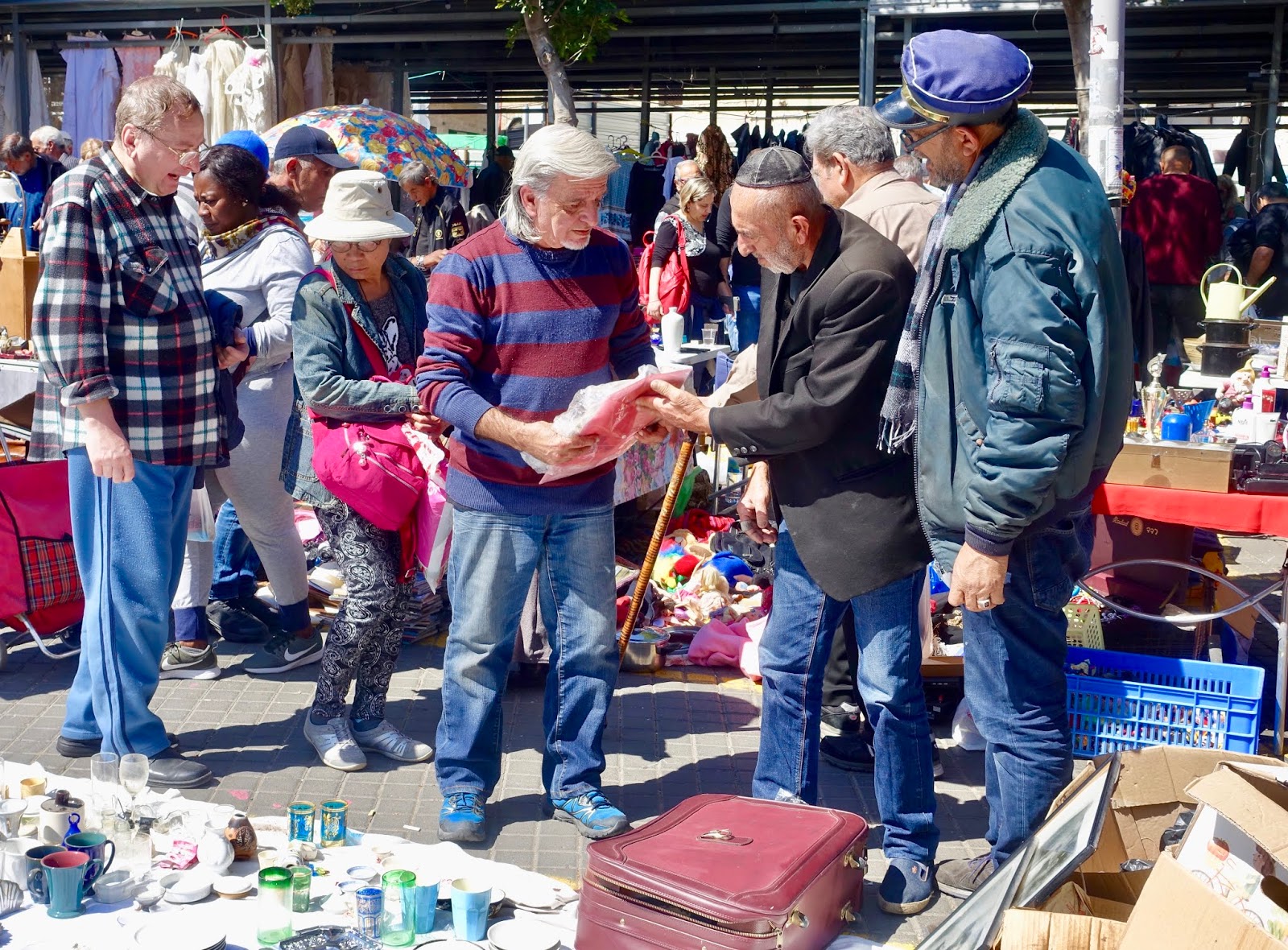
One part of the Shuk is relatively unchanged. Behind Oley Zion there is a piece of open ground where traders come and spread out their goods on trestle tables or in a number of cases on the floor. You can find just about anything here – books, antiques, clothes, dolls, games, CDs and vinyl, electrical goods, hand-made jewellery, pictures, old photographs strewn on the floor or in boxes - people's life stories being offered for sale. I often look at them and wonder who these people were and what happened to them. The customers here are as diverse as the goods and include secular and religious Jews, Arabs, overseas workers from Africa, China and the Philippines as well as tourists all of whom come in the hope of finding a treasure. I enjoy watching the bargaining that takes place here, including unexpected exchanges such as a Filipino woman bargaining down the price of some second hand Barbie dolls – in perfect Hebrew. But even here there is a hint of change. On Fridays in particular it is not unusual for professional photographers to turn up accompanied by models who strut amongst the customers and pose beside piles of old clothes. 


Bargaining in the informal part of the shuk
Coffee is another Jaffa tradition
Music in Friday morning
Friday is the busiest day in the Shuk. The streets fill up with locals and tourists who come to shop, eat and enjoy the street entertainers including impromptu performances by mime artists and musicians. The streets are filled with haunting Persian and Middle Eastern music played on the oud, saz and kamancheh. These young musicians bring the rich musical heritage and traditions of Mizrahi Jews to a new, primarily young audience. Also on Friday, in the midst of all of this activity, young Lubavitcher men work from a small stall and invite Jewish men to put on tefillin and pray in the street. Open air prayers are not limited to Fridays. Many of the longer established traders are religious and it is not unusual to see an open air minyan during the week.

For the moment the Shuk will retain its attractive mixture of old and new, traditional and modern but as Reuven, Yaron and Miriam say, further change is inevitable. Most of the children of the carpet repairers and antique sellers prefer different careers and many of them work in the professions. Whilst it is sad that some of the old skills and traditions will eventually disappear perhaps the new arrivals are really part of another tradition in the Shuk - that of change, but change mixed with respect for the past.

Hezzi Motada, craftsman at work

Trying before buying
Friday photo-shoot

You can see more pictures from Israel here.

Tuesday, 23 April 2019

Tel-Aviv Tales 3 - Beit Shimon Levi, a ship on dry land


The corner of Lavanda and HaMasgar in Tel-Aviv is not the most fashionable part of the city. Many of the buildings are in poor condition and there are few facilities. The heavy traffic on HaMasgar also makes this perhaps one of my favourite city's most polluted areas. However, it is on this corner that an iconic example of Tel-Aviv's modernist architecture stands. Beit Shimon Levi (the Shimon Levi House) was built in 1934-5. It is said that Levi himself designed the house although it is also, and perhaps more accurately, credited to architect Arieh Cohen who was responsible for a number of other buildings in the city.

The building was designed in defiance of the planning laws in place during the 1930's which restricted height to no more than three storeys. Beit Shimon Levi consists of six storeys in total - a basement, a ground floor, three further floors and a small attic at the summit - double the legislated amount. Following difficult negotiations, Levi was able to secure permission from Tel-Aviv's first mayor, Meir Dizengoff, to proceed with construction and to move his family in. Unfortunately they were not to live there for very long and moved out in 1937 due to financial difficulties. In later years the house was used by the Haganah as a look-out point during the period leading to independence and at one point it also housed a synagogue. Today it is used solely for residential purposes.

The house is affectionately referred to locally as the ship building due to its ocean liner type design, narrowing at each end and rising to a significant height with both curved and squared off balconies. These nautical references were common during the 1920's and 1930's and are classic features of Art Deco and modernist architecture. The building has protected status but looks to be in need of at least external decoration. Although not on the itinerary of most tourists a visit to this part of town is well worth it as there are two more excellent examples of Arieh Cohen's work at 26 and 28 Rosh Pina Street. He was also responsible for the more centrally located 251 Dizengoff Street.

Monday, 1 April 2019

Tel-Aviv Tales 2 - Sweet Story On Matalon Street

Matalon Street is adjacent to Lewinsky, home of the famous shuk of the same name. Whilst the shuk is home to shops selling spices, herbs, olives, pastries and coffee, Matalon is the place to find everything you need for a party, not least costumes. I have passed along this street many times but only recently did I notice a small shop front with a sign behind the window reading Konditoriah Albert, 1935. 


My curiosity was aroused by the possibility of seeing a piece of Tel-Aviv history and the potential for indulging my well known passion for all things sweet. Unfortunately Albert was closed. I tried again the following day still with no luck and began to worry that the shop had ceased trading. I decided to try once more. It was a case of third time lucky and to my delight I stepped into a world that has not changed in decades. The walls were covered with press cuttings about the shop as well as photographs of impressive, smartly dressed men and women from a world that no longer exists - Saloniki in the years before the Second World War Most striking of all was a faded, sepia picture of a woman with a serious expression and large, haunting eyes and wearing a traditional Greek head covering.

I was soon to find out that the woman in the picture was the mother of Albert Yehuda who brought his family from Saloniki to Tel-Aviv in 1935. The family initially settled in the Florentin neighbourhood where he established his famous Konditoriah that 84 years later still bears his name. The business relocated to its current location in the early 1960s and is today managed by Albert's son Yakov together with his wife Lavana.  I was able to spend a little time talking to Lavana who explained that only the best natural ingredients are used to make their confectionery and that everything is made on the premises and that their processes are the same ones Albert followed back in the 1930's. Whilst she was speaking, Yehuda was hard at work in the kitchen whilst her brother carefully removed the skins of hundreds of almonds preparing them for use in their various products. Many sweet treats are on offer here including a Greek version of Kadaif, made with nuts and the famous Marzipan Kisses - two boxes of which I managed to consume over a few days. Addictive. I also enjoyed the orange jellies that I bought on my first visit to Albert's.

Albert Yehuda came to pre-state Israel because he wanted his. family to be part of the re-emerging Jewish state. Lavana assured me that both her family and that of her husband came for purely positive reasons but throughout the 1930's many Greek Jews were to leave the country of their birth due to rising nationalism which on occasion turned violent. In July 1931 at least one person was killed and many Jewish families were left homeless in Saloniki when the city's Campbell district was attacked by 2000 rioters over a period of four days. Following this, many Jews left for Eretz Israel, Haifa in particular where they sought works in the docks.

Whilst talking to Lavana we break off regularly so that she can deal with the steady flow of customers who come in person or who call in their orders by telephone. A number of businesses in the neighbouring streets are owned by families that came from Greece but Albert's is almost certainly the last Greek konditoriah in Tel-Aviv (if not in all Israel) and a real piece of the city's history.


You can see more pictures from Israel here.

Friday, 8 March 2019

Tel-Aviv Tales 1 - Sonia and Yakov


Sonia and Yakov Shmueli sell hand made velvet and lace curtains, tablecloths and antiques in Jaffa's Shuk HaPishpeshim (flea market). They opened their shop 38 years ago and have been there ever since. Like many Israeli couples, they come from very different backgrounds. Sonia was born in Drahovo a small town in the Carpathians, now part of Ukraine, but which has also been in Czechoslovakia, Hungary and the Soviet Union. Yakov was born into an Iranian family in Teheran 70 years ago.

Sonia came to Israel in 1971. A few years earlier it has been practically impossible for Jews to leave the Soviet Union and those who applied to emigrate were harshly treated as were their families. At the beginning of the 1970's, there was a relaxing of these restrictions and emigration steadily increased. On arrival in Israel Sonia worked in a religious kibbutz. "I loved it, working in the fields or the orchards. The work was hard but I was young and didn't know anything different. And every night I dreamt of a man who lived in Tel-Aviv". That man was Yakov. He had arrived much earlier, in 1949 just after the founding of the modern state of Israel. His family had a comfortable life in Iran but his father was a committed Zionist and wanted to make aliyah, despite the protestations of his wife. Yakov tells the story of how his father told her "we will go and see if we like it. If you are not happy we will come back to Iran". She agreed  to her husband's proposal but when they arrived, he kissed the earth and promptly tore up their Iranian identity papers so that return was impossible. 

The family were initially housed one of the ma'abarot, a camp designed as temporary accommodation for the hundreds of thousands of Jews who came to Israel following independence in 1948. As the new state struggled to cope with such a large influx of people and at the same time fight a war of survival against its neighbours, the ma'abarot left a lot to be desired. Accommodation was flimsy lacking heating, ventilation and modern sanitation. Yakov remembers their home - a tent - being swept away in heavy rain. His father had spent all of the family resources on the move from Iran and so it was very difficult for them to improve their situation but after six months they managed to set up home in the HaTikva neighbourhood of Tel Aviv.

After leaving the kibbutz, Sonia found work in Netanya where she became friends with a girl who often spoke about her kind, handsome brother. The two friends spent a day together in Jaffa where they were joined by Yakov and a friend of his. Sonia remembers how the friend took a fancy to her and spoke continuously. Talkative as the friend was it didn't help his case as she only had eyes for Yakov and the two of them started to meet. Her father was not happy about the relationship, saying that this young man was not a Jew because "he doesn't wear a kippah". Nonetheless  he went to meet Sonia's family one Friday, wearing a kippah and to ask for permission to marry her. The initial response was a very definite "no". Several members of her religious, Ashkenazi family objected most strongly to her marrying a Sephardi Jew. Emotional scenes followed, described by Sonia as a "balagan" and she left home on shabbat, declaring she would never return. Yakov's sister came to the rescue speaking to various parties and eventually the way was paved for them to marry. They have four children and 12 grandchildren. I asked them how much they think attitudes have changed today and they told me that of course there are still people who hold the old prejudices but that they are a small minority. Their own children demonstrate this more open attitude and are married to people from several different communities.

In the picture at the top of this post the Shmuelis hold a reproduction of a photograph of Yakov, his mother and siblings taken just before they left Iran. He is the smallest child with his mother directly behind him.

Tuesday, 16 October 2018

Moshe Gerstel and Haifa, City of the Future

During the 1930's Haifa was often referred to as the "city of the future". It underwent significant development in the inter-war years when the Hadar HaCarmel neighbourhood was established with Modernism as the dominant architectural style. Perhaps the most iconic of the new buildings was the market hall of Shuk HaTalpiyot on Sirkin Street.


The shuk was built in response to the events of the Arab revolt of 1937-39 which caused the Jewish residents of the mainly Arab lower city area to flee the area and Jews from across Haifa to no longer feel safe to visit the markets there. Consequently plans were made to build a major market in the centre of Jewish Hadar. The site selected was extremely challenging, located on a steep slope on rocky ground. Nonetheless a design competition was held and architect Moshe Gerstel, working with engineer C. Cohen submitted the winning entry. His design was judged unanimously to be the best as it addressed the difficult issues of the site and required only local materials. Construction commenced in 1939 and the building was inaugurated in April 1940 when the city's Mayor praised the architect who "with imagination and ingenious creativity gave this city of the future a structure in which she can take pride". 

Gerstel's design included a rectangular structure at the front of the  building and a circular market hall to the rear. The stalls were arranged over three floors underneath a glass roof that flooded the building with natural light. There were also to be stalls on the ground floor and in the basement. Horizontal ribbon windows covered the surface of both parts of the building, giving views over the city and the bay. The exterior is striking due to the bands dividing the levels and the decorative fins above the main entrance. The fins are separated by a glass ladder, allowing even more natural light to flow in. The shuk quickly became a focal point for Haifa's Jewish residents. Nissim Levi describes it as "...the biggest and fanciest shopping centre in the Middle East...The central structure was roofed with a brilliant glass ceiling and the sunlight that seeped inside glittered on the fresh fruits and vegetables and created a colourful celebration that the eye can never get enough of". He also recalled  the wide range of products available and the songs and slogans made up by the vendors to attract customers.


Sadly the building has been allowed to deteriorate terribly and when I last visited two years ago only the basement remained in use for the sale of produce. The ground floor had a few low quality stalls and the upper levels were sealed off. Many of the windows were broken and feral cats roamed about. Netting had been installed to prevent pigeons causing further damage but serious action is required if the building is to survive. 

Gerstel was an extremely interesting character. Born in Galicia, Poland in 1886 he studied in Lviv and Vienna, saw active military service in the First World War and then lived and worked in Bucharest from 1922 to 1935, where he designed many buildings. He made aliyah in 1935. Settling in Haifa, he established a life long friendship with Hajj Tahir Karaman, a successful Arab businessman and deputy mayor of the city. Although Karaman was an Arab nationalist he was not opposed to co-operating with Jews and recommended Gerstel to several other wealthy Arab families who commissioned him to design homes for them. Their friendship was so strong that when the Gerstel family were in financial difficulties, Karaman not only took them in but added four rooms to his own home for them. Gerstel designed a house for his friend in the same street as the Shuk and continued designing for the family even when they left Haifa after 1948.


Karaman's recommendations resulted in commissions for three adjacent residential properties on Tchernikovsky Street on Mount Carmel. These include the Agnes Khouri house at number 29, built in 1937 and which has a spectacular glazed curved corner. One of the three properties is now divided into two with a Jewish family living in one half and an Arab family in the other, perhaps continuing the architect's tradition of good inter-communal relations. Gerstel's star began to fade in the 1950's but he remained in Haifa until he died in 1961. Several of his buildings have survived until today.


Sunday, 15 April 2018

Josef Berlin - Modernism in Tel-Aviv

Josef Berlin was born in Mogilev in today's Belarus in 1877. He studied at St. Petersburg Academy of Art graduating  in 1911, going on to win several architectural competitions. He designed at least a dozen buildings for various municipalities and banks before making Aliyah (emigration to Israel) in 1921. Once in Israel he obtained work as the Chief Architect in the Public Works Department of the trade union Histadrut. During his three years there, he designed a number of buildings in Tel-Aviv including the Electric Corporation on HaHashmal Street, a textile factory and a number of private houses. These included the Shapira House in Bialik Street which later became a synagogue. In recent years the building has been surrounded by hoardings, awaiting renovation.

Former Ha'aretz print works, 56 Mazeh, built 1932
When Berlin arrived in Tel Aviv the prevalent architectural style was Eclecticism which combined elements of art nouveau with Oriental and Biblical motifs. Although influenced by this style, he did not adopt it in its entirety. He preferred to work with elements of classical architecture whilst using locally available materials including concrete and lime mortar. Leaving the Hisadrut in 1924, he formed a partnership with Richard Pancovsky, a civil engineer from Czechoslovakia. Together they founded the Association of Engineers and Architects operating out of the Twin Building a 7-9 Mazeh Street which was designed by Berlin and included his family home. Today the building houses a bookshop and a cafe.This new venture initially included a school of architecture under Berlin's direction but it closed after one year. Pacovsky had trained in Prague and he may have introduced his new partner to the work of Skupina, an influential Czech avant-garde movement.

Former Moghrabi Cinema, completed 1930
Berlin's iconic Moghrabi cinema was completed in 1930. For this project he pioneered the use of silicate bricks and from then onwards dropped all classical references. Examples of his work with this material can still be seen at 46 Allenby and in his son, Ze'ev's work at the fabulous former home of the poet Ravnitzki at Ahad Ha'am 80. Sadly, the Moghrabi was damaged by a fire in 1986 and was demolished. Many older Tel-Aviv residents still have memories of it. Another of his designs, the Ohel Mo'ed synagogue on Shadal Street, was completed in 1931.  This building which still stands, is best admired from the inside where you can look up into its mesmerising dome. The Ravnitzki house, built in 1929, is currently under restoration and hidden behind hoardings.

Ravnitzki House, 80 Ahad Ha'am, completed 1930.
Dome interior, Ohel Mo'ed Synagogue, Shadal Street, completed 1931.
Ze'ev Berlin was born in 1906 and trained as an architect in Brussels. On his return to Tel-Aviv in 1932 he worked in partnership with his father and then, in 1936, moved to Haifa and established his own practice. During the period of their partnership, they designed several buildings in the city including the recently restored apartment building at 82 Rothschild and my favourite Berlin structure
the former Ha'aretz newspaper print works. This modernist gem tucked away at 56 Mazeh, was built in 1932 to the designs of father and son. Mazeh is primarily a residential street and would have been completely so at the time the print works were constructed. It is surprising that permission was granted for a noisy industrial unit that may well have operated through the night, printing the next day's edition.

Ha'aretz left the building some years ago but the current owners have retained the original facade, maintaining it in excellent condition. It has strong features, with extensive use steel framed glass, rounded balconies and balustrades and a cantilevered roof. However the highlight for me is the glazed corner stairwell that gives views into the zigzag staircase, adding drama to the design. Its squared-off corner contrasts with the curves of the rest of the balconies. It is possible to peep through the door and see a reproduced image of the building back in the 1930's. The only significant difference is that it still bore the name of the newspaper on the facade. 

Some commentators have compared the former print works to the early works of Bauhaus luminary Walter Gropius and those of Erich Mendelsohn who deigned the de la Ware pavilion in Sussex. But I feel that this is Berlin's own style drawing on his experience to create a modernist masterpiece - small but very beautiful. Josef Berlin designed at least 83 public and private buildings in Tel-Aviv, several of which can still be seen. He died in 1952 aged 75, whilst Ze'ev lived on until 1961.

Apartment building, 82 Rothschild, completed in 1932, restored 2013.

Sunday, 25 March 2018

Jerusalem - the people in the street

Jerusalem is one of the most stimulating cities in the world.  Important to three major world religions, not only does it have an extremely diverse resident population but it also attracts visitors from all over the world. The city also has hundreds of cafes, busy markets, street musicians and artists and a unique architectural backdrop that make it perfect for people watching and candid photography. This post includes some of favourite images from my recent visit.

Strolling with the strollers, Ben-Yehuda Street
Ben Yehuda Street in the city centre is packed with souvenir shops but still attracts many Jerusalemites who go there to eat, to meet friends or just to pass though this pedestrian thoroughfare on the way to somewhere else. I noticed the two Orthodox Jewish women in the picture above when I was sitting listening to a young woman playing the public piano at the bottom of the street. I like the way the mother on the left and the child on the right are looking at the camera whilst the other two look in the opposite direction.

And speaking of music, musicians can be found almost everywhere in Jerusalem. Abilities vary tremendously but I especially enjoyed the accordion playing of a young Japanese woman who performed a series of chansons near the steaming chairs in Jaffa Street and an Haredi singer and guitar player in Mamilla who gave superb performances of the Eagles' Hotel California and Marianne Faithfuls's As Tears Go By. Good as these two were the star of the show was another singer and guitar player at Shuk (market) Mahaneh Yehuda. Srugim is one of my all time favourite TV series, partly because of the excellent theme song originally recorded by Erez Lev Avi. One evening when walking in the market I thought the song was being played at one of the stalls. Turning on to Jaffa Road I realised that it was being performed live by a young man with a superb voice. A very excited crowd had gathered around him and unusually, waited to hear more songs once he had finished.

Japanese chansonnier on Jaffa Street
Haredi man performing "Hotel California" at Mamilla
This superb vocalist was performing outside Shuk Mahaneh Yehuda
Mahaneh Yehuda is one of my favourite places for candid street photography. It is full of people whose faces tell a story, sometimes sad, even distressing but always interesting. It is also fascinating to notice the differing styles of dress of - not necessarily related to religion or ethnicity but to their personal tastes. The weather was a little chilly and  many people wore scarves as protection against the cold. I liked the scarf worn by the man in the picture below but was also taken by his face where it was still possible to see traces of his younger self despite his age. He is quite stylish in an understated way. The man singing the Srugim song was also decked out in a thick scarf of orange, brown and red, complementing his thick brown jacket. 

My third scarf wearer was an older man I noticed several times. Dressed in what had once been a good quality coat and trousers he was a striking figure, usually upright and purposive despite his begging in the street. He sat a long way apart from the other beggars and I was able to take some candid pictures of him. The depth of the sadness in his face is astonishing and a reminder of how hard the lives of some of the people here have been.

Doing the shopping, Mahaneh Yehuda
Sadness, Mahaneh Yehuda
The market is also a place where unexpected things can happen. One morning a group of young people were making a film which involved a song and dance routine. Spotting one of the elderly herb sellers near the main entrance they asked him to sit in front of them whilst they performed. Not only did he oblige them but he stood up from his chair and did his own version of the dance routine, clapping and singing along with them before sitting down as soon as the song concluded and returning to selling his herbs. A star is born.

A star is born, Shuk Mahaneh Yehuda
Yusuf waiting for customers, Arab shuk in the Old City
Indian tourists visiting the Church of the Holy Sepulchre
Ethiopian Orthodox Christian women on the way to the Church of the Holy Sepulchre
I first spotted Yusuf a couple of years ago. An elderly man with a bright welcoming smile, he is a tailor working in the Old City's shuk. This time I took an item of clothing to him for a simple repair. We chatted a little whilst he worked and he told me that he had been a tailor working in the city for more than 50 years. We spoke in Hebrew as I have only a few words of Arabic and he does not speak English. I asked him if there was much work these days. He said that there is very little work and that today, people prefer to buy something new rather than repair things. Work has become so scarce that he is considering closing his tiny shop. I was to hear a similar story from other tailors and also from a cobbler I met in Tel Aviv. My picture shows Yusuf waiting patiently for another customer. It is sad that these old skills, passed from one generation to another are now disappearing.

The old city is another great location for seeing people from many different backgrounds in close proximity to each other. The Church of the Holy Sepulchre receives visitors from all over the world. In the space of a few minutes it is not unusual to see groups of Russian, Ukrainian or Ethiopian Orthodox Christians, people from Latin America and Western Europe and possibly groups of Muslim tourists from India or Turkey. More recently there has been an increase in tourists from Asia and on this visit I saw several Chinese tour groups as well as Indonesians and Filipinos. In the late mornings, the courtyard in front of the church becomes full of people who enter through the narrow arch on one side or down a flight of steep relatively narrow steps opposite. It can become difficult to either enter or exit and also to get a clear shot or good pictures. Early morning is generally better whilst the quiet evening hours give the opportunity for low light photography.

During the time I spent in and around the courtyard, several Ethiopian groups visited. I noticed the mother and baby pictured below in the courtyard whilst the group of elegant more mature women were passing through the tourist shops that line the approach to the church. The group of Muslim tourists from India were striking due to the brightly coloured clothing of the women and the uniformly white suites worn by the men.

Cuddling up to mum, Church of the Holy Sepulchre
It takes ten minutes or less to walk from the Church to the Kotel in the Jewish Quarter of the Old City. Again people from all over the world and of all faiths come here for many different reasons. I was there twice during my recent stay, once early in the morning and again in the evening after Shabbat had "gone out". My evening visit was especially interesting since people were still dressed in their Shabbat best clothes. The four young men in the gold coloured kaftans were chatting after the conclusion of prayers and I was able to take a series of photos of them as they turned and changed expressions whilst each one spoke. The Kotel is the most sacred site in Judaism but this does not mean it is a quiet place, People talk, pray out loud and there is much movement which can make it hard to capture clear pictures.  I was especially please to capture the morning prayers image with the young man facing in the opposite direction to the others and the seated man poring over the sacred text.

After Shabbat, the Kotel
Morning prayers, the Kotel
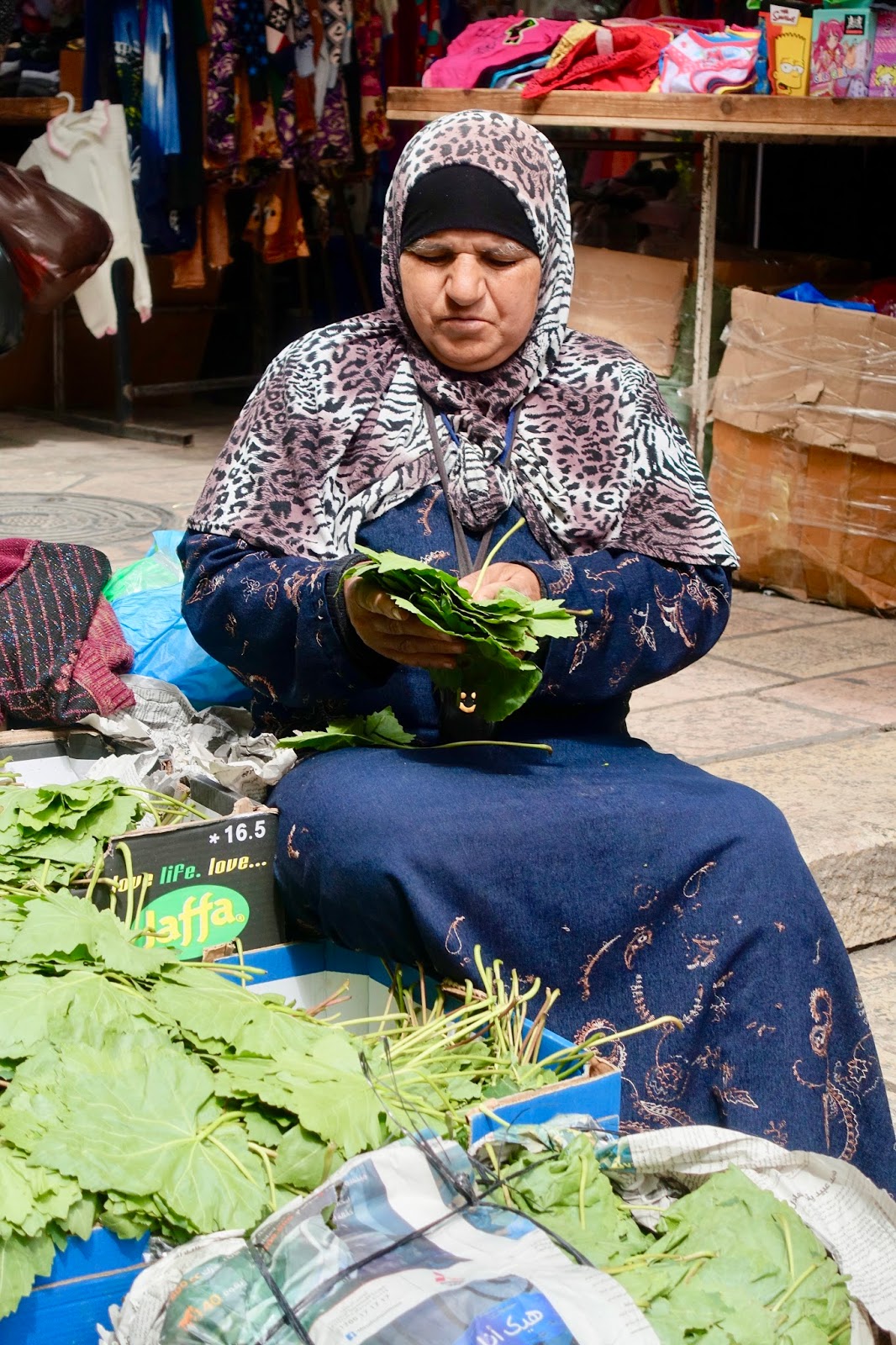
Nowhere is very far from anywhere else in the Old City. The Damascus Gate in the Muslim quarter is a very short walk from the Kotel. This is one of the busiest parts of the shuk and the place where local people go to shop for food and household goods rather than the more tourist oriented businesses near the Church and the Jaffa Gate. I visited on Shabbat when the Jewish quarter is quiet and people flock to this part of the old city. The area close to the Gate is packed with small shops selling all kinds of provisions whilst there are also people who set out their goods on the ground, especially women selling various kinds of herbs and vegetables. The woman in the picture below is one such trader whilst the boy carrying the bread was making a delivery from nearby bakery.

Jerusalem, everywhere you look there is something interesting to see...and someone interesting too.

Selling herbs near the Damascus Gate
Bread delivery, Damascus Gate
Elderly man, Damascus Gate

You can see more pictures from Israel here