Showing posts with label Books. Show all posts

Wednesday, 20 May 2026

Boundaries of Choice: Five Fiction Reads

It’s been some time since I last wrote about books. This post reviews five - or perhaps four and a half - novels that I have recently read. My choices span continents and genres to suit a variety of tastes but they share one thing: characters facing major, life altering choices.

We begin in the UK, where crime writer A.A. Dhand introduces us to the complicated world of a new “hero” in his challenging yet gripping novel, The Chemist. From there, Lea Ypi’s book delves back into Albanian history, exploring a diverse, many-layered, but now disappeared world. This one is the “half” - all is explained in the review below. Next, Ben Markovits’ latest novel tells the story of an unplanned road trip by a disappointed, middle-aged basketball fan.

Finally, we look at two titles from contemporary Indian writers. Both are second novels following acclaimed debut titles. Building on the success of a first book is a well-known challenge that authors sometimes fall short on, but that’s definitely not the case here.

A.A. Dhand - The Chemist


In this, his sixth full-length novel, Dhand introduces us to a new leading character. Idris Khan, the chemist of the title, runs a pharmacy on a rundown Leeds estate. His ex-wife, Rebecca, is one of dozens of locals who visit him every day for their methadone prescription. She fails to turn up one day and his resulting search for her draws him into a violent turf war between two powerful drug gangs. 


As the story progresses, Idris is provoked to commit terrible acts from loyalty and necessity. He is forced into a series of decisions that challenge both his professional oath and his personal morality, engaging in violence and using his knowledge to outwit the gang leaders. 


Dhand’s style creates a sense of urgency, making it difficult for the reader to resist starting the next chapter and then another one. His writing is gritty, realistic and brave. He does not shy away from tackling difficult issues, including racism and prejudice between minority communities and the impact of cultural practices on the lives of his characters. He also writes with authority. He comes from a British Asian background, has a Master of Pharmacy qualification, and several years of experience in the profession. 


The Chemist is not a comfortable read. The scenes that play out on the bleak housing estates on the city’s periphery are particularly dark, yet authentic. The estate residents include students, methadone users, drug gangs, the vulnerable and exploited and “ordinary” people, just trying to survive against overwhelming odds. Particularly memorable are Al-Noor, a Syrian refugee trying to keep his young son away from malign influence; Amy, a young woman drawn into prostitution and Rebecca whose commitment to helping others places her in danger.


Brave, authentic, gripping, The Chemist is a great addition to the British crime writing canon. It is also just the beginning of Idris Khan’s story, as he features in Dhand’s new book, The Kingpin, due out in July.


Lea Ypi – Indignity: A Life Reimagined


Indignity is not, strictly speaking, a novel. Author Lea Ypi describes it as a re-imagined telling of her grandmother’s life story in Ottoman Salonica and in pre-Second World War and then communist Albania. This reimagined approach, involving detailed dialogue between characters real and imagined, led me to include Ypi’s book in a list of fiction reads.


She began researching this story after seeing a photograph on social media of her grandmother, Leman, honeymooning in the French Alps in 1941. This was despite having been told that all evidence of her younger days had been destroyed during the early part of Albania’s communist period. Intrigued, she began researching her family history in archives opened to the public following the fall of the old regime in the 1990s.  


Leman is portrayed as a resilient, talented, determined woman who manages to survive some of the most turbulent events of the 20th century. Her story takes place against the backdrop of forced population exchanges between Greece and Turkey, the Italian and German occupations of Albania during the Second World War, the deportation of Salonica’s Jews, and the establishment and collapse of one of the world’s most repressive communist regimes. Historical characters also appear, including communist leader Enver Hoxha and Albania’s first and last monarch – King Zog. Real life British spy Vandeleur Robinson also features in the story. 


The “fictionalised” chapters are used to develop characters and demonstrate changing political moods and allegiances, and to show how historical events impact and are reacted to by Leman. They are interspersed with the author’s experiences in various archives as she searches for the truth about her grandmother. Ypi also introduces us to Leman's social milieu – that of writers, artists, politicians, revolutionaries and socialites from different backgrounds. Many were learned, multi-lingual people of various ethnicities and religions, representing a culture that no longer exists.


Women feature strongly in the story, some of them breaking long-held taboos and customs, but others fall prey to them. Her feminist aunt, Selma, for instance, commits suicide rather than go through with an arranged and unwanted marriage. This act highlights the meaning behind the book’s title, a refusal to surrender to the indignity of a forced existence. Indignity matches the sharp observation of Ypi’s acclaimed first book, Free, (so good I’ve read it twice) and consolidates her position as a major talent in modern biographical writing.


Ben Markovits - The Rest of Our Lives


Tom Layward, a 55-year-old law professor, drives his daughter to Pittsburgh to start university, then rather than heading home to his wife in New York, heads west. He spends several days visiting his brother, his son, an old girlfriend, eating at roadside diners and playing basketball with strangers. 


The background to this unplanned road trip is that twelve years earlier, his wife Amy, had an affair and Tom had resolved to leave her once their children had grown up. After dropping his daughter, he remembers this promise to himself and takes off. 


The trip forces him to confront problems at work, hidden health issues (which will later assume greater importance), an unsatisfactory relationship with his son, and to confront various other disappointments. He sums all of this up when describing his marriage, saying: “What we obviously had, even when things smoothed over, was a C-minus marriage, which makes it pretty hard to score much higher than a B overall on the rest of your life.” How is he to face his remaining years?


Tom is disappointed with life but is still likeable. He finds it easier to make connections with strangers rather than to communicate with close family and old friends. This may be because some of those he meets in bars, diners and on basketball courts, are also looking for something from their lives although they don’t quite know what. These and other characters are well-drawn, including his wife Amy, who makes several appearances in the book, has her own disappointments and is not written as a minor character.


Basketball features largely in this story. We learn that he was once a player (as was the author) and planned to write a book on the sport. Whilst on the road he decides to resuscitate this project and to this end, makes notes and collects anecdotes from strangers, but admits to himself that the book will never be written. This involves the use of a few “techie” basketball words. Look them up or don’t – I didn’t but this did not impact on my enjoyment. Tom’s challenge is to come to terms with past failures and to embrace his remaining years with hope.


The Rest of Our Lives was shortlisted for the 2025 Booker Prize.


Rahul Bhattacharya – Railsong


Charu is the daughter of an inter-caste marriage; her father, a railway worker, renounced his Brahmin status and family name to marry a woman of lower social standing. He becomes involved in left-wing political activism which forces the family to flee to the safety of a tribal village, making the first of many moves and journeys that will chart Charu’s life.


Railsong describes a double journey, one physical, the other personal. The former tracks her moving from Bihar to Bombay, as well as travelling across the country to fulfil her duties as a welfare officer for the Indian Railways. The latter deals with the sexism and opposition she encounters from more senior male colleagues. It also charts her emotional growth as she forms friendships, deals with office politics and eventually marries. Her story is one of transience and evolution, living in temporary accommodation, buffeted by events in the lives of others and by rapid change in a newly independent country. 


The passage of time is marked by the ten-yearly census in which Charu notes the rapidly expanding population and is conscious of her “smallness” set against such vast numbers. Historical events anchor the timeline – the assassinations of Indira and Rajiv Gandhi; the demolition of the Babri Masjid and various strikes and protest movements. 


The role and position of women in Indian society is a constant theme of the book. We see an aunt condemned to a life of servitude when she becomes a widow. When Charu's mother dies, the aunt is expected to move in with the family, to cook, clean and care for them. The possibility of her re-marrying or living independently is unthinkable. In contrast, Animesh, Charu’s father, is pressured to re-marry. These themes culminate in Charu’s wedding. Breaking with tradition, she chooses a love marriage. Already controversial, her entry into a Gujarati family brings new challenges – shared faith but different traditions, food and language.


Though she continues to work, she faces hostility from her conservative in-laws, who oppose her independence. Her husband, although supportive, is unable to stand up to his parents. He advises her that she must: “dissolve like sugar in milk,” giving up her own identity to blend-in and make the household run smoothly.


Railsong tells the story of one woman’s resilience, as she refuses to “dissolve” into her surroundings or surrender to the oppressive and unreasonable expectations of others.  Charu sets her personal struggle against that of a newly independent country as it tries to balance tradition with modernity. Bhattacharya has an engaging style, with well-drawn, believable characters and superb historical and social contextualisation, making this epic double-journey a moving, irresistible addition to modern Indian fiction.


Megha Majumdar – A Guardian and a Thief


Megha Majumdar’s second novel, like its predecessor, is set in her home city of Kolkata. Described as a moral thriller, the story takes place a few years in the future as law and order begins to break down, and the population struggles with flooding and extreme heat.


Ma, her two-year old daughter Mishti, and her elderly father (referred to as Dadu), plan to leave India to join her husband who is already settled in the USA. They have their passports and visas ready but shortly before their departure date lose everything in a burglary. Ma then sets out to recover or replace her documents, triggering a series of events that lead to a shocking denouement.


One of the key themes of the book is an examination of human responses to adversity. Dadu loves the city and the kindness and human connections it was once known for. He exemplifies this through giving precious cold water to a rickshaw driver. But kindness may only last so long in extreme situations, and we also see him stealing an orange from a starving child to feed his own granddaughter. 


The other main character is Boomba, a young man who leaves his village to find work and to support his parents and little brother. He finds a series of jobs but like Ma, he too meets disaster and turns to crime, including theft. The reader may wish to consider how society views Boomba’s stealing to help his family survive, against that of Dadu who despite the hard times, is still much better-off. For both of them, love and desperation blur the lines between right and wrong. 


The story is interspersed with telephone calls between Ma and her husband in the USA. Neither of them tells the full story of their condition and situation, preferring to keep the truth to themselves, hoping to resolve their mounting problems rather than to reveal them.


Majumdar’s first novel, A Burning, became a New York Times best seller and was also shortlisted for the Andrew Carnegie Medal for Fiction. It was my favourite book of 2020. Repeating success with a second novel is always a challenge, but I read A Guardian and a Thief in two sittings, anxious to know the outcome of Ma’s and Boomba’s struggle for survival. The book has also received critical acclaim and a Carnegie award. 


It would be interesting to know what you think of these selections, or to hear about what you’ve been reading recently. Let me know in the comments!

Wednesday, 26 January 2022

Best Reads of 2021 Part One

I had hoped to begin traveling again last year but other than a few nights in Kent, Covid kept me in London. I tried to use my time profitably by beginning to learn a new language, producing a small book of pictures and stories from my travels, and of course, by reading. I spent many happy hours - and quite a lot of money - in London's bookshops, especially Foyle's flagship store on Charing Cross Road, Daunts on Cheapside and Stanfords in Covent Garden. I also bought several books from The Book Corner, an excellent independent book shop in Saltburn-by-the-sea, that kept me supplied with reading material during the various lockdowns. This post is the first of two detailing my favourite fiction reads in 2021. 

Anthony Quinn's London, Burning brilliantly re-creates the mood of  the city during the chaotic late 1970's. The story is set against a background of strikes, rubbish-filled streets, IRA bombings, National Front marches and the collapse of old political loyalties in the dying days of Jim Callaghan's Labour government.

There are four main characters. Hannah Strode, a young reporter with a talent for uncovering corruption, and Vicky Tress, a policewoman at the beginning of her career, work in different worlds but face similar challenges of dealing with casual sexism and patronising attitudes to women. Freddie Selves is a brilliant but philandering and unlikeable theatre director, while Callum Conlan, a young Irish university lecturer becomes a victim of prejudice and circumstance. The fears, hopes and romances of the four play out against the political backdrop, with their fate coalescing around the murder of Anthony Middleton, an ex-spy and hawkish Shadow Cabinet member. Middleton is clearly based on real-life politician, Airey Neave a member of Margaret Thatcher's inner circle before she became Prime Minister, and who was killed in a bomb blast.

As well as the 1970's political references, Quinn reminds us of the cultural mood of the decade, with passing references to World of Sport and Dickie Davies, John Travolta's white suit, the Deer Hunter movie and Punk Rock. One of the minor characters attends a Clash concert. Although the action takes place several decades ago, the main themes are topical - a changing political landscape, the threat of terrorism and the hypocrisy of the elite. But perhaps there is hope. Towards the end of the book, Freddie shares the following thoughts "When you behaved decently and put others before yourself people liked you. And when you behaved like a prick people resented you. It wasn't such a difficult principle. But it seemed to have taken him most of his life to grasp it". 

Trevor Wood's One Way Street is the second in a trilogy of crime novels set on the streets of Newcastle-upon-Tyne. Homeless military veteran Jimmy Mullen, has a habit of getting drawn into the city's underworld. This time he is drawn into the search for the suppliers of a dodgy batch of spice that appears to be behind a series of drug-related deaths amongst the city's teenagers. 

As in the first novel, Jimmy is ably (well, more or less), assisted by his two friends - Gadge, an alcoholic IT expert and teenager Deano whose search for his missing brother is one of the main strands of the plot.  These characters are further developed in this story, as are those of several of the supporting cast, including Kate, the daughter Jimmy hasn't seen in years and his extremely tough probation officer, Sandy, who knows when to step in and when to feign ignorance. 

Jimmy is a tough character, sometimes given to violence, but despite this, he also has a more vulnerable side and we see him struggle with PTSD, following active service in the Falklands. The city makes a perfect stage for Wood's writing. I enjoyed the local references to Dog Leap Stairs, the Crown Posada pub and Brighton Grove, all of them real places, and all of them familiar to me from my student days. Wood perfectly describes the Crown Posada as "...a proper drinker's pub. Great beer, a handful of old men at the bar who looked like they'd taken root, and a snug in the corner if you wanted privacy". I also enjoyed the scenes set in the local library where Gadge helps Jimmy look for evidence on the internet. I especially liked the no-nonsense, but heart of gold librarian who allows Gadge to charm his way back in to the library after having been "banned...for attempting to fart the national anthem..."

Trevor Wood describes himself as "an adopted Geordie" after having lived in Newcastle for twenty-five years. The first book in the trilogy, The Man On The Street received the CWA New Blood Dagger award. The follow-up,  Dead End Street, was released earlier this month.

Ulrich Alexander Boschwitz wrote The Passenger in 1938, shortly after Kristallnacht, the state-sponsored pogrom that finally made clear Nazi intentions towards the Jews. It is the story of Jewish businessman Otto Silberman who flees his home to escape the violence and who is quickly abandoned by his non-Jewish wife, his friends, colleagues and business associates, several of whom take the opportunity to divest him of his belongings.

He goes on the run, taking one train after another, traveling around Germany in an attempt to find a safe place, a friend or acquaintance who is willing to help him. He attempts to cross the border into Belgium but is sent back to continue his journey to nowhere. Silberman's shock at his transformation to pariah status was the shock of many middle-class German Jews whose ethnicity and, or, religion was incidental to them until the Nuremberg Laws of 1935. He may have been successful and respected but he is now  reduced to the letter "J" stamped on his papers.

There are many eerily prescient moments in the book. At one point Silberman, reflecting on his situation says "If only I'd gotten a visa earlier on! But who could have foreseen any of this..." Yet the writer does seem to have foreseen where things would lead, and has Silberman say "Perhaps they'll carefully undress us first and then kill us, so our clothes won't get bloody and our banknotes won't get damaged" before going on to say "These days murder is performed economically". He could not have known that this was exactly what was to happen just a few years later.

The author's own story is tragic. He was born in Berlin in 1915, left for Oslo in 1935 and then studied at the Sorbonne in Paris. He wrote two novels including The Passenger before he managed to settle in England in 1939. When war broke out he was interned as an enemy alien and then shipped to Australia with many other detainees. He was allowed to return to England in 1942, but his ship was torpedoed by a German submarine, and all 362 passengers were killed. He was just twenty-seven years old.

In Lottie Moggach's Brixton Hill, Rob is serving the last few months of a seven year prison sentence for an initially unspecified crime. His preparation for freedom includes being allowed out to work in a local charity shop during the day, before returning to the prison at night. To be certain of his impending freedom, he must stay out of trouble, prove he can be trusted and not make contact with outsiders other than the staff at the shop.  The manager treats him with disdain and Rob spends most of his time sorting through unwanted belongings, preparing them for sale. 

A chance encounter on Brixton Hill puts his freedom in jeopardy. An attractive woman, Steph, "walking expertly in high heels," trips and literally falls at his feet. He helps her up and then over the following weeks continues to bump into her. They begin to form a connection but in order to maintain it, Rob must avoid telling her where he really lives. He must also ensure that the prison authorities do not find out. But is it really a coincidence that he regularly sees her, and is she really everything she says she is? Steph also has something to hide and although Rob is incarcerated in a building, she is a prisoner of circumstance.

The descriptions of prison life are detailed and believable. Drugs, suicide, violence and the impossibility of being able to trust anyone all feature strongly. The horror of sharing a small cell with a stranger is perfectly illustrated by Rob's dislike for his loathesome cellmate, Marko. Marko is addicted to trashy TV shows, sneers at Rob's books and constantly looks for an advantage or hold over him. He is so annoying that Rob admits to having been happier when he shared with a quiet, polite character, who left him in peace, but who he eventually discovered, was in prison for having stabbed someone to death. 

Both main characters have something to hide, something to lose and a desire to escape their surroundings. The uncertainty about how they might achieve this is maintained to the final pages. Tense, engaging and full of authentic scenes from south London, Brixton Hill is a contender for my favourite fiction read of 2021. 


Nadifa Mohamed's The Fortune Men is based on the true story of a murder in 1952, in Cardiff's docklands. A Jewish woman, Lily Volpert (Lily Volacki in this story) was found in her shop and Mahmood Mattan, a Somali sailor becomes a suspect, is arrested and put on trial. The evidence against him is flimsy and circumstantial but an overtly racist police investigation and a series of dishonest witnesses combine to frame him. When his unsympathetic defence lawyer describes him as "Half child of nature - half semi-civilised savage" the outcome of the trial seems inevitable.

There are many moving scenes in this story, especially those in the condemned cell as Mattan awaits the outcome of his appeal application. His develops a relationship with his jailers, some of whom try to calm and encourage him as he veers from confidence to despair. The scenes of him waving through the prison bars to his wife and sons are particularly affecting.  

The story includes some rich background detail as Nadifa Mohamed describes the diverse make-up of Cardiff's Butetown during this period, with a cast of characters that includes Somalis, Yemenis, Jews, Italians, Poles, Africans and people from the Caribbean. The story provides a glimpse of daily life amongst these largely male communities and their clubs, bars, cafes and boarding houses. Many of them were seamen, some of them settled in the city, others waiting for a ship and a job. Some of the men married local women as did Mattan. We are also given Mattan's back story - his childhood in Hargeisa, British Somaliland, his time at sea and his experiences in various ports. 

The author makes interesting use of press cuttings and quotes to tell the story but also had access to someone who knew Mattan. Her father knew him in when they both lived in another port city, Hull, part of the same Somali community. Many British port cities are, or were, home to long established and sometimes relatively large numbers of Somali and Yemeni seamen. It is estimated that 1,500 Yemenis lived in Cardiff in the 1920'a - half of the city's ethnic minority population at the time.

The Fortune Men was deservedly shortlisted for last year's Booker Prize. The author previously won the Betty Trask Award for Black Mamba Boy, based on her father's life in Yemen in the 1930's and 1940's.

Look out for Best Reads of 2021 part two, coming soon!

Saturday, 20 February 2021

Best Reads of 2020 Part Two

A recent Adrian Yekkes post featured reviews of some of my favourite reads of 2020. It focused on five great works of contemporary fiction, all of them by Indian writers. This post continues the literary theme with five more of my favourite books from last year.

Andrew Cartmel's Vinyl Detective series is perfect for me combining music with the detective work of the unnamed hero and his fabulous partner, Nevada. Low Action is the fifth title in the series and once again the pair accept a commission to track down a rare vinyl record, the pursuit of which inevitably leads them into trouble. This time they investigate a series of attempts on the life of an ageing rock star's girlfriend, whilst simultaneously searching for a rare album of the fictional disbanded punk girl group - the Blue Tits. Low Action sees the return of several old favourites including the afore mentioned ageing rock star, Erik Make Loud, free loader Tinkler and shaved headed cab driver Agatha. I am especially fond of Agatha who gets drawn into the trickier parts of the couple's work and is admired from afar by Tinkler. 

In Low Action, Cartmel works his usual magic, leading us through numerous twists and turns, developing his characters so that one feels they've known them for some time. The reader develops either a liking or disdain for each one, before reaching the final denouement which never fails to surprise. The series has great continuity with all the little habits and interests of the main characters maintained and developed with each book. The Vinyl Detective always has something to say about the quality of his coffee and Nevada can be relied upon to choose a great wine and to track down haute couture fashion in second-hand shops whilst simultaneously searching for the elusive vinyl. At the same time, there are always new subjects in his stories and trouble is sparked by all kinds of jealousies, resentments and grudges. It's worth starting at the beginning of the series if you haven't read any of them, but each title  can stand alone. Cartmel has also written a number of Doctor Who novels and novellas and wrote scripts of the TV series in the late 1980's.

Still on the subject of crime, I discovered the books of A.A Dhand for the first time last year. Amit Dhand's stories, set in Bradford look at crime through the prism of various social issues including religious and political extremism, corruption and poverty but without becoming didactic or cliched.

His detective, DI Harry Virdee is a complex character who resorts to unorthodox methods to solve cases. and this often lands him in trouble with his superiors This includes occasionally securing the help of his brother who is himself involved in the city's underworld. The books also have a sub-plot. Virdee is a Sikh married to a Muslim woman. Their marriage has caused both families to sever ties with them. These mutual prejudices are to some extent examined in each of the stories but are given particular attention in his most recent novel One Way Out. 

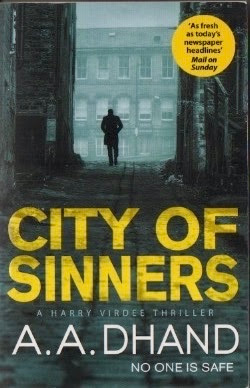
The first of his books I read was City of Sinners which left me hungry for more of his writing. Our hero is tracking a vicious serial killer bent on revenge for a perceived slight several years previously. Although he doesn't realise it at first, the grudge is somehow linked to Virdee and threatens to destroy his family. The tension builds to an almost unbearable level that kept me reading into the night, too worried to put the book down until I reached the end. 

Dhand grew up in Bradford and as a teenager helped his parents in their convenience store. His experience there was no doubt a rich source of ideas for the characters and story lines of his books. He went on to qualify as a pharmacist, a profession which he still practices full-time. There are plans for Streets of Darkness, his  first novel, to be made into a TV series. 

Elif Shafak's 10 Minutes 38 Seconds In This Strange World was shortlisted for the 2019 Booker Prize. It is an atmospheric tale of outsiders, misfits that the city needs but doesn't want. It centres on Tequila Leila, an Istanbul sex-worker, brutally murdered and dumped in a garbage bin in the back streets of the city. The first half of the book deals with what happens to her mind after death, where for ten minutes and thirty eight seconds her life passes before her as each memory is evoked by a different smell or taste - lemons, cardamom coffee, wood and even sulphuric acid. 

This device is used to take us through her life from her childhood in a small village to her escape to Istanbul where she becomes a prostitute and where her life is shaped through her relationships with her five best friends. All of them are, to some extent, outsiders. Jameelah is a Somali woman, brought to Istanbul by human traffickers. Zaynab122 (the number refers to her height) is a very religious refugee from Lebanon who is taunted for her dwarfism. Sinan is her best friend from childhood, Nalan is a trans woman and Humeyra has fled her abusive husband. 

This group inhabit what was once a very diverse city and the writer's affection for those times is clear. A couple of years ago I heard her speak about how her beloved Istanbul has been cleansed of much that made it both interesting and a refuge for the dispossessed.  Shafak describes the quarter in which she once lived as having a synagogue, an Armenian church, a Greek church, a Sufi lodge and a Russian Orthodox Chapel "between rows of licensed brothels" all within short distance of her street. Istanbul has also been cleansed of her presence as she now lives in the UK after having been prosecuted in Turkey for daring to refer to the Armenian Genocide in her work. 

The second half of the book deals with what happens to Leila's body after her death. Her friends are not happy to let her lay in an unmarked grave where those who die in the street or without relatives are dumped. They embark on an almost slapstick mission to bury her somewhere more fitting, avoiding pursuing police as they drive through the night in a stolen truck. This is a final act of friendship and an indication of how even in death the outsider will no longer find a welcome in the city. 

Shafak has a particular talent for enabling the reader to feel they are in the room with the characters. I especially felt this in the scenes in Leila's apartment and in the tension of the stifling life she lived in the village before her escape. The story examines some of her favourite themes - the treatment of women and sexual minorities, growing problems with religious and political orthodoxy and the rejection of difference. These subjects are also examined in her earlier works including The Bastard Of Istanbul, The Flea Palace, Three Daughters of Eve and Honour - all of them cracking reads.

Not many people can say that they won the Booker Prize with their first novel, but Douglas Stuart can. The Glasgow born, New York based fashion designer picked up the 2020 prize for Shuggie Bain the story of a young boy growing up in Glasgow at the beginning of the 1980's. The focus of the novel is Shuggie's relationship with his alcoholic mother Agnes and his attempts to save her from herself. In the early chapters his older brother and sister take responsibility for her but eventually leave in order to save themselves and so it's just Shuggie and Agnes from then on. 

Agnes is a fascinating character. Despite living on an isolated sink estate in what was then a decaying city, she is determined to keep a clean house, to wear only the smartest clothes that show off her figure at its best, to always attend to her hair and not to go out without getting made up first. All of this despite her growing reliance on the alcohol that takes most of her weekly benefit payments. There are brief moments of respite when it looks as if everything will be fine. From time to time Agnes and Shuggie decide they will be "new" and she stops drinking, but the city, her neighbours and her need for love are always going to be there to pull her back down.

As if this isn't enough for a young boy to cope with, he is also gay. His way of speaking, attention to his appearance and disinterest in the games of other boys lead to him being described as "not right" by friends, relatives and neighbours. They also make him vulnerable to abuse by adults and older children.

Whilst Shuggie and Agnes are the main characters, there are several other stories here. Her parents have a dark secret. The female neighbours on the estate are both jealous and secretly admiring of her appearance and most of them have stories of their own with husbands made redundant in middle age and destined never to work again but still having to maintain themselves and several children. And then there's the issue of sectarianism with religious affiliation governing who will be friends with whom and where they will live, or go to school. However, despite the misery of much of their lives, Agnes and Shuggie manage moments of humour and there were occasions when I laughed out loud whilst reading this. It's a great, albeit difficult read, and good to see a novel featuring authentic working class characters receiving the highest accolades.


Avi Luria, a 73  years old retired engineer who seems to be in the early stages of dementia is the hero of Israeli writer A.B. Yehoshua's latest novel,  The Tunnel. Avi's memory loss is first alluded to when he forgets to collect his grandson from school and then has trouble remembering people's first names, including that of a woman he once had a brief affair with.

His wife Dina is a high profile paediatrician who wants him to remain active and intellectually engaged in order to slow the progress of the disease. She persuades him to return to his former employer, the Israel Roads Authority as a volunteer where he becomes involved in a supposedly secret project to build a military road in the Negev Desert. The project is hampered by the road needing to pass through the location of a hill at the summit of which are ancient Nabatean ruins. Not only this, the hilltop is home to a family living in Israel but who lack appropriate documentation to do so. The family claim to be trapped and unable to live elsewhere and so Avi develops proposals to take the road underneath the hill, a costly project that will bring many technical challenges. The project gives him a new lease of life but his family are troubled by his occasionally going missing and some of his former colleagues are against his ideas.

The tunnel is a metaphor both for Avi's dementia as his world narrows and slowly darkness begins to surround him. However, perhaps all is not lost and as Dina says "Does it matter what day it is, if there is love every day". The tunnel idea is also a reference to the ongoing political situation in Israel with opportunities for resolution narrowing but then there is always light at the end of the tunnel. 

You might also like Best Reads of 2020 Part One - Contemporary Indian Fiction or Essential Items And Other Tales From A Land In Lockdown - Stories From The Pandemic

Saturday, 16 January 2021

Best Reads of 2020 Part One - Indian Contemporary Fiction

I had planned to spend all of last September in India. For obvious reasons I couldn't go and so instead I  visited vicariously by immersing myself in contemporary Indian fiction. I have previously enjoyed the works of Kushwant Singh, Hassan Sadat Manto, Anita Desai, Rohinton Mistry, Bapsi Sidhwa and others but thanks to The Scroll I have discovered several new authors from different communities and from different parts of India. The books I enjoyed most share a number of themes - the vulnerability of outsiders of various kinds, friendship, betrayal and relationships between the classes, sexes, rich and poor. These are universal themes and can be found in the literature of most countries, but the five books included in this post explore them in a specifically Indian context.

Megha Majumdar's debut novel, A Burning, was one of my most engaging reads of the year. Set in the author's home city of Kolkata, the story begins just after an horrific terror attack has taken place. It revolves around three main characters, Jivan who lives in the slum but has dreams of a good job and a better life; her friend and neighbour, Lovely, who also has an ambition to leave the slum and to be a success in Bollywood and PT Sir, Jivan's former sports teacher. Jivan helps Lovely to improve her chances by teaching her English and whilst at school was well liked by PT Sir due to her sporting abilities. Although she has ambition she is young and naive and becomes implicated in the attack when the police examine the contents of her beloved mobile telephone. As the story unfolds, the moral character of both Lovely and PT Sir are tested as they are forced to compromise between helping Jivan or pursuing their own desires. All three are outsiders in their own way. Jivan is a Muslim, Lovely is a Hijra and PT Sir is not well regarded at his school. Lovely and PT Sir have both been fond of Jivan but when choices arise between opportunities to improve their lives or to forgo them and instead help her, their loyalty is put to the test.

Majumdar builds the tension as the story progresses, raising and then dashing hopes at various times,  as the story moves to its shocking denouement. Throughout, she exposes the hierarchies that govern every day life, at work, at home, even in prison. She studied in the United States and now lives in New York where she works as an editor at Catapult. Her book has received substantial praise from some very big names. Amitav Ghosh describes it as "...the best debut novel I have come across in a long time..." and Yaa Gyasi called it "An excellently crafted, utterly thrilling novel full of characters I won't soon forget". A Burning was long listed for the 2020 JCB Prize and shortlisted for the 2021 Andrew Carnegie Medal for Excellence in Fiction. It might just be my book of 2020.

Hansda Sowendra Shekhar, author of My Father's Garden also writes about outsiders. He is a doctor as well as being an accomplished writer who has published three novels and a book of short stories. Born in Ranchi, the capital city of Jharkand in north-east India, he is a member of the Santhal ethnic group  who are one of the Adivasi or tribal communities. He is also gay. His writing explores the lives of the Santhal and neighbouring communities, the various social problems they face and their suffering at the hands of multi-nationals who wish to use the mineral-rich Adivasi lands for profit, forcing out the Santhal and other groups. Some of his short stories have provoked controversy amongst his own community due to the candid depiction of sex, prostitution and other issues. This led to calls for his brilliant collection of short stories - The Adivasi Will Not Dance - to be banned. 

My Father's Garden has also encountered controversy as it tells the story of a young gay Santhal doctor, his search for love and companionship and the difficulties of managing the expectations of his family and community. The first half of the book details the highs and lows of an affair with a fellow medical student and the different understanding, needs and wants that the two of them have from their relationship. The second half tells the story of a platonic friendship with the head clerk of the hospital where our hero is posted and how this changes over time to leave him disillusioned when his corrupt nature is exposed. The story explores several themes including the search for love, rejection, disappointment and the condition of being a permanent outsider even in one's home or family.

India's small but accomplished Parsi community has provided several writers who have achieved international recognition. Canada based Rohinton Mistry has scooped numerous awards for his epic novels of Parsi family life whilst Bapsi Sidhwa, born in Karachi when it was still part of an undivided India, has also achieved international recognition with two of her books being the basis for successful films. Last year I discovered another Parsi writer - Thrity Umrigar. Born in Mumbai she moved to the United States at the age of 21 and her stories are set in both India and her adopted country. 

I enjoyed two of her novels in 2020 - The Space Between Us and The Secrets Between Us. Set in Mumbai, they chart the relationships between Sera Dubash, a wealthy Parsi widow who survived an unhappy and sometimes violent marriage and her illiterate maid, Bhima who has her own sad story and who works to enable her orphaned grand daughter, Maya, to attend college. Umrigar cleverly contrasts the lives of the two women - Sera living in comfort in a beautiful apartment in a wealthy part of the city, Bhima scraping by in a small house in one of Mumbai's slums. Over many years they have shared an unspoken understanding of the other's secrets, yet still Bhima is not permitted to sit on the furniture she polishes every day and although she cooks Sera's meals she may not eat from the same plates or drink from the same cups. Umrigar contrast the lives of the two women which although very different materially are similar in many ways. Both had unsuccessful marriages and both choose to live their lives for their children or grandchildren. Both keep up pretences, Sera that her marriage was happy and Bhima that although she may live in a slum, she is not of it. Despite this, when a crisis arrives in the shape of a new and dreadful secret, this "nearly" friendship is placed under unbearable pressure in which themes of loyalty, truth, betrayal and redemption are examined. The books also capture something of the spirit of Mumbai. I especially enjoyed the scenes on Juhu beach, where Bhima and Maya go for fresh air and to temporarily escape their poverty and where both Bhima and Sera revisit memories of happier times.

Annie Zaidi is a journalist, novelist and playwright. Originally from Allahabad, she is not the first acclaimed writer in the family. Her maternal grandfather was Urdu Laureate, Ali Jawad Zaidi. Her most recent work, Prelude To A Riot uses a series of soliloquies, interspersed with clever use of poems, news reports and advertisements to tell the story of a South Indian village where religious intolerance threatens to destroy long established friendships between Hindus and Muslims. The soliloquies give voice to a range of opinions across age, class, sex and religious boundaries, giving depth to each character and background to the relationships and connections between them. 

Developing her theme of growing intolerance, Zaidi seems to make reference to what has become known as cancel culture. When the local newspaper publishes an anonymous poem, the recently formed Self Respect Forum, writes to the editor, objecting to its inclusion, claiming it makes disrespectful reference to a deity and also because too much space has been devoted to it "...the forum feels strongly that this much space need not be devoted to cultural inputs, especially on weekdays". The female editor writes a robust response "We must not forget that anybody who seeks to block the flow of ideas or people, creates artificial hurricanes" and suggests they visit the much neglected local museum where ancient statues depict the said deity in the same way as the poet. The Forum fail in their attempt to prevent further poems being published but are nonetheless outraged.

This relatively short but extremely powerful novel also exposes the discrimination faced by migrant workers who are paid less than the locals, not allowed to live in certain neighbourhoods and vulnerable to violent attacks. In Devaki's soliloquy she hears her father angrily describing his workers as "bloody illegals" before acknowledging that they are "cheap hands". Devaki asks "Does Appa (father) ask which side of the border they come from when he's bargaining like the devil himself to pay just half the government rate?". Resentment, jealousy, fear and denial fill the pages of this book which as the title indicates, does not end in a riot, but it is clear that something dark is likely to happen. Prelude To A Riot was shortlisted for the 2020 JCB Prize.  

My final choice in this, the first of two posts on my best reads of 2020 is the superb Djinn Patrol on the Purple Line by Deepa Anappara. The Kerala born author is also a journalist has won numerous awards for her reports on the impact of poverty and religious violence on the education of children. This is her first novel. 

Djinn Patrol is the story of a series of child disappearances as seen through the eyes of three young friends - Jai aged nine and addicted to reality police shows, his studious friend Pari who is the only girl of the trio,  and Faiz who although still of school age has to work to help his family. The friends attempt to solve the mystery of the missing children taken from their slum in one of India's cities. The Purple Line of the title refers to the city's metro system and the Djinn comes from Faiz' idea that the children have been spirited away by one of these creatures. Pari is dismissive of his idea and Jai decides to undertake an investigation into what is really happening.

The parents and relatives of the missing children are treated with thinly disguised contempt by the authorities and the police show no interest in finding missing slum children. Local politicians attempt to make political capital from the misfortune of those gone missing and this has some impact within the community with neighbours becoming suspicious and threatening to turn on each other.

The writer sets the context by detailing the realities of slum life where many residents struggle to feed themselves and their families. Then there are the daily indignities of  having to use overflowing communal toilets, queuing for water early in the morning and the total absence of privacy. As if to emphasise the poverty, the slum is adjacent to a series of high rise luxury apartment blocks where the city's wealthy live behind high walls protected by security guards. Many of the women who live in the slum work in the homes of the wealthy madams, cooking and cleaning for them and looking after their children. The apartment dwellers and their less fortunate neighbours are linked in an economic relationship but as the story unfolds there may be other links too.

In the afterward of the book, Anappara writes that every day in India 180 children go missing. A disappearance will only make the news if the perpetrator is caught or if there are what she describes as "graphic details" surrounding the crime. She reports being struck by the total absence of the childrens' voices in these cases, which is why the format of her book is unusual. It places the children at the front of the story, not only the young detectives who search in the dangerous bazar and foggy narrow neighbourhood lanes, but also the missing. We meet them before they disappear. We know who they are and we care about them. 

Djinn Patrol on the Purple Line has been recognised with a string of awards including the Lucy Cavendish Fiction Prize, the Bridport/ Peggy Chapman-Andrews Award and the Deborah Rodgers Foundation Award. it has also been shortlisted for  the JCB Prize and the Women's Prize For Fiction. I must also mention the very striking design of the UK edition's cover, the work of Suzanne Dean, and although I know the old adage about books and covers, this one certainly catches the eye. 

Regular followers of this blog will know that reading is one of my passions. Although it is hard to feel positive about 2020, having to stay at home for much of the time meant I was able to indulge that passion even more than usual. Another post featuring five (or maybe a few more) titles is coming soon!

You might also like Essential Items And Other Tales From A Land In Lockdown

Thursday, 26 November 2020

Essential items and Other Tales from a Land in Lockdown - Stories from the pandemic


My plan for September had been to spend the whole month in India. For obvious reasons I wasn't able to go and instead traveled vicariously through the pages of contemporary works of fiction by Indian writers. This proved to be a journey of discovery made from my armchair and through the pages of some great books by, amongst others, Deepa Anappara,  Megha Majumdar and Hansda Sowvendra Shekhar. Most recently I have been reading Essential Items and Other Tales from a Land in Lockdown by Udayan Mukherjee. This collection of ten short stories, all of which take place during the Covid crisis, describes the lockdown experiences of different levels of society but with common themes running though them.

Perhaps the strongest of these themes is that of the outsider. Some are literal outsiders, such as those that live in the street outside the gated communities of the better off, dependant on and waiting for acts of charity in order to survive. And there other, more surprising outsiders, such as the one in a group of wealthy young professionals, whose anger at the virtual signalling charitable work of his friends boils over during a forbidden drinks party. But the most moving and striking example of the outsider, is dealt with in the penultimate tale - Homecoming. When India's lockdown was announced at just four hours notice, millions of internal migrant workers began desperate attempts to reach their home areas rather than being stranded without work or funds in the larger cities. As transport ground to a halt amidst frantic scenes at bus and train terminals, many of these workers began to walk hundreds of miles in order to get home. The un-named narrator of Homecoming tells the story of his return from Gujarat to his village in Uttarakhand. Seemingly cheated of his savings being held "for safekeeping" by his boss, he finds himself, together with many other returnees, held in a camp, separated from the locals to prevent the spread of infection and then forced to stand in line under the watchful eye of baton wielding police, three feet apart from his companions, whilst waiting to be loaded on to a special train. The combination of camps and trains is chilling for historical reasons but equally disturbing is the cold and suspicious welcome some received on reaching their villages, where the locals perhaps rightfully so, were fearful of the virus having been brought from the city to their homes.

Other stories in the collection show a more positive approach to the outsider and the power of the occasional kindness of strangers. In Shelter from The Storm, another group of migrant workers passing through Kolkata get caught in a storm (that really did take place) and sit outside the gates of a formerly wealthy family. Hoping for assistance they are met with a surprising response, whilst in Border Town, a stranded traveller is taken in by an elderly man and his grandson, despite opposition from their neighbours. 

Other stories demonstrate the author's skills in capturing the less public impact of the lockdown on a variety of lives. His characters include an older woman who may or may not have dementia, two funeral workers in Varanasi, worried at the prospect of catching the virus from the bodies they are paid to cremate and the women who clean the houses of the wealthy who one by one were asked not to come to work in case they brought the infection with them and who then worry about their ability to survive without work. The stories are firmly set in India and relate to Indian themes and society but the issues they tackle are universal and will be familiar to readers almost everywhere.

The author was born in Kolkata and previously worked in TV, covering the financial markets. He is also the author of two previous novels. As with several of the books I have enjoyed this year, I came across a review for Essential Items on scroll.in which is not only a news site but also contains extensive coverage of India's arts scene including specialist sections on books and cinema. Try something different - have look!

Tuesday, 11 August 2015

Ladybird By Design - books for children and a step back in time

Ladybird By Design, the exhibition currently showing at the House of Illustration in Kings Cross brings back many childhood memories for me. I was an odd child, interested in books, maps, history, the world and things that seemed very exotic and inaccessible to a child growing up in a small seaside town in the North-East of England. I don't remember there being many books in our house and we were not regular library users, which is odd given my later career path. However I do remember having a small number of Ladybird books which were probably purchased in the town's branch of WH Smith and which were treasured possessions to the extent that I remember taking them to school to show my teacher and her being a little surprised to find me reading Warwick the Kingmaker!


Ladybird publishing celebrates its centenary this year. I must admit I was surprised to learn that the company is still with us and still producing children's books. The iconic ladybird logo was registered in 1915 by Loughborough printers Wills and Hepworth who experimented with producing illustrated books with an educational focus for young children but the fifties and sixties were the golden age of Ladybird publishing for children. Produced to a winning and at the time ground breaking formula, the books featured one page of text followed by a full page illustration, no matter what the subject. Editorial director, Douglas Keen recognised the importance of layout and illustrations and commissioned leading artists and illustrators for the many series published by Ladybird.

Keen was the reason for much of Ladybird's success during its golden age. He first worked for Wills and Hepworth as a salesman in 1936 and returned to the company in 1946 after spending six years in the RAF as part of a mobile radar unit during the Second World War. Traveling widely as a company rep he spoke to teachers and booksellers to discover what kind of books British children wanted and identified a need for well illustrated, easy to read factual books. Convincing his employers that this was worth pursuing through producing a prototype books on birds, illustrated by his mother-in-law and producing the text himself, he laid the foundations of a phenomenally successful series of books.

As well as producing interesting non-fiction for children, Keen oversaw the production of the Key Words reading scheme series, which may seem old fashioned now, but which was used to teach many children to read from the late 1940's until the mid 1970's, not just in the UK but overseas as well. One of my friends from the Far East reports learning to read with this series under the direction of parents and starting school already literate. I am not one of those many children taught to read with this scheme. I was damned to the boredom of the Janet and John series and its dire text. I can still remember some of the text from those books - "Look John look, the dog has the ball, the ball goes up up up". Tedious in the extreme and I often wondered why the ball never came down down down, but I did learn to read as did thousands of other children with schemes such as these. 

It is easy to underestimate how revolutionary these books were. Children's publishing today is bright, colourful and exciting but until the early 1960's many books for this age group were fairly dull with dense text and limited, often poor quality illustrations. I remember ploughing my way through a copy of the Water Babies at age 10 or 11. Not a picture in the book and very long passages without obvious places to pause - it was a miracle I got to the end of it, especially as most of it was read after lights out by holding the corner of the curtain open with one hand to let light in whilst holding the book with the other.

Over time Ladybird developed a wide ranging list with series on historical figures, travel, machines, people's jobs, Bible stories, achievements, fairy tales retold, science and of course animals. The natural history books were particularly charming and designed to promote a love of natural history amongst children. I particularly liked the "What to look for.." series with one each for winter, spring, summer and autumn. This series was illustrated by Charles Tunnicliffe a well known hand much respected painter of birds and animals. A further wildlife series was published in 1972, with a focus on conservation included "Disappearing Mammals" and "What on earth are we doing" amongst the titles. Disappearing Mammals commented that "Man has no right to rob future generations of the interest, inspiration and beauty that can be had from contacts with animals". It is fashionable in some circles to sneer at publishing from this period as old fashioned or as having a narrow view of the world. Some of these books stand up rather well to this kind of criticism when closely examined.

However, the travel books are perhaps not so able to stand up to this kind of scrutiny. The Flight series included six titles - Australia, Canada, USA, India, Africa and the Holy Land. I was the proud owner of at least three of these - India, the Holy Land and Africa. This series featured Alison and John, a brother and sister who appear to have been frequent flyers with their businessman father. Published in the early 1960's this kind of travel must have seemed enormously exciting for most British children and something few could aspire to. These children were well behaved and quite serious - John took notes in his notebook, Alison did drawings of where they had been and at least in the case of the Holy Land title, was constantly armed with her Bible from which she would read about the places they visited. The father was very engaging, asking the children lots of questions and explaining key moments in the history of the places visited.


This series has received particular criticism. The family see the world from a very white and very British point of view. The depiction of local people in the books in a number of cases would not be acceptable today - a theme further developed in the way women are dealt with in other series. Over time this began to change, especially during the late 1970's and beyond but by that time the bubble had burst, children's publishing had changed and the Ladybird approach had become old fashioned.

Despite this very British approach, the books were translated into a number of languages and were successful overseas. The books have been translated into up to 70 different languages as diverse as Arabic, Chinese, Icelandic, Malay, Swedish, Welsh and Zulu. At least some were translated into Esperanto - the international language created by I.L Zamenhof in 1887 (and which never took off) whilst others were produced using ITA - the initial teaching alphabet which was a method of teaching reading popular in the 1960's. 

Marketing was a key element to the success of the books with Ladybird being one of the first lists to produce its own point of sale and promotions material. The exhibition at the House of Illustration includes a letter from a bookseller asking for more such material and a different range of books to display having sold out his previous stock.

Things change. The world moves on and Ladybird has developed and modernised its approach whilst keeping some of the key features of its early success.  I recently re-purchased a couple of titles that I once owned - Flight Four - India and Flight Six - The Holy Land. I spotted them on Amazon for a couple of quid each and couldn't resist having another luck. Dated yes, innocent seeming certainly, but they still carry a certain charm and innocence and it is not difficult to see how children of the pre internet, i-Phone, modern picture book and Harry Potter age would be drawn to them.

The exhibition runs until 25th September and the gallery shop is selling old and new ladybird titles as well as postcards, posters produced for the exhibition as well as the new book by Lawrence Zeegan Ladybird By Design.