Showing posts with label Postcard from India. Show all posts

Tuesday, 20 October 2026

We Want To Live: survivors of the Bhopal disaster remember December 1984

Note to readers: the following accounts contain stark, graphic descriptions of the immediate aftermath of the gas leak and its long term health impacts. Some names have been changed to protect the privacy and identity of the individuals concerned.

On 3rd December 1984 over half a million people in Bhopal, Madhya Pradesh, were exposed to highly toxic methyl isocyanate in one of the worst ever industrial disasters. Today, the former Union Carbide factory from which the poison gas escaped, stands abandoned and desolate. I arrived there on a dark and rainy morning at the tail end of the monsoon. I expected to find the site secured and protected by heavy security. I was wrong. The gates were open on one side of the low perimeter wall but the road behind was overgrown and a few stray dogs were the only sign of life.

In 2006 the Indian Government issued an affidavit stating that about 558,125 injuries including 3,900 of a severe and permanently disabling nature occurred on the night of the disaster. Estimates of the immediate death toll vary, but the official number is 2,259. Other sources claim 8000 deaths within two weeks of the leak and a further 8000 from gas-related diseases. The deaths were not the end of the story and today many survivors of that night still live with the memory of what happened

“It was like a scene from a movie"

Abdul has a small paan shop not far from the factory. He is quick to smile and has a steady flow of customers who come to spend a few rupees on paan or to stop and chat for a while. He is 50 and would have been just eight years old at the time of the disaster. His father once worked in the factory but not at the time of the accident. He has clear memories of that night and how his father’s quick thinking saved their family. 

“In the middle of the night we started coughing and finding it hard to breathe. We went outside and the sky was very black. People were running in different directions. Some of them had covered themselves with wet blankets. Many were going towards the bus station and the railway station. I suppose they thought they could escape but the wind was blowing the gas in the same direction. Our father took us the opposite way.” (Note - the heroic efforts of the station staff to save passengers at Bhopal Junction that night are shown in the Netflix drama series The Railway Men).

Abdul paused for a moment and seemed to take a few deeper breaths before continuing: "We went home the next morning. There were many dead people and dead animals near the house. It was like a scene from a movie. People’s eyes were popping out. Their tongues were hanging out. There was urine and faeces everywhere.”

Mohamed, 55, was looking after a nearby shop while his friend, whose shop it is, had gone to buy chai. Gentle-mannered and quietly spoken, he too recounted his experiences of that night: “We lived about ten kilometres from the factory but we felt as if someone had squeezed tobacco into our eyes. We covered ourselves with wet blankets but still had trouble breathing. Our throats were burning. On the second day we saw corpses everywhere. The authorities began moving people away to camps that were set up on the outskirts of the city.” 

“It gives me goosebumps to think about it."

Shiva has similar memories. I met this frail 71 year old as he sat outside a small Hindu temple. He said “Just after midnight we started to find it hard to breathe and our eyes were burning. Our Muslim neighbour came and we discussed the situation. He thought it was a small issue that would pass and said he was staying at home. I decided to take my family away but my eyesight was damaged and I can hardly see these days. The following day there were many dead bodies in the street. It gives me goosebumps to think about it.” 

The three men’s stories bear striking resemblances and are borne out in published accounts of what happened - breathing difficulties, burning eyes, the use of wet blankets as a form of protection and the devastation they witnessed in the days immediately after. But 42 years later, the trauma and the anger still linger on. Abdul said: “Since that night, I have had respiratory problems and I have very little energy. My mother died from cancer. We received 50,000 rupees compensation from the Government. We were angry that Arjun Singh helped the American, Anderson, escape justice.” 

Arjun Singh was the Chief Minister of Madhya Pradesh from 1980 to 1985 and Warren Anderson, the CEO of Union Carbide. Anderson flew to Bhopal on December 7th 1984, was immediately arrested and charged with culpable homicide. Singh authorised his release and had him flown out of the city, later claiming he had done so under pressure from Central Government. 

In a lane not far from where I met Shiva, a man who wore a mask over the lower part of his face. Amit, aged 48, runs a tiny general store. He spoke about how the legacy of the disaster continues to affect his family: “I was six years old at the time of the accident. We lived here and didn’t want to leave, so we covered ourselves in blankets. Both of my parents have been sick since that time and I have cancer of the face.” When he finished speaking he removed the mask to reveal that a whole section of the lower side of his face had been eaten away by cancer, before adding: "We received 50,000 rupees in compensation."

We want to live 

In 1984, 50,000 rupees equated to between $4000 and $4400. At the time several bodies, including Amnesty International, criticised this as insufficient to cover lifelong medical costs, lost livelihoods and other likely expenses. Funding for the payouts came from a sum of $470 million paid by Union Carbide as part of an out-of-court agreement with the then Indian Government. This came in 1989, five years after the disaster, while payouts did not begin until 1992. The agreement precluded any civil claims being brought by individuals. The sum of $470 million was based on an under-estimation of the number of deaths and injuries. 

There is a small memorial opposite the factory site, a few hundred metres from Abdul’s shop. It is the work of sculptors Sanjay Mitra and Ruth Waterman. Mitra is Indian, Waterman Dutch and a Holocaust survivor. It is surrounded by a metal fence and depicts a wailing mother holding an infant, symbolising loss and the continuing impact of the catastrophe. The mother and child face away from the road, their backs to the abandoned factory. It bears the inscription:

No Hiroshima, no Bhopal, we want to live. Memorial dedicated to the victims of the gas disaster caused by the multinational killer Union Carbide on 2&3 December 1984. 


Further reading

For those wanting to better understand the events of 3rd December 1984, as well as the context and aftermath, a detailed account can be found in Dominique Lapierre and Javier Moro’s book Five Past Midnight In Bhopal. However, it should be noted that the book was published in 1997 with an English edition in 2001, so later developments are not covered.


Friday, 17 April 2026

A single boy - a postcard from Odisha.


When I arrived in Raghurajpur, the dancers were already applying make-up in preparation for their performance. All four were dressed in silk saris and traditional jewellery, including a tiara-like item, known as a mukut. Nothing unusual perhaps, except that three of the four dancers were male and just one a teenage girl. I was warmly welcomed and told to take as many pictures as I wanted.

Gotipua is a traditional Odissi dance performed by boys. The term itself comes from the Odia words, goti, (meaning single) and pua (meaning boy). Previously, female temple dancers known as maharanis or devadasis, performed these dances. During the colonial period, the collapse of old social systems and the decline of royal patronage caused the deterioration and eventual criminalisation of the devadasi system, which had seen young girls married to temple deities and working as temple servants.


“We have toured in Europe and even performed at the Royal Festival Hall in London, but the covid period caused many problems. Despite this, we are devoted to preserving our dance and culture,” said Sri Laxman Maharaja, leader of the troupe and accomplished dancer and musician. His sons and grandchildren also perform and together with students drawn from surrounding villages, keep Gotipua alive. Many of the fifty-five students currently studying under him come from less well-off families. They train every day, first in the early morning before school, and then again in the evening. They also receive food and accommodation - an important, practical help for those from poorer families.

Two of the boys, aged ten and thirteen, began talking to me in a mixture of Hindi and English. Their own language is Odia, but both learn Hindi at school and the older boy was also studying English. They asked me about my work. I showed them one of my books, they examined it closely, commenting and asking questions: “Where is Cuba?”, “These women in Myanmar look like the tribal people in Odisha”, and, in response to a picture of a Kolkata chaiwalla - “Do you like chai?” I confirmed that I most definitely do like chai and a few moments later a cupful was produced for me.

As their preparation continued, they helped each other tie their long hair into elaborate knots, completed aspects of each other’s make-up and checked each other’s clothes. Once ready, they made their way to a raised open-air platform where the guru and his two older sons waited cross-legged, instruments ready.

They performed three dances combining vigorous, tandava (masculine) elements,  and more graceful lasya (feminine) movements and poses. They also sang while performing, the guru beating time to the music. Afterwards, I was invited to the family home where some of the students also live and where there is a small rehearsal hall on the first floor. At the rear of the house, the family maintains a gaushala, a shelter for fourteen cows. The obligatory and very welcome chai, served soon after my arrival, was made with milk from the same animals.


You might also like Beads of the Bonda or Holy Food - both in the Postcard from Odisha series

Follow me on Instagram @adrianyekkes

Friday, 10 April 2026

Unfiltered - A postcard from Odisha

Almost everything is sold in the weekly market in Chatikona – fruit, vegetables, dried fish, clothes, electrical goods, haircuts, financial services, and dark, thick-veined, air-dried tobacco leaves. Locals buy the leaves either to chew, or to make into large homemade cigarettes or cheroots, which can be five to eight inches in length. These cheroots are called a sutta in the Chatikona area or a pikka in other parts of Odisha and in neighbouring Andhra Pradesh.

The pungent, earthy, aroma drew me to a tobacco vendor’s stall, where a group of women sat on the floor, preparing the leaves they had purchased. Some were already smoking and after taking a few drags, put the lit end  of the sutta into their mouths to extinguish it, before placing it behind an ear, in their hair or clothing to return to later. 


Ponala was one of the group and was about to smoke. Her nose rings identified her as a member of the Desia Kondh community, part of the wider Kondh group of the tribes of Odisha. They live mainly on the lowlands and foothills, undertake settled farming and of all the Kondh, are the group whose lifestyles are closest to that of their non-tribal neighbours. Many now follow Hinduism or Christianity, or combine one of these with their traditional animist beliefs.


Ponala agreed to be photographed smoking her sutta.  She untied her matches from the corner of her sari-like clothing, lit-up, took an initial drag  and then continued to inhale and exhale, the smoke drifting upwards partially concealing her face. As she showed no sign of wanting to move on, I continued working with the camera, capturing dozens of images and recording the whole process from start to finish. A little group of her friends came over, intrigued, and began to call out encouragement in the local language as well as: “chalo!” (let’s go!) in Hindi. 


When she had finished, I asked her age. She shrugged, raised her hands and said “no idea,” before letting out a smoker’s laugh and heading back to the tobacco stall.


You might also like Beads of the Bonda

Friday, 3 April 2026

Beads of the Bonda - A postcard from Odisha.


“I don’t feel well, so I’m not drinking today,” said Adi, one of a group of Bonda tribeswomen who had agreed to participate in a short photo shoot at the weekly market in Onukudelli, Odisha.

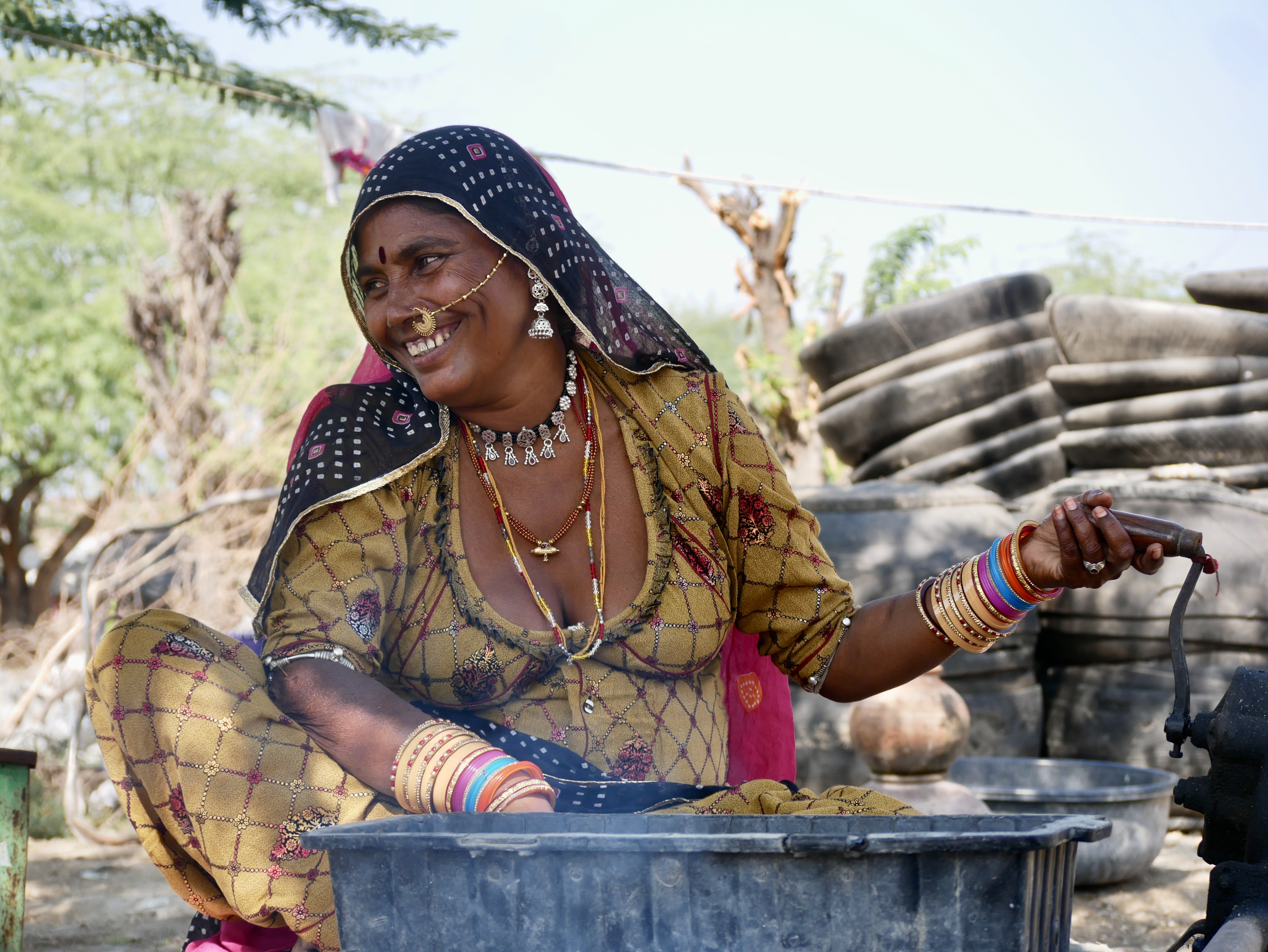
The Bonda women are immediately recognisable. Only partially dressed, they wear a ringa – a short piece of cloth around their waists, while their torsos are covered in a string of colourful beads, as are their shaved heads. Around their necks hang heavy bead necklaces and aluminium bands called khagla and their arms are lined with bangles. When leaving their villages, some of the women wear simple dresses or wrap themselves in a piece of blue cloth for modesty.


The reason for this unique appearance is found in the Hindu epic, the Ramayana. Some Bonda women are said to have mocked the goddess Sita as she was bathing.  Enraged, she cursed them to eternal nakedness and to giving up their hair. When they pleaded for forgiveness, she softened and conceded the waist cloth and beaded jewellery. 


The Bonda are one of the oldest and most culturally distinctive tribal communities in India. They live mainly in hilly areas near Lamptaput and in the Malkangiri district of Odisha. They are believed to have come from Africa, possibly as long ago as 60,000 years. Bonda society is matriarchal, and women dominate and are responsible for the tribe’s economic activity. They are also, in all senses, the senior partner in marriage, taking a boy five to ten years younger as a partner. It is then the woman's role to raise him, and his to look after her when she is older. 


They practise shifting cultivation, growing paddy, millets and maize as well as gathering forest produce. The Bonda men are known for being skilled marksmen and in the past would visit markets carrying bows and arrows. The women make small items of jewellery, decorative items and some textile items which they offer for sale at Onukudelli. 


There are perhaps only 25,000 Bonda in total. Life expectancy is low, and the tribe has been identified as being at risk of extinction. Their unique culture and way of life is also threatened by de-forestation, economic poverty and pressure to assimilate into the Odia language. Several of the tribal communities, including the Bonda, are known to consume significant amount of desi (country) alcohol. At the Onukudelli market, numerous vendors sell mahua, a spirit made from the fermented, sun-dried flowers of the tree of the same name. This mildly sweet alcohol was banned by the British in 1892, but several states have since legalised it and there is even a bottled, premium band nowadays. 


Except for Adi, the women involved in the photoshoot drank throughout the time we spent together – some of them from glasses and some from the dried gourd seen in the photograph above. 


Friday, 27 March 2026

Holy food - A postcard from Odisha.


Bhubaneshwar’s Ananta Vasudeva Hindu Temple, built in the 13th century, is unique in that it is the only one in the old town that is dedicated to Lord Vishnu. Like many Hindu temples, it provides a range of services, including the preparation and distribution of food known as prasad or in Odisha, abdaha. It is the same food served at the Puri Jagannath Temple.


Every day, hundreds of male workers are involved in the delivery, preparation, cooking and then sale of the food. They are drawn from families who have fulfilled these roles for generations and live in the vicinity of the temple. The abdaha is cooked in the temple kitchens and placed in clay pots before it is first offered to the gods and then served at nominal cost to devotees in the adjacent Bhaga Bazar. 


All the food is fully vegetarian and is also made without onions, garlic, potatoes and tomatoes which are not considered Indian in origin. Dishes include kanika, a sweet fragrant rice, yellow in colour and flavoured with clove, cinnamon and clarified ghee. Dalma is a slow cooked lentil and vegetable stew made with very little oil and besara is made with mustard paste, fresh grated coconut and assorted vegetables with a spice mix and a fried crunchy coconut topping. Sweet dishes are also prepared. Everything is served on banana leaves.  


The workers carry the clay pots, either singly on their shoulders, or with several loaded into large baskets and carried on their heads. Everything is transported at great speed as the workers move between different parts of the temple, from delivery point, to kitchen, to the offering to the deities and then to the place of consumption. This labour begins early in the morning and goes on until the food is served between 12.30 and 2pm daily. Amongst those eating are numerous priests, many of whom will have earlier carried out rituals beside the water tank opposite the temple, to mark the death anniversaries of relatives or for other purposes. Hindus come to them with offerings and to be guided through the appropriate pooja (prayers). Some pay for the priests to eat at the temple afterwards.


It is forbidden for outsiders to touch the food during preparation, or to enter the kitchens. If these stipulations are contravened, or if food is spilt, it will be considered contaminated and disposed of. Arrangements can be made for delivery to other locations and small vehicles line the road, ready to fulfil this purpose.


You might also like Phnom Penh - three stories from the alley


Thursday, 11 July 2024

No begging and no prostitution

“My parents said they would accept me on two conditions - no begging and no prostitution. Now I work with NGOs and community members to improve the lives of people like me and I have a good relationship with my family,” said Lavania. We were speaking outside the Koothandavar temple in Koovagam, a small village that attracts up to 200,000 visitors for its annual festival. Like Lavania, many who come to participate in re-enacting the story of the god Aravan, are hijra, sometimes called eunuchs or kinnars. In India they are recognised in law as a third gender. Most adopt female dress and behaviour and traditionally earn a living by collecting alms and giving musical performances at weddings, births and festivals. During the Mughal period some held high positions in court and would be called upon for advice on religious matters or to give blessings during important ceremonies. 

Lavania 

In the Mahabharata, a narbali, or human sacrifice was required to appease the goddess Kali before the start of a war. Aravan volunteered himself but did not wish to die a virgin. The gods Arjuna and Krishna are unable to find a wife for him as no woman wished to become a widow the day after her marriage. Krishna assumed the form of Mohini, a woman, and married Aravan.  The next day the groom was sacrificed to Kali and his body cut into 32 pieces. The goddess then blessed Arjun with victory and  Mohini grieved and followed the rituals of widowhood. The festival re-enacts this story. 

I met Lavania on the first day of the festival when thousands waited to enter the temple to take part in a ceremony that would see them “married” to Aravan. Many were hijra, but perhaps half were villagers including men, women and children. Devotees emerged from the temple wearing bangles and a thali (also known as a mangalsutra), the necklace worn by married women to ward off the evil eye. Outside the temple and in the village streets, crowds gathered to take part in various pooja (rituals) and to receive blessings from the hijra.  Small fires were started and the hijra circled the flames, clapping and chanting in a form of call and response. The villagers watched closely while clutching small gifts and financial donations to give in return for advice and blessings. 

Waiting to enter the temple to marry Aravan

Village craftsmen receiving blessings for a hijra guru

Other pooja involve animal sacrifice. A group of men arrived leading a young goat to the open ground outside the temple. A small crowd gathered around to watch a priest as he covered the goat with turmeric and said prayers over it. When the prayer was finished, one of the men stepped forward and slit the goat’s throat. It struggled for a moment and was then still, its blood spreading on the ground. I was assured that this was an honour for the goat who would be reincarnated as a higher being.

The conditions laid down by Lavania’s family may seem strange, but they reflect the lives of many of the community, who unable to secure employment, make a living by begging in the street or through prostitution. Very slowly this is changing, and Lavania is one of a growing number of hijra who now work in mainstream jobs. In Mumbai I met community members working in catering and as beauticians. One was a law student. The day before the festival began I met Suganiya who said: “I have a job, I work in an office.” She agreed to be photographed but asked: “Shall I change my sari first?” “No need,” I replied, “You look fine as you are.”

Suganiya

The first day of the festival was joyful and the mood celebratory. In the morning and early afternoon the craftsmen of four local villages continued their work on making an idol to represent Aravan. Each village makes different sections of the god which are then assembled and mounted on a wooden chassis. I watched the Koovagam artisans painting their section. One of the temple priests encouraged them to: “make it beautiful.” In the evening there were theatrical performances, concerts, a fair, fashion shows and a beauty contest. The crowds made it impossible for vehicles to reach the village and participants had to walk a few kilometres along a dusty road to get there. I spent some time watching a talent show. Hijra performers sang and danced to popular film songs, cheered on by an audience of thousands. Reporters from local radio and television stations filmed the activity and carried out interviews amongst the crowd. 

The second day was more emotional. The crowds grew bigger and the narrow village streets became harder to negotiate. Dozens of devotees pulled the idol, stopping every hundred metres or so, as people called on the priests to shower them with garlands, dropped from the pinnacle.  Parents surged forward to hand babies and small children up to the priests who gave blessings before carefully passing them back down. The road is uneven and when the idol rocked precariously from side to side, the crowds pressed back against houses to avoid being crushed. Hundreds of police officers were on duty to maintain order, the size of the crowd, their religious fervour and the extreme heat (it was 43 degrees and humid) making their work harder. Despite this, they remained calm, and the crowd co-operative. “There won’t be a lathi (baton) charge today,” said Vinodkumar, my guide and interpreter.

The idol being pulled through the village

Calling for blessings from the idol

“My husband must go to war, he is a great warrior"

Many people left the chaos of the street and took refuge on the rooftops. At one home the residents invited me to join them. Their roof was almost level with the head of the idol. Down below, the hijra continued to sing, dance and perform pooja.  One group circled a fire, clapping, alternately leaning towards and away from the flame and  singing a song about Aravan: “My husband must go to war, he is a great warrior, but I don’t want him to fight, I too have many qualities, he should stay at home with me.” Others threw pieces of coconut into a fire and said prayers over them. The villagers edged closer to the flames and when the chanting was finished, some leaped forward, hoping to pull pieces of coconut from the fire, believing they will bring prosperity and protection. Coconuts featured in another pooja. A hijra guru said prayers over a flame, then her followers aggressively hurled the fruit at the ground, in the belief that they were destroying negative energy. Again, the crowd tried to gather the pieces, the pushing and shoving causing several to fall to the ground. 

For a while I remained on the roof, photographing the activity below. Someone call out in English: “Hey camera man! Take my picture!” I looked for the source of the request and saw a hijra looking up, lips pursed and hands on hips. As I pointed the camera, others began calling out, posing, blowing kisses and making heart shapes. The crowd cheered. When I came down from the roof someone else called out with a different request. “Buy me an ice-cream,” said Ramiya, who sat in the shade rubbing her feet. “What flavour do you want? Come with me and choose,” I replied. “Any flavour will do. My feet are too sore to walk,” she said. A vendor was offering ice-cream on a stick for a few rupees. I bought two for Ramiya, who then posed for a portrait.
I left Ramona and followed the procession of the idol out of the village and into the fields. The rough ground made its progress even less stable and at one point the police became more rigorous, forcing the crowds to one side for their own safety. The idol would soon be destroyed - re-enacting the death of Aravan. Those who had married the god the previous day, broke their bangles and waited in line for a priest to cut the thali from their neck, leaving the ground covered with symbols of widowhood

“Hey camera man take my picture"
Broken bangles and discarded thalis

During the second day, some of the hijra changed their clothes, donning the white sari customary of Hindu widows. Shenpagavali wore a white sari and asked me to photograph her, before telling her story: “I am 72 years old and I come from Kanjipuram village. I lived with a man for fifty years but he died last year and now I am alone. There were 12 children in my family. After my father died I came out. My family accept me and some of them came to the festival with me. I make a living by collecting donations at local shops and by doing small jobs for an NGO. People don’t give me trouble. I do not drink, smoke or take part in sexual activities. I come to the festival every year to pray that next year will be better. I studied to grade 12 but left home at 12 years of age. My guru has 20 chelas (students), but I don’t have any followers.” I saw Shenpagavali again later that day. As I left the village for the final time, I looked back and saw her. She had changed back into colourful clothe and danced alone to the music being played in the temple grounds.

Shenpagavali 


You might also like - Hijras of Shyampur

Sunday, 28 January 2024

Sleepless in Churu - Maharaja Ganga Singh

Seven years ago, I spent two nights in a room where every surface was covered with brightly coloured murals. Rather than sleeping, I lay in bed staring at them for much of the night. The works of art covered the walls and ceiling of Maharaja Ganga Singh's windowless room in Malji Ka Kamra, in Churu, Rajasthan, a once neglected haveli, lovingly restored as a hotel. The haveli was built in 1920 by Malji Kothari, a Jain merchant, and used by the Maharaja whenever he visited the town. It was also the setting for many important gatherings involving royalty, prominent merchants and British officers. 

I didn't think much more about the Maharaja until recently, when doing research for another writing project, I discovered that Sir William Orpen's 1919 painting of him is exhibited in the  National Portrait Gallery in London. The gallery caption referred to his distinguished military career, but Ganga Singh was also an accomplished linguist, reformer and politician. 


Maharaja Ganga Singh of Bikaner, by Sir William Orpen, 1919.


Ganga Singh ruled the former princely state of Bikaner from 1888-1943. He became Maharaja at eight years of age, when his brother died without leaving a male heir. The young royal studied at Mayo College in Ajmer - sometimes referred to as the Eton of India - where he received a western education. He was a talented student, excelling in English, speaking the language flawlessly and always winning first prize in this subject. In later life he liked to tell jokes and anecdotes while speaking in a Cockney accent. At fourteen, he left the college to study under a tutor who helped him develop riding and shooting skills and an understanding of the British system of government. In his free time, he enjoyed sports including cricket and roller skating.


The Maharaja replaced a British appointed regent in 1898, assuming full duties at the age of eighteen. Almost immediately he was met with a crisis as famine, cholera and smallpox struck his subjects. Thousands died and many others fled to the more verdant Punjab. Ganga Singh's response was to modernise his state, borrowing money to finance nine irrigation projects, two railway lines and three roads, as well as medical relief centres and the provision of interest free loans to farmers. These projects also provided much needed employment for his subjects. In 1927 his public works programme culminated in the opening of the Ganga Canal. This involved the conversion of one thousand kilometres of desert into green fields, enabling five hundred new villages to be established on previously uninhabitable land. 


His reputation as a reformer was further enhanced by his establishing a representative assembly in 1913, a High Court system in 1922 and a series of financial benefits for his employees including life insurance. He also set up a savings bank for ordinary citizens, outlawed child marriage, introduced prison reforms and established several institutions including educational facilities for women. His commitment to education was recognised in 2003 when the University of Bikaner changed its name to Maharaja Ganga Singh University. 


The Maharaja also had a distinguished military career. He founded the Bikaner Camel Corps, a force of five hundred men, that became known as the Ganga Risala. After he offered their service to the British, the Corps saw action in China during the Boxer Rebellion of 1900 and in Somaliland in 1902-1904. They also served in the First World War, and in 1915, routed Turkish forces at Suez in Egypt. Ganga Singh was much admired by the British and became a member of the Imperial War Cabinet. In 1919 he was a signatory of the Treaty of Versailles and from 1924 he represented India at the League of Nations. During this period, the movement for Indian independence gained momentum.  The Maharaja, although on good terms with the colonial authorities, also desired greater autonomy, but feared the end of the Princely State system in an independent India ruled by the Congress Party. He preferred a federal approach, combining independence with the retention of his princely powers. He failed to gain support for this approach and  after Independence, Bikaner and the other states were absorbed into a unified India.


The Maharaja’s military status and contribution was immortalised by Sir James Guthrie in another painting held by the National Portrait Gallery - Statesmen of World War One. In an imagined scene, Ganga Singh appears with the Prime Ministers of Australia, Canada, New Zealand, Newfoundland and South Africa. The then British Prime Minister, Lloyd George is also present, as are others who at one time or another fulfilled that role - Arthur Balfour, Winston Churchill, Andrew Bonar Law and Herbert Asquith. Back in Churu, his image appears on the exterior walls of the Parekh haveli, built in 1925. The murals show him using various forms of transport including a Rolls Royce and a horse drawn carriage. 


The Maharajas were famed for their lavish lifestyle and for entertaining. Ganga Singh was no exception, always well turned out, he took particular care with his facial hair. One courtier is quoted as saying: "Every day after a bath, for at least ten minutes, he set his moustache with a very fine elastic netting." Furthermore, after getting dressed, he would, "...go to the room where his shoes were all in a row, and he would pick up a long pointer like you have in school. He would just touch one of the shoes with it and that pair would be polished and brushed." Despite his love of stylish clothes and liberal approach to social matters, he held conservative attitudes about family. His wives never appeared in public without wearing full purdah and no photographs of them exist.


Ganga Singh also served opulent dinners. In his controversial book, Passion India: The Story of the Spanish Princess of Kapurthala, Javer Moro claims that when asked for the recipe of a particular dish, the Maharaja said: “Prepare a whole camel, skinned and cleaned, put a goat inside it, and inside the goat a turkey and inside the turkey a chicken. Stuff the chicken with a grouse and inside that put a quail and finally inside that a sparrow. Then season it well, place the camel in a hole in the ground, and roast it.” Clearly, camels played a significant part in the Maharaja’s life, both on the battlefield and on the dining table. Moro's book is a fictionalised version of the diaries of Anita Delgado. The Maharaja of Kapurthala fell in love with her when he saw her dancing in a Madrid café. She travelled back to India with him, changed her name to Prem Kaur and became his fifth wife. 


Ganga Singh did not live to see Independence. In his role as a full General of the British Army, he offered to go to the front in 1939 at the outbreak of the Second World War. He was rejected due to his age, but did see active service in the Middle East in 1941. Within a year, he had returned home, diagnosed with a terminal cancer to which he succumbed on the second of February, 1943. He is still remembered for his reforms and achievements, not only in Bikaner, but also in London's National Portrait Gallery.

Monday, 6 November 2023

"This peacock tattoo will take me to heaven" - The Gadia Lohar of Rajasthan

My first encounter with the Gadia Lohar was short and unexpected. On the road from Delhi to Churu in Rajasthan, camera in hand, I got out of the car, to stretch my legs. A man working at the side of the road jumped up and ran towards me, shrieking, whooping and shaking his ample belly from side to side. My driver, Naresh, horrified, told me to get back into the car. It was my first time in India, so I did as I was told and we drove off. “What was that about,” I asked him. He replied, “He has some problem sir,” and left it at that. He later explained that the man was a Gadia Lohar, a nomadic blacksmith. Lohar is the Hindi word for blacksmith, and gadia means cart - their means of travel, and their home while on the road.

Gadia Lohar woman winding the bellows, Pachewar

The five vows of the Gadia Lohar

Until 1568, the Gadia Lohar were a settled people, producing weapons for the Maharana of Mewar's army. In that year, Maharana Pratap Singh was defeated by the invading Mughals at the Battle of Chittorgarh and was forced to flee. In a show of loyalty, the Gadia Lohar also left, vowing not to return until Chittorgarh was retaken. They also vowed not to live in a house, sleep in a bed or draw water from a well and began to live the life of itinerant workers. Pratap Singh never did retake the city and they remained nomadic, traveling from place to place on their bullock carts in search of work. In 1955, Pandit Nehru visited Chittorgarh and in a filmed ceremony, released them from their vows. Despite this, many Gadia Lohar are still not settled and live in makeshift camps, at risk of being moved on with little or no notice.

Rajasthan has many diversions and I forgot about the man at the side of the road, until during one of the covid lockdowns, I discovered the Netflix documentary India's Forgotten People. Deana Uppal, a reality TV contestant turned actress and filmmaker, curious about the Gadia Lohar, befriended a group camped near Jaipur. Her film shows their problems, traditions and way of life. It also exemplifies the widespread discrimination they face. In Jaipur, when she asks about meeting them, she is warned that the Gadia Lohar are dangerous criminals and should be avoided. She later discusses their plight with officials, who although polite, fail to address any of the issues she raises with them.  

"It is hard to make a living from this work"

More recently, I met Gadia Lohar communities in Rajasthan, in Deboli and near Pachewar. The Deboli group were camped on rough ground in the centre of the city. A couple were working at the entrance to the camp, the woman winding the bellows while her husband did the hot work, heating the metal. They then worked together, wielding hammers to mould the red-hot items into shape. They toiled without protective gear, in thirty-five degrees of heat, inhaling the thick smoke from their small furnace. They make tools, knives and other kitchen implements for sale in the street, but cannot compete with the cheap, mass produced items available in the markets. An elderly man, one half of a married couple who came to speak to me said, "We are skilled but these days it is hard to make a living from this work. Our ancestors produced weapons but today people don't want the things we make." 

He put on his best turban for a photograph, Deboli

The Deboli group had an additional problem. They claim to have lived in this location for many years but admitted that it is an unofficial settlement. The authorities want to develop  the site and have told them to leave. He also said, "Some people have already gone to the new place, but it is not big enough for all of us and there is not enough money to build houses for everyone." Those that remained were living in tents, some large enough to accommodate an extended family and their cart. One resident proudly showed me his family's gadia, “It is fifty years old,” he said as he pointed out the brightly coloured, hand-painted decorative patterns on its sides.  

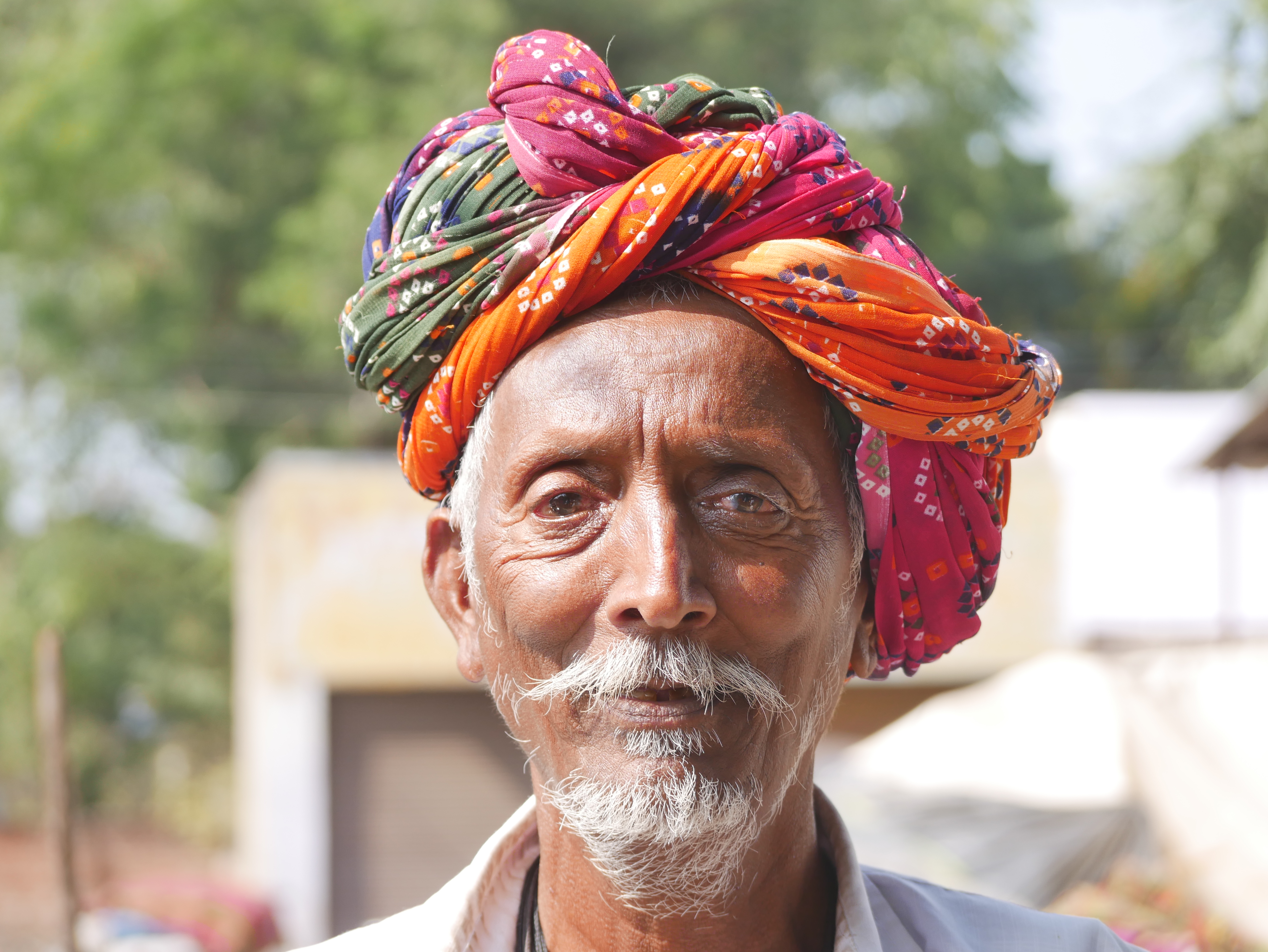
Before I left, I photographed the elderly man and his wife, but not before, at his insistence, he put on his best turban, replacing the gamcha (workers' scarf) he had been wearing when I arrived. His wife pulled her dupatta (scarf used to cover head and shoulders) further forward on her forehead and pointed out her bhanvaria (nose ring) and tattooed earlobes to me. Once ready they stood side by side, very formal, him extremely tall and her, petite. I also took individual portraits of them.

Gadia Lohar woman in Deboli, wearing the bhanvaria (nose ring) and traditional jewellery

"This peacock tattoo will take me to heaven"

I met Shankar Gadhia Lohar at a tea stall in Pachewar, a village of about nine thousand people, one hundred kilometres from Jaipur. He invited me to his settlement where he lives with his extended family, just a few kilometres away. Shankar makes kitchen utensils and small ornamental items which he then sells at the side of the road. I bought a colander from him for 50 rupees (about 50 pence), which came in useful when I visited a Bhand community on the opposite side of the road. 

Shankar is not the only craftsman in the family. His older brother, Hanuman, is an accomplished metalworker whose work has attracted awards and media attention. He has a workshop on Pachewar's main street where visitors are offered tea and snacks, but where there was no pressure to buy. His wife and daughter-in-law work with him and at the time of my visit, his children were quietly doing their homework after school. Hanuman concentrates on producing art works and I came away with two small pieces - a camel and a snake. 

One of the older women in the settlement had facial tattoos. I asked if they had a meaning. "No, no, they are just for fashion," said one of the younger men. On hearing this, the woman, who until that point had been silent, became very animated and contradicted him. "They protect us against misfortune," she said, "and this peacock tattoo will take me to heaven." She also explained that the jewellery Gadhia Lohar women wear, acts as a deterrent to the evil eye. When she finished speaking, Shankar introduced her to me as his mother.

Hanuman, Gadia Lohar artisan, Pachewar

"I used to work as a day labourer to pay for my schooling"

While Shankar's mother was speaking, Sangram Singh Gadia Lohar arrived. We drank tea together and he spoke about his efforts to secure educational opportunities for his community. He said, “I used to work as a day labourer to pay for my schooling. I completed higher secondary education and then worked for an organisation that trains people in community development. I started an open-air school for our children, but it is difficult to get regular attendance as most of the parents are uneducated and do not understand why school is important.” He also spoke about the difficulties of finding somewhere to settle, and said, “I have worked very hard to persuade the authorities to give small parcels of land so that we can build our own houses. The problem is that although we are told we can build on the land, we do not receive documentation. This means we can be moved on at short notice.” 

Sangram said, “Our traditional way of life is no longer sustainable. The young people need to be educated, to develop new skills, or to adapt our traditional craft in the way Hanuman and Shankar have.” While he was speaking a small boy came out of one of the tents. After playing with a tyre for a few minutes, he opened his father’s toolbox, took out a hammer and began hitting a charpoy (day bed), imitating the adults working nearby. I asked his father if the boy will go to school. He smiled and said, “I don’t know.”

"Will he go to school?" I asked.

You might also like "What have you brought me?" - an encounter with the Band in Rajasthan

Tuesday, 14 November 2017

A Postcard From India - 9 Cochin, people at work.

Cochin was the final stop on my recent tour of India. It had a different pace and feel to the huge cities further, less crowded and more relaxed. But there was at least one similarity and that was the warm hearted welcome of the people in the street, in the cafes and at their place of work.

In Cochin I met people from many different backgrounds. I met fishermen whose families have worked here for generations, people working in the Dhobi Khana in Fort Cochin, women working in weaving and pappadum co-operatives and merchants selling all kinds of fruit and vegetables in the bazaar at Ernakulam. And of course, there were chance encounters with people in the street. As elsewhere in India, people were happy to stop, talk, offer tea and to be photographed.

Husband and wife ironing team, Dhobi Khana
Washerman, Dhobi Khana
Mumbai's Dhobi Ghats (laundries) are well known and attract many visitors from around the world. Less well known, but just as interesting is Cochin's Dhobi Khana. This is where hotels, hospitals and private homes can send their laundry to be dealt with in the traditional way. The current site was established in 1976 by the Greater Cochin Development Authority but the laundry dates from the colonial period when the British brought Tamil villagers here to work as washermen.

The Khana has separate sections for washing, drying and ironing. Items are first soaked in water and a light detergent before being beaten on stones, rinsed, dried and ironed. There are 40 "pens" in which the washing takes place, each pen being allocated to a separate family. The washing is normally done by men whilst both men and women iron and women look after the drying. Some of the charcoal irons used were originally brought from Sri Lanka, several decades ago, their continued use a testament to their durability. Drying takes about five hours and the items are hung without the aid of pegs, instead they are tucked between the ropes so that the wind cannot carry them away. Rice water is used for items that require starching.

Despite the work being hard, several older people are still employed here. This may in part be because the younger generation are drifting away from this type of work and finding employment elsewhere. The laundry also competes with technology as more and more hotels, hostels and hospitals have their own automated facilities. The people I met were friendly and used to visitors coming to see their pace of work. When asked if they would mind being photographed, some of them assumed quite formal poses. There were of course exceptions - including the wife of the serious looking man in the blue shirt. She found it all amusing!

Babu!
One of the most rewarding things about traveling are chance encounters with people in the street. After visiting St. George's Orthodox Church in Mattanchery, I noticed a single storey house painted in pastel colours, with a split "saloon style" door, what appeared to be a drop down counter and the remnant of two posters. I took a couple of pictures and a face appeared at the open upper part of the door. A young man waved, called hello and indicated that he would like to be photographed. I went across to him, managed to exchange a few words and then took the picture above. He told me his name is Babu. He was very pleased to be photographed. 

Similarly, when walking in Synagogue Lane, I noticed an elderly man dressed in a crisp white t-shirt and brightly coloured lungi. This was Hamid, aged 82 and still working as a cycle rickshaw driver. His rickshaw was parked outside one of the restaurants on the Lane whilst he sheltered from the afternoon heat and waited for his next customer. I learned that he has a family that take care of him but that he wants to continue working and to maintain some independence. He was clearly proud of his elegant and very well kept rickshaw.

It is not unusual to meet people who work into their old age in India. Many continue to work in family businesses whilst others work independently in order to maintain themselves. I saw several older women working in the streets selling lottery tickets including the lady dressed in purple pictured below.

Hamid, cycle rickshaw driver
Lottery ticket saleswoman
Many of the people I met earn a living from selling food in the street or in cafes and restaurants. The bazaar at Enrkulam is full of colour, aromas and noise. Here you can find brightly coloured spices, home made pickles, countless types of garlic and onions, every kind of fruit and vegetable you could think of and lots more. There are also different kinds of banana for sale . I spotted a store room door left open and was fascinated by the shapes of the bunches of green bananas pointing outwards and the contrast with the red walls of the shop. Whilst photographing this, the merchant asked me to wait a moment, retreated to the rear of the shop and then came back with a huge bunch of bananas that he proudly held up for another picture. The merchants here and at other markets in India were very proud of their fresh produce and several would hold up their best stock to show me and to pose for a picture.

Proud of the produce, Ernakulam bazaar
Weighing bananas, Ernakulam bazaar
Lime seller, Ernakulam bazaar
It was towards the end of the day when I arrived at the bazaar and some of the merchants were beginning to wind down and relax after a long day of selling. I noticed three men sitting in the shade, baskets of limes at their feet. The wall behind them was plastered with posters announcing a political conference, some of which featured pictures of Stalin who could also be seen in a framed painting at the top of the wall beside portraits of Lenin, Marx and other Communist luminaries. Private enterprise meets socialism in the market place. I especially wanted to photograph these men because of the backdrop, the way the light fell across their crisp white clothing and the gentle face of the man beneath the Stalin poster.

Under the posters, Ernakulam bazaar
The Sree Venkateshwara tea shop in Parur was one of my favourite places in Kerala. As well as tea, the shop sells tasty hot snacks and treats, all of them prepared on the premises using local produce. I visited on a Saturday morning and the shop was full with local people enjoying the tea, snacks and the chance to catch up on news with friends and family. One of the staff asked me where I was from and how I liked the tea before inviting me to look around behind the scenes where I saw chapatis being made, vegetables being peeled and curries being prepared for the hungry customers. I was also given free rein to take as many pictures as I liked. Some of the staff found this very amusing, especially when their friends were being photographed but all were interested in seeing themselves on the camera and I was able to arrange for them to receive copies of the pictures later on. Perhaps the star of the show was the man making the tea who pulled an impossibly long flow of liquid between the pot and a jug

Pouring the tea, Sree Venkateshwara tea shop Parur
In the kitchen, Sree Venkateshwara tea shop, Parur
Keeping an eye on things, Sree Venkateshwara tea shop, Parur
Sree Mahila Thejas Pappad
There are several co-operatives in Kerala, organisations where people work together for mutual social, economic and cultural benefit. The co-operatives are mutually owned and democratically organised. I visited two such organisations in Cochin, both of them run by and for women. Sree Mahila Thejas Pappad produces many different types of papad, also known as pappadums, the thin, disc shaped food usually made from black garam flour, fried or cooked with dry heat. Fans of Indian food will have enjoyed them with pickles whilst waiting for their man courses to come to the table.  This co-operative produces, packs and distributes thousands of papad every day, including deep red ones, filled with chilli and sweeter banana chips. I left the co-operative with several purchases to enjoy on my return to London.

I visited a second women's co-operative, one where many women are employed in weaving. The co-operative trains local women to use traditional hand-operated looms to produce garments and household goods in order to be able to make a living.

Weaving co-operative
Chinese nets fishermen
Frying fish straight from the waterside
Kerala is famous for its cuisine which includes many dishes made from locally caught fresh fish. The Chinese fishing nets of Cochin are one of the area's special attractions. The nets are attached to fixed land installations set up on bamboo and teak poles held horizontally by large mechanisms that lower them into the sea. The nets are left in the water for a short time before being lifted out by the fishermen pulling on ropes. Legend has it that the nets were introduced to the area by an explorer, one Zheng He,  who came from the court of Kublai Khan. For a small fee, the fishermen will show tourists how the nets work as well as giving them the chance to help pull the ropes. There are also independent fishermen who work with less sophisticated but still traditional methods, standing in the sea and casting nets by hand.

Every evening, the fishermen come to a small jetty in Cochin where the daily catch is auctioned. A crowd quickly gathers and the sale proceeds apace. It is not unusual for the purchased fish to be taken directly to one of the street food stalls adjacent to the water and then cooked immediately. You can't get any fresher than that.


You might also like A Postcard from India - 6, Calcutta - the people in the street or A Postcard from India - 8, Jewish Kerala

You can see more pictures from India here.