Showing posts with label Hijra. Show all posts

Thursday, 11 July 2024

No begging and no prostitution

“My parents said they would accept me on two conditions - no begging and no prostitution. Now I work with NGOs and community members to improve the lives of people like me and I have a good relationship with my family,” said Lavania. We were speaking outside the Koothandavar temple in Koovagam, a small village that attracts up to 200,000 visitors for its annual festival. Like Lavania, many who come to participate in re-enacting the story of the god Aravan, are hijra, sometimes called eunuchs or kinnars. In India they are recognised in law as a third gender. Most adopt female dress and behaviour and traditionally earn a living by collecting alms and giving musical performances at weddings, births and festivals. During the Mughal period some held high positions in court and would be called upon for advice on religious matters or to give blessings during important ceremonies. 

Lavania 

In the Mahabharata, a narbali, or human sacrifice was required to appease the goddess Kali before the start of a war. Aravan volunteered himself but did not wish to die a virgin. The gods Arjuna and Krishna are unable to find a wife for him as no woman wished to become a widow the day after her marriage. Krishna assumed the form of Mohini, a woman, and married Aravan.  The next day the groom was sacrificed to Kali and his body cut into 32 pieces. The goddess then blessed Arjun with victory and  Mohini grieved and followed the rituals of widowhood. The festival re-enacts this story. 

I met Lavania on the first day of the festival when thousands waited to enter the temple to take part in a ceremony that would see them “married” to Aravan. Many were hijra, but perhaps half were villagers including men, women and children. Devotees emerged from the temple wearing bangles and a thali (also known as a mangalsutra), the necklace worn by married women to ward off the evil eye. Outside the temple and in the village streets, crowds gathered to take part in various pooja (rituals) and to receive blessings from the hijra.  Small fires were started and the hijra circled the flames, clapping and chanting in a form of call and response. The villagers watched closely while clutching small gifts and financial donations to give in return for advice and blessings. 

Waiting to enter the temple to marry Aravan

Village craftsmen receiving blessings for a hijra guru

Other pooja involve animal sacrifice. A group of men arrived leading a young goat to the open ground outside the temple. A small crowd gathered around to watch a priest as he covered the goat with turmeric and said prayers over it. When the prayer was finished, one of the men stepped forward and slit the goat’s throat. It struggled for a moment and was then still, its blood spreading on the ground. I was assured that this was an honour for the goat who would be reincarnated as a higher being.

The conditions laid down by Lavania’s family may seem strange, but they reflect the lives of many of the community, who unable to secure employment, make a living by begging in the street or through prostitution. Very slowly this is changing, and Lavania is one of a growing number of hijra who now work in mainstream jobs. In Mumbai I met community members working in catering and as beauticians. One was a law student. The day before the festival began I met Suganiya who said: “I have a job, I work in an office.” She agreed to be photographed but asked: “Shall I change my sari first?” “No need,” I replied, “You look fine as you are.”

Suganiya

The first day of the festival was joyful and the mood celebratory. In the morning and early afternoon the craftsmen of four local villages continued their work on making an idol to represent Aravan. Each village makes different sections of the god which are then assembled and mounted on a wooden chassis. I watched the Koovagam artisans painting their section. One of the temple priests encouraged them to: “make it beautiful.” In the evening there were theatrical performances, concerts, a fair, fashion shows and a beauty contest. The crowds made it impossible for vehicles to reach the village and participants had to walk a few kilometres along a dusty road to get there. I spent some time watching a talent show. Hijra performers sang and danced to popular film songs, cheered on by an audience of thousands. Reporters from local radio and television stations filmed the activity and carried out interviews amongst the crowd. 

The second day was more emotional. The crowds grew bigger and the narrow village streets became harder to negotiate. Dozens of devotees pulled the idol, stopping every hundred metres or so, as people called on the priests to shower them with garlands, dropped from the pinnacle.  Parents surged forward to hand babies and small children up to the priests who gave blessings before carefully passing them back down. The road is uneven and when the idol rocked precariously from side to side, the crowds pressed back against houses to avoid being crushed. Hundreds of police officers were on duty to maintain order, the size of the crowd, their religious fervour and the extreme heat (it was 43 degrees and humid) making their work harder. Despite this, they remained calm, and the crowd co-operative. “There won’t be a lathi (baton) charge today,” said Vinodkumar, my guide and interpreter.

The idol being pulled through the village

Calling for blessings from the idol

“My husband must go to war, he is a great warrior"

Many people left the chaos of the street and took refuge on the rooftops. At one home the residents invited me to join them. Their roof was almost level with the head of the idol. Down below, the hijra continued to sing, dance and perform pooja.  One group circled a fire, clapping, alternately leaning towards and away from the flame and  singing a song about Aravan: “My husband must go to war, he is a great warrior, but I don’t want him to fight, I too have many qualities, he should stay at home with me.” Others threw pieces of coconut into a fire and said prayers over them. The villagers edged closer to the flames and when the chanting was finished, some leaped forward, hoping to pull pieces of coconut from the fire, believing they will bring prosperity and protection. Coconuts featured in another pooja. A hijra guru said prayers over a flame, then her followers aggressively hurled the fruit at the ground, in the belief that they were destroying negative energy. Again, the crowd tried to gather the pieces, the pushing and shoving causing several to fall to the ground. 

For a while I remained on the roof, photographing the activity below. Someone call out in English: “Hey camera man! Take my picture!” I looked for the source of the request and saw a hijra looking up, lips pursed and hands on hips. As I pointed the camera, others began calling out, posing, blowing kisses and making heart shapes. The crowd cheered. When I came down from the roof someone else called out with a different request. “Buy me an ice-cream,” said Ramiya, who sat in the shade rubbing her feet. “What flavour do you want? Come with me and choose,” I replied. “Any flavour will do. My feet are too sore to walk,” she said. A vendor was offering ice-cream on a stick for a few rupees. I bought two for Ramiya, who then posed for a portrait.

I left Ramona and followed the procession of the idol out of the village and into the fields. The rough ground made its progress even less stable and at one point the police became more rigorous, forcing the crowds to one side for their own safety. The idol would soon be destroyed - re-enacting the death of Aravan. Those who had married the god the previous day, broke their bangles and waited in line for a priest to cut the thali from their neck, leaving the ground covered with symbols of widowhood

“Hey camera man take my picture"
Broken bangles and discarded thalis

During the second day, some of the hijra changed their clothes, donning the white sari customary of Hindu widows. Shenpagavali wore a white sari and asked me to photograph her, before telling her story: “I am 72 years old and I come from Kanjipuram village. I lived with a man for fifty years but he died last year and now I am alone. There were 12 children in my family. After my father died I came out. My family accept me and some of them came to the festival with me. I make a living by collecting donations at local shops and by doing small jobs for an NGO. People don’t give me trouble. I do not drink, smoke or take part in sexual activities. I come to the festival every year to pray that next year will be better. I studied to grade 12 but left home at 12 years of age. My guru has 20 chelas (students), but I don’t have any followers.” I saw Shenpagavali again later that day. As I left the village for the final time, I looked back and saw her. She had changed back into colourful clothe and danced alone to the music being played in the temple grounds.

Shenpagavali 


You might also like - Hijras of Shyampur

Sunday, 2 April 2023

The Hijras of Shyampur

It took a little time to find Miss Bobby’s home. It was behind one of Shyampur's main streets, down a narrow, litter strewn alley on a raised platform with several other houses. All of them consisted of a single room constructed from corrugated metal. I later learned that the platform is to protect the homes from the sewage that sometimes comes to the surface during the monsoon.

Miss Bobby was not feeling well. She sat on her bed, arms folded. Her hennaed hair was swept back and tied into an austere bun. She is the guru or leader of a group of Hijra (third gender) living in Dhaka’s Shyampur neighbourhood. She is also the founder of Susto Jibon – an NGO that focuses on health and human rights for third gender people. She greeted us with an almost imperceptible nod and said, “hello,” in English. Like Munaji in Delhi, she was at first a little cold and understandably suspicious but began to warm when I asked her about the NGO. She said, “I started it in 2000. I could see that the community needed somewhere to go for help and information. We began by offering advice on safe sex and giving out free condoms, lubricant and medicines. Our work has developed over the years and now we also do blood tests, run community workshops and teach craft skills.”

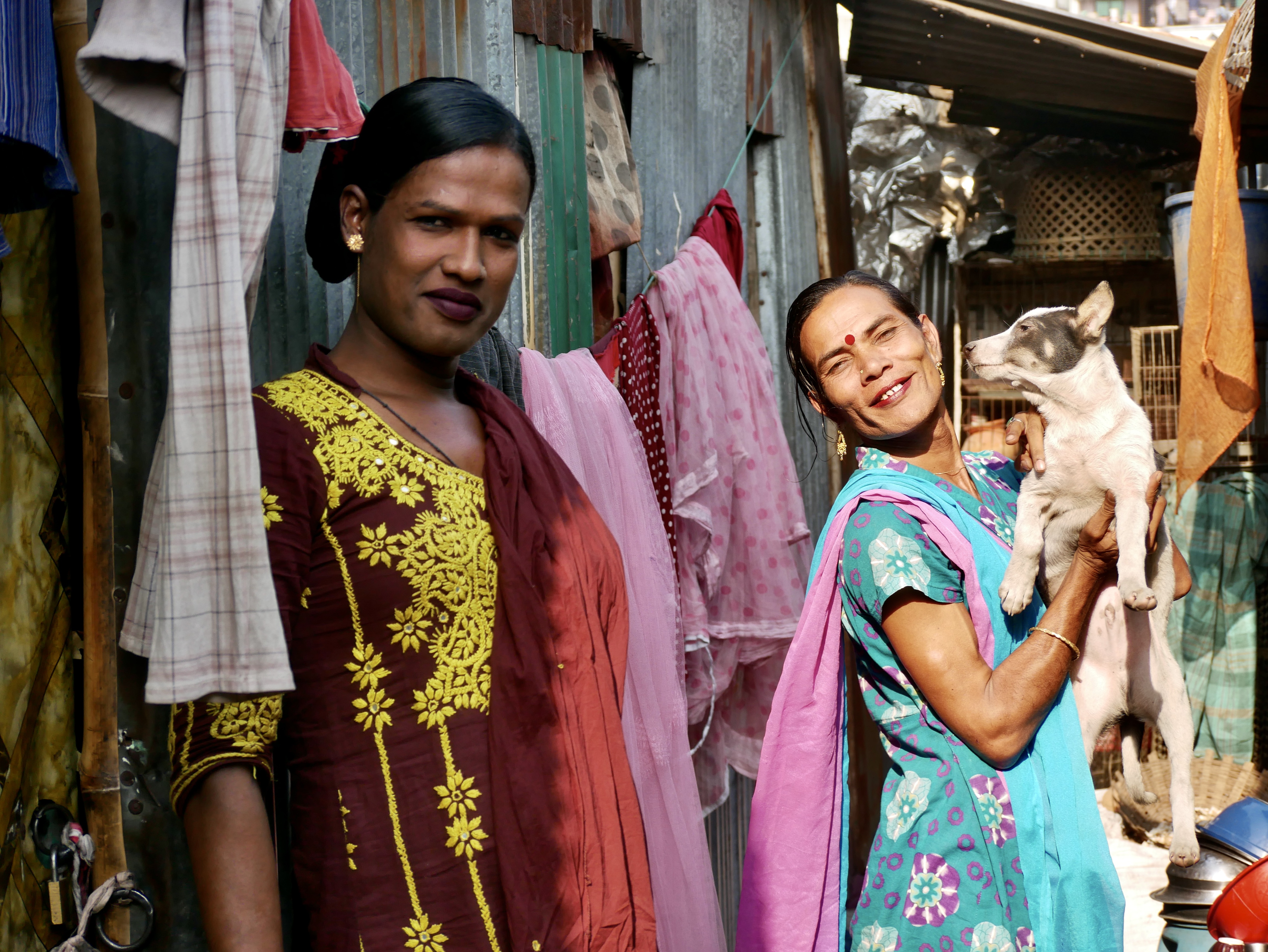
Sanjeeda and Meryl (holding her pet dog)

I asked her about her own story. She said, “I am 60 years old. I joined the community about 40 years ago and have been leading it for the last 15-20 years. I realised I was not like other boys when I was seven or eight. I didn’t need to tell my family as they could see it for themselves. They were not pleased. My father, who was a government worker would become very angry and beat me.” She paused briefly and then continued, “I felt very sad and lonely but then I saw a group of Hijra performing in the street, singing and dancing.  I wanted to join them. Now I am the leader of that community.”

While we were speaking two of her followers came into the room and listened to our conversation which was conducted in a mixture of English, Hindi and Bangla and with the help of a translator. Meryl and Sanjeeda are two of the 3-400 Hijras living in this area. I asked Miss Bobby if the neighbours are accepting of them. She said, “We have been here for ten years now, and our neighbours do not trouble us. It wasn’t like this in the past, but today we are accepted and sometimes we are called upon to make peace between couples who are fighting or quarrelling.” 

Meryl and Sanjeeda also shared their stories. Sanjeeda is 36 and was born in Shyampur. Like Miss Bobby, she understood that she was different at an early age and although her parents were accepting of her, the neighbours were not. She said, “they would come to our house and say to my father ‘we don’t want your son to play with our children, keep him away’.” She continued, “my father is dead now. My mother lives with me.” She eventually found her way to the Susto Jibon office, and after receiving help and advice, joined the community.

I asked about her experiences at school, but she said, “I only completed class one. I cannot read or write.” Like the other community members, Sanjeeda collects donations from shops and people in the street and performs and gives blessings at weddings and on the birth of a new baby. I wondered how people respond to their requests for alms. “Some people are kind and give money, but others shout at us and tell us to get work. We sometimes get attention from religious people. They say very bad things to us,” she said, and then added, “I usually collect as part of a group, so I am not afraid.” 

Meryl plays up for the camera

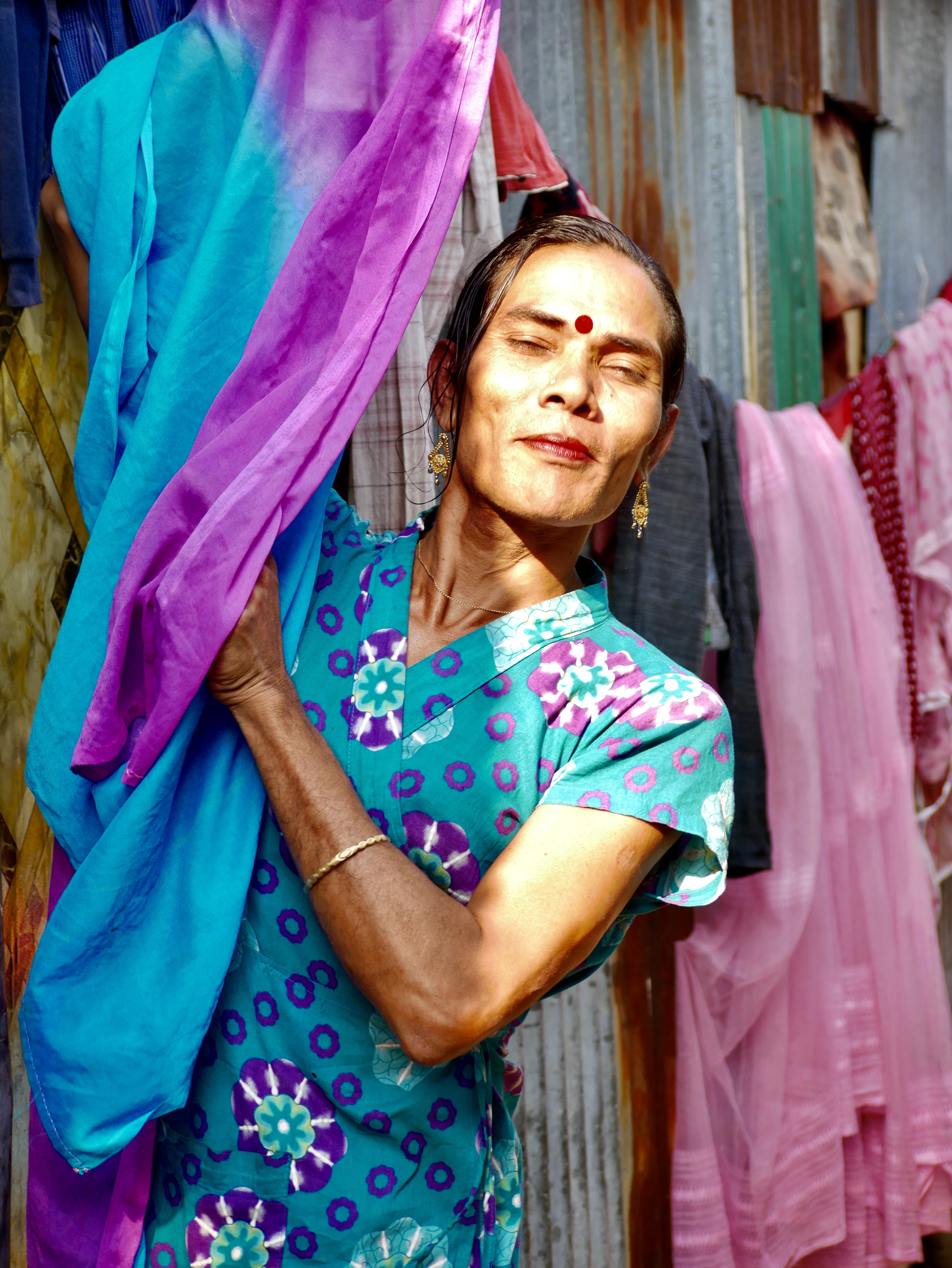
Meryl is 42 and of striking appearance. Her hair was pulled back, emphasising her high cheekbones and she wore a large bindi between her eyebrows. She was born in Old Dhaka, one of ten children in a family where the father had two wives. “My family were very kind to me and wanted me to stay with them, but I realised I had to leave and live with people like me,” she said. We stepped outside onto the platform to take some photographs and she immediately began playing up for the camera, spinning around, covering her face with a dupatta and picking up her pet dog and cat saying, “they are my babies.” Sanjeeda looked on, amused, clearly the more reserved of the two.

Meryl is known for her singing and dancing, and she wanted to perform for us. She prepared by brushing out her long hair and applying fresh make-up, all the time feigning shyness and laughing. She then stepped down from the platform into the narrow alley, picked up the neighbour’s baby and began to sing and dance in time to Sanjeeda’s tabla playing. The neighbour was unperturbed, and the baby seemed to enjoy the attention. At the end of the song, Meryl joined Sanjeeda on the platform and Miss Bobby re-appeared. I left a “tip” with her, and we made our way to another Hijra household.

Paakhi Islam and her friends were waiting in a room at the top of an unfinished apartment building. The room is accessed through a shared courtyard and a series of staircases lacking bannisters. Chickens roamed freely in the yard below and a woman was cooking on the walkway of one of the upper levels. Paakhi is 33 and has been a member of this group for 12 years. Her story is like that of Meryl and Sanjeeda. She said, “When I was ten, I thought ‘I am a boy, but I behave like a girl’. My parents couldn’t understand me. I know my mother loved me, but my father would beat me. The neighbours were also a problem and would say ‘you are half woman, don’t come around here’.” She eventually found her way to Miss Bobby’s NGO, made friends and received help. Her mother is dead now and her father lives in Spain, but she has no contact with him.

Paakhi is better educated than most of the other group members. She studied until she was 16 and completed class eight. She has also worked in the fashion industry. Her height and looks have attracted attention and she has appeared as a model in a professional fashion show. Bangladesh is one of the world’s major garment producers, but modelling opportunities are limited, and she still collects donations from shopkeepers once a week. She also gives blessings and dances to supplement her income. 

Paakhi Islam, model

While Paakhi sat on her bed talking to me, several members of her group, cross-legged on the floor, chatted and joked with each other. They were very different from Miss Bobby, Sanjeeda and Meryl. Two of them, perhaps in their twenties, wore male clothing, had short hair and had not shaved for a couple of days. When I asked about this, they explained that they only wear saris when they go collecting. One of the group, Imran (not his real name), had a full beard and a white topi or skullcap, as worn by some religious Muslim men.  When I entered the room, he - (I use the word “he” because Imran describes himself as a man. If I were able to write this in Bangla, this would not be an issue as the same word is used for “he” and “she” just as it is in Hindi)- gave a nervous laugh and covered the topi with a scarf in the way that some women wear hijab. His friend Palash said, “I began feeling different between the ages of eight and ten. My family understood what this meant and that it was not good. There were serious quarrels and I understood I needed to live somewhere else.”  

I asked Imran about his religious appearance and if he faces extra difficultires because of his faith. He said, “Yes, I am religious. I like to read the Koran. But I know I am different. I used to collect money and dance at weddings with my friends, but I didn’t enjoy it and so instead, I opened a small pharmacy to support myself. I hope God loves me and will help me with my business.” He continued, “I opened a second branch of my business in my village, but the religious people give me problems. When I’m in the village I try to behave like a man but sometimes I cannot control it.” He said, "there is a madrassa (religious school) in Dhaka that caters for third gender people and takes students of all ages. I haven’t had any trouble from extremists, but there are groups that threaten our community and some people have been killed.”

Imran has bravely tried to overcome a major problem for the Hijra community – that of earning a living outside of collecting alms, dancing and giving blessings, or working in prostitution. I told the group about a scheme in Karachi, Pakistan where Hijras are successfully employed to recover the tax arrears of small businesses. In India there have also been programmes to employ Hijras (and lesbian, gay and transgender people) in the Delhi Metro system. They listened with great interest but then cast doubt on such schemes ever being implemented in Bangladesh.

I was curious to know if there were any links between Hijras and gay and lesbian people. Homosexuality is illegal in Bangladesh. Although the laws are generally not enforced there is strong social disapproval of same-sex relationships and in recent years, high-profile gay rights campaigners have been murdered. When I asked about this, the mood changed and all denied any link. Paakhi explained that, “to be Hijra is legal, but these things are not. It is very dangerous for those people. We are not the same. We don’t know them”.

As I left, Paakhi and her friends asked me to visit again. In the courtyard one of her group asked me if I would spend a few minutes talking to a girl who lived on the ground floor of the building. She had not met a foreigner before and was curious about me. I spent a few minutes talking to her and was impressed by her English – she was just twelve but spoke confidently and with good pronunciation before shyness overcame her and she went back into her home.

Miss Bobby in yellow with Sanjeeda and Meryl

Tuesday, 18 September 2018

I Have Food, Water and Clean Clothes What Else Do I Need - Muna of Delhi

To be Hijra is to be neither male nor female but to possess elements of both. In India Hijras are recognised in law as a third gender and may adopt what is widely held to be female dress and behaviour. They have traditionally earned a living by collecting alms and by giving blessings and performances at weddings, births and festivals. Drawn from all religious groups, their devotion to Bahuchara Mata, a mother goddess comes before observation of any other faith they might follow. India's Hijra community has a recorded history of over 4,000 years.They are mentioned in ancient literature including the Ramayana and other important texts.  During the Mughal period some of them held high positions in the court and would be called upon for advice on religious matters or to give blessings during important ceremonies.


Muna is 70 years old and Hijra. She was born into a respectable Syed Muslim family, close to the Jama Mosque in Delhi.  Feeling different from an early age, she chose to leave the family and to live separately. Last week, together with my guide/ interpreter I had the privilege of spending an hour with her and hearing her story. For the first few minutes she was a little cold, sitting on the floor outside her home, rinsing out clothes and looking away from us as she spoke. As time went on she became more comfortable, spoke more freely and looked us in the eye. 

Muna is a guru and highly respected in the Hijra community. In the past she had students who would accompany her about the city, learn from her and eventually become gurus themselves, operating in different parts of Delhi. The former students still visit from time to time but do not provide any material support. She seems a solitary figure and when asked about family says that she has only superficial contact with them but wants nothing more. Due to her age she is eligible to receive a small amount of financial support from the government but has yet to do so. Despite this she describes herself as rich "I have water, food and clean clothes. What else do I need?".

This simple yet wise approach to life was displayed when during the course of the discussion we sent a small boy to bring tea from the chaiwallah. My guide asked him to bring 4 teas, one for each of us and another for the rickshaw wallah who had brought us to the meeting. Muna objected saying that we only needed 2 teas and 4 cups. She maintained that 4 teas is extravagant and chided us that we would not be able to look after our families if we "waste money on tea".

Muna is critical of what she describes as "fake Hijeras" involved in drugs, prostitution or crime. She says that they fear her when she walks in the red light areas and come to touch her feet and to give her respect and because of this she does not make trouble for them. Many of them come to her for blessings at festival times and on other important occasions. Respect is something that Muna talks about a lot. Although born a Muslim she respects all religions, is happy to give blessings to people of all faiths and will eat the food of any religious group if called upon to attend a wedding or some other ceremony. The only exception she makes is that she will not eat at the home of a family that consumes pork. Religion remains important to Muna but her devotion to Bahuchara Mata is of the greatest importance.

Towards the end of our time together she explained the reason for her initial disinterest. She is suspicious of outsiders many of whom come to her in order to make money and write or say disrespectful things about her. Some have promised help to complete an application in order to receive señor citizen's allowance but that help has not materialised.

As we stood to leave, Muna got up to give us a blessing, placing water on our foreheads and asking that we be safe and protected. I am not someone who could be described as spiritual but I felt a certain calmness from her, despite, or perhaps because of her direct way of speaking. Although there has been legislation to recognise the Hijras, abuse and discrimination is still widespread. It easy to change the law but not so easy to change attitudes and beliefs. I understood her preoccupation with respect.

Several writers say that the word "Hijra" has an Arabic source and means leave or migrate and interpret the word as being one who has left their tribe. Although Muna left her family and community many years ago she still lives close to the Jama mosque, part of a different tribe but not so very far from her previous one. I hope to meet her again.