Showing posts with label Travel - Cambodia. Show all posts

Friday, 5 December 2025

Travels with my camera 2025 - the best photographs.

This year, I have visited countries in three continents. In this post I will share some of my favourite pictures from these travels with my camera.

In February and March I visited Cambodia for the second time. Phnom Penh has to be one of the best cities in the world for candid street photography while the towns and villages also have many interesting subjects. The visually striking, orange-robed Buddhist monks can be found everywhere, and people are generally open to being photographed. 

I photographed the little monk pictured below, in a monastery in Phnom Penh. As a novice, in addition to his studies, he will have many chores to complete each day. These include helping to prepare and serve food, doing laundry work and keeping the monastery clean. He will also have a little free time before lunch, his second and final meal of the day. This small boy was enjoying that time, playing imaginatively with bricks left over from a building project in the monastery grounds. 


I met Somrat Wah, the woman washing dishes, in one of the many alleys that lead off the Orussey Market in central Phnom Penh. She cooks a variety of dishes at her stall from early in the morning until mid-afternoon every day. Her upright stance, elegant attire and open smile made me want to photograph her. This picture of Somrat is a candid shot, but I was able to speak to her afterwards and to hear her story. You can read it here.

In 2023, I visited a small monastery not far from Siem Reap. It was there that I met Cai, an older monk who told me about his experiences during the Khmer Rouge period and how he survived a bullet wound to the head. I returned to the monastery this year to find that he was no longer living there. I left his picture with one of the senior monks in case he returns or comes to visit. The picture below shows a small boy looking through the window of one of the buildings in the same monastery complex. He seems far away, perhaps thinking about his future, or dreaming of being somewhere else. My friend and wonderful photographer, Kimleng Sang accompanied me to the monastery and to several villages around Siem Reap, just as he did two years ago. His work has received international recognition and can be seen here. He also offers a range of photo tours which are a great way of seeing and experiencing local life.


There are no direct flights between London and Cambodia and my connection was in Saigon. I had not been to Vietnam before and decided to delay my journey home and spend a few days there. I was fortunate to link up with French photographer and Saigon resident, Adrien Jean, who led me through early morning markets, city streets and lanes, far away from the main tourist sites. I was able to meet people who had lived through the Vietnam war and who were happy to share their stories. Adrien also encouraged me to try some new approaches, including shooting images reflected in the mirrors of motorcycles, glass display cabinets and the plastic awnings of shops in the flower market. This resulted in one of my favourite pictures of 2025. It shows crisp pink and white orchids in the foreground combined with the slightly blurred reflection of the shop behind and a woman wearing a traditional conical hat. 

Another of my favourite pictures of the year was taken in Saigon. It is a candid shot of a small shop where eggs, garlic, sauces, preserves, pickles and other items essential to Vietnamese cooking are sold. The woman vendor sits with her back to the camera, talking to someone on her phone. Her hair matches the colour of her blouse, the egg wrappers and other goods in the store. But, it was the image on the back of her sleeveless top that first caught my attention. It shows a woman, head turned to one side, but looking at the viewer, almost as if she is looking out for customers while the vendor has her back turned - watching you, watching me. 

I last visited Romania in 2012, when I spent several days in Bucharest, photographing the city’s art deco and modernist architecture. I returned in June this year and spent several days in Maramures, a rural area close to the border with Ukraine. My objective was to photograph a community whose traditional, agricultural way of life is coming to an end. The work is physically hard and pays little and many young people have opted to leave, choosing to work in the cities or to go abroad. I was accompanied by local photographer Vlad Dumitrescu, who acted as guide, interpreter and fixer. Through Vlad, I was able to hear the stories of elderly residents who still have clear memories of life during the communist period and even before and during the Second World War. You can read some of those stories here.  

My favourite picture from my time in Romania, is that of a married couple, Anuta and Patru. They invited us into their home where at first we sat in a room flooded with light and where Anuta spoke about their life together. They then showed us into another room, much colder and darker then the first. The only light came through a single window covered by a net curtain. Anuta sat beside the window and picked up her needlework. Patru, stood close by watching.  Their quiet companionship was touching and the scene reminded me of a Flemish painting. It is my favourite picture of the year. You can read the couple’s story here.

Pachewar is a small Rajasthani town of about 7,000 people. It is also the source of several of my favourite pictures since I began photographing people. On my first visit in 2022, I met and photographed Guni, an older woman of striking appearance. I returned to the town in September this year and was able to give her a large format print. I also revisited a Gadhia Lohar community on the outskirts of the town, to distribute some pictures and reconnect with the artisans I’d met previously. The Gadhia Lohar traditionally work as blacksmiths, but demand for their household products has reduced due to the availability of cheap, mass-produced goods. Some have reinvented themselves as artists working in metal.

Several members of one Lohar family asked to be photographed. They were teasing one of the children -  Anita - because this ten year old girl is the only relative with curly hair. Despite being a little shy at first, she wanted to be photographed too. The resulting portrait is one of my favourites of the year and is included below.

Back in the centre of Pachewar, I noticed a flash of red on the opposite side of the road. It was a scarf worn by a young woman who sat head down, reading. I could not get a clear shot because of the traffic and so I walked to the middle of the road and tried again. At this point the young woman looked up, saw me and looked directly at the camera. She was not afraid of the camera and began to smile and pose a little. I showed her the shots and we exchanged a few words. Her long chunni (scarf) contrasts beautifully with her green clothing and the dull, peeling paint of the backdrop.


Jojawer is another small town in Rajasthan. It has a bazar, several tea-shops and many friendly people, curious about outsiders. There is also a tiny art-deco neighbourhood, established by Jain families, most of whom have now departed for the larger cities. One evening, I passed a group of moustachioed men sitting talking outside a shop, all of them wearing orange turbans. Surprised to see me, they paused their conversation, asked me where I am from, and agreed to be photographed.

Jojawer is an important centre for the Ribari community - herdsmen known for their thick, rope-like red turbans and white garments. In the evenings, I walked a couple of kilometres outside of town to see the Ribari men returning home with their cattle after having been out all day, grazing them. I was invited into some of their compounds, where their wives and daughters were busy preparing the evening meal. One family were working together to administer a herbal “medicine” to their goats to prevent them catching diseases. Kallu Ram, perhaps in his 60s, owns a large piece of land and has about 40 cattle. He is pictured below, looking directly into the camera and holding his staff.

Readers who are familiar with my photography will know that I enjoy taking portraits. This year’s travels provided many opportunities to take close-ups. My best portraits come when I have been able to spend a little time with the subjects, to exchange a few words, to enjoy a snack or drink tea together. On the way to Pushkar, I made a brief stop in a Rajasthani village and met Lal Niwas in a tiny teashop. He comes from the Mali community - gardeners who cultivate vegetables and flowers which they then sell in local markets. While we sat enjoying our tea, a fight broke out between two young men who had some dispute relating to money. As they traded slaps and insults, Lal Niwas turned to me and said: “Welcome to our village.” He is pictured below.


And finally, early in the year, my daughter and I took a short road trip in the South Australian outback. It was very different from my usual travel experiences that focus on interactions with people. Here, I became fascinated by the landscape, the colours of the earth and the very big sky. It made me very aware of just how small we are and how big nature is, as illustrated by the picture below, showing our car and the South Australian sky.

In June 2026, I will return to the Jeannie Avent Gallery in East Dulwich, where several of the photographs in this post will be exhibited. I hope to see you there! In the meantime you can see my work on Instagram or on my website.

Monday, 24 November 2025

Phnom Penh - three stories from the alley

“I smoke three packs of cigarettes a day and take two energy drinks. I go to Bangkok once a year for a health check and they say I am fine,” said Lim Seng as he took another drag on one of the 60 cigarettes he smokes each day.

I have to admit he looked strong and healthy despite the unorthodox diet. I first met and photographed him two years ago, while exploring the narrow alleys near Phnom Penh’s sprawling Orussey Market which teems with customers from early morning. The narrow, shady alleys leading off the market, are home to thousands of small businesses. It is here that many shoppers, workers and local residents come to eat their breakfast and drink their morning coffee (iced to provide some relief from the heat and humidity.) The alleys are also home to many stories waiting to be told.

Lim Seng likes to sit at his small table, watching the comings and goings in the street. Earlier this year, I returned to Phnom Penh and took a large format copy of the picture to give to him. He invited me to sit, sent for coffee from the shop opposite, and began to talk about his life. “I am not from Phnom Penh,” he said, “I was born in Guangdong in China 82 years ago. When I was seven months old, the Japanese invaded and my family fled. We moved from place to place and finally settled in this neighbourhood. My parents opened a cake shop, selling our goods to local restaurants.” 

“Hard work is good for us."

He paused to take another drag on his cigarette and then gave an instruction to his grandson who disappeared into the shop. “He is 40 years old, but he looks younger doesn’t he? Hard work is good for us,” said Lim Seng. I confirmed that he did indeed look much younger. Despite the heat, he had been carrying huge, heavy looking boxes in and out of the shop and had not broken sweat. After a few minutes the grandson re-emerged carrying a photo album which Lim Seng opened and began to leaf through, using the pictures to illustrate his story. “I first went back to China in 1966 when I managed to get a visa to go and see my grandmother. I went again in 2008. This time my wife came with me. We visited Beijing, Shanghai and five provinces in all.” He proudly showed me pictures from the trip and pointed out various family members. “That’s my aunty. She died last year. She was 100 years old. These are my children - I have four, two boys and two girls. I also have eleven grandchildren and one great grandchild,” he said.  I asked him what happened to the family during the Khmer Rouge period. “We were sent to work near Battambang,” he said, “my sister did not survive."

Neighbours and passers-by began stopping, curious to know what we were talking about. Lim Seng showed them the photograph I’d brought, propping it up and displaying it on the table. His wife had died a year earlier and he spends much of his time sitting outside the shop, talking to passers-by, playing online games and watching Chinese films and TV shows on his I-pad. We had a photograph taken together and I resumed my walk. I saw him again the following day. He called me over and showed me that he’d posted on Facebook that he has a friend from England. The photograph I brought for him had been laminated and was prominently displayed on his table so that friends and neighbours could admire it.


“We don’t use fish sauce in our cooking.”

“We don’t use fish sauce in our cooking,” said Tay Lang Kang, joint owner, with his wife, of a small noodle shop, a few steps from Lim Seng’s table. All dishes in this restaurant are made without the pungent fish sauce, ubiquitous to the cooking of this region.“I think the smell is too strong so I persuaded my wife to use palm vinegar instead. She listened and took my advice,” Tay Lang explained. It seems to have been a good decision as there are continuous queues either for takeaway, or to sit and eat at one of the shop’s few tables. I liked the slightly sharp taste of the palm vinegar on my vegetable noodles. Beef and pork versions are also available and very popular. For customers who want extra palm vinegar, there is a bottle on each table, as well as soy sauce, hot chilli sauce and a sweeter variety of chilli. 

Tay Lang sat with my friend, Vanarith, of Urban Eats Phnom Penh, and I, and told us a little about his family and the history of the business. “I grew up in Svay Rieng province in south-east Cambodia but our ancestors arrived here from China about 100 years ago. We don’t know which part of the country they came from. My wife’s family opened this business in 1982,” he said. "During the 1990s, I worked in a Cambodian restaurant in Germany. I had a four year visa but was single and alone, so my parents encouraged me to find a wife. When I met Yeung Chan, I fell in love immediately. When we got married, she didn’t want to move to Germany and so we now run the business here.” 

The shop attracts a variety of customers, mainly locals but also some tourists and people who work in the area. Mornings are especially busy and it was interesting to see families with small children crowded onto one motorcycle, waiting for their food, alongside occasional Buddhist monks who stood outside waiting to collect alms and give blessings. There is a small Buddhist shrine inside the shop at which the owners make a daily offering. At the time of my visit, like many other business in Phnom Penh, Chinese New Year decorations were still on display despite the celebrations having passed.

Tay Lang and Yeung Chan prepare the food themselves and everything is freshly cooked at a table facing the street, making service quick and convenient. The shop is open every day and everything is freshly cooked to order. “We open from seven until five or five-thirty and are busy all day. We work very hard - we didn’t even have a honeymoon,” said Tay Lang. 

“I was a beautiful baby. Everyone wanted to adopt me."

After enjoying my vegetarian noodles, I wandered off into another narrow, but very busy alley. A line of vendors offering sweet or spicy treats lined one side. At each stall, families waited patiently for their orders to be satisfied. I bought some sweets from one vendor and while eating them, I noticed an elegantly dressed woman washing dishes on the opposite side of the alley.

Somart Wah was born in Phnom Penh and is in her late 60s. She told me her story. “I am the oldest of nine siblings. In the 1970s, my family became increasingly worried about the deteriorating situation in Cambodia and in 1972 we fled to Vietnam. We had to work very hard there and we often didn’t have enough to eat,” she said.  She paused for a moment and then added: “We had it hard in Vietnam, but I know what the Khmer Rouge did here and it was much worse than anything we went through. I returned to Cambodia in 1979, shortly after Pol Pot was defeated. Later, I had a chance to leave but I decided to stay.”

She spoke about her work. "I started my business in 1981,” she said, “at first, my nieces and nephews helped me but later on they moved away. One young family member helps out now. I cook eight to ten dishes each day for lunch and then I clear up and go home. A different trader has this spot in the late afternoon and evening.” I asked her what dishes are most popular. She replied: “Common food, like braised pork with duck eggs and bamboo shoots.” 

Somart is not married: “I had to look after my parents and siblings, my nephews and nieces, so I never got married.” She paused for a moment before saying: “But I was a beautiful baby. Everyone wanted to adopt me.” As I left she resumed washing the dishes, white bowls, decorated with floral motifs that matched her dress.   

You might also like Urban Eats Phnom Penh: From hunger to food tours or I was so happy I couldn’t sleep

Tay Lang and Yuen Chan’s noodle shop is in an un-named and un-numbered alley between alleys 168 and 170 near the Orussey Market. It is sometimes referred to as the Kemara Guesthouse alley. 

Saturday, 10 May 2025

Life with the monks - Stories from Cambodia

“I like being here, but I have to leave the monastery because of a family problem. I want to come back, but if I can’t, then I’ll start a mobile cremation business to earn a living.”

Ra has been a Buddhist monk for five years and lives at Wat Trach, a small temple and monastery near Siem Reap, better known for its proximity to the World Heritage Site, Angkor Wat. I met him in the temple grounds and asked about the tattoo that covers his chest and arms. “It's for protection,” he said, “Thoen Theara (a famous Cambodian kick-boxer and Ken Khmer fighter) has a similar tattoo.” I was at the Wat to distribute some photographs I'd taken two years previously and to observe the monks’ daily activities. 

A hornbill in the rafters

When I arrived, most of the twenty or so resident monks had gone to attend a funeral in a nearby village. Two senior monks remained with a young novice and two small boys from the local village who assist at the Wat and carry out various chores. Travellers will be familiar with the early morning, barefoot, street procession of Buddhist monks as they collect alms of food and other items in return for blessings. Less well-known are the daily routines inside the monastery. 

Shortly after I arrived, the novice began sweeping the floor of the main hall. He worked hard to remove the dust and other detritus blown in from the surrounding fields and forest. The two assistants cleared the dishes from the monks' breakfast and carried them to a small metal roofed shelter for washing. At one point a hornbill flew into the main hall and settled in the rafters, looking back at me as I admired its enormous curved beak. Hornbills establish strong pair bonds and often stay together for life. After this one’s partner died, it took up residence in the room of the head monk. It is not the only bird that lives at the Wat. Several wild fowl, formerly forest residents, have made their home here and together with numerous dogs, they are fed leftovers each day.

Once the sweeping was complete, the novice joined his two friends to help with the dishes before going on to do the laundry, washing his orange robe in soapy water before rinsing it and hanging it to dry. He then took a short rest, stretching out on the floor of the main hall for a short nap. 


When the other monks returned from their funereal duties, they were served lunch, resulting in yet more dishes. This time the novice oversaw a group of three other little monks who while washing up, discussed some matter at great length and in some degree of agitation. One of the temple dogs briefly watched them work their way through the pots and pans. He quickly lost interest when another monk appeared with food for the dogs. The pack pursued him to the feeding place, barking and jumping up in excitement. There was clearly a pecking order amongst them as some held back allowing the leaders to eat first. When one small dog tried to join them, he was chased away and hid amongst the bushes.

"Only do good things. Some monks have been fighting. This is not allowed."

Lunch is the second and final meal of the day and must be consumed by midday. Nothing else will then be eaten until breakfast early next morning, but it is permitted to take liquids. There are numerous explanations for this rule. Fasting in the afternoon and evening is thought to encourage self-discipline and mindfulness. It is also believed to promote good digestive health, allows for greater concentration and therefore benefits meditation. More practically, collecting alms in the afternoon is considered impractical, perhaps because of the extreme heat, and so is restricted to the early morning hours.

Lunch at Wat Trach is a quiet, almost informal affair due to the relatively small community. In Battambang, over one hundred novices and more senior monks lined up in strict order before being allowed to enter the dining hall. During lunch, one of the seniors gave a talk to the assembly: “Only do good things. Some monks have been seen fighting, this is not allowed...” The latter piece of advice was directed at some of the small boys who had come to blows, as small boys often do. 

All of the food must come from donations, either from the early morning procession or from devotees who visit the monastery for advice, or to receive a blessing. Most bring offerings of food or money with them. Blessings usually take the form of prayers said in the presence of the devotee but in some cases, water will be poured over a person’s head while the monk chants. This symbolises purification, removing negative karma, invoking health and well-being and bringing about spiritual peace. 

Once the monks have completed their daily chores, an hour or so is allocated to resting before religious studies resume. At Wat Trach the novice monks used this time to sit and chat, but in Battambang, dozens of little monks played with home-made kites while in Phnom Penh, one played games of the imagination with bricks left over from a building project.


“I enjoy the learning and education."

When I asked Ra what he liked about life in the monastery, he said: “I enjoy the learning and education.” Today many monks, especially the younger generation, receive formal secular education in addition to their religious studies. I met monks in Battambang, Siem Reap and Phnom Penh who were studying languages, business and social sciences at university, combining higher education with monastic life. Not all of them will live the life of a monk forever and it is important that they can support themselves should they leave.

Men and boys become monks for a variety of reasons. Some come because they are orphans or because their family is unable to care for them properly. Placing these children in the monastery assures that they will a least have a place to sleep, be fed twice a day and receive some form of education. Many are able to maintain contact with their families, to receive visitors and to occasionally go home. Some join the monastery in later life, perhaps after becoming widowed. Cai, the monk I met and interviewed at Wat Trach in 2023 joined the order after the death of his wife. Some are monks for only a very brief period - as little as one day - after the death of a particular relative. All are free to leave and return to civilian life if they wish. 

I managed to find three of the monks I’d photographed in 2023. One had already left the monastery to deal with some family matters, but by chance came back to visit while I was there. His hair had grown back and it took a few minutes for me to recognise him. Cai was temporarily at another monastery, so I left his picture with one of his friends. 

I hope to be able to give Ra his picture on a future visit - if he is still there. The idea of a mobile cremation service may seem strange to westerners, but it is a well established business in Cambodia, especially in the rural areas. Cremation is usually performed in or near temples, but sometimes, for logistical or cultural reasons, this is not possible.  A portable pyre is transported to a location where a cremation is required. Monks will be invited to say prayers for the deceased and a temporary dais is constructed for this purpose. Different sizes and designs are available according to how much the family are able to pay. I witnessed one such funeral a short drive from the centre of Battambang. Ra said: “I did many different jobs before I became a monk, but being a cremator is the best profession. People will always need cremations. It’s a good business."

You might also like “I felt a burning sensation on my forehead and realised I’d been hit."

Tuesday, 18 June 2024

Urban Eats Phnom Penh: from hunger to food tours - Stories from Cambodia

“You can understand a lot about a culture from its food,” said Vanarith, expert in Khmer (Cambodian) cuisine and owner of the recently established Urban Eats street food tours in Phnom Penh. I asked him to explain. “You can learn a lot of facts from museums or from visiting monuments such as palaces and temples and that’s important, but by sitting down and eating with local people and hearing their stories, you can begin to understand their history, traditions and culture,” he said. 

“You can understand a lot about a culture from its food"

Just thinking about those noodles brings back the taste.

It was early morning in Phnom Penh and we were eating fried noodles in a small, family-run business, established more than 30 years ago and now run by the grown-up children of the owners. The cafe was an open fronted establishment, allowing customers to watch the early morning street activity, including a procession of Buddhist monks and groups of children on their way to school. Vanarith had collected me from my hotel for a morning street food tour adapted to my vegetarian requirements. I’d been a bit concerned that this might present a difficulty but he reassured me saying: “I can design a tour to accommodate different dietary needs. The morning tours are especially good for vegetarians and even vegans.”

Just thinking about those noodles brings back the taste. They were the culinary highlight of my tour, simple, honest and flavourful. I could have eaten a second plate but had to keep room for other treats. These included the local take on doughnuts - a thick, deep-fried savoury breadstick, as well as local fruits and fresh juice from a stall run by a Vietnamese family. The tour had begun with an iced-coffee in the Old Market (Psa Jas in Khmer) where a friendly woman was selling baguettes on a street corner. She laughed when I told her her they were as good as those sold in Paris. I wasn’t lying. 

Baguettes as good as those sold in Paris.

I asked Vanarith how he came to be working in tourism and specialising in food tours. He said: "When I was born, my family were living in the jungle with soldiers fighting the Khmer Rouge. (The communist Khmer Rouge had been ousted from power in 1979, but the remnant fought on for several years). I was always hungry. At three or four years of age I learned to cook simple dishes but there was never enough to eat. I remember begging the soldiers for rice. Later, when I was in an orphanage, I loved helping in the kitchen. I would chop vegetables and prepare herbs and was given extra food for doing this. When I lived in a hostel I cooked for my friends. I would ask them for fifty cents each and then prepare two or three dishes for them. I went to the market to buy the food and brought it back to wash, prepare and cook. I did everything except washing the dishes - I don’t like doing that.” 

Vanarith with the US Ambassador on an evening food tour

“We suffered very badly and were subjected to intense abuse.”

He explained how he came to be in an orphanage: "In 1999, we came to live in Phnom Penh. My parents left me and my three siblings in the care of a woman who turned out to be involved in drugs and prostitution. We suffered very badly and were subjected to intense abuse - both physical and mental. We were often beaten.” He continued: "One afternoon I was playing in the street with some friends. I had no shoes or t-shirt and only wore torn shorts. A woman approached me and asked if I would like to live in an orphanage. She said I would be given food, a place to sleep and that I’d go to school. Of course, I said ‘yes’ but first we had to ask the permission of the woman who was supposed to be looking after us. She agreed to us let us go but because of where we had been living we had to take a a blood test. Luckily we all tested negative. I was eight years old.”

At 17 he moved to a hostel, unsure of how to earn a living. “I had no qualifications, no degree, I had not been to college,” he said, “It was hard to find a job that would pay enough to live on. But I had learned English by taking some classes, listening to podcasts, using YouTube, watching movies and most importantly by talking to people. For a while I volunteered at the orphanage, helping to organise things and although I had no formal skills, I would  translate and teach a little English to the children.” He went on to work for an NGO where he further improved his language skills, before securing a job with a tour company and then working as a freelance guide for two years. During this time he acted as guide for some high profile clients including the US Ambassador and the vlogger behind Strictly Dumpling, a YouTube channel with more than four million subscribers. “In these jobs I learned about the travel industry and became experienced in interacting with tourists.  It’s this that gave me the confidence to start my own business,” said Vanarith. 

With Mike “Mikey” Xing Chen of Strictly Dumpling fame.

The five-star reviews on the Urban Eats Facebook page suggest this confidence is well placed. I asked about his future plans. “Many of our recipes and ingredients came close to being lost during the Khmer Rouge period. Some chefs, are working hard to save this heritage, visiting villages, speaking to elders and recording the recipes. I’d like to be able to introduce some of my guests to these dishes," he said, before adding: “And I want to develop my business and be successful, but I haven’t forgotten how I started. Many people here lack basic things such as clean water. I’d like to help them and plan to donate a percentage of my profit for this purpose.” My own plans involve some more of those noodles.

With Cambodian chef, Chef Nak, who is leading the work to 
recover recipes lost during the Khmer Rouge period.

You can contact Vanarith through the Urban Eats Facebook page and follow him on Instagram. 

All pictures provided by Vanarith with the exception of the lady with the baguettes, which was taken by the author.

You might also like I Used To Steal Small Amounts Of Rice Just To Survive or I Was So Happy I Couldn’t Sleep

You can read more about the work to record and preserve Khmer cuisine here.

Monday, 21 August 2023

"I was so happy I couldn't sleep" - Stories from Cambodia

"I was born at the end of the Khmer Rouge period, so I have no memory of it" said Kimleng Sang, acclaimed Cambodian photographer and popular tour guide. He continued, "My parents spoke later on about having to work very hard and not getting enough to eat. We were not allowed to eat fish, chicken or meat, only boiled rice. People would sometimes take papaya or banana roots and make a soup, but it was not permitted to eat the fruit." 

So strictly were these rules enforced by Pol Pot's communist Khmer Rouge regime, that when Kimleng's father secretly caught a chicken in the forest, his older brother didn't know what it was. "My father told him it was a special kind of rat," he said, "because eating a chicken was enough to get you killed if anyone found out." A favourite trick of the Khmer Rouge was to question children who were less likely to realise the implications of their answers and could inadvertently cause whole families to be summarily executed. The family were farmers, and better equipped than many to survive the forced labour, but they lost at least three relatives - a cousin, an uncle and one of Kimleng's grandfathers, all of whom disappeared and have never been found.

"The worst job I ever did"

The Khmer Rouge were driven out in 1979, having managed to kill or cause the deaths of up to two million people in the preceding four years. Over time some semblance of normal life returned, but the family still struggled. Kimleng explained, "Although we owned some paddy fields and grew rice it was not enough for us to live on. When I was 14 I left home for Phnom Penh and took a job as a security guard and gardener for a rich family. They had been living in France, but returned in 1993, when the first elections were held after the departure of the Khmer Rouge." This was one of several jobs he would take, including unblocking toilets, driving and later on, working in a garment factory. He describes the latter as "the worst job I ever did. I worked from six at night until seven in the morning making clothes. I was tired all the time." For these long shifts he received $45 per month, $15 of which was his contribution to a shared rent, leaving very little for food, clothes and other expenses. 

He realised that his lack of education was holding him back. "I saw that city life could be good and that if you were educated you didn't have to work as hard as the people in the village," he said. "I left school when I was 13, and only completed grade five. I couldn't read or write even in Khmer but I had a friend who was a teacher who helped me become literate in my own language and also taught me English."

"I fell in love with photography"

In 1999, Kimleng returned to his village and told the family he didn't want to work as a farmer. Instead, he bought a tuk-tuk, drove local customers and began to meet foreign tourists. One tourist would help change his life. "I met many foreigners, including several who came for photography. I worked as their driver and helped to carry their equipment. In 2005 or 2006, I drove Canadian photographer David Bibbing during his stay in Cambodia. By this stage I was paying close attention to how the photographers worked and David noticed my keen interest. A year later he came back and surprised me with the gift of a simple digital camera. He helped me to use it and I fell in love with photography. When he gave me the camera I was so happy I couldn't sleep."

Kimleng went on to meet more photographers and received advice on lighting, technique and composition. He began combining his love for photography with his transport business and promoted himself as "the tuk-tuk photographer." By 2015, he had become successful enough to employ a driver which meant he could spend more time talking directly to his clients, explaining cultural matters and helping them get the pictures they wanted. "This made my service better and also provided a job for someone else," he said. 

I asked what it is that makes photography so attractive to him. He said "I especially like photographing people and love interacting with them, but I also enjoying taking pictures of nature." I recently spent three days with him, photographing life in villages close to Siem Reap, where he now lives. His affection for the people was obvious. He knew many of the villagers and took time to ask about their lives and families, listening intently to their stories. He also has a lively sense of humour and enjoyed making them laugh. His connection to the people and landscape can clearly be seen in his work which deserves an even wider audience.

Due to his own early experience, Kimleng strongly believes in the importance of education. During the covid lockdown, he started a school for village children to learn English. Unlike other schools in Cambodia, it does not require fees, but to fund resources, the pupils collect plastic items which are then sold for recycling. He explained, "this helps us to buy learning materials and also contributes to a cleaner environment, clearing the village of discarded items". The teachers are volunteers from overseas  and teach the class online. "We are very grateful to our overseas friends who help us. We would like to develop the school further, perhaps with a resident volunteer teacher who would come and stay with us." Anyone interested in helping with the school can contact Kimleng directly through his social media links, listed below. 


You can follow Kimleng on Instagram and find more details about his photography tours on his website.

For more stories from Cambodia see I used to steal small amounts of food just to survive and I felt a burning sensation on my forehead and realised I'd been hit

The photographs featured in this post were provided by, and are used with the permission of Kimleng Sang

Friday, 30 June 2023

"I felt a burning sensation on my forehead and realised I'd been hit" - Stories from Cambodia

"I've heard of England but I don't know where it is" said Chai. This 63 years old  Buddhist monk had asked me one of the standard questions asked of travellers, "where are you from?" We were sitting in the compound of a monastery in the Cambodian countryside, about an hour's drive from Siem Reap. It was late afternoon and the gentle breeze both lowered the temperature a little and warned of the forthcoming evening rain. Other monks sat smoking in the shade. One of the younger ones crossed the compound to where we were sitting and climbed into a hammock to listen to our conversation.

When we arrived, Chai was cleaning his teeth with a stick. He was extremely slim, gaunt even, his ribs clearly visible under his exposed right shoulder. His shaved head emphasised his lack of weight. His chest, throat and chin were tattooed. I asked him if the dots on his chin had a meaning. "It's for protection" he said. Many Cambodians believe that tattoos can ward off evil spirits or bad luck. We would return to this theme of protection and belief a little later.

I encouraged him to tell me about his life. He said "I was born in Battambang province. My family worked on the land. I never went to school. I cannot read or write. When the other monks read scriptures, I just follow them and join in the prayers. I got married when I was 22 and I have three children. I became a monk when I was 58, after my wife died. I couldn't live with my children and so I came here".

We were briefly interrupted by the arrival of an elderly man chewing zucchini seeds. He squatted down beside us, smiled and followed our conversation with curiosity, looking directly at whoever happened to be speaking. He was barefoot, wore only an old pair of trousers and had draped a krama, the traditional checked Cambodian scarf, over his shoulder. His teeth were stained red, the tell-tale sign of excessive consumption of paan - an Areca nut slaked with lime and wrapped in a betel leaf. It acts as a mild stimulant and is popular across south and south-east Asia. When chewed it releases a bright red liquid that permanently stains the teeth and lips. If mixed with tobacco it can cause cancer of the mouth. Our visitor shared his zucchini seeds with us, then after a few minutes, took a cigarette from Chai and went on his way.

The monk returned to his story. "I joined the army when I was 17 or 18. I wanted to support Sihanouk against Lon Nol. I didn't like Lon Nol and I was against the coup. Later on Sihanouk joined forces with the Khmer Rouge and so I ended up fighting alongside their soldiers." I was intrigued by Chai having been drawn into the Khmer Rouge forces, not by choice, but because Sihanouk formed an, admittedly shaky, alliance with the communist group. I asked him to talk about that experience, but he seemed reluctant and I let it go.

His few sentences about the war hide the complexity of Cambodian history during the 20th century. Sihanouk ruled as Monarch from 1941 until 1955 when he abdicated in order to participate in politics more directly. In the same year, his party won a general election and he became Prime Minister. He then ruled the country under various titles until 1970, when he was deposed by the National Assembly led by Lon Nol. Sihanouk spent the next five years in exile in China and North Korea during which time he began to back the communist insurgent Khmer Rouge, led by Pol Pot. The Khmer Rouge eventually defeated the government forces in 1975 and took control over the country. Then began four years of extreme brutality and repression, causing the deaths of up to two million people. In 1979, the Vietnamese army invaded Cambodia. Pol Pot and his regime were forced out, but his troops continued to fight in remote parts of the country for the next several years.

I asked Chai about the mark between his eyebrows. He said "In 1982 I was involved in the fighting against the Vietnamese, somewhere near the border with Thailand. I felt a burning sensation on my forehead and realised I'd been hit. I was unconscious for almost two days but I didn't die thanks to the blessed scarf I wore and which protected me.  I woke up in a Thai hospital where I was looked after by French doctors". He sat in silence for a few minutes and then asked if I wanted to photograph him. I did, and he kindly stood for a series of pictures.


You might also like "I used to steal small amounts of rice just to survive"

Follow me on instagram  https://www.instagram.com/adrianyekkes/

Monday, 5 June 2023

"I used to steal small amounts of rice just to survive" - Stories from Cambodia

Phnom Penh in May is not hot. It's very hot, and very humid. Residents and visitors alike seek respite from the soupy atmosphere by spending time on the riverside walk, just a few blocks away from some of the city's main streets and the old market known locally as Phsar Chas. 

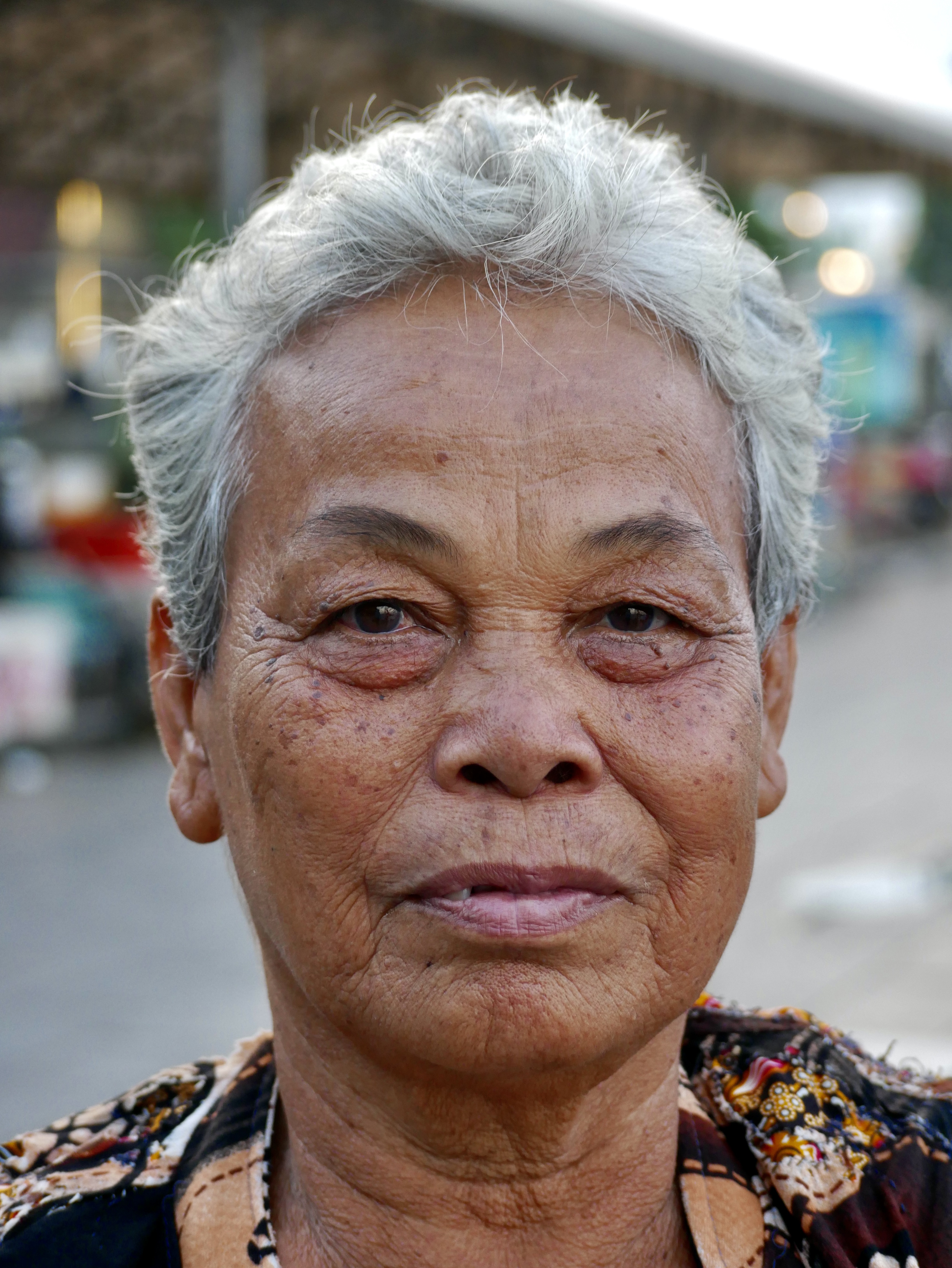
The riverside area has been cleaned up in recent years and now hosts good quality restaurants, bars and hotels. There are also many informal stalls close to the river. I stopped to buy cold water from one of the vendors, a smiling, silver haired woman wearing a brightly patterned blouse. As she handed me the bottle, I asked  how she came to be doing this work. Song Yeun said she had been selling goods in the street for many years. I asked her if she lived with her family, and unprompted, she began to tell her story. "I am 68 now but I became a widow at 21" she said. "My husband was an educated man and was killed very soon after the Khmer Rouge took over. My own family were farmers. I grew up in a village and managed to convince them that I could work in the fields. So I was spared". 

She referred to the Khmer Rouge as "the Angkar" a Khmer language word meaning "organisation" and the term that the Pol Pot led communists used to describe themselves. The regime held power between 1975 and 1979, dismantling civil society and brutalising the population with forced labour and summary executions. Estimates vary but the Khmer Rouge caused the deaths of up to two million people through starvation, exhaustion or outright killing. Educated people were seen as particular enemies and many teachers, professors, doctors, writers and artists were murdered. 

Song Yeun's experience of agricultural work was no guarantee of being spared or surviving, but it gave her a better chance than many of those forcibly evacuated from Phnom Penh a few days after the Khmer Rouge entered the city. She continued "There were famous people in the work camps. The singer Pan Ron was there. I tried to help her but they killed her too". Pan Ron (also known as Pen Ran) was a prominent singer and songwriter who had great success in the 1960's and early 1970's. Her music was influenced by western rock and soul styles and some of her lyrics were deemed risqué for their time. As all things western were deemed unacceptable, this made her. particular target. She is remembered in a series of murals outside the Space Four Zero gallery in Palace Lane, Phnom Penh. Several of her recordings have been uploaded onto YouTube. 

Song Yeun went on to describe some small acts of resistance. "At night they would put spies under our huts to listen to our conversations. You could be executed for any criticism of the regime. We knew they were there and we used to pee through a whole in the floor above where they would be laying. They couldn't say anything or move as they'd give themselves away". She laughed at the memory, but then grew serious and said "We were starving and I used to steal small amounts of rice just to survive. If they'd caught me I wouldn't be alive now." 

The Khmer Rouge regime was ousted in 1979 when Cambodia was invaded by Vietnam, although fighting between various factions continued into the 1990's. After being released from the work camp, Song Yeun somehow made her way back to Phnom Penh, discovered that she had lost most of her family and had to find a way of supporting herself. "Some men asked me to be a prostitute" she said, "But I refused. I knew I could work. These days I have trouble with my legs and people say 'you are old, stop doing this job and just beg' but I won't do that. I want to keep working". 

I bought an extra bottle from her and continued along the promenade. A group of overweight western men in shorts and vests sat drinking outside a bar. On the opposite side of the river, close to the shore, I could see the makeshift homes of the Muslim fishing families. I looked back at Song Yeun. She sat waiting for customers and smiling at passers-by.