Showing posts with label Myanmar Journey. Show all posts

Sunday, 2 February 2020

Faces of Yangon

Yangon is one of those cities that tourists visit for a couple of days, go to the main attractions and then leave thinking they've seen everything. They are wrong. True, it may lack the sophistication of some major Asian cities, has little in the way of nightlife and its public transport system can be challenging. But none of this matters when there is something, or someone, interesting around every corner. The eclectic mix of architecture that includes Indian and Chinese influences, crumbling survivors of the colonial period and classic Burmese style pagodas is reflected in the diversity of the people, many of them happy to share their story with interested passers-by.

Buddhist monk on Yangon's Circle Line train
The best place to see this rich mix is of course in the streets, particualrly the numbered lanes that cross the main boulevards of the city centre. From 17th Street to the high 20's it is a good idea to look up and admire the many remaining shop-houses, some of them 100 years old. Built to accommodate a commercial purpose on the ground floor with a residential unit above they are beginning to fall victim to developers so go and see them now. Some have retained their wooden facades and in 19th street in particular there are a number of Clan Association buildings with Chinese signage and the occasional, live, fighting cock tethered outside. There are also numerous markets. 17th Street hosts a famous daily street market as does the upper end of 38th Street, both of them selling all kinds of fresh fruit, vegetables, meat and fish as well as flowers, spices and other goods. The famous Bogalay Zay and Bogyoke markets are also worth a visit although the latter a little too touristy for me nowadays. Outside of the organised markets there are countless, often "informal" vendors selling snacks. fruit, household goods or offering various street side repair services.

Happy vendor, 17th Street
Waiting for customers, rickshaw driver, 14th Street
Interesting as the architecture and sale goods are, it is of course the people of Yangon that bring these streets to life and who hold a special attraction for me. They also make this one of the most photogenic locations I've ever visited and in general people are happy to pose for photographs. It is also relatively easy to take candid shots of the city's street life. One of the iconic sights of Yangon and Myanmar generally is the daily procession of Buddhist monks and nuns collecting donations of rice, other foods and sometimes money from the faithful who hope to gain merit from this good deed. I often find this to be can a moving sight as some of the nuns in particular are very young, many of orphans or from families too poor to look after them.

Breakfast in the San Pya fish market
Shy porter, Thiri Mingalar wholesale market
As well as walking the streets of Yangon, I enjoy visiting the huge wholesale markets located just a short distance from the city centre. The San Pya wholesale fish market and the vast Thiri Mingalar fruit, vegetable and flower market receive few foreign visitors.  So few that I don't recall seeing a single tourist during any of the visits I've made. The workers may be a little surprised to see a foreigner but are nonetheless very welcoming. In most cases they are too busy to spend much time talking but the workers are generally relaxed about being photographed. This makes up for the overpowering smell at San Pya which permeates everything and which will require you to send all of your clothes to the laundry after a visit!  Waterproof boots are also strongly advised if visiting.

This cheeky pair followed me around Thiri Mingalar until I took their picture
Worker with neck tattoos,  San Pya fish market
During my most recent time in Yangon, I had the privilege of visiting the neighbourhood of a good friend who I first met as a guide four years ago. Yuzana Garden City is about a thirty minute drive from the city centre. Primarily a residential area, it also has a large, busy market selling the usual food items and household goods. Until recently the market location was not busy as the vendors preferred to set up shop at the roadside. This may have been good for business but it prevented traffic from passing or in some cases even entering the streets. The local authority stepped in and there is now enforcement in place to prevent this behaviour - although it doesn't stop some vendors sneaking back to the street side in the afternoons!

As we walked through the market, people called out "hello"and "where are you from" - something that I have experienced in my travels in many countries, but here they also like to tease. The female vendors in particular have a good sense of humour, suggesting I might like to marry their friend or take them back to London with me. Several of them claimed me as their relative when neighbouring vendors expressed surprise at seeing me. My kind of humour. Here, not only were people happy to be photographed but some also requested me to take their pictures or those of their friends. I often find that when someone volunteers their friends for a picture, what they really mean is they want one of themselves but are too shy to ask. My hour or so in the market here passed very quickly and I am extremely grateful for the experience.


Herbs vendor, Yuzana Garden City
Snacks vendor, Yuzana Garden City
Rickshaw driver waiting for customers, Yuzana Garden City
I've written several times about the etiquette of photographing people in the street but it's worth mentioning a few things again. If I want to take a close-up or a more "formal" portrait, I always seek permission first. I wouldn't want someone to come up to me shove a camera in my face and then walk off. If I can I make efforts to talk to the person a little before requesting a picture. It's helpful to walk with someone local as they can interpret and also advise on any important issues that might not occur to an outsider. If I want to photograph children I always ask the parent or an adult accompanying them and I never photograph children who are alone. In markets I often buy something from a vendor first. This works better in some cases than in others. Buying a few pieces of fruit is not a problem and they can always be given to someone who needs them more than me. Fish, meat or live animals is a bit more of a problem! Obviously for candid shots things are a little different but it is still important to be sensitive and if someone says "no" or indicates they are unhappy with being photographed then accept this graciously and point your camera elsewhere. It is always good to show people their pictures on the camera screen and if possible to print copies and take them back to the although this can be difficult due to one's schedule or because it can be hard to find the people again.

The portraits featured in this post were taken over five days in January this year. I printed copies and was able to distribute some of them. I plan to continue this project and to capture the stories of some of Yangon's people during my next visit.


You can see more pictures from Myanmar here.

And to close, some more citizens of Yangon...

Rakhine woman, fruit vendor outside Indian Bazaar
Buddhist nun, 18th Street
Vendor, 17th Street
Alone and watching the world go by, 17th Street
Just me and my phone, porter in 17th Street
Ponderous look, 38th Street
Preoccuiped smoker, Merchant Road
Mister Ayoob, merchant in 41st Street
Time for a rest, 17th Street
Confidence, Innsein township, Yangon suburb 

Monday, 20 January 2020

Meeting the Kayan Women of Myanmar

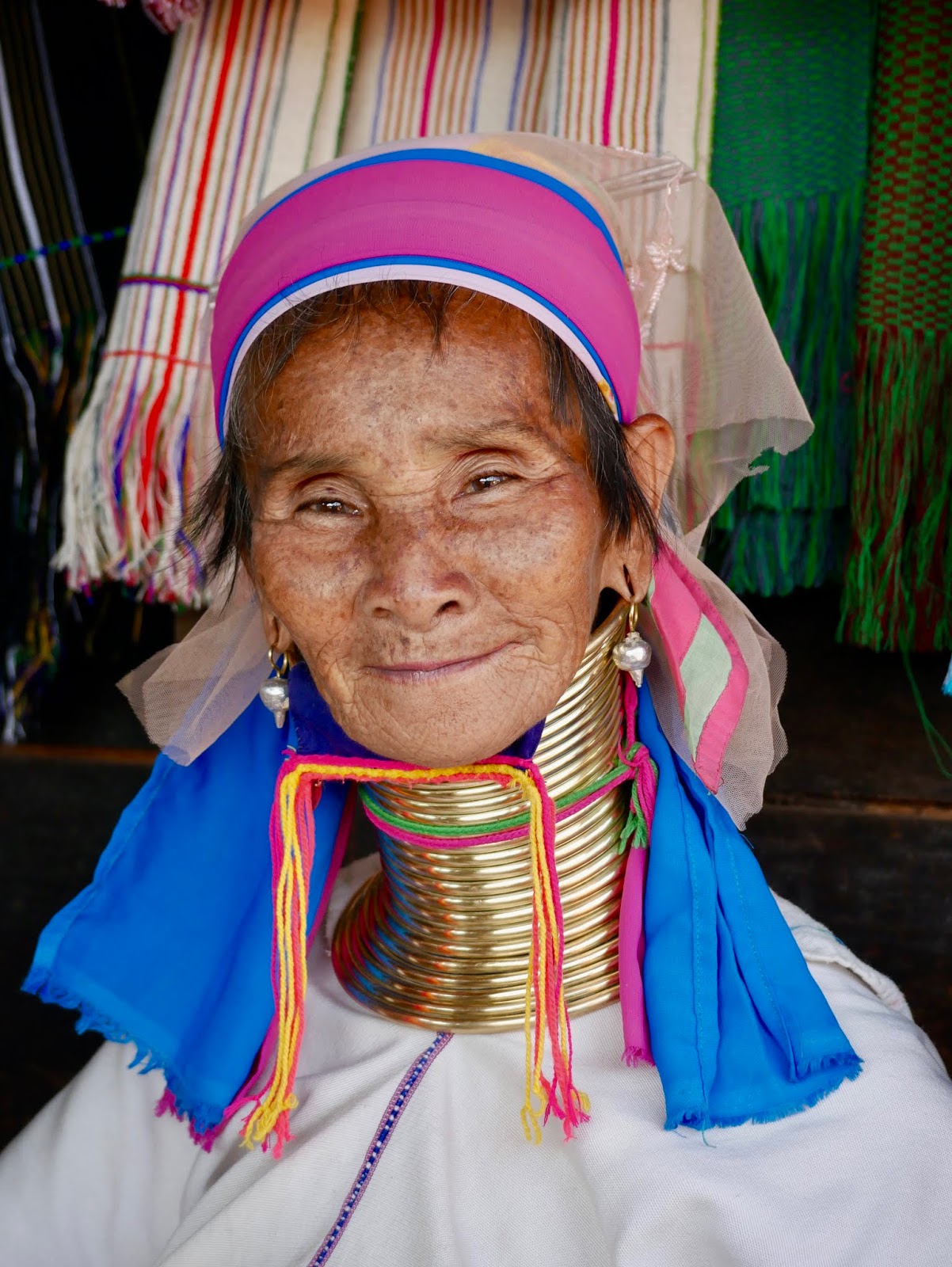
Myanmar, formerly Burma is a country about which relatively little is known in the west. The city of Mandalay is familiar to us due to Kipling's now problematic poem of the same name and also perhaps because it is mentioned in the children's song Nellie The Elephant familiar to those of us who grew up in the 1960's. There is also a widely held (although inaccurate) belief that Road To Mandalay was a title in the famous Bob Hope and Bing Crosby movie series. Initially there had been a plan for a film of this name but the final title replaced Mandalay with Singapore. Somerset Maugham and George Orwell also wrote about their experiences in the country but offer insights from a relatively narrow point of view. However, there is a particular image that many people associate with Myanmar, that of the Kayan women who wear brass coils around their necks and legs. I recall seeing pictures of these women in a set of encyclopaedias purchased by my grandparents from a traveling salesman in the 1960's. I never thought that I would get to meet them but during my recent time in Myanmar I was able to visit the village of Kasae Kum and meet some of the women who continue to wear the coils. 

Best friends, Bilot and Bilone
Muthan aged 71 welcomed me into her home with a glass of tea and invited me to sit down. Both she and her husband are artisans. Muthan spins cotton and makes and sells scarves whilst he is a woodcarver, producing small figures of Kayan women for sale to tourists. Together they had eight children, five of whom have already died, some in childhood. She explained that until fairly recently there was no access to modern medicine here and that it was difficult to reach the nearest town with no easy roads out of the village. This was a story I was to hear several times over the course of the morning. Despite this, they have 20 grandchildren, all of whom live within walking distance. One of them spent some time peeping at me from the upper level of the house before deciding that going outside was a more interesting option. 

I asked Muthan how long she has worn the coils. She told me that she first put them on at the age of five and that initially it was very painful as her muscles had not developed sufficiently to support their weight. Whilst explaining this, she lifted the coils slightly to show me a heavy dark bruise on her shoulder. They are rarely removed other than for renewing perhaps every five years or to undergo a medical examination. In recent years some women have stopped wearing them altogether. This is said to result in pain which subsides after a few days but which leaves permanent discolouration. 

Muthan


Muthan's grandson
Muthan's daughters and granddaughters do not wear the coils. She has mixed feelings about this and said that she respects their decision but is sad that the tradition is being lost. This was to be something common to the families of each of the women I met in Kasae Kum.  I asked her about the origin of the custom and how it began. There are various stories relating to this but she produced one that neither I nor my guide and interpreter had previously heard. She said that the Kayan women were told to wear them in case they should be scattered from their homeland, dispersed and unable to find each other. The coils were to be relied on as a means of identification. 

One explanation given is that they were meant to protect the women from enslavement by other ethnic groups, making them less attractive to other tribes. At the same time there is also a widespread belief that the coils enhance the beauty of the wearer, emphasising their slender necks, whilst a third explanation compares the appearance of the wearers to a dragon, a key figure in Kayan folklore as well as that of other tribes.

She also had questions for me, questions that were asked by each of the women I was to meet. They were focused mainly on my family, marital status and how many children I have. All of them were surprised that I travel alone and told me I should come again and bring my family next time. She offered me home made rice wine, the drink of choice amongst the Kayan and other communities and was a little surprised when I declined, explaining that I don't drink alcohol. She poured more tea instead and told me that she also likes beer but that it is bloating and can make you very fat! Before leaving I bought one of the scarves she makes. She placed the money inside the coils before thanking me for visiting.

Mutayant
Mutayant's busy granddaughter!
Mutayant lives a short distance from Muthan's home. She is 78 years old and a widow, She was not born in Kasae Kum but came there from her mountain village when she married a local man. The marriage produced ten children, six of whom have already died for reasons similar to those of Nuthan's. Like her neighbour she has 20 grandchildren and four great grandchildren some of whom were playing in her compound. Both Mutayant and Muthan are Animists as are many Kayans. There are also significant numbers of Christians amongst the community as well as Buddhists and people who mix Animism with another faith. Choice of religion appears to have no impact on maintaining Kayan traditions.

Mutayant put on the coils at the age of 10. She said that her daughters and granddaughters do not wear them as they "don't want to face discrimination when going out of the village to study or work". She said that she would never try to force the younger generation to wear them but had been angry with one of her daughters who had worn hers at a conference and sold them to a Chinese delegate. One of her granddaughters, two years old, was very busy playing outside the house, pulling faces, saying a few words of English, pretending to be working and generally entertaining us. It seems that her life will be very different to that of her grandmother. 

Bilot aged 73 and Bilone, 82 are best friends. Both of them widows, they spend most of their day together, talking, helping each other and enjoying the taste of rice wine. Bilot said "ask anyone in the village, everyone knows us, Bilot and Bilone". Both women had ten children. Bilot says that this is not considered excessive within the community and adds with a mischievous laugh "fortunately my husband died 32 years ago or I am sure I would be nursing another baby even today". Bilone joins her in laughing as do I, perhaps surprised at her candour. Both women put on the coils in their early teens and both wanted to wear them. Bilot said that the coils should be worn because "girls are more naughty than boys. They run around more so their parents say they need to wear them to prevent them from doing this. I used to climb trees and misbehave". Bilot is the only one of the women to give this explanation.

Bilot
Bilone
As with the other women none of their daughters or granddaughters wear the coils. I asked them how they feel about this and in response they said that if young women don't wish to wear them it is their choice. Earlier I had seen a group of eight young girls in the centre of the village, all of them wearing coils but later learned that these are not the same as those worn by the older women and are easily removed. It may be that they are being worn for the tourists. I asked the two friends what they think about people coming to see them. They said that they enjoy it. "We can't travel so people come to us. We like to hear about the outside world". They wanted to know how far I had traveled to meet them but had no concept of where I might be from. The interpreter told me that they have little knowledge of the world outside the village and would not really know where Yangon is or what it might be like.

Kayan girl, Kasae Kum village
Bilot and Bilone had several questions for me, most of them the same as those asked by their neighbours - why do you travel alone? how many children do you have? how old are you? They enjoy rice wine and drank it from a special bowl throughout the time I spent with them. They wanted to know if people drink rice wine in the UK and if I would like to try it myself. Bilot also enjoys chewing the betel nut, known as paan in India and this too was offered to me. Unfortunately I had to decline both as I don't drink and don't chew betel. She told me she chews it in order to keep her mouth fresh and laughed when I asked her if she was worried about the negative impacts it can have on the mouth and teeth, not least dyeing them bright red. She seemed genuinely happy as did Bilone whose grand children came in and out of the house as we spoke, one of them stopping for a quick cuddle with his grandma.

I enjoyed my time in the village and learned a lot not just about the lives and customs of the Kayan women but once again about how similar our ambitions are despite the differences between us. All of the women I spoke to wanted whatever was best for their children and grandchildren even if it meant abandoning some of their cherished traditions. I liked their curiosity about the outside world and their willingness to be open with outsiders. As I left I realised that they may well be the last generation of Kayan women to wear the coils and that many of their traditions will end with them.

A cuddle with grandma
Please note I refer to the women throughout as Kayan rather than the other term sometimes used - Padaung. I am advised that this is considered to be pejorative despite being used throughout Pascal Khoo Thwe's 2002 book From The Land Of Green Ghosts. I also met two women in the main market at Loikaw who used the term to describe themselves although they did not wear the coils.

You can see more pictures from Myanmar here

Sunday, 12 February 2017

Jewish Yangon

The Musemah Yeshua Synagogue in Yangon's 26th Street is a glorious reminder of a once thriving Jewish community. Today there are no more than 20 Jews resident in the city - the remnant of a community that peaked at about 2,500 before the Second World War. The main Jewish holidays are still celebrated in the synagogue with the congregation augmented by visiting tourists and at least some of the up to 100 Jews from other countries who work for various organisations in Myanmar. 
Synagogue entrance
I was able to visit the synagogue during my recent tie in Yangon and to admire the light, airy, beautifully maintained building, on the edge of Yangon's India Town and not far away from the city's last remaining Jain Temple. The entrance is discrete but clearly signed and visitors are offered a warm welcome six days a week - the building is closed on Sunday. Completed in 1896, it has beautiful stained glass windows, ornate decorative details around the bimah and beautiful bamboo and teak seats, reflecting local traditions and tastes. Despite being tucked away in a side street, the interior is very light and airy and does not have the air of sadness of many European synagogues with communities of similar size but different history. 


Myanmar's first Jews arrived in the early 1800's - merchants and traders from Calcutta, most of them members of that city's Iraqi Jewish community, originating from Baghdad. They were involved in a range of trades including textiles, timber, ice production and bottling. Some members of the community became influential and prominent in civic life and one place was allocated to the community on the Yangon (then Rangoon) Municipal Committee. Participation in public life reached a peak in the early part of the twentieth century with the appointment of Jewish mayors to both Yangon and the smaller city of Pathein (then Bassein). 

Brothers Judah and Avraham Ezekiel came from Baghdad to Myanmar in 1840, settling in Mandalay and worked for the Burmese monarch, King Mindon, as accountants or bookkeepers. At some point the brothers quarreled, separated and Judah moved to Yangon where he became so successful that a street was named after him possibly due to his philanthropy which included paying for the metaling of the road. He ensured the care of "his" street by leaving nine rupees per month in his will for its ongoing cleaning. He appears to have been a larger than life character in all senses of the term. Almost Englishmen a short history of the Jewish community in Myanmar includes a story describing the reluctance of rickshaw drivers to carry him due to his large size which on one occasion caused him to go through the floor of a carriage.

Sofaer building, Merchant Street
Isaac Sofaer was another prominent member of the community. Born in Baghdad in 1867, his father brought him to Yangon at the age of nine. On completion of his education he worked for a wine and spirits company before going into business with his brother Meyer in 1893. Messes Sofaer and Co also sold wines and spirits and became involved in exporting rice. Isaac was not only a successful businessman but also took part in civic life supporting organisations such as the Agricultural Society and the Burma Pasteur Institute.

He was also responsible for the design of the elegant and imposing Sofaer building, completed in 1906 and which still stands today on the corner of Merchant Street in the city centre. The building once housed the Reuters telegram office, a Filipino hairdressers and shops selling Scotch whisky, Egyptian cigars and English sweets. The design included ceramic floor tiles, imported from Manchester and arranged in a green, gold, lapis lazuli and burnt sienna mosaic. Some of the original tiles still remain. The building today is a shadow of its original self but there are signs of recovery with Gekko, a very successful Japanese restaurant taking space on the ground floor as well as one or two shops selling tourist items. The Lokanat Gallery on the first floor is the city's longest established independent gallery.

The golden age of the community ended abruptly in 1941 when most of its members fled as a result of the Japanese invasion. Although some people returned at the end of the war, the much reduced numbers made it difficult to sustain community life. In addition to this here were various disputes about the management of the community, which did not help matters. These and other issues are detailed in Ruth Fredman Cernea's excellent book Almost Englishmen: Baghdadi Jews in British Burma which charts the history of the Jews in Myanmar. There was a second wave of departure in the 1960's following nationalisation of almost all the country's businesses. There has been no rabbi since 1969 and kosher meat is not available. Community members compromise with halal produce.

Shop sign with a Magen David "for luck".
Despite this, you could be forgiven for thinking that Yangon's Jewish community is much larger than it really is. This is because it is possible to see a Magen David (Star of David) displayed outside many businesses across the city. This is not that the businesses are Jewish owned but rather that some locals believe the symbol will bring them luck and success. However there is at least one building with a Magen David on its facade that does have strong Jewish links. The wooden building in the picture below, close to the magnificent Shwedagon Pagoda complex was once Jewish owned and the location for an ice factory. Look closely and you can see the Star at the apex of the facade. The community may be very small, but its presence and achievements live on through the synagogue, the Sofaer building and through symbols such as these.  

Former Jewish owned ice factory with Magen David on facade
Visitors wishing to know more about Myanmar's Jewish history might like to contact Myanmar Shalom  which can organize visits to the synagogue and to the places connected with the community's history.

You might also like - Myanmar Journey Part One - Yangon

You can see more pictures of Myanmar here.

Friday, 3 February 2017

Myanmar Journey Part Four - North to Lake Inle

Lake Inle covers about 45 square miles in the Southern Shan State in Northern Myanmar. It was the final stop of my trip before returning to Yangon for the journey home. I took a short flight from Bagan to Heho and from there was driven to the small town of Nyaungshwe which has several hotels, hostels, restaurants and cafes and is a great base from which to explore the Lake.

Early morning fishing on the lake.
Many people still live on the water in houses supported on stilts. Belonging to the Intha (sons of the lake) ethnic group, they are thought to be descendants of the Mon people from the south-east. I was lucky enough to be able to eat lunch in two private homes and was shown around the cosy interiors which included very modern facilities and of course access to satellite television which judging from the number of dishes on roofs and balconies is widespread here. As well as private homes there are also schools, temples, shops, a post office and even a library on the lake - all built on stilts and all accessed by boat. Some of the more enterprising residents run "mobile shops" - selling food, flowers and other items from small canoes. 

One of the absolute highlights of my time at Lake Inle was getting the unexpected opportunity to see inside a heritage house. And not just any heritage house - the oldest one on the lake at over 100 years old. Spotting it from the water, I asked the boatman to stop for a moment so I could admire and photograph this teak building which has beautiful decorative trellis work on the balconies and upper facade. It turned out that my guide was related to the owners and she kindly invited me to look inside. The interior has many rooms over two levels and I was able to look at old photographs of the family and surrounding area. It was a real privilege to see inside and to receive a warm welcome.

Heritage house, Lake Inle
Library on stilts, Lake Inle
A street on the water.
With mum and grandma.
Unfortunately the Lake is suffering from modern problems, decreasing in size and becoming more polluted with more litter, more motorised vessels and chemicals from the huge "floating gardens" where tomatoes and other plants are grown on the water but anchored to prevent them floating away. Despite this, the Lake was perhaps my favourite stop in Myanmar. I won't forget the early morning on the boat, seeing the silvery waters and the sun fighting its way through the mist casting just enough light to see the fisherman with their conical hats. These are no ordinary fishermen as they propel and steer their boats using their unique leg rowing technique, performing an amazing act of skill and grace. Used to the tourists, some of them will approach your boat and pose for photographs if you are lucky.  It is important to note that it can be very very cold on the lake early in the morning and also in the evening. A jacket and hat are essential and for the colder mornings most boats transporting visitors will have blankets.

Fishing on the lake.
As well as fishing, the locals make their living in a variety of ways. Some of them are involved in the traditional crafts practiced on the lake such as boat building, textile production and design (including items made from lotus), lacquer making, making items made from gold and bronze, jewelry and even cheroots made for the local market. Most visitors to the Lake will find themselves taken to several workshops to see the production of these items and where there will be an opportunity to make purchases. Unlike in some of the neighboring countries, there was absolutely no pressure to buy. Long may that continue.

On my second day at the Lake I got up early - very early - and left the hotel by small boat on a journey of just over one hour, to reach the market at Nan Pan. I had already enjoyed several markets in Myanmar with their spectacular colours and lively atmospheres but nothing had quite prepared me for this. Organised in different places on a five day rota and therefore known as the Five Day Market, huge numbers of traders arrive very early in the morning coming from far and wide to sell their goods. 

Pa-O women selling fruit and vegetables ate the Five Day Market
Pa-O woman at the Five Day Market
Traders and visitors come to the market by boat.
You really can buy just about anything here. There are the usual vegetables, fruit, herbs and spices, fish, meat and dried foodstuffs but this is only a small part of what the market has to offer. You can buy a new boat. You can get measured up for new false teeth and collect them the next time you come to the market. You can buy clothes for all ages and in all sizes. You can buy craft items, antiques real and fake, religious paraphernalia, electrical goods, books, magazines and stock up on betel. You can even get the latest pop tunes downloaded onto your telephone if you aren't able to do this yourself. And you can take time out from shopping and bargaining in one of the many (many) tea shops and cafes. I enjoyed two "Chinese donuts" - the non-sweet slightly oily ones that you can get in most Chinatowns around the world.

Fresh fish at the market
Alternative medicine at the market
Like Myanmar's other markets, everywhere you look there is colour.  It comes from the goods such as the bright yellow turmeric,  dazzlingly orange fruit and vegetables and deep green leaves of vegetables that you have never seen before. It also comes from the people with representatives from many of Myanmar's 135 ethnic groups attending the market either as traders or shoppers, most of them dressed in the clothes of their cultural group often including brightly coloured headscarves. The traders are friendly people and most will happily explain their goods to you without expecting a purchase. I couldn't resist some tiny ceramic figures representing some of the different ethnic groups - the Shan and Pa-O in particular. 

Our young stall holder!
Dyeing lotus cloth
At one of the many betel stalls, a very small girl was cutting up leaves in which to wrap the areca nuts, tobacco and lime before selling them to the many keen shoppers. She saw us approaching, waved at us and when my guide, May, asked her how old she was, not only did she tell us that she was three years old, but also what her name was and that she was in charge of the stall! Such ambition for one so young. At another stall run by an elderly Pa-O woman whilst looking at the herbs, spices and vegetables, I noticed that she also sold peanuts. I must have said "peanuts" out loud because she said "yes peanuts, you are doing well!" and laughed and waved as I moved on.

I also visited a number of sites in the vicinity of the Lake. The Shwe Yan Pyay Monastery and Temple lies between Heho airport and the lake. The teak monastery was built in the nineteenth century and today provides education both Buddhist and secular for boys from poor families. The interior is beautiful with its teak floors and coloured glass decorative features. The adjoining temple has a red painted interior and again makes use of coloured glass in freezes depicting scenes form the life of Buddha and from traditional beliefs. The interior walls include many small Buddha statues, displayed in niches and named for people from around the world who have made donations to the monastery and temple. 

Shwe Yan Pyay Monastery
Buddha niches at the Shwe Yan Pyay Temple
The village of Inthein is a busy stop along a canal leading off from the main body of the lake. There are many ruined and partially overgrown stupas just behind the village, some dating from the seventeenth and eighteenth centuries and many with carvings of Buddha, elephants, peacocks and figures from Buddhist beliefs. Most of the stupas are in very poor shape and visitors must note and comply with signs provided for their safety. Some of the structures are in the process of being reclaimed by nature as trees and plants wind their way around them and in some cases even grow from inside. 

Crumbling stupas at Inthein
Carvings at Inthein
Two days at the Lake passed very quickly as did my two weeks in Myanmar. I am already planning to return next year to see more of this most beautiful and welcoming of countries.


You can see more pictures of Myanmar here.