Showing posts with label My London. Show all posts

Sunday, 31 January 2021

A Place Full of Stories - East London's Novo Jewish Cemetery

The Novo Cemetery in Mile End is just a ten-minutes walk from my home. I have lived here for almost twenty years but it is only very recently that I "discovered" the cemetery through the Discovering and Documenting England's Lost Jews project. Established in 1733 and now tucked away within the grounds of Queen Mary University, the cemetery has been the resting place of some very prominent people. Champion boxer Daniel Mendoza was buried here as was Benjamin Disraeli whose grandson of the same name became Britain's first Prime Minister of Jewish heritage, famed comic actor David James (David Belasco) and Diego Pereira who served as financier to the Austrian Empress, Maria Theresa. It is fascinating to think that these illustrious characters were buried just a short walk from where I now sit.


Grave of Orovida Abigail Bensusan

It has also been the final resting place of the less well known, including tailors, rag merchants, quill pen makers and feather makers who lived and worked in the once predominantly Jewish East End and were eventually buried here. I wonder if any of the traders mentioned in my recent post on Sclater Street were laid to rest in the Novo Cemetery.


The graveyard itself has quite a story. In 1656, after an absence of almost 400 years, the presence of Jews in England was accepted but not officially recognised. In the same year, a small synagogue was established in Creechurch Lane in the City of London and in 1657 a piece of land was purchased in the then rural Mile End, for use as a burial ground. Over the next several years as this predominantly Sephardi community became more established and expanded in size a larger cemetery was needed and in 1726 an additional piece of land was leased for this purpose. A short distance form the original burial ground it was named the Nuevo (new) Cemetery and the former site became known as the Velho (old) cemetery. The first burials took place in the Novo in 1733.


Nature has begun to take over some of the gravestones


Over the next century London's Jewish population continued to grown and in 1855 it was necessary to purchase a further 1.7 acres of land to accommodate its needs. By 1899 the cemetery held about 9000 graves. At this point, the Sephardi community began to drift away from this part of London and a new cemetery was established in Golders Green. In 1906 the Novo was closed for adult burials and in 1918 for children. Despite this, occasional internments took place into the 1970's.


In 1973 about 7000 bodies were disinterred from the pre 1855 site and reburied in a communal grave in Essex, leaving about 2,000 graves in place. This was because the expanding Queen Mary College, now a University, required additional space and an agreement was reached between the Sephardi community and the College to transfer part of the burial ground to College ownership. Daniel Mendoza was one of those disinterred and this great Jewish and British sporting hero now lies unacknowledged in a shared pit.


Hands signify the grave of a Cohen 


A life cut short


Books may indicate that the deceased was a scholar 


Wandering through the cemetery on a crisp, cold winter's afternoon I was struck by how much cemeteries can tell us about the communities they serve and how many stories are waiting to be unlocked from them with just a little research. As already noted, the Novo Cemetery is a Sephardi burial ground and this is evidenced by the Spanish and Portuguese names marked on almost every one of the gravestones as well as by the tradition of laying the stones flat rather than upright. This is to remind us that regardless of our status in life, in death we are equal. Some gravestones carry visual clues to the lives of the deceased. An image of hands usually denotes that the person is a Cohen, that is, of the priestly caste and that they can claim to be descended from Aaron, brother of the the Biblical prophet Moses. Images of books may indicate that the deceased was a scholar or rabbi, whilst a tree or a tree being cut down means that a life was cut short. Candlesticks are sometimes carved into the headstones of women as a reference to their responsibility for lighting candles on Shabbat. 


Non-Jewish visitors may wonder why there are small stones or pebbles on many of the graves. Various explanations are given for this including the belief that the soul of the deceased remains near the body for a while after death and that rocks will prevent it from leaving too soon. There may also be practical reasons for this tradition. In Biblical times burials would take place under a pile of rocks rather than a heavy slab and so the placing of stones on graves in the modern era may be a reflection of this. Today it indicates that someone has visited the grave.


It is important to note that although all of those buried here are from the Sephardi community, not everyone came from Spanish or Portuguese family backgrounds. A whole row of graves is given over to the illustrious Sassoon family who originated from Baghdad in Iraq and became one of the world's foremost merchant families over several generations with business interests in  Bombay (today Mumbai), Shanghai and Hong Kong. Amongst others, Flora Sassoon, wife of David Sassoon founder of the dynasty and former leader of Bombay's once substantial Jewish community, (nee Farha Hyeem) is buried here.  


Grave of Flora Sassoon (nee Farha Hyeem)


Cemeteries have always been important sources of information for historians but today the little bit of information contained on a headstone can lead us on the most fascinating of virtual journeys via the internet. The stone pictured at the top of this post is that of Orovida Abigail Bensusan who died on 30th July 1912 aged 69. We can learn from it that she was the daughter of Samuel and Esther, that she probably never married (no other family name is given other than that of her parents) and the quote from Proverbs indicates that she was well thought of and did not need praise.


"Give her of the fruit of her hands and let her own works praise her in the gates". 


A little research reveals many interesting details about her and her family. Both parents were born in Gibraltar which remans home to a significant Jewish community today. Although I have not been able to find out when the family came to London, the 1871 census shows Esther, Orovida's mother, living in Lambeth. By 1881 she was living in Penge not far from the site of the Crystal Palace, which perhaps indicates that the family had become more prosperous. 


Although Orovida appears not to have married, according to the Ancestry website, she did have a child with one Abraham Corcos, a merchant born in Oran, Algeria in 1810. He was father to at least nine children, some of them born in Algeria and Morocco, and who had three different family names between them. Orovida and Abraham's daughter, Esther Corcos was born in London in 1873. Details of Orovida's life after the birth of Esther are sketchy until 1911 when it is known that was living in Stamford Brook, Chiswick with her niece Esther (daughter of Orovida's brother Jacob) and her niece's husband...famed French artist Camille Pissarro. Orovida was clearly a much loved aunt as the couple named their only daughter after her. Orovida Camille Pissarro was herself to become a distinguished artist studying with her father and then with Walter Sickert before rejecting their styles in favour of Chinese and other Asian techniques.  Her works can be found in the collections of both the Tate and the Royal Academy.


The Novo Cemetery is full of stories like that of Orovida Abigail Bensusan and whilst not everyone will have had links with world famous artists, discovering their personal histories will be  just as interesting. The website of the Discovering and Documenting England's Lost Jews project includes testimony from Jews with Sephardi heritage, more details about the history of the cemetery and stories of some of those buried there. The cemetery is open to visitors and is a short stroll from either Mile End or Stepney Green Underground stations.  


You might also like Sclater Street - full of history and a hot spot for street Photography or Whitechapel Library - University of the Ghetto


Friday, 1 January 2021

Travels With My Camera 2020 - The Best Pictures

I had big travel plans for 2020. For obvious reasons most of them did not come to fruition, including a first time visit to Angola and a return to India. However, I did manage to travel a little before everything stopped. I spent a few days in Bangkok at the beginning of the year en route to my third visit to Myanmar. I also made my annual Israel visit but had to cut things short when it became obvious that air travel was grinding to a halt. This resulted in my doing significantly less photography than in previous years. It also meant that lockdown permitting, I spent some time in the streets of London looking for interesting shots much closer to home.

The pictures included in this post are some of my personal favourites from 2020. Others have been particularly well received on social media or at the exhibition I was able to hold at the Jeannie Avent Gallery in Dulwich, South London in August. This sixth incarnation of my Travels With My Camera show was the most successful so far. It was a great location and a rewarding experience. I enjoyed talking to visitors, listening to their feedback and learning from the advice of some of the more experienced photographers who came along. I had planned another exhibition in the cafe gallery of the Queen's Theatre in Hornchurch but this, like much else, fell victim to the lockdown.

Bilone and her grandson, Kasae Kum, Kayah State, Myanmar

Pop Nyat Khaing school for nuns, Loikaw, Myanmar 

Despite the disruption to my plans, 2020 provided me with some new experiences. In Myanmar I visited Kayah State for the first time and spent time in villages only recently opened up to overseas visitors. This included spending time with several members of the Kayah ethnic group who gave me free reign to photograph them going about their daily activities. The picture of Bilone with one of her grandchildren is perhaps my favourite picture of the trip, if not of the year. I was struck by the easy and obvious affection between grandmother and grandchild and how comfortable they were together. I also loved the way the light fell on Bilone's face, illuminating her love for the child. 

Still in Kayah State, I visited a school for young nuns in Loikaw. Many of the girls are orphans or from families unable to look after them. They are placed in the nunnery where they will be fed, cared for and receive at least some education. Many of the children were shy, but one girl in particular was fascinated by the camera. She grinned at me and pulled faces before turning back to her work. She then turned round once more just as a patch of light fell on the wall behind her. And that was the shot. 

Shy flower seller, Yangon

Breakfast at the wholesale fish market, Yangon

Yangon is one of my favourite cities and once again I enjoyed early morning expeditions to the various wholesale markets, photographing the workers going about their daily tasks as well as capturing some interesting portraits. I especially like the picture of the shy flower seller who was at first reluctant to be photographed, but then changed his mind and approached me whilst carrying a huge bunch of white flowers, hiding just a little of his face being them. The woman seen ladling food from her bowl in the picture below was enjoying her breakfast in the wholesale fish market when I saw her. The Yangon based watercolorist and my good friend, Sai Pyae Sone Aye, used this photograph as inspiration for one of his beautiful works. I look forward to seeing it next time we meet.

Still in Myanmar, I visited the city of Mawlamyine for the first time. I happily spent a couple of days wandering through its narrow lanes and markets and am keen to return at the earliest opportunity. It was here that I came across a young man working on a new well, pumping muddy water from the ground in an area where instant access to clean water is not guaranteed. He is pictured below.

A new well, Mawlamyine, Myanmar

Alone in a crowd, Meah Shearim, Jerusalem, Israel

I love portrait photography and am especially attracted to informal portraits where the subject has less opportunity to hide their true mood or feelings. I particularly like three portraits from 2020. The first is of a young Jewish man taken during the Purim celebrations in Meah Shearim, Jerusalem. This is an ultra-Orthodox neighbourhood and photography is normally unwelcome there, but during Purim with the right approach and some contacts it is possible. Purim is a chaotic time in Meah Shearim. People wear costumes or disguises and alcohol consumption is encouraged - at least amongst the men. This young man seemed alone in the crowd, slightly apart from the celebrations and although physically present, somehow absent. I wonder what his story is.

The second portrait I've chosen from last year is of a little girl in Bangkok. I noticed her sitting with her grandmother on the step of a shop house in the Klong Toey market. Noticing the camera, and much to her grandmother's amusement, she began to laugh, wave and pose before finally leaning standing quietly against the house gate which framed her face perfectly. In this quiet moment she is somehow similar to the young man in Jerusalem, lost in thought, no longer with us.

My third choice is a portrait of Bilot, another Kayah woman and friend of Bilone featured in the picture at the top of this post. I spent some time talking to her before taking the camera out. She was optimistic and funny. She offered me home made rice wine and betel leaf and teased me about traveling alone. I think this portrait captures the self she showed me during our conversation.

The dreamer, Klong Toey, Bangkok, Thailand

Bilot laughing, Kasae Kum, Kayah State, Myanmar

On the way to the flea market, Sclater Street, London

After my Myanmar/ Bangkok and Israel trips I had a long spell where I hardly picked up my camera. I fell ill in late March and took several weeks to recover and of course, the national lockdown much reduced the opportunity for my preferred kind of photography. However once the initial lockdown was lifted, I made several weekend visits to Spitalfields, close to my home in East London. The Sunday fleamarket market and nearby shops act as a magnet for many young, fashion conscious visitors. They also attract many local people who have lived in the area either their whole life or for many years. The pictures above and below were taken in Sclater Street near the market and represent the different audiences it attracts. 

On the catwalk, Sclater Street, London

I originally intended to include just ten pictures in this post but whilst drafting it I decided to indulge myself and include two more shots from my time in Jerusalem. One shows an ultra-Orthodox Jewish boy entertaining himself whilst his father (not pictured) says his prayers at the Kotel (also known as the Western Wall and the Wailing Wall). I liked the interplay between the lines on his sweatshirt and those of the stacked chairs, as well as his stylised movement. The second picture is of a teenager, sunlight on his face and the worse for wear after over indulging at Purim. 

When you get bored waiting for your dad, Jerusalem, Israel

Too much to drink at Purim, Meah Shearim, Jerusalem, Israel

Thank you if you came to my Jeannie Avent Gallery exhibition, or if you follow me on various social media. I hope to see you again soon. Happy New Year to everyone.

If you are interested in any of these pictures please contact me at adrianpwhittle@outlook.com

You might also like Purim in Meah Shearim or Meeting the Kayah Women of Myanmar

Follow me on instagram or Flickr 

Please note: All rights reserved. None of these images may be reproduced, stored in a retrieval system, or transmitted in any form or by any means, electronic, mechanical, photocopying, recording or otherwise without my prior written permission.

Monday, 24 August 2020

Whitechapel Library - University of the Ghetto


Twenty two London public libraries and cultural facilities have borne the name of Victorian journalist, philanthropist and politician John Passmore Edwards (1823-1911). His particular interest in funding public libraries may have been due to his reportedly having access to few books as a child. The first London library he funded was the former Whitechapel Library, now absorbed into Whitechapel Art Gallery at 77-82 Whitechapel High Street.

It opened its doors on 9th May 1892, the construction costs of £6454 being fully provided by Passmore Edwards but this was not the first attempt to provide a public library in this part of London. The Public Libraries Act of 1850 had followed a Select Committee report that suggested libraries could be used to steer people towards "temperate and moderate habits". Despite strong opposition to the Act from some MPs, it was eventually passed. The Act allowed for levying a charge on the rates of a half-penny in the £ in order to ensure continued funding. Such proposals had to be put to the vote locally before a free public library could be established and in 1878 the voters of Whitechapel rejected adopting the legislation, opposed to providing a facility "...wherein idle people may enjoy themselves".

Samuel Barnett, social reformer and Vicar of St. Jude's Church and his wife Henrietta, co-founder of Toynbee Hall campaigned for a library in Whitechapel but in 1891 Passmore Edwards came forward with the necessary sum.  A site was identified and architects Potts, Son and Hemmings were engaged to design the building. Initial services included a closed-access lending service, separate reading rooms for boys and girls and a reference library. Closed access meant that readers had to ask a member of staff to check the availability of books for them rather than having direct access to the stock. This was common practice in the early days of public libraries. There was also a museum of the natural history collections of the Reverend Dan Greatorex who had earlier established small collections of books on merchant ships for the use of the seamen.

Impressive hours of service were offered, including Sunday afternoons and late opening until 10pm. A programme of talks and lectures was held and schools were able to borrow items from the museum. Modern technology meant that the building had its own generator so as not be dependant on an external energy supply. Formal opening took place on 25th October 1892 with Lord Roseberry, Foreign Secretary and Chairman of the London County Council as the guest of honour.

By the end of 1892, there were 2,500 members including actors, comedians, diamond cutters, lard refiners, leather merchants, at least three journalists and my favourite, "ladies with no occupation given". This impressive list tells only part of the story of the library's role in its community which by 1914 is said to have included 90% of the total Jewish population of the UK. Evidence of its impact is borne out by the stellar list of writers, artists and future academics who made use of it during their youth. It is known that artist Mark Gertler borrowed art books from the library and practised drawing in the reading room. Fellow Whitechapel Boy David Bomberg was also a user.

Playwright Arnold Wesker used the library as a child and later spoke about borrowing and enjoying The Wind In The Willows. Fellow playwright and novelist Bernard Kops was also a regular user and loved the place so much he wrote a poem in its honour as well as a play set within the building. Child psychologist and author of The Ascent Of Man, Jacob Bronowski studied there and mathematician Selig Brodetsky learned English in the library. Born in Russia and one of thirteen children, Brodetsky had a fine career in academia. He studied at Cambridge, lectured at Bristol University, held a chair in Applied Mathematics at the University of Leeds and for a time was President of the Hebrew University of Jerusalem. East End chroniclers Simon Blumenfeld and Willy Goldman also studied there.

Perhaps the most famous former user was poet and painter Isaac Rosenberg. The child of poor Jewish immigrants from Lithuania, he was also the author of some of the most famous poetry to emerge from the First World War and was tragically killed in action on 1st April 1918. He is memorialised with a Blue Plaque on the exterior of the building. The achievements of Rosenberg and other writers and artists led to the library being referred to as the university of the ghetto.  Most of the users would have lived in dark, overcrowded and noisy conditions with no space for quiet study, reading or reflection. The library provided this and enabled some of them to go on to great things whilst to others it was a place to find peace and cultural enrichment. Lack of space at home remains one of the main reasons why people come to public libraries today and competition for study space can be fierce.

In 1900 the library came under the auspices of the former Metropolitan Borough of Stepney. Over the next few decades a large collection of Judaica was developed, lending became open access in 1922 and in 1930 a children's library was established in the basement.  Aldgate East Underground Station lies beneath the building and in 1937 a street level entrance to the Tube was inserted into the facade. The East End was severely bombed during the Second World War and damage was sustained to the second floor in 1940. From the late 1940's onwards the neighbourhood began to change with the large Jewish community moving away and being replaced by newcomers, particularly from the Sylhet region of Bangladesh which until 1971 was part of Pakistan.

Levels of use fell in the decades following the War and when I first visited in the early 1990's the building was in a poor state of repair and in need of investment. By this time, Whitechapel was under the control of the London Borough of Tower Hamlets, one of the poorest areas in the city and one whose library service was amongst the least used in London. The Council undertook a re-branding exercise, closing some libraries and opening a series of modern, purpose built Idea Stores, combining library services with adult education and expanded access to technology. Whitechapel Library was closed in 2005 and was replaced by the much larger and more strategically located Idea Store, close to Whitechapel Station, a street market and the area's main shopping facilities. On the last day of service, an evening event was held to commemorate the contribution of the library to the local community. It featured performances by Anna Tzelniker, the last active performer of the once great Yiddish theatre and a reading by Bernard Kops of  his poem, Whitechapel Library, Aldgate East.

The building received Grade II listed status in 1990. After closure it was acquired by the neighbouring Whitechapel Art Gallery which also has a long tradition of serving the local community and has exhibited works by the aforementioned Gertler, Bomberg and Rosenberg. On a personal note, most of my career was spent working in and managing public libraries. Researching for this post I realised that at different times I either worked in or was responsible for six of Passmore Edwards' London libraries. Is this a record?

Perhaps the last word should go to Bernard Kops.


Monday, 29 June 2020

Whitechapel Road - The Working Lads' Institute


It's interesting that we can walk past a building hundreds of times without really noticing it and then one day it catches the eye. I must have walked past the former Working Lads' Institute on Whitechapel Road hundreds, possibly thousands of times but only recently noticed it. It stands next to the main and currently closed entrance to Whitechapel Underground Station, a six storey red brick building, completed in 1885. Designed by Scottish architect George Baines, the facade features Portland and Ancaster stone dressings and a three sided Oriel window flanked by additional bay windows at first floor level. It was formally opened to great fanfare by the Prince and Princess of Wales on 31st October 1885. The Illustrated London News reported that "despite the rain which continued throughout the day, there was an immense assemblage of people along the roadway through which the Royal party had to pass".

The Institute began life as an organisation in 1878, in Mount Place, also in Whitechapel, and was founded by Henry Hill, a successful merchant in the City of London. Hill's objective was "to supply a counter attraction to the low music halls and other east end resorts for the young which are so fatal to their social and moral well-being". To this end a library, lecture hall, classrooms, laundry, kitchen, gymnasium and swimming baths were provided for the area's young working class men. The lecture hall could accommodate up to 600 people and boasted stained glass windows with representations of art, religion and industry as well as nine semi-circular lights with images of the seasons and sports. The main facilities were advertised by the words Lecture Hall, Gymnasium and Swimming Bath carved in stone above the two entrances at street level on Whitechapel Road. It was these signs that finally drew my attention to the building and led me to notice the much larger Working Lads' Institute sign emblazoned across the full width of the building at the upper level. How did I ever miss it? 

The total cost of the project was £12,000, a significant sum for the time. Hill did not manage to raise all of the required capital before construction started and so the works were completed in two phases. He managed to secure additional funds from Reverend Thomas Jackson who ran an Evangelical Mission in Clapton and had a history of working with the poor. Jackson was to have a long association with the Institute and eventually purchased the building in 1896, saving it from the threat of closure due to a constant lack of funds.  He was influential in increasing the organisation's work with young homeless men. From the beginning, accommodation was offered for those in need with an initial 24 beds and space to expand to 60. Additional beds were made available to young men aged 17-21 including some who were referred by the courts with Jackson sometimes acting as probation officer. However, it is important to note that not all of those who made use of the hostel had been involved in criminal activity and that some would have committed what would be considered very minor offences today.

As well as providing education, leisure and refuge to young men, the Institute occasionally hosted other activities, including in 1888 the inquests into the deaths of Mary Ann Nicholls (also known as Polly Nicholls) and Annie Chapman, two victims of the Whitechapel Murderer.  

The Institute no longer operates from Whitechapel Road and has been renamed the Whitechapel Mission. The building now contains a number of flats with retail units at ground floor level. The facade was restored in 2012 as part of a wider improvement project linked to the London Olympics. This online edition of Spitalfields Life includes pictures of some of the lads who attended activities or lived there as well as of one of the stained glass windows. It also makes reference to the Institute being one of the first organisations of its type to admit Black men and includes a photograph of Reverend Jackson with a group of Black soldiers at the time of the First World War. So much history in one building. 

Thursday, 30 August 2018

Northwood Hall - 1930's luxury in Highgate

Luxury Art Deco apartment blocks were built all over London during the 1930's. Offering the latest domestic conveniences, concierge services and in some case swimming pools and resident only restaurants  they were designed with the principles of modernity and luxury firmly in mind. Many of these buildings have survived including Northwood Hall in Hornsey Lane, Highgate, built in 1935 and designed by architect Charles Edward Bright.


Northwood Hall is large and imposing with a striking main entrance topped by stylised lettering carrying the building's name. Behind this sits a recessed and glazed stairwell topped by a tower rising one level above the rest of the structure. The original almost 200 flats were advertised as having either two or three bedrooms with large reception rooms and various modern facilities. The rental cost per annum in 1935 ranged from £105-175 per annum and for this tenants got central heating, constant hot water, heated linen cupboards, an electric lift, garage space, a fitted kitchen and a de-luxe bathroom. Peace and quiet was ensured through the sound proofing of all corridors.

Architects working in the modernist style emphasised not only modernity and luxury but also healthy living. Charles Edward Bright reflected this in the building's unusual cruciform shape, intended to maximise the amount of natural light flowing into each unit. The inclusion of semi-circular sun windows in some flats and French windows leading to external balconies in others further enhanced this. The balconies are architecturally interesting too, protruding from the building and of unorthodox design with one rounded and one squared off end.


Still with healthy living, exercise was encouraged by setting the building in extensive gardens and by providing tennis courts where according to the advertising brochure residents could participate in tournaments during the summer months. Of course, exercise wasn't compulsory and for the less sporty residents, the roof garden may have been more attractive. Sadly neither of these features have survived. The tennis courts were built on many years ago and the roof garden is no longer accessible. The loss of the roof garden is particularly unfortunate since it must command spectacular views across the city as do the flats at the upper levels. Indeed this was a feature of the original advertising which boasted that it was possible to see as far south as Crystal Palace on a clear day.

The annual rent included access to uniformed porters who could also arrange for maid services but perhaps the most splendid facility of all was the restaurant that offered both table d'hote meals and an a la carte menu. Not only that, meals could be served in your flat if you preferred to eat at home. These arrangements were not unusual in apartment buildings of this period - the Isokon in nearby Belsize Park had a famous restaurant and bar - but I am not aware of any that have survived until today. I understand that the former restaurant space was converted into additional flats whilst a residents' shop also closed.


The architect had an interesting career. Educated at the Bartlett, he went on to work as an assistant to Herbert Baker, Edward Lutyens and Guy Dawber from 1928. He designed at least three more London apartment buildings during the 1930's, including Benhurst Court in Streatham which has some design similarities to Northwood Hall. He also saw military service in Gibraltar during the Second World War.

Recently proposals were brought forward to add two storeys to the building consisting of 22  new apartments with a total of 55 bathrooms (!) Whilst there are many examples of adding a single  storey to buildings of this kind, it is most unusual for changes of this extent. If implemented this would have significant impact on the original design, destroying its lines, proportions and in particular detracting from the previously mentioned main entrance. The building is not protected by listed status but significant opposition to the proposals including more than 40 objections submitted to Haringey Council's Planning Department resulted last week in their withdrawal. New proposals are to be drawn up and consulted on. It is hoped that a more sympathetic approach will be taken. 

Tuesday, 28 August 2018

Picture Post 71 - A Hidden Art Deco Treasure in London's West End.

One of London's most attractive Art Deco facades is tucked away in a side street, just a few steps from Bond Street in the city centre. Built in 1937, Blenstock House was designed by architects Fuller, Hall and Foulsham who were also responsible for the superb Ibex House near Tower Hill.


The building stands on the corner of Blenheim and Woodstock Street and gets its name from a combination of the two. It received Grade II listed status in 2009 due primarily to its use of "eye-catching materials on the facade which is clad in buff, yellow and peach faience, a distinctive and stylish example of Art Deco architecture". Other features referenced in the listing include bent glass vertical windows, a stair tower, flagpole and the rooftop advertising frame. The stylised external sprinkler stop valve signage is also thought to be original. I particularly like the "thermometer" feature in the centre of the facade and the glazed tower which stands to the left when facing the building. According to the official listing details, some original internal features have been retained including the brass handrail and metal balustrade of the main staircase.


The building was originally the offices of Phillips auctioneers, a company with a long history, founded in 1796 by one Harry Phillips. Harry had served as a senior clerk for Christie's auctioneers before branching out by himself. The first Phillips auction in Blenstock House was held in 1939. Although the building was leased to Phillips, other businesses also occupied space here including sportswear manufacturers Berker Sportscraft Ltd who moved there in 1946. By 1951 two more companies had space here - Glendining and Co Ltd (another auctioneers) and Fina Petroluem Products. Over time Phillips expanded and by 1974 they were the sole tenants. In 1989 they established an interconnection to their other premises in nearby New Bond Street to form a single unit. Bonhams took over the entire building in 2001.

The architectural company of Fuller, Hall and Foulsham was based in Hemel Hempstead and its partners were to design many buildings there during the expansion of the town in the 1950's as well as AMP House in Croydon, completed in 1964.

Saturday, 18 August 2018

China Town Rediscovered

I have recently been spending time in Chinatown, photographing the street life and discovering things  that I'd hadn't noticed in more than 30 years of going there! I have to admit that it is some time since I last went to a restaurant there but I often partake of those long, deep fried "Chinese doughnuts" if I am there at the weekend and occasionally buy little treats including sweets made from various beans, or mangosteens, a small and delicious fruit I developed a liking for when living in Thailand some years ago.

Dansey Place grocery shop
Taking a break, Rupert Court
I have many memories of spending time in this part of London, including eating with groups of friends, once or twice attending parties in tiny flats tucked away above restaurants and even going to the Guang Hwa bookshop to purchase of Chinese books for a library service I once worked in and which had several Chinese customers. My recent forays, reading and internet research have made me appreciate Chinatown much more and have also provoked in me discomfort about its future as more businesses are forced out through hikes in rent whilst the number of gambling establishments increases.

For those not familiar with London's Chinatown, it is a collection of about nine streets clustered on the southern side of Shaftesbury Avenue. People know it for its restaurants but bakeries, supermarkets selling Asian food items, hairdressers and community organisations can also be found there. There are also a handful of Japanese and Korean restaurants offering alternatives to Chinese dishes. The main thoroughfare, Gerrard Street is always busy, especially at weekends when Chinese people come from across London and the South-East to shop and to meet friends and family. Many tourists visit and are easily spotted having their photograph taken under one of the ornamental gates before choosing a place to eat. This street is also the main focus of public cultural activity at Chinese New Year and other festival times as well as a place you might see a political demonstration by Falun Gong, Jehovah's Witnesses distributing brochures translated into Chinese or occasional buskers at the junction with Wardour Street.

Wardour Street

Deliveries, Wardour Street
London's original Chinatown was in Limehouse in the East End where most of the city's Chinese population lived at the beginning of the 20th century, many of them running businesses catering to seamen from the nearby docks. The area was heavily bombed during the Second World War and many Chinese businesses and homes suffered destruction or damage. Post-war demolitions destroyed most of what remained and a new Chinatown was gradually established around Gerrard Street in the late 1960's and early 1970's. However the Chinese presence in this part of the city predates this. In "London Nights Out: Life In Cosmopolitan London" Judith R. Walkowitz refers to Soho restaurants run by Hong Kong Chinese in the 1930's as well as other Chinese businesses bombed out in Limehouse coming here in the 1940's on extremely disadvantageous leases just to stay afloat.


Shopping in Gerrard Street
And so to my discoveries. Wong Kei in Wardour Street is one of London's best known Chinese restaurants. For years it was renowned for the rudeness of the staff who who bellow at customers "upstairs upstairs" as they entered or insist you share tables with people already seated when there was space elsewhere. I remember one famous occasion when going there to eat with a group of Chinese friends one was so incensed with the rudeness of our reception that he almost came to blows with one of the waiters. This robust welcome became part of the experience of eating at Wong Kei and people would go there to "enjoy" the experience as well as to sample the food.

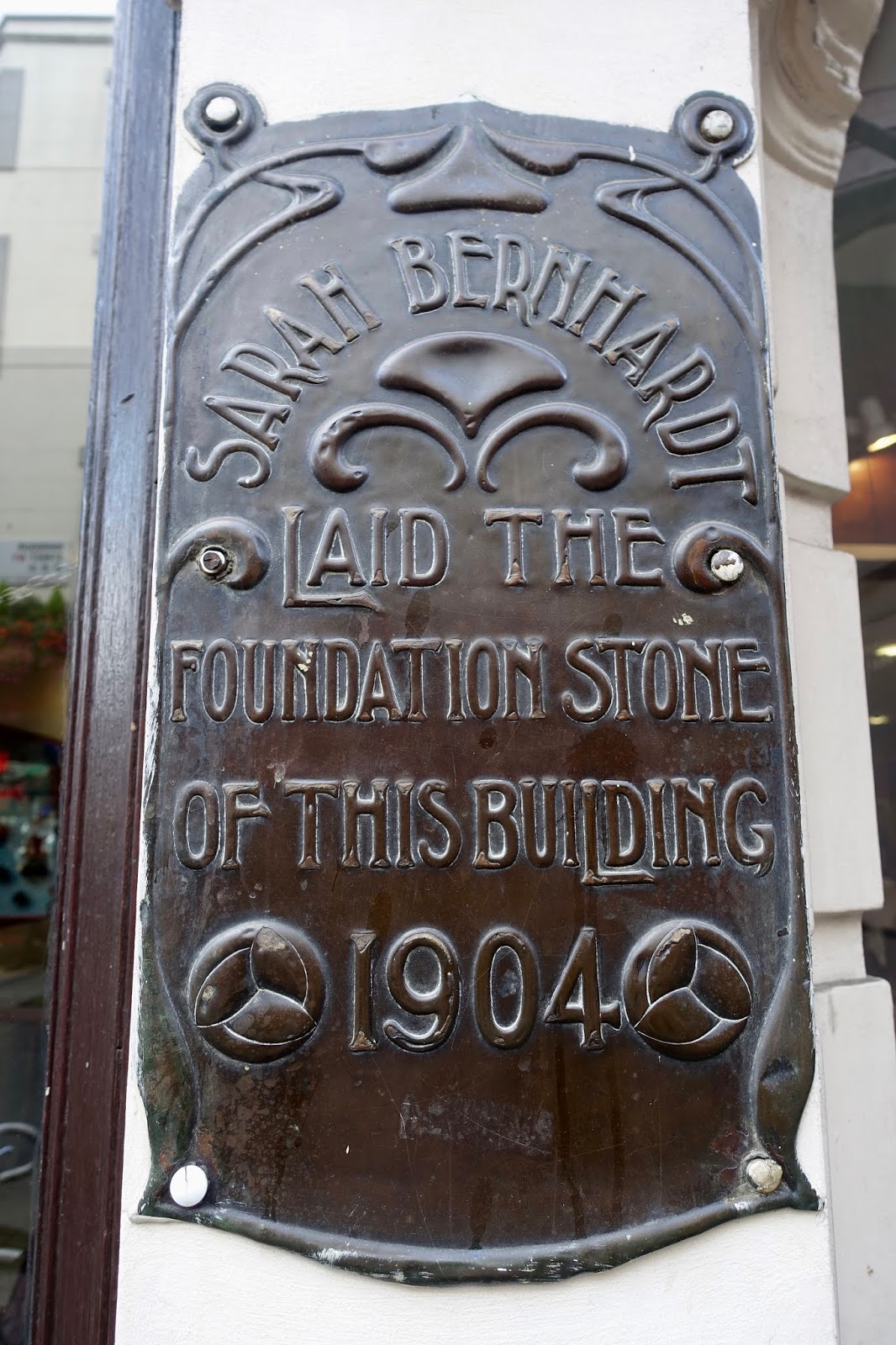
The Wong Kei building has quite a history. Built in restrained art nouveau style, the foundation stone was laid in 1904 by none other than actress Sarah Bernhardt whilst the coping stone was laid by Henry Irving. Both were extraordinary people. Bernhardt was the supreme star of the French theatre during the late 19th and early 20th century even after having a leg amputated in 1915. She also inspired several of the wonderful art nouveau posters of Czech artist Alphone Mucha. Irving was born into a working class family in Somerset, rose to become a luminary of the British theatre and the first actor to be granted a knighthood in 1895.  This building is proof that one should always look up when walking in London. I have a passion for art nouveau but entranced by the menu in the window only recently noticed the obvious architectural features and plaques to Bernhardt and Irving. For many years the building was home to William Berry "Willy" Clarkson's Wigs by Clarkson. Clarkson was not only an excellent wig maker and costumier, but also an accomplished blackmailer and fraudster. Perhaps unsurprisingly he died in suspicious circumstances in 1934.


Dansey Place
Just across from Wong Kei, there is a narrow alley that runs behind a string of restaurants. This is Dansey Place. At first site (and smell) it is neither welcoming nor attractive. However it is worth venturing in if only to visit Lo's Noodle Factory where delicious fresh noodles are made and sold  very cheaply from this "hole in the wall" operation. Peep over the counter and it is possible to see huge sheets of noodles being stretched out before cut and packed into bags ready for sale. There is also a seafood stall in the street and a small, red and green painted grocery shop.

Our friend Willy Clarkson has a connection with Dansey Place too. Before the Second World War the street was a notorious gay meeting place. Men would congregate in a public lavatory opposite Clarkson's shop and which became known as Clarkson's Cottage. It was also a haunt for blackmailers who would extort money from the men - male homosexuality being completely illegal in the UK until 1967. The facility was so notorious that when it was closed in 1945, a wealthy New Yorker bought it and installed it in his garden.

A modern conversation in Gerrard Street
Nice hoardings but another closed restaurant
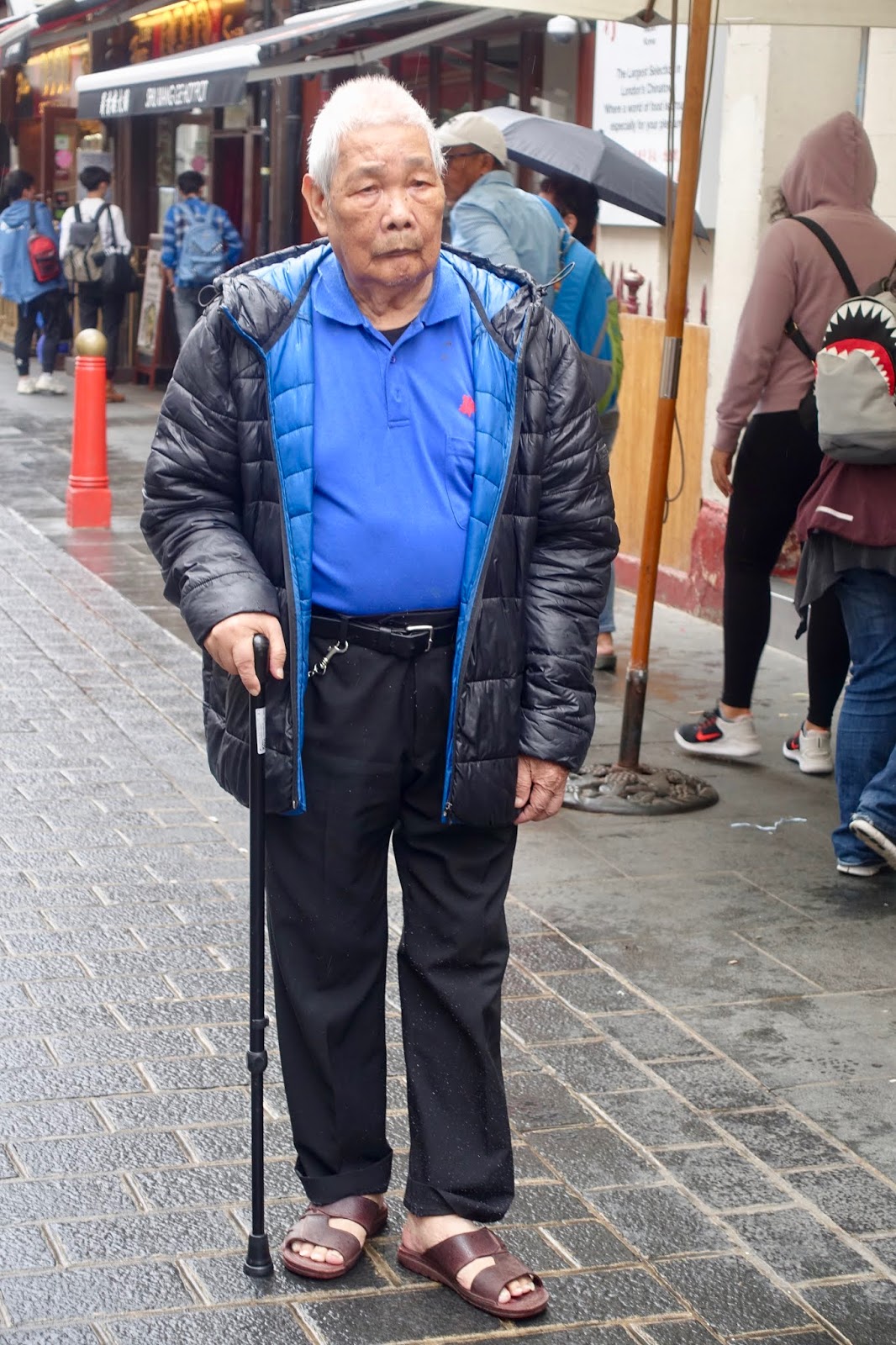
London's Chinatown is small compared to those of say New York, San Francisco, Manila or Melbourne but it is no less interesting. Whatever time you choose to wander its few streets there will be something to see including early morning deliveries to the shops and the restaurants, waiters and waitresses having quick cigarette breaks before the onslaught of lunchtime customers,  people snacking outside the bakeries and the of course occasional street trader. I recently noticed a couple of older men selling garlic and green vegetables spread out on newspaper. I bought something from each of them and asked if they would let me take their pictures. We do not have a language in common but we somehow understood each other and they agreed for me to take their portraits - both extremely amused that I should want to. I have since returned to give them hard copies of the photographs. Both of them were surprised and after looking at the pictures placed them very carefully in their wallets. One tried to give me free garlic in return! Portraits of the two gentlemen are featured in this post.

It is true that we often don't notice the things we see very day and we don't always realise their value or consider them special until they are lost. This tiny enclave in the centre of London is important not only to the various Chinese communities or as a tourist attraction but because it represents an important part of the city's history. The losses due to high rents and the encroachment of unrelated businesses is worrying. It would be shameful if these few streets lost their unique character in the way that much of the neighbouring Soho has.

Gerrard Street
Lisle Street

Saturday, 21 July 2018

Picture Post 69 - The Former Rex Cinema, Bethnal Green.

Half way along Bethnal Green Road in East London stands a rather sad looking building, its facade partially covered in fly posted hoardings and well established weeds visible at the upper levels. This is the former Rex Cinema, one of London's many "lost" Art Deco buildings.


The site was originally occupied by Smarts Picture House which opened in 1913 and was part of a chain of several East End cinemas operated by one George Smart. The original building was the work of architect Philip Tree whose design included a large hexagonal tower, a low entrance facade and a single screen auditorium with seating for 865 patrons. Unlike many cinemas of this period there was no balcony and film goers were all seated at ground floor level. A small stage was available for other types of performance and two dressing rooms were included in the design.

The building was extensively remodelled in 1938 under the supervision of George Coles who was responsible for several cinemas in the Odeon chain of impresario Oscar Deutsch. The tower and facade were demolished and replaced with a new, streamlined design. The new look included a fabulous new tower with a fin at its centre surrounded by a semi-circular recess. Murals were added in the auditorium together with a stepped ceiling and new lighting. The cinema re-opened towards the end of the year as the Rex. The new name was displayed in neon lights at the top of the fin. St. Louis Blues starring Dorothy Lamour and Exposed with Glenda Farrell were amongst the first screenings.

The Rex operated until 1949 when it was renamed the Essoldo and became part of the chain of the same name. The chain was founded by Solomon Sheckman in Newcastle-upon-Tyne in the 1930's. The company name was made up of the first two letter of the names of his wife, Esther (ES), himself (SO) and his daughter Dorothy (DO). Sheckman also owned the former Empress cinema in nearby Hackney.


The Essoldo lasted only a little longer than the Rex had and closed in 1964. Christopher Lee's Devil Ship Pirates was its final screening. Like many other cinemas that closed in the 1960's and 70's, it was converted into a bingo hall but this too closed in 1990. After this, Frankie Trimmings, a wholesale business selling soft furnishing trimmings took over the building. At some point the former large glass fronted boxes that had displayed stills from films were removed but otherwise the building was maintained in relatively good condition until 2015 when the company moved out. Since then the interior has been gutted (and possibly part demolished) and its current condition, at least what can be seen of it, is not good. 

However, there may still be a future for the former cinema as in October last year plans were announced to convert the building into a boutique hotel using the former Rex name with a single screen cinema and a rooftop bar and restaurant. Details of the proposals can be seen here and appear to retain some of the original facade design.

There are some good internal images of the former cinema here.

Thursday, 12 July 2018

London - Modernist Magnet and Art Deco Destination

London has many Art Deco and modernist buildings. The cinemas, theatres and tube stations are well known but represent only a small proportion of the city's inter-war architecture, examples of which can be found right across London, often in unexpected places. Many of these buildings deserve to be better known, including those featured in this article. 

Ibex House is possibly one of London's best kept architectural secrets and a superb example of  streamline modernism. Tucked away in the East End, near Tower Hill, it was built in 1937 and was designed by architects Fuller, Hall and Foulsham who also designed Blenstock House, the famous Bonham's art auctioneers' showrooms in the more fashionable West End.

Ibex House, Fuller, Hall and Houlsham, 1937.
Inspired by Erich Mendelsohn's Schocken Department Store in Berlin, Ibex House was built on a steel frame and rises to 11 storeys including a basement. It is clad in striking black and beige faience and has the longest strip windows in London. It also has some beautifully curved elements, recessed upper levels and dramatic glazed "thermometer" stairwells on one side of the building. The original stylised lettering displaying the building's name has been retained as have the wonderful curved glass windows of the ground floor Italian cafe. 

It is a huge building and with 200,000 square feet of office space it is London's largest remaining office block of the 1930's. In 1937, space was offered here for a rental of six shillings per square foot, inclusive of cleaning. I am sure that today's rate is significantly more! As with many buildings in this city, Ibex House has a story attached to it. It is said that Hitler wanted it for his command headquarters should he have been successful in invading the UK and therefore ordered that this area not be bombed. I am unable to verify the truth of this but have heard a similar story about Senate House and the University of London. Given that the Nazis were generally disdainful of all things modernist it seems unlikely, but nonetheless is a good yarn. The building received Grade II  listed status in 1982, protecting it from the fate of several of its former neighbours, demolished to make way for new office blocks. 

4 Valencia Road, Douglas Wood, 1934.
Stanmore in North-West London is one of several places that were developed due to the extension of the Underground system in the 1930's. The extended network brought many former villages on London's periphery within easy reach of the city and work. Many more affluent families chose to move out into what became known as Metroland, attracted by the benefits of a better environment as well as rapid transport to their place of work. 

Stanmore Underground Station opened in December 1932 and the previous year permission was given for a residential development on the land around it. As part of this development, architect Douglas Wood designed numbers 2, 4, 6 and 8 in Valencia Road, all of them in art deco style. Now a private road, it has been included in one of the local authority's conservation areas. In 2015 number 4 was restored under the supervision of English Heritage before being offered for sale at a cool £1.75 million. It has five bedrooms, five bathrooms and a variety of other spaces designed over three floors. There are two roof terraces and a spectacular staircase with a brushed chrome bannister and glass panels. The original Crittal windows have survived but have been double glazed to cope with the English winter. 

The house was completed in 1934 and was originally the property of Attilio Azzali who came to London in 1926, fleeing poverty in Italy. He settled in the Kings Cross area where he established a restaurant and then two more in other parts of the city. According to the Azzali family legend he brought his wife Elvira to Stanmore for a day out in 1932. He fell in love with the area which would still have been rural then and so purchased one of the four houses being built by the Douglas Wood Partnership. The family retained the house until 2009 when it was sold and restored.

Kingsley House, Peter Caspari, 1934.
Still in North London, Willesden Green is home to another magnificent modernist building. Kingsley Court is surrounded by large, slightly forbidding Victorian houses common across this part of London. Architect Peter Caspari designed the building for Davis Estates. Construction commenced in 1933 and was completed the following year. There are 54 flats over six storeys designed on a z-shaped plan in part due to the very narrow site at the junction of two roads and adjacent to railway tracks. Caspari worked creatively within these restrictions, producing a design with undulating and recessed features, a tower on the curved corner and a white banded facade on the main road. The main entrance is set in a curved protruding lobby, topped with fenestration and leading to a recessed central stairwell. The glazing is divided by four white bands echoing the thicker rendering on the main facade. Kingsley Court was granted Grade ll listed status in 2000.

The architect was a German Jewish refugee who had been an active member of an anti-Nazi organisation. He fled Germany in 1933 after being tipped off by his chauffeur that he was to be arrested, first going to Switzerland before coming to London. He quickly learned English in order to secure work and Kingsley Court was one of his first commissions. It has been described as the first Expressionist building in the UK which should come as no surprise since Caspari had previously worked with Erich Mendelsohn as well as having had contact with Walter Gropius and Mies van Der Rohe. He would design one more apartment block in London before emigrating to Canada after the War, where he was responsible for several buildings in Toronto and Calgary.

Cholmley Lodge, Guy Morgan, 1935.
Cholmley Lodge in Highgate was built in 1935 and was the work of Guy Morgan. Morgan also designed the more well known Florin Court in the City of London which has featured in a number of episodes of the TV series "Poirot". The Lodge has about 50 flats and has an unusual and striking facade with a deep scooped recess. It was constructed with yellow bricks and cast stone with steel horizontal bar casement windows. There are four entrances with fluted surrounds and a curved canopy, each bearing the name of the block in stylised lettering. Boldly projecting, squared off balconies on every floor enhance the overall impact. Each section has a staircase tower leading to a flat roof designed as a sun deck and which must offer spectacular views across the city. Reflecting both the modernity and class divisions of the 1930's, the design included a series of lifts for residents and separate staircases for tradesmen - the latter at the rear of the building. It received Grade ll listed status in 2003 for both architectural and historical interest.

If things had gone as planned, Cholmeley Lodge would never have been built in London. It was originally intended for Bournemouth but was rejected by the local planners as they found the ultra-modern design too stark and demanded that the elevation be softened with Tudor style timber work. Thankfully, the architect refused to comply and Bournemouth's loss became Highgate's gain. The apartments are considered to be very desirable and in 2016 one sold for £1.3 million.

I suspect few people would put Whitechapel on a list of places to look for London's best Art Deco or modernist buildings. However the area has a number of impressive examples of the style, including Gwynne House which is tucked away in a side street behind the Royal London Hospital. Completed in 1938 it is one of three remaining modernist buildings in the East End that were designed by Hume Victor Kerr. Built on a reinforced concrete frame, its neat walkways and striking tower are reminiscent of some elements of Bauhaus architecture and provide a sharp contrast to the older houses that surround it. The tower was built to house a lift and stairs to each level and originally contained a telephone kiosk for the use of residents. Each flat had two bedrooms, a living room, a small kitchen and a bathroom. The design also made provision for heat conservation and the walls were insulated with cork.

Gwynne House, Hume Victor Kerr, 1938
The twenty flats were intended to attract students, social workers and professionals who would not only benefit from the modern design but also from the services of a caretaker who was housed in an additional flat on the roof. Over the years a number of tenants worked at or were otherwise connected with the Royal London which for some years provided subsidised accommodation here for nurses and trainee doctors. In 2012 the building was sold to developers who undertook renovation and then offered the flats for sale. The metal fence at ground floor level is thought to be original but the porthole doors are not and were added during the renovation, presumably to enhance the nautical references. Although Whitechapel remains one of the cheaper areas of London in which to buy property, a flat in Gwynne House could set you back about £0.5 million.

These are just a few examples of London's large and impressive collection of Art Deco and modernist buildings which as well as apartment blocks and offices include a recently restored swimming pool, a former laundry and even a car park. The city should be on the list of must visit places for all deco devotees.

This article will appear in a forthcoming edition of Spirit of Progress, the quarterly magazine of the Art Deco and Modernism Society of Australia. The Society organises walks, talks and other events across Australia but the membership is drawn from all over the world. You can see their Facebook page here.