Showing posts with label Yangon. Show all posts

Wednesday, 13 May 2020

The Ahuja Family And Early Burmese Photography.

From 1824 to 1937, Burma (today's Myanmar) was ruled as part of British India. It was then governed as a separate entity until independence in 1948. During the colonial period, many Indians came to live, work and establish businesses in the country. It is estimated that there are over 900,000 people of Indian ethnicity living in Myanmar today, many of them the descendants of those who came in the 19th and early 20th centuries. The Ahuja family arrived in Rangoon (now Yangon) in 1885 when D.A. Ahuja acquired the Kundandass and Co. photographic studio. There is a division of opinion about where the family came from. In his excellent book, Burmese Photographers, Lukas Birk suggests they came from Shikapur, Sindh in what is now Pakistan but at least one other source refers to them as Punjabis. 


1901 was an important year for the business. In addition to changing its name to the D.A. Ahuja Studio, our man published a guide to "Photography in Burmese for Amateur Photographers" and his nephew Tickamdas Naraindas Ahuja (T.N.) joined him from India. The studio thrived, attracting customers from the British community as well as from local families who came to be photographed or to buy cameras and photographic paper imported from India. The success of the business is demonstrated through the studio being located on the first floor of a building at 47 Sule Pagoda Road, in the heart of downtown Yangon. There is anecdotal evidence of the business surviving there until the 1960's.

Around 1906, D.A. acquired a number of pictures taken by German photographer Philip Adolphe Klier. The collection included architectural and highly stylised ethnographic pictures taken in different parts of Burma. Ahuja began publishing the pictures as postcards but there seems to have been some problem about how he acquired these works and in 1907, Klier took successful legal action against him. Losing the legal battle was only a temporary setback as in 1909 Ahuja purchased the archive of Italian photographer Felice Beato and also became the legal owner of Watts and Skeen, a studio established by Frederick Skeen in 1887. The Skeen family also had a photographic business in Ceylon (now Sri Lanka). Beato's archive included landscape works, stylised portraits and also war photography from Japan, China and the Middle East. Klier died in 1911 and from 1914, Ahuja resumed producing some of his pictures as postcards. He was to publish 600 cards over the next 20 years, some of which can be found at card sales or occasionally on eBay. The cards were sent to Germany to be chromo-lithographed, ensuring the best quality finishes.


The postcards cover a wide range of subjects. There are several studio shots of elegant women, slightly stiff looking family groups, important monuments, snake charmers and dancers. There is also at least one card showing prisoners in Rangoon jail queueing to collect their food which whilst fascinating is an unusual image to send to the family back home.

D.A.'s nephew, T.N. opened his own studio in 1916 with a shop at 86 Phayre Street (now Pansodan Road) where he operated as an agent for Kodak products. There is some evidence that he also served as magistrate. Business was interrupted in 1942 when the family fled before the arrival of the Japanese but they quickly returned to reopen the studio at the end of the war. In 1948 T.N.'s son, R.A. Ahuja opened another studio at 386 Dalhousie Road (now Maha Bandoola Road). The store became the sole agent in Burma for the sale of Gevaert products and operated until 2007. R.A. the last remaining member of the Ahuja family in Burma died in 2014, bringing almost 130 years of their presence in the country to an end. The date of D.A.'s death is unknown.

The images included in this post are from reprints of the cards I purchased from the Yangon Heritage Trust at 22-24 Pansodan Road in 2017. The Trust is a great source of information on Yangon's built heritage. As well as selling books, maps and postcards, it stages occasional exhibitions and guided walks.  I have a habit of buying postcards on my travels and then putting them "somewhere safe" when I get home. During the lockdown I have been sorting through my collection and rediscovered my Ahuja cards. I also turned back to the already mentioned  excellent book by Lukas Birk which has a short section on the Ahujas.  Birk is an accomplished traveller and photographer whose projects have included research into the now almost disappeared box cameras of Kabul. 


D.N. Ahuja also produced postcards featuring images from India, some of which may have been his won work. You can see some of them on the Paper Jewels website.

It is not possible to confirm which of the images featured in this post are the work of the Ahuja family or are from other photographer's archives.


You can see more pictures from Myanmar here.

Sunday, 2 February 2020

Faces of Yangon

Yangon is one of those cities that tourists visit for a couple of days, go to the main attractions and then leave thinking they've seen everything. They are wrong. True, it may lack the sophistication of some major Asian cities, has little in the way of nightlife and its public transport system can be challenging. But none of this matters when there is something, or someone, interesting around every corner. The eclectic mix of architecture that includes Indian and Chinese influences, crumbling survivors of the colonial period and classic Burmese style pagodas is reflected in the diversity of the people, many of them happy to share their story with interested passers-by.

Buddhist monk on Yangon's Circle Line train
The best place to see this rich mix is of course in the streets, particualrly the numbered lanes that cross the main boulevards of the city centre. From 17th Street to the high 20's it is a good idea to look up and admire the many remaining shop-houses, some of them 100 years old. Built to accommodate a commercial purpose on the ground floor with a residential unit above they are beginning to fall victim to developers so go and see them now. Some have retained their wooden facades and in 19th street in particular there are a number of Clan Association buildings with Chinese signage and the occasional, live, fighting cock tethered outside. There are also numerous markets. 17th Street hosts a famous daily street market as does the upper end of 38th Street, both of them selling all kinds of fresh fruit, vegetables, meat and fish as well as flowers, spices and other goods. The famous Bogalay Zay and Bogyoke markets are also worth a visit although the latter a little too touristy for me nowadays. Outside of the organised markets there are countless, often "informal" vendors selling snacks. fruit, household goods or offering various street side repair services.

Happy vendor, 17th Street
Waiting for customers, rickshaw driver, 14th Street
Interesting as the architecture and sale goods are, it is of course the people of Yangon that bring these streets to life and who hold a special attraction for me. They also make this one of the most photogenic locations I've ever visited and in general people are happy to pose for photographs. It is also relatively easy to take candid shots of the city's street life. One of the iconic sights of Yangon and Myanmar generally is the daily procession of Buddhist monks and nuns collecting donations of rice, other foods and sometimes money from the faithful who hope to gain merit from this good deed. I often find this to be can a moving sight as some of the nuns in particular are very young, many of orphans or from families too poor to look after them.

Breakfast in the San Pya fish market
Shy porter, Thiri Mingalar wholesale market
As well as walking the streets of Yangon, I enjoy visiting the huge wholesale markets located just a short distance from the city centre. The San Pya wholesale fish market and the vast Thiri Mingalar fruit, vegetable and flower market receive few foreign visitors.  So few that I don't recall seeing a single tourist during any of the visits I've made. The workers may be a little surprised to see a foreigner but are nonetheless very welcoming. In most cases they are too busy to spend much time talking but the workers are generally relaxed about being photographed. This makes up for the overpowering smell at San Pya which permeates everything and which will require you to send all of your clothes to the laundry after a visit!  Waterproof boots are also strongly advised if visiting.

This cheeky pair followed me around Thiri Mingalar until I took their picture
Worker with neck tattoos,  San Pya fish market
During my most recent time in Yangon, I had the privilege of visiting the neighbourhood of a good friend who I first met as a guide four years ago. Yuzana Garden City is about a thirty minute drive from the city centre. Primarily a residential area, it also has a large, busy market selling the usual food items and household goods. Until recently the market location was not busy as the vendors preferred to set up shop at the roadside. This may have been good for business but it prevented traffic from passing or in some cases even entering the streets. The local authority stepped in and there is now enforcement in place to prevent this behaviour - although it doesn't stop some vendors sneaking back to the street side in the afternoons!

As we walked through the market, people called out "hello"and "where are you from" - something that I have experienced in my travels in many countries, but here they also like to tease. The female vendors in particular have a good sense of humour, suggesting I might like to marry their friend or take them back to London with me. Several of them claimed me as their relative when neighbouring vendors expressed surprise at seeing me. My kind of humour. Here, not only were people happy to be photographed but some also requested me to take their pictures or those of their friends. I often find that when someone volunteers their friends for a picture, what they really mean is they want one of themselves but are too shy to ask. My hour or so in the market here passed very quickly and I am extremely grateful for the experience.


Herbs vendor, Yuzana Garden City
Snacks vendor, Yuzana Garden City
Rickshaw driver waiting for customers, Yuzana Garden City
I've written several times about the etiquette of photographing people in the street but it's worth mentioning a few things again. If I want to take a close-up or a more "formal" portrait, I always seek permission first. I wouldn't want someone to come up to me shove a camera in my face and then walk off. If I can I make efforts to talk to the person a little before requesting a picture. It's helpful to walk with someone local as they can interpret and also advise on any important issues that might not occur to an outsider. If I want to photograph children I always ask the parent or an adult accompanying them and I never photograph children who are alone. In markets I often buy something from a vendor first. This works better in some cases than in others. Buying a few pieces of fruit is not a problem and they can always be given to someone who needs them more than me. Fish, meat or live animals is a bit more of a problem! Obviously for candid shots things are a little different but it is still important to be sensitive and if someone says "no" or indicates they are unhappy with being photographed then accept this graciously and point your camera elsewhere. It is always good to show people their pictures on the camera screen and if possible to print copies and take them back to the although this can be difficult due to one's schedule or because it can be hard to find the people again.

The portraits featured in this post were taken over five days in January this year. I printed copies and was able to distribute some of them. I plan to continue this project and to capture the stories of some of Yangon's people during my next visit.


You can see more pictures from Myanmar here.

And to close, some more citizens of Yangon...

Rakhine woman, fruit vendor outside Indian Bazaar
Buddhist nun, 18th Street
Vendor, 17th Street
Alone and watching the world go by, 17th Street
Just me and my phone, porter in 17th Street
Ponderous look, 38th Street
Preoccuiped smoker, Merchant Road
Mister Ayoob, merchant in 41st Street
Time for a rest, 17th Street
Confidence, Innsein township, Yangon suburb 

Monday, 21 January 2019

Return to Yangon

I love Myanmar. I l especially love Yangon. That may surprise some people. Most visitors choose to spend only a couple of days in this former capital city, see Shwedagon and then head off to Bagan or Inle. But they are missing out on the glorious chaos of Yangon, a chaos lived out in streets that teem from early morning to late at night. It is two years since I was last here and much has changed. There more restaurants and banks and trendy cafes have popped up in surprisingly large numbers. Best of all, efforts have been made to clean up some parts of the city and to improve the environment of those living there - although a huge amount remains to be done.

Yangon is a city of contradictions. The influence of Buddhism is everywhere with monks and nuns a constant presence in the streets and yet the Muslim call to prayer is heard throughout the day. There are also Hindu temples, churches of various denominations and a synagogue that serves the remaining 20 Jewish residents of Yangon. There is even a Jain temple although that may now be without a congregation as I understand there are no longer any resident Jain families. The built heritage is also astonishingly diverse and includes some of the finest colonial period buildings in Asia. Many are decaying, some have already lost and others are being saved including the Burmese Favourite department store, established in 1918, empty since 2005 and now undergoing restoration.

Arched windows, Chinatown
Colonial building, Downtown Yangon
Entrance, Chinese temple
The best way to discover the secrets of a city is to explore it on foot and so during my recent visit I spent many hours strolling through the numbered streets, arranged on a grid system like that of New York. I delighted in wandering up and down the lanes, finding markets I didn't know existed, using my ten or so words of the Myanmar (Burmese) language to engage with people and to secure a photographic record of my trip. Knowing those few words  - hello, how are you? thank you - was in many cases enough to win the warmest of smiles and a hearty response, even if preceded by a look of surprise. There were some linguistic surprises for me too such as the two boys playing football in the courtyard of a Chinese temple, keeping score in English and pretending to be Manchester United against Arsenal.


I have already mentioned the ubiquitous presence of monks and nuns. They can be seen everywhere, collecting alms in the mornings and then walking the streets throughout the day. The monks early morning round to "collect the rice" is a disciplined affair, barefoot in all weathers and locations including the wholesale fish market where the ground is covered in waste. In the mornings people stand at the side of the road waiting for them to pass so that they can donate to them and then receive a blessing.  Most Buddhist men will spend at least some time as a monk even if they choose to do so for a short period before returning to secular society. There is no such obligation for women but the nunneries (like the monasteries) take in orphans and children from poor families unable to look after them. Many of the girls out collecting are extremely young, even less than ten years old. They usually walk in pairs or small groups but I came across larger groups of eight or ten on a couple of occasions.

Despite being an experienced traveler, I felt protective towards these children and began buying fruit in the mornings in order to give it to them as they passed by. I was aided in this by the generosity of some of the vendors who for reasons best known to themselves insisted on giving me extra fruit but refused to accept additional payment. I encountered this behaviour on many occasions during my time in Myanmar. But back to the nuns. On one morning having already given away all of my fruit I placed a few bank notes into the collecting bowl of the smallest girl in a very young group. The others immediately surrounded me calling out and holding up their bowls. How could I refuse? I could only think of my own grand daughters and how I would feel if this was their life. On a lighter note nuns come in all ages. I met two older women sitting outside Bogyoke Market. I asked if I could photograph them. They agreed but asked me to wait a moment to allow them to tidy up their clothing, taking my request very seriously.

A young monk at the fish market - notice the bare feet
Mister Ayub with his portrait
Ko Mint Lwin
Daw Khin Eye
If I have time and can find somewhere to print from a USB I try to return to the people who have allowed me to photograph them and present them with a copy of their picture. In Yangon I was able to do this for several people. These included some interesting characters. Mister Ayub has a shop in 29th street. His family came to the then Burma from Surat, Gujarat in the 1840's, established a business and have been in Yangon ever since.

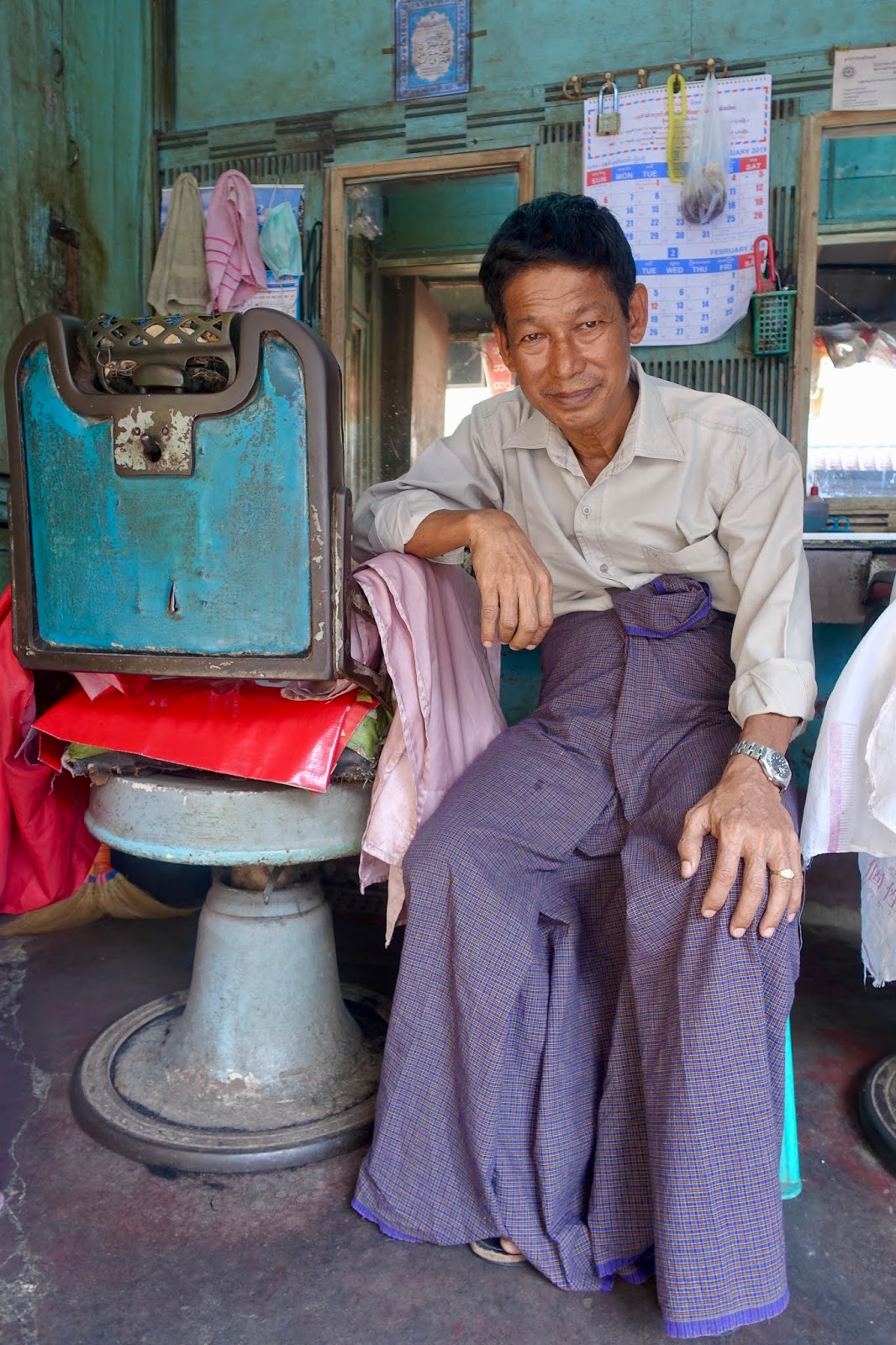
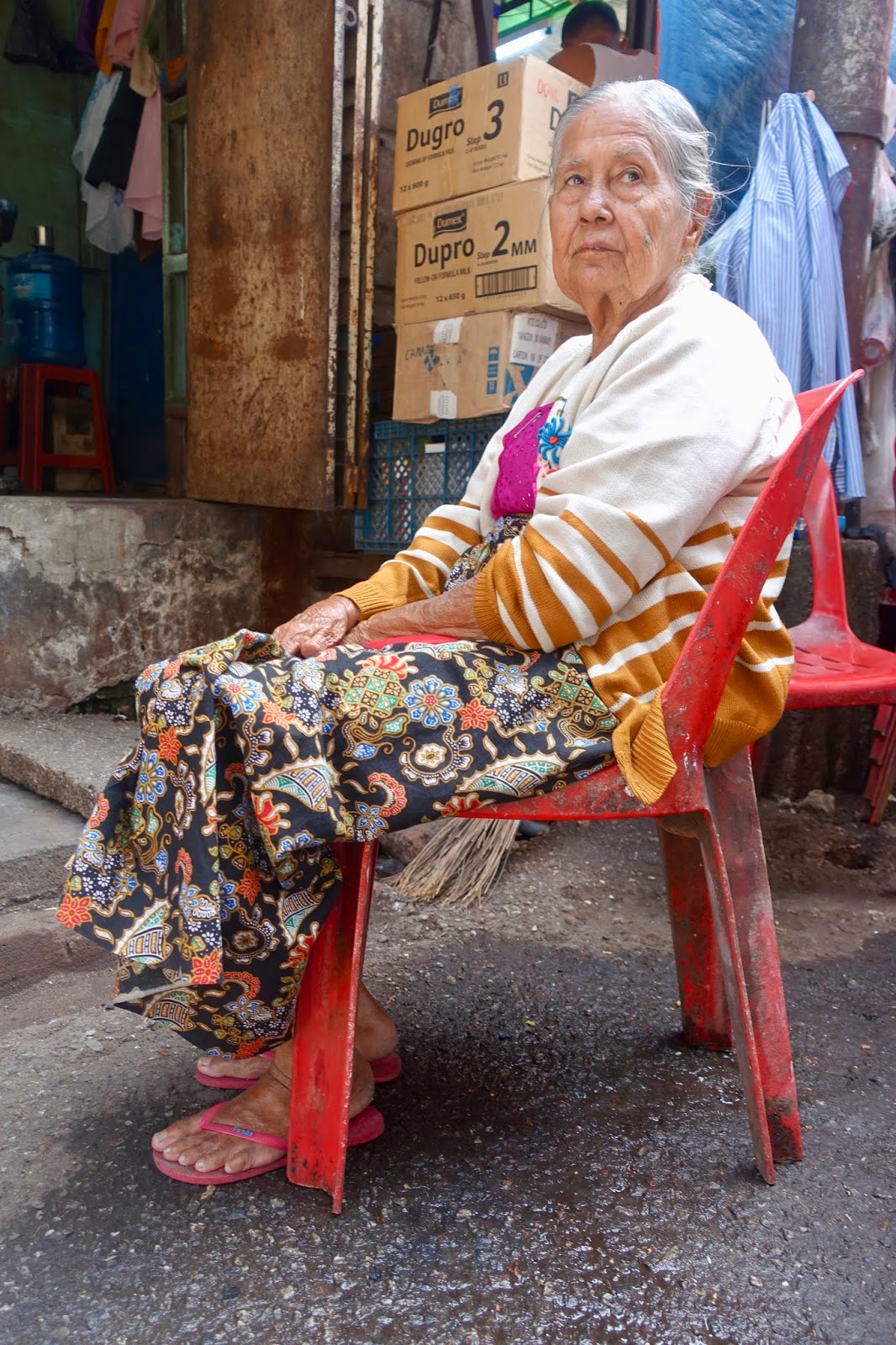
Ko Myint Lwin is a barber. I noticed his open fronted shop and its very old furnishings as I walked the streets on the first day of my trip. His elderly mother, Daw Khin Eye was sitting outside the shop and told me that she thought that some of the chairs originally came from the UK. I treated myself to a 30 pence haircut when I returned to hand them copies of their pictures.

Ten years ago I bought myself a Vivienne Westwood sweater that I can't bear to part with. It has been repaired many times and I needed to repair it again in Yangon. U Zaw, owner of a small tailoring shop in the Bogalay Zay market fixed it for me on my second day in Yangon. He established his shop, New Land, in 2016 when he moved to the city from a much smaller town. It was also a new profession for the family as his father was an engineer who worked on the railways. U Zaw did not want to accept payment from me saying that I was a guest. I insisted on paying but again, the cost was less than a pound. He works on an old Singer machine.

U Zaw, a tailor with a generous heart
Dried fish vendor, wholesale market
Informal street market, Downton Yangon
Yangon is a city of markets including huge wholesale fruit, vegetable and fish suppliers, smaller more local affairs and large numbers of seemingly informal vendors grouped together in particular streets. On this visit I walked from my hotel in 38th to 13th Street, enjoying the chaotic scenes of Chinatown and the Indian Quarter. Here amongst the old but surviving shop houses I saw chickens being plucked in enormous vats of water, meat of all kinds being cut up and displayed and snacks, fruit, vegetables and household goods on sale. Vendors call out to attract customers and delivery vehicles manage to manoeuvre amongst the most crowded and narrow of streets, albeit not always successfully. On my final day in the city I saw a delivery van accidentally overturn the stall of a woman selling fruit. Some very severe words were exchanged despite the driver getting down from his truck to help put things right.

Porter, wholesale market
A cleaner environment
Since my last visit some efforts have been made to clear the once horrifying alleys that are hidden between the numbered streets. Previously piled high with domestic rubbish and overrun with rats a number have been cleaned up by Doh Eain, an NGO that works with artists to beautify public spaces. A few simple swings and slides have been installed and the local children now have somewhere safe and pleasant to play. The project was paid for through crowd funding, perhaps demonstrating the scale of the challenge and the competing priorities in a country trying hard to deal with many issues. Small scale community based projects such as this are important in supporting people to look after their own environment.

Regular readers will know that I sometimes struggle with food when traveling. This is because I am  1) a vegetarian 2) addicted to coffee and cake 3) picky. Yangon coped admirably with me. I returned to my old favourite Pansuriya which has good coffee and a variety of tasty vegetarian dishes. Food is served in a large airy room decorated with old pictures of Yangon and other memorabilia. But I also have a couple of new favourites. Rangoon Tea House is a modern version of an old idea, serving good tea and coffee, a big range of Myanmar traditional food and dishes influenced by other cultures. And for the most authentic experience, nothing beats Lucky 7 Tea House. A huge cafe, it is busy from morning to night, has great staff, serves great tea and the tastiest samosas I have ever eaten - and I've been to India twice.  You might need to wait for a table at both places, but the wait will be worth it. And what about cake? Well, there's always the Strand Hotel's cafe.

I said at the beginning, I love Yangon. I can't wait to return - and I won't wait two years next time.

You might also like Myanmar Journey Part One - Yangon

You can see more pictures of Myanmar here

Sunday, 12 February 2017

Jewish Yangon

The Musemah Yeshua Synagogue in Yangon's 26th Street is a glorious reminder of a once thriving Jewish community. Today there are no more than 20 Jews resident in the city - the remnant of a community that peaked at about 2,500 before the Second World War. The main Jewish holidays are still celebrated in the synagogue with the congregation augmented by visiting tourists and at least some of the up to 100 Jews from other countries who work for various organisations in Myanmar. 
Synagogue entrance
I was able to visit the synagogue during my recent tie in Yangon and to admire the light, airy, beautifully maintained building, on the edge of Yangon's India Town and not far away from the city's last remaining Jain Temple. The entrance is discrete but clearly signed and visitors are offered a warm welcome six days a week - the building is closed on Sunday. Completed in 1896, it has beautiful stained glass windows, ornate decorative details around the bimah and beautiful bamboo and teak seats, reflecting local traditions and tastes. Despite being tucked away in a side street, the interior is very light and airy and does not have the air of sadness of many European synagogues with communities of similar size but different history. 


Myanmar's first Jews arrived in the early 1800's - merchants and traders from Calcutta, most of them members of that city's Iraqi Jewish community, originating from Baghdad. They were involved in a range of trades including textiles, timber, ice production and bottling. Some members of the community became influential and prominent in civic life and one place was allocated to the community on the Yangon (then Rangoon) Municipal Committee. Participation in public life reached a peak in the early part of the twentieth century with the appointment of Jewish mayors to both Yangon and the smaller city of Pathein (then Bassein). 

Brothers Judah and Avraham Ezekiel came from Baghdad to Myanmar in 1840, settling in Mandalay and worked for the Burmese monarch, King Mindon, as accountants or bookkeepers. At some point the brothers quarreled, separated and Judah moved to Yangon where he became so successful that a street was named after him possibly due to his philanthropy which included paying for the metaling of the road. He ensured the care of "his" street by leaving nine rupees per month in his will for its ongoing cleaning. He appears to have been a larger than life character in all senses of the term. Almost Englishmen a short history of the Jewish community in Myanmar includes a story describing the reluctance of rickshaw drivers to carry him due to his large size which on one occasion caused him to go through the floor of a carriage.

Sofaer building, Merchant Street
Isaac Sofaer was another prominent member of the community. Born in Baghdad in 1867, his father brought him to Yangon at the age of nine. On completion of his education he worked for a wine and spirits company before going into business with his brother Meyer in 1893. Messes Sofaer and Co also sold wines and spirits and became involved in exporting rice. Isaac was not only a successful businessman but also took part in civic life supporting organisations such as the Agricultural Society and the Burma Pasteur Institute.

He was also responsible for the design of the elegant and imposing Sofaer building, completed in 1906 and which still stands today on the corner of Merchant Street in the city centre. The building once housed the Reuters telegram office, a Filipino hairdressers and shops selling Scotch whisky, Egyptian cigars and English sweets. The design included ceramic floor tiles, imported from Manchester and arranged in a green, gold, lapis lazuli and burnt sienna mosaic. Some of the original tiles still remain. The building today is a shadow of its original self but there are signs of recovery with Gekko, a very successful Japanese restaurant taking space on the ground floor as well as one or two shops selling tourist items. The Lokanat Gallery on the first floor is the city's longest established independent gallery.

The golden age of the community ended abruptly in 1941 when most of its members fled as a result of the Japanese invasion. Although some people returned at the end of the war, the much reduced numbers made it difficult to sustain community life. In addition to this here were various disputes about the management of the community, which did not help matters. These and other issues are detailed in Ruth Fredman Cernea's excellent book Almost Englishmen: Baghdadi Jews in British Burma which charts the history of the Jews in Myanmar. There was a second wave of departure in the 1960's following nationalisation of almost all the country's businesses. There has been no rabbi since 1969 and kosher meat is not available. Community members compromise with halal produce.

Shop sign with a Magen David "for luck".
Despite this, you could be forgiven for thinking that Yangon's Jewish community is much larger than it really is. This is because it is possible to see a Magen David (Star of David) displayed outside many businesses across the city. This is not that the businesses are Jewish owned but rather that some locals believe the symbol will bring them luck and success. However there is at least one building with a Magen David on its facade that does have strong Jewish links. The wooden building in the picture below, close to the magnificent Shwedagon Pagoda complex was once Jewish owned and the location for an ice factory. Look closely and you can see the Star at the apex of the facade. The community may be very small, but its presence and achievements live on through the synagogue, the Sofaer building and through symbols such as these.  

Former Jewish owned ice factory with Magen David on facade
Visitors wishing to know more about Myanmar's Jewish history might like to contact Myanmar Shalom  which can organize visits to the synagogue and to the places connected with the community's history.

You might also like - Myanmar Journey Part One - Yangon

You can see more pictures of Myanmar here.