Showing posts with label Travel - Italy. Show all posts

Wednesday, 8 July 2015

Milano 2015 - a day at the Expo

I recently visited Milan for the first time and whilst there had the chance to spend a day at Expo Milano 2015, which has chosen Feeding the planet, energy for life as its theme. 145 countries are represented at the Expo, many with their own stand alone pavilion whilst others have grouped together in regional clusters or under particular themes - including coffee and chocolate - each of which have several countries exhibiting on the same theme but showing different approaches to production. What a treat!

Waiting to get into Ecuador's pavilion
The pavilions are set out in a temporary boulevard, 1.5 kilometres long and the whole site covers 1.1 million square metres of exhibition space. 20 million visitors are expected before the Expo ends and there were many thousands of visitors on the day I attended. The gates open at 10 am and I made a point of arriving very early in order not to have to wait. This was a good decision as there were already lengthy queues at the ticket desks half an hour before opening - I bought my ticket in advance!

One of my main reasons to visit was to enjoy the architecture of the pavilions. I was not disappointed. There is an extremely eclectic mix of styles and approaches ranging from the austere modernity of the Sudanese pavilion, to the inventiveness of the Polish structure, and lets be honest, the crassness of some that shall remain nameless!!! It is hard to pick out favourites to feature so what follows are just a few of my the highlights. 

Entering the Expo site one of the very first pavilions visitors come to is that of Brazil. A long queue had already developed here within half an hour of the gates opening. Designed by Arthur Casas and Marko Brajovic, the structure included a netting walkway suspended above the floor of the pavilion, from where visitors can look down at the plants growing below. The accompanying exhibition illustrates Brazil's approach to research in models of consumption and production, combining technology, culture and society. 

Brazil's pavilion
A little further along the boulevard, the Israeli pavilion explored similar themes. The presentation covered Israel's significant contribution to developing sustainable methods of agriculture, particularly in relation to efficient use of scarce water resources which have helped turn many of its dessert areas green. These methods have been shared with other countries as have developments in desalination. The theme of the Israeli pavilion Fields of tomorrow is further demonstrated by the exterior of the building which features a green wall, divided into rectangles and growing different varieties of grasses and crops. The pavilion is the work of accomplished Israeli architect David Knafo who has built a reputation in the field of sustainable architecture having won the Agro Housing competition in Wuhan, China.

Israel's pavilion
I enjoyed the fun approach of Brazil's pavilion and the inventiveness of Israel's, but I have to admit that the Polish pavilion combined both of these elements with a really well thought out response to the theme of the Expo with its apple crate wooden structure, magnificent secret garden, contextual film,  shop and restaurant both of which showcased Polish cuisine and food production.

The pavilion is entered through a narrow alley leading to a staircase which in turn leads visitors to the secret garden with its winding path between the flowers and herbs, reflective walls and gentle music. The peaceful ambience of this very hidden space is a welcome respite from the huge crowds on the boulevard and I enjoyed the very delicate and interesting version version of  Theme from a summer place that was being played as I strolled through. The pavilion was designed by Piotr Musialowski of the 2PM architectural firm. I loved the simplicity of the overall design, the surprise of the garden and yes, even the colours of goods shelved in the shop, Polish pickles, preserves and alcohol. Well done Poland.

The entrance to the Polish pavilion
Poland's secret garden
I had to visit the British pavilion twice before I could get in. On my first attempt the queue for entry was discouragingly long and so I retreated to the coffee cluster - more of which very soon. I am very happy that I returned and managed to get inside on the second attempt. Accessed by a maze, the pavilion is visually stunning - a metal construction that from the distance resembles a huge swarm of bees and which was inspired by the unique role of hives in our ecosystem. The design, which is the work of Wolfgang Buttress combines excellent designs with strong environmental credentials. The accompanying explanations include references to the UK as a hive of industry and standing underneath the pavilion and looking up into the mesh of the "hive" the movement of visitors at the upper level really does resemble bees at work. 

The British pavilion was so popular that stewards were employed to manage the flow of traffic through the heart of the hive, extolling us to keep moving so that more people could enter. As with many of the pavilions, efforts were made to display national cuisine. The Pimms may have been a cliche but the availability of chips was a very nice touch! 
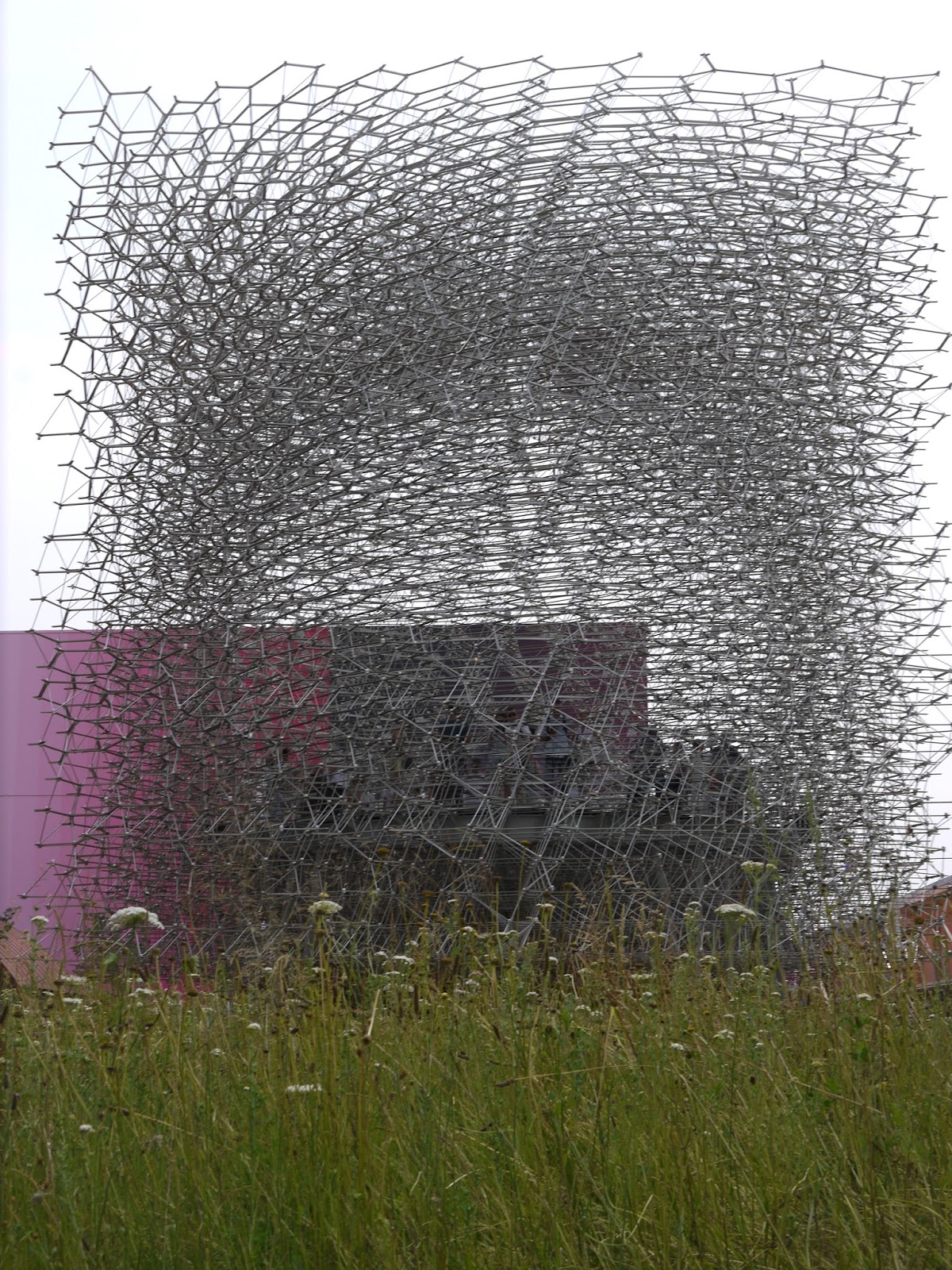
Britain's hive of industry
Which leads me back to coffee. In addition to the stand alone national pavilions,there are also a number of "clusters" based on particular themes. Friends and regular readers will know that my shoes were magnetised to this group of small pavilions which included contributions from Burundi, Dominican Republic, El Salvador, Ethiopia, Guatemala, Kenya, Rwanda, Timor-Leste, Uganda and Yemen. I managed to get a look in just about all of them but lingered in the Ethiopian pavilion where a coffee ceremony was taking place and where it was possible to get a free sip of richly flavoured East African coffee. I spent even more time in the Yemen pavilion where a variety of pieces of "jewellery" were on sale as well as much more interestingly, different types of ground coffee. The aroma of the different blends not only drew me to the pavilion but also resulted in my purchase of half a kilo of Mocha. Happy to pay 15 Euros for my purchase, the salesman attempted to engage me in some good old fashioned middle eastern bartering, assuring me that I wanted to buy three bags for 40 Euros. A kind offer, but I was on Easy Jet with only hand luggage so it was a non-starter. And just so you know I would never fly with them again. Late leaving London and late leaving Milan. No explanations and no apologies. And not even that cheap. There is nothing easy about Easy Jet. The Mocha is delicious in case you are interested and there is also a Lavazza stall in the coffee cluster so it was only polite to enjoy a cup there and a couple of Italian pastries.

Coffee salesmen in Yemen's pavilion
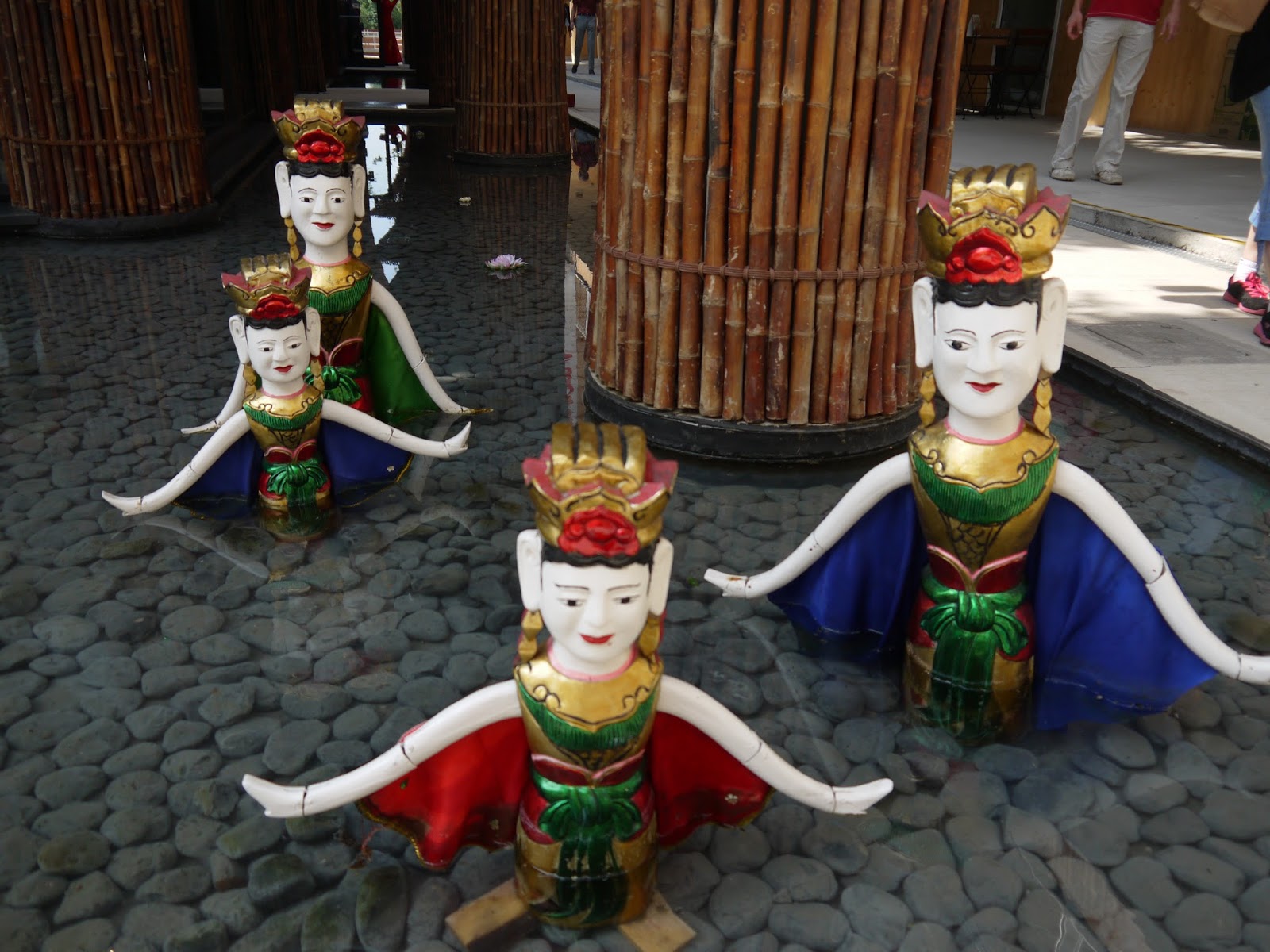
The architecture may have been the main attraction for me but I also enjoyed the surprise and delight of encountering the unexpected. I have already mentioned Poland's secret garden, but add to this some delightful Vietnamese musicians (and the tiny characters on display in the pool outside the Vietnamese pavilion), the floating discs suspended from the ceiling of Brunei's building and the Slovenian swing dancers (and the people in animal costumes who tried to join in, causing some consternation to the dance group). I loved the spectacle of colour that is the exterior of Ecuador's entry, the strange racquet like discs outside the Korean pavilion and the stylish lettering and decorative features of Angola's. I enjoyed the graceful curve of the Uruguayan pavilion and was struck by the huge reflective canopy of Russia's - Big Brother may still be watching us. Oh, and I also liked the Malaysian curry, Israeli ice-cream, Belgian chips, Ethiopian coffee and Italian pastry that helped sustain me throughout the day. 

The Expo runs until October 31st. Is best to buy tickets online in advance to avoid long queues. I managed to combine my visit with two extra days in the city which holds many delights. 

You might also like A Few Days In Milan.

Russia's reflective canopy
Uruguay's pavilion
Korean racquets
Vietnamese figures
Floating discs from Brunei
Stylish lettering from Angola

Friday, 26 June 2015

A few days in Milan

I recently spent a few days in Milan. The focus of my visit was the Expo 2015 and I will post separately about that, but I also managed to fit in a quick look at the city including some of its more unusual sites!

No trip is complete for me without trying out a city's cafes and I managed to visit two historic establishments during my short stay in Milan. Cafe Campanari in Galleria Vittorio Emanuele II is in the very centre of the city, just across form the Duomo (cathedral). Opened in 1915, the walls of the main room are covered in exquisitely coloured mosaics depicting exotic birds and flowers. Many patrons choose to stand at the bar to drink their expresso, admiring the mosaics which were the work of Angiolo d'Andrea. It's also cheaper to stand rather than to sit - although many tourists choose to park themselves just outside the cafe in the Galleria itself to receive table service, possibly missing the mosaics and the beautiful little curved wooden staircase in the smaller room. This cafe was once the haunt of  Verdi, Toscanini  and other major Italian cultural figures and still retains its original elegance.

Main bar, cafe Campanari
On the subject of elegance, Cova at Via Montenapoleone 8 is another of Milan's historical cafes. Founded in 1817 by Antonio Cova, an accomplished pastry chef and one of Napoleon's soldiers, its cakes and sweets attract both locals and tourists. The cafe also appears in a number of works of literature including Ernest Hemingway's  short story In Another Country  - "We all understood the Cova, where it was rich and warm and not too brightly lighted, and noisy and smoky at certain hours, and there were always girls at the tables and the illustrated papers on a rack on the wall. The girls at the Cova were very patriotic and I found that the most patriotic people in Italy were the cafe girls- and I believe they are still patriotic". Well the waiting staff are all men these days and we didn't discuss patriotism but they did bring me a rich, dark hot chocolate and an equally rich tiramisu - which is much more interesting!

Still on the subject of food, Milan has some great places to eat. Eataly is a fresh food emporium spread over three floors in Piazza XXV Aprile where the products are divided according to theme and region. Shoppers can walk from floor to floor taking in the colours and aromas of cheeses, herbs, vegetables, fruits and sweets as well as browsing the tubs and jars of olives, olive oil, balsamic vinegar and preserves. If all of this makes you hungry, there are also themed eateries on each floor. I enjoyed a lunchtime plate of "lasagnette" - a thin flat pasta similar to lasagne and filled with pumpkin, herbs, tomato and garlic. Delicious. Previously a theatre, the store continues to supply entertainment in the form of cookery demonstrations with the chance to taste and occasional live music on the upper floor.

Eataly, fabulous food on three floors
Milan is a great city for architecture fans, with buildings from various historical periods and in many different styles, dating from the 13th century or earlier right up to some ultra modern developments. Perhaps the most well known of Milan's buildings is its cathedral - the Duomo. Work began on the building in 1386 and although much of it dates from then, it wasn't finally completed until 1965! The third largest church in the world after St. Peter's in Rome and Seville's Cathedral, it is a huge structure, dominating the city's main square. I visited on the evening of my arrival when the majority of the crowds had dispersed and I was able to take the lift to the roof top and wander through its terraces, enjoying the views of the city. The interior is also worth a visit with its 52 pillars, five aisles and  striking stained glass windows made in the 19th century by the Giovanni Battista Bernini and his two sons who were amongst the first to use the then new technique of enamel decoration.

The Duomo
The church of San Maurizio at Corso Magenta 15, dates from the 16th century and is adjacent to a former monastery, now an archaeological museum. The exterior of the church is very ordinary but step inside to see some of Italy's most beautiful frescos as every surface is covered with biblical scenes or highly colourful decorative detail. The artists included Bernardino Luini who trained with da Vinci, Luini's brother Aurelio and Venetian artist Simone Peterzano who taught Caravaggio. The church is divided into two parts with a smaller hall and series of tiny chapels entered from the main street, behind which stands a much larger hall and chapels accessed by stepping through a low and narrow doorway. This was a real treat as not only was I able to enjoy more paintings and decorative details there, but a string quartet was rehearsing too. it was one of those unexpected moments that can make travel such a joy. 

Detail, Church of San Maurizio
E1/ E2 building, Piazza Gae Aulenti
It will be no surprise that Milan is rich in historical and religious architecture, but I wonder how many people know about its cutting edge modern district in Piazza Gae Aulenti. Modern architecture - sometimes I love it, sometimes I don't. In this case I love it. The main elements of the Piazza include the Unicredit Tower, designed by Cesar Pelli and at 231 metres high, Italy's tallest building and the E1/ E2 building which for me at least, is a take on modernism with its beautiful white lines, extensive use of glass and curvaceous facade. The E1/E2 building is a favourite of mine for another reason too - it houses a branch of Grom who sell what is arguably the best coffee ice cream in the world. A cup with one scoop of coffee and another of Madagascan vanilla ice cream was not cheap, but cor blimey was it worth it. Trust the italians to combine great architecture with great ice cream. Lovely. 

Unicredit Tower, Piazza Gae Aulenti
The space at the centre of the piazza is used for a range of activities. On the day I visited a youth basketball tournament was taking place. The piazza leads to another landmark building -  the Bosco Verticale, or in English, the vertical forest, two high rise buildings of 18 and 26 stories respectively. Even from a distance it is possible to see its green mantle provided by the 5,000 varieties of shrubs and 15,000 types of perennials being grown on every balcony. There are also almond, cherry, ash and alder trees, vines and many kinds of flowers selected for each balcony dependant on its level of exposure to the sun. This is all managed through a centralised irrigation system and more than  1200 ladybirds released onto the building to fight aphids! The design was the work of Studio Boeri, and architect Stefan Boeri.

Bosco Verticale/ Vertical Forest
Fans of modern architecture might also like to visit the new Museum of Culture in Via Tortona. I managed a quick visit here on my first evening. To tie in with the Expo, the museum was staging Mondi i Milano, an exhibition about earlier Milanese expos including those from the end of the 19th and beginning of the 20th centuries when the world was very different and European powers were keen to show off their colonial possessions. I have to say the art produced to promote those events, the original catalogues and the ornate pavilions was extremely beautiful. But, why oh why was the catalogue not available in English and why were there no postcards or posters available for sale from the exhibition? Back to the architecture. The museum was designed by British architect David Chipperfield.  The star of the show is the covered plaza reached by a flight of stairs which opens onto a surprising curvilinear space clad in sating glass through which natural light floods. I went in the early evening, hence the eerie green effect in the photograph below.

Detail, Museum of Culture
Detail, Casa Galimberti
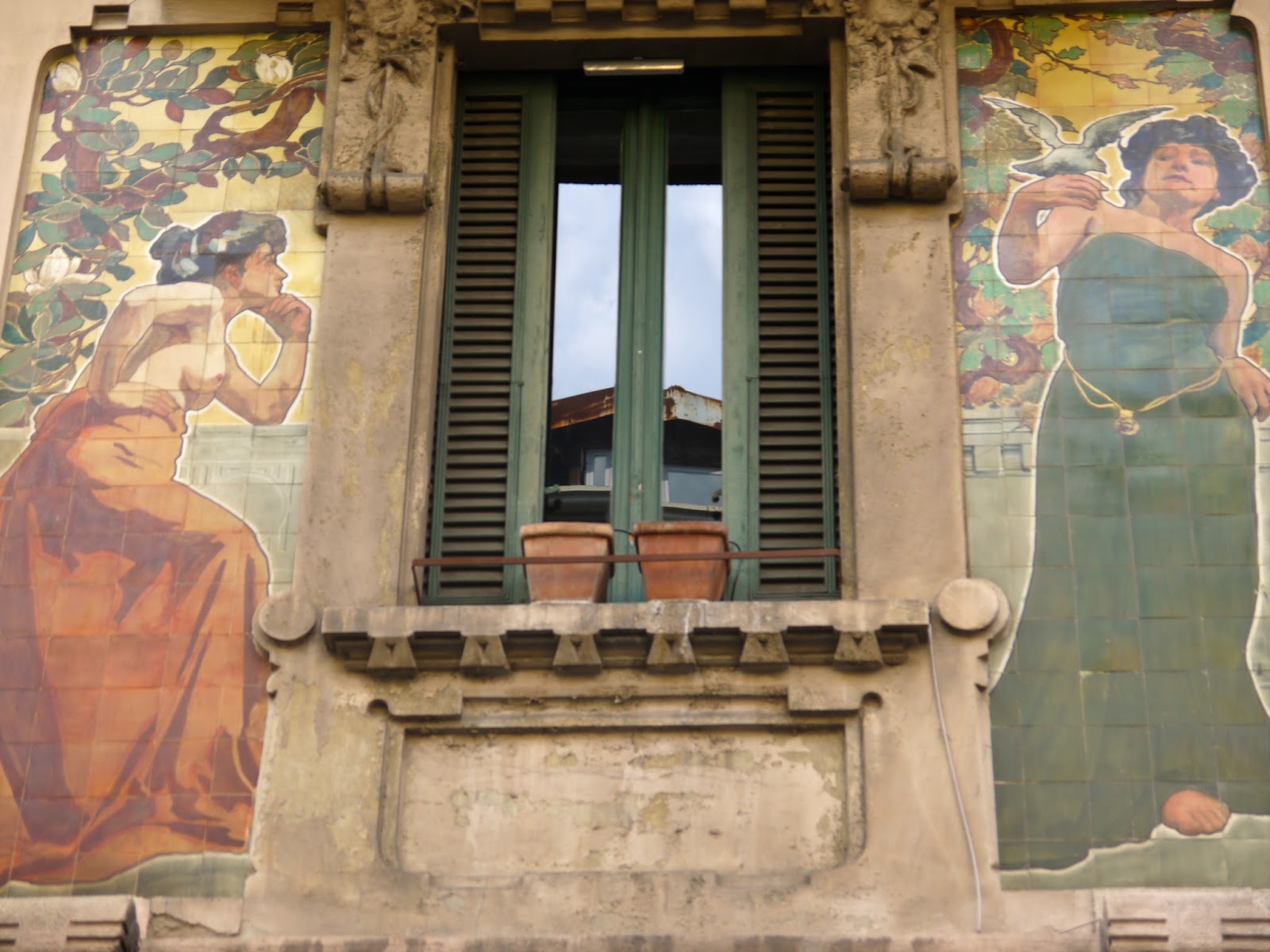
Regular readers will know of my passion for art deco and modernism as well as for art nouveau architecture. I have already posted about art nouveau masterpiece Casa Galimberti here but can't resist including another picture of it above. 

The city also has some modernist and art deco treasures. Villa Necchi Campiglio was built between 1932 and 1935 for the family of the same name and designed by Piero Portaluppi. It was the home of industrialist Angelo Campiglio and his wife Gina Necchi of the famous sewing machine brand family It has been open to the public since 2011. Sadly it wasn't open on the day I visited as it was being used for a photo shoot for Todd shoes. I was able to snatch a look at the exterior from the adjoining cafe but couldn't get close enough to properly admire the copper door or to see  the collection of paintings by Morandi, Sironi and de Chirico. The Necchi-Campiglios wanted for nothing and the house includes an early intercom system, tennis courts and a heated swimming pool. They counted the nobility amongst their friends including members of the Spanish and Savoy royal families. The gardens reminded me of Giorgio Bassani's book The Garden of the Garden of the Finzi-Continis, set in 1930's Italy. I was very disappointed not to get inside. I'll have to go again.

Villa Necchi Campiglio
Cinema Anteo
I also spotted a great modernist cinema, Cinema Anteo at Via Milazzo 9. I have so far been unable to find any details of the building such as the identity of the architect or the date built, so if anyone reading knows, please post the details in the comments box below! More Milanese modernism in a later post.

So, that's cafes, coffee, a museum and architecture, which leaves shopping and jazz! Milan is a shoppers paradise. There are many design shops selling stylish items for the home, well made clothes, Italian food and drink. This was a very short trip so no time for real shopping but I did browse the book shops in the Galleria Vittorio Emanuele II, which are just about hanging on to their place between the high end and expensive designer shops as well as making a quick visit to Corso Como 10 which doubles as the name and address of this concept store. Here, you can find contemporary fashion for men and women, household items by leading Italian designers, posters and postcards and a large selection of art books. There is also a gallery which was exhibiting photographs from the Futurist movement when I visited and a very smart cafe/ restaurant in the green and peaceful courtyard garden. Great for browsing and looking at lovely things even if you don't want to buy.

Galleria Vittorio Emauele II
And finally jazz. Milan is one of a number of cities around the world that has a branch of New York's famous Blue Note Club. There is room for a few hundred seated and standing room by the bar.   Seating is not allocated in advance, so its good to turn up early if you want to sit near the front. Standard club food is on offer. The programme is impressive with a mixture of local and international artists. On the night I went, Brazilian vocalist Rosalia de Souza treated us to a number of songs from the Jobim songbook as well as some more contemporary compositions. She played one good long set and had great support from her quartet. The club has a friendly and welcoming atmosphere.

There is much to see and do in Milan. its possible to pack a lot into a couple of days if you plan carefully and make clever use of the clean, modern and very efficient metro system, but I have the feeling I've only scratched the surface. I'd like to see more.

Detail, entrance to Corso Como 10

Sunday, 21 June 2015

Picture post 44 - Casa Galimberti, Milan's art nouveau masterpiece


Via Marcello Malpighi is a quiet street in Milan's Porta Venezia neighbourhood. It is also home to a stunning art nouveau building - Casa Galimberti, built between 1903 and 1905 and designed by architect Giovanni Battista Bossi. The building occupies a corner spot and has elegant balconies, stonework floral motifs and even the fall pipes have small decorative features. But all of this is upstaged by the riot of colour that covers the rest of the exterior. Almost every part of the upper levels is covered in hand painted tiles depicting idyllic scenes, beautiful women, trees, plants, flowers and fruits. The effect is mesmerising. The female figures rival those of Klimt and the Vienna Secession and no doubt impressed the many visitors the city received for the 1906 Expo when Milan showed its new found confidence to a worldwide audience. What could have been more ostentatious than Casa Galimberti?


Bossi was an accomplished architect, having designed a number of tombs in Milan's Cimitero Monumentale for wealthy families as well as several other impressive houses across the city.  He was also a professor of architectural design and co-editor of the journal Italian Architecture. Numerous artisans worked on the decorative features. The tiles were the work of the Ceramic Society of Lombardy whilst the floral elements of the pictures were by a Signor Pinzauti and the figures by Umberto Brambilia. Local ironworkers, Arcari and Ajay of nearby Via Magenta were responsible for the wrought iron details. Casa Galimberti still serves its original functions with shops and cafes on the ground floor and four flats per floor over each of the four upper levels.

The building is perhaps Milan's finest example of Liberty Style - Italy's version of art nouveau, which shares many of the features of Vienna's Secessionism, Riga's Jugendstil and the many other schools of this most decorative style. The city boasts architectural treasures of many styles and from many periods, but this beautiful apartment building is easily my favourite.


Monday, 9 December 2013

Turin Part Two - Primo Levi, cinema city and Italian art deco

Turin's main synagogue, Piazzetta Primo Levi
The synagogue in Piazzetta Primo Levi is one of Turin's most striking buildings. With clear Moorish influences and four onion domes it is clear evidence of a once prosperous and significant community. Today's community numbers less than 1000. In 1931 there were a little more than 4,000 Jews in the city - not a large community and one that has been reduced over time by emigration, a declining birth rate and of course the impact of the Holocaust. Down to just over 1,400 people in 1938,  246 Turinese Jews were deported from Turin to Auschwitz in the winter of 1943. Just 21 returned, one of whom was Primo Levi, surely Italy's most gifted writer and perhaps the chronicler of the Holocaust and its immediate aftermath through his books If This is a Man, If Not Now, When? The Drowned and the Saved and The Truce

Having survived Auschwitz and the long and difficult journey back to Italy, Levi reestablished himself, writing several books and working in the paint business. His death is shrouded in mystery. He died in April 1987, falling from the interior landing of his third storey apartment. The coroner declared his death to be suicide but some family members disagreed.

The synagogue sustained damage during the war but was restored in 1949 and is today in excellent condition. Like many larger synagogues in Europe it's community uses only part of the building for regular services due to its small size with the main prayer hall being used only for special occasions.

Mole Antonella, symbol of Turin - the spire, temple and dome
Grand as the synagogue is, it might have been even grander if the building originally planned as the Jewish house of worship for the city had been used for that purpose. In 1863, the city's Jews commissioned architect Alessandro Antonelli to build a synagogue but as time went on, the scheme expanded and costs soared to the extent that the project was no longer affordable to the community and the city government too it over. It took until 1889 to complete, the architect failing to see his work finished, having died the year before. The building which became known as the Mole Antonella has a  thin spire which sits on top of a small columned temple which in turn sits on a large (very large) dome. In a further round of controversy, it lost 47 metres of the spire in high winds in 1953. It was rebuilt with a metal frame covered in stone.

Initially used as a museum of the Risorgimento (the re-unification of Italy), it is now home to the Museo Nazionale del Cinema. I visited the museum whilst in Turin and enjoyed the galleries arranged around the exterior of the building and containing an excellent poster collection, memorabilia from Italian and Hollywood films, contraptions and screenings from the early days of cinema. A visit also gives the chance to see numerous classic films running throughout the museum as you explore its collections. It is also possible to take an elevator ride to the top of the building and view the city. As waiting time to get into the elevator was two hours, I passed on this occasion, but my friends stuck it out and went to the top for some magnificent views. The elevator journey includes a ride through the huge open dome overlooking the lower museum galleries. I think that might have been a bit much for me - the walk around the upper floors of the museum having left me a tad vertiginous! The museum has a good shop with lots of postcards, posters, books and cinema "stuff". I chose some postcard reproductions of film posters from 1918 and 1920, reproduced below.

Postcard of film poster for Italian movie La Contessa Misera, 1918.
Postcard advertising La Decima Musa, 1920.
The city has a long history of and love affair with film. It was here that film chromatography was first established, whilst the proximity to France meant that local filmmakers were influenced by the Lumiere brothers. Italy's first cinema screening took place here in 1896 whilst in 1914, Giovanni Pastrone's Cabiria, one of the world's first blockbusters premiered here. In later years, Rome assumed leadership of the Italian film industry but Turin is still important and since 1982 has hosted a prestigious international film festival. Still on film, whilst wandering the streets behind Via Roma, I came across the wonderful art deco facade of Cinema Lux. This cinema which opened in 1934 was originally called Cinema Rex, then the Dux and finally acquiring the name Lux after the Second World War. Located in the very elegant Galleria San Frederico adjacent to Piazza San Carlo it was once Turin's most luxurious cinema with over 1,500 seats and was the work of architects Giovanni Canova and Eugene Corte. Corte, born in Geneva had studied under Jean Luis Pascal whose main claim to fame was in assisting Charles Garnier with the design of the Paris Opera.

Lux Cinema, Galleria San Frederico
No trip is complete for me without seeing at least a few modernist buildings from that most creative of decades - the 1930's. In Turin, I knew that the Liberty Style art nouveau architecture was going to be the star of my show and indeed it was, but I was thrilled to happen upon a couple of cracking modernist buildings too. Close to the Lux cinema I came upon the Torre Littoria in Via Giovanni Battista Viotti. tilt in 1933 and designed by architect Armando de Villa Mellis. It made significant use of innovative materials for the time including glass bricks, split tiles and linoleum. It was also the first building to be constructed with a welded steel support structure. Totalling 19 floors, the summit is 109 metres above ground and the tower remains one of the city's tallest buildings. It is adjoined by a cool, modernist 9 storey lower body with beautiful curves, lines and clean crisp colours. I love it! I have included pictures of two more modernist buildings in Turin, one adjacent to the Torre Littoria and another in the Liberty Style district just outside the centre of the city. I have been unable to find details for these buildings…if anyone knows about them please contact me on the blog.
Torre Littoria, Via Giovanni Battista Viotti.


Wednesday, 4 December 2013

Turin part one - elegant art nouveau and some rather good cafes

Postcard for the Turin 1911 Esposition

Turin is the home of Fiat cars, the La Stampa newspaper and Lavazza coffee. From 1861-1865 it had four glorious years as Italy's capital city, ceding this honour to Florence before Rome became the capital of a unified Italy in 1870. Today Turin has almost one million inhabitants, is Italy's fourth city and retains much of its earlier elegance.

This is a city that embraces both style and modernity. First hosting the Universal Exposition in 1902 and then again in 1911 it was a showcase for art, commerce and industry at the beginning of the twentieth century. On my recent visit I was able to see the physical evidence that remains from that period as well as to discover some very pleasant literary and cafe surprises!

Fenoglio-la-Fleur House, Corso Francia. Pietro Fenoglio 1902-3
The beginning of the twentieth century was the heyday of art nouveau in Europe with Brussels, Prague, Budapest, Riga, Vienna and a host of other cities producing hundreds of new buildings in the style. Turin was no exception and today many examples of the Italian interpretation of this genre remain. In Italy it is known as Liberty Style and one its main exponents was Pietro Fenoglio, a native of Turin. Born in 1865, he graduated at the Royal School for Engineers in 1899 and was inspired to work in the Liberty Style by the 1902 Exposition. Active in politics as well as architecture, he was elected Alderman of the city in 1902 and oversaw the city plan, completed in 1908, which may well explain the preponderance of beautiful buildings from this period. Clearly a man of many talents, he also founded and made significant contributions to the journal Modern Italian Architecture and went on to become Chief Executive of the Italian Commercial Bank in 1917.

I was able to see a number of his buildings on my visit to the city. Most spectacular is the Casa Fenoglio-la-Fleur which stands on the junction of Corso Francia and Via Principa d'Acaja. A masterpiece of stained glass, ornate balconies, and a facade covered in the floral motifs, this was the Fenoglio family home and work place for a short period before it was sold to French businessman Lafleur. On Monsieur Lafleur's death, he left the house to a charity for orphans. Neglected for many years it was purchased privately in the 1990's and a full and careful restoration completed. It now has both residential areas and offices. I liked the Casa so much I went back for a second look during my  short stay and am I glad I did. The sun was shining directly into the stained glass of the overhanging bay windows producing vibrant blues, reds and purples to cheer a frosty December morning. Wonderful.  

Casa Tasca, Via Beaumont. Giovanni Battista Benazzo, 1903
On the edge of the old city, Casa Fenoglio-la-Fleur is one of many Liberty Style buildings in this area and a stroll around the adjoining streets reveals many other treasures. Just a short step away at the junction of Via Beaumont and Via Pifetti is the Casa Tasca, dating from 1903 and designed by Giovanni Battista Benazzo. The apartment building carries the architect's autograph underneath the protruding bay window at the junction of the two streets. Covered in floral motifs, geometric patterns,  balconies with carved details, wrought iron gates and curved iron "vegetation" on the main entrance, Casa Tasca is a very large corner lot and it is easy to spend a long time admiring it,  discovering new details from different angles. Just around the corner at Via Pifetti 10 and 12, stands a pair of small private houses dating from 1908 designed by Giovanni Gribodo. Both have a number of art nouveau decorative features, but it is the figure on the upper facade of number 10 that stops passers-by in their tracks to admire this elegant woman and her fruit trees. Imagine coming home to this every night!

Private house, Via Pifetti. Giovanni Gribodo, 1908.
Casa Reda, Via S. Francesco d'Assissi. Giovanni Reycand, 1902
There are also examples of Liberty Style in the centre of the city. Another favourite is  Casa Reda at Via S. Francesco d'Assissi 15. Built in 1902 and designed by Giovanni Reycand this is also something of a show stopper. The yellow painted facades have columns of green and brighter yellow floral motifs whilst under the eaves there are beautiful images of fruit trees. The ground floor houses a book shop which carries a few titles in English as well as travel guides and postcards. Via S. Francesco d'Assissi quickly became one of my favourite Turin streets. The building adjacent to Casa Reda features decorative panels on the upper facade whilst the pasticceria/ confetteria at number 17 has external mosaics showing views of the nearby alpine valleys. Casa Florio at the junction with Via Bertola has more of those lovely protruding bay windows with iron floral motif details and dates from 1902 and was designed by Guiseppe Verdi Bellini.

External mosaic, Confiterria, Via S. Francesco d'Assissi. 
On the subject of pasticcerias (pastry shops), I am very pleased to give Turin a good report! My favourite is the very elegant Cafe Torino in Piazza San Carlo. Opened in 1903, the cafe has seen many famous customers including publisher Einaudi, anti-fascist politician and former prime minister Alcide de Gasperi and most fabulously, Ava Gardner. The cafe's main attractions for me are the stunning art nouveau staircase and curved ceiling to floor windows at the rear of the cafe.A close runner-up is the patisserie - I had an individual cheese cake topped with a marron glace washed down by bicerin. This is a local Piedmontese drink made from chocolate, coffee and thick cream. Real heart attack stuff but delicious and very welcome in the sub zero temperatures of a Turinese December. The cafe is credited with introducing winter al-fresco service in Turin, under external infrared heaters. For hardy souls only I think - the temperature didn't rise above 4 degrees on my visit and plunged below zero in the evenings. Back inside, those in a hurry can drink their espresso at the long bar, chat with the waiters and make their choice from the large selection of works of art also known as Italian patisserie.

Cafe Torino, Piazza San Carlo. Staircase and windows..and no, that isn't me!
Turin boasts a number of belle epoque style cafes, several with their original fittings and fixtures intact. 
Cafe San Carlo is a close neighbour to Cafe Torino, just a few steps further into Piazza San Carlo. Opened in 1842, it has two rooms, the first offering a close up view of the huge range of patisserie, chocolates and other sweet treats from the comfort of sofas and easy chairs. Cafe San Carlo also has a proud history of loyal famous customers including Antonio Gramsci, writer, politician and leader of the Italian Communist Party in the 1920's, anti-facists Carlo and Nello Roselli and five times Prime Minister and leader of the Liberal Party Giovanni Giolitti. Cakes seem to appeal to all political persuasions. I'm told that Alexandre Dumas took his first taste of bicerin in Cafe San Carlo!

Also worth a stop is Baratti and Milano at Piazza Castello 27. Originally a confectionary and spirits shop opened in 1858, a coffee house was added for the 1911 Exposition. The coffee house quickly attracted writers and artists. It remains busy today with both locals and tourists - and the confectionary is still going strong too. The lobby is a riot of gold coloured surfaces, red and silver sweet wrappers and fin-de-siecle elegance.

One side of Baratti and Milano faces onto the Galleria Subalpina, built in 1873 and modelled on the Parisian shopping galleries of the same period. Designed by architect Pietro Carrera, the Galleria sustained some damage in the second world war but was faithfully restored and is now home to a number of small shops. My favourite is Galleria Gilibert, a family business opened in 1992 selling old books, prints and posters. The collection includes vintage theatre, politics and tourism posters many of which can be viewed on the website. The shop is very neatly arranged and a very friendly welcome is offered by the owners. 

Galeria Subalpina, Piazza Castello.
Severely limited in terms of what I could buy to bring home due to Ryanair's baggage policy, I resisted making a purchase in Galeria Subalpina, but must confess I did part with money in the Sunday book market which stretches along both wings of Piazza Carlo Felice carrying on for much of the length of Via Roma. This is a bibliophile's heaven with books of all ages and on all subjects including some in English. As well as books, you can find magazines going back to 1900, postcards, prints and various items of printed ephemera. Its fantastic. Many items date from the 1930's and display striking art deco/ modernist design principles, but I finally gave in and bought a small number of postcards from the 1911 Exposition. For an undisclosed sum as they say. You can see one of them reproduced at the top of this post.

I will leave you with a few more examples of Liberty Style architecture and will post again on my Turin visit, including on the city's modernist architecture, its most famous literary son Primo Levi and its tallest building that has a very unusual history.

You can see more pictures of Turin here. You might also like Hungarian art nouveau...in Venice.

Casa Medana, Via Lombroso. Enrico Bonicelli, 1902.
Detail, Casa Florio, Via Bertola. Guiseppe Velati Bellini, 1902.
Pallazzina Rossi-Galateri, Via Passalacqua. Pietro Fenoglio, 1903.