I first visited Mandalay two years ago when I spent my time at the the U Bein teak bridge at Amarapura, the temples, palace and nunnery of Sagaing and the "mini Bagan" at Paleik. Returning earlier this month I wanted to see more of the daily life of Mandalay's citizens and to capture snapshots of it in a photographic record.
 |
| Central Market, Mandalay |
With this in mind I began by exploring some of Mandalay's many markets. Perhaps the most interesting is the central market with its hundreds of vendors offering fresh fruit and vegetables, flowers, fish, meat, electrical goods, clothes both new and second hand and almost anything else you can think of. It includes a covered area, street stalls and informal vending that takes place on the railway lines behind the main building. Trains still operate here and when they are heard approaching the vendors quickly gather upon the parasols used for protection from the sun, place their goods between the lines and retreat for the few minutes it takes for the train to pass. Within seconds of the train going by, the parasols are back in place, the goods recovered and business is resumed. The whole thing is managed quickly, without fuss and with minimum of disruption to business. I tried to imagine something like this happening at home...
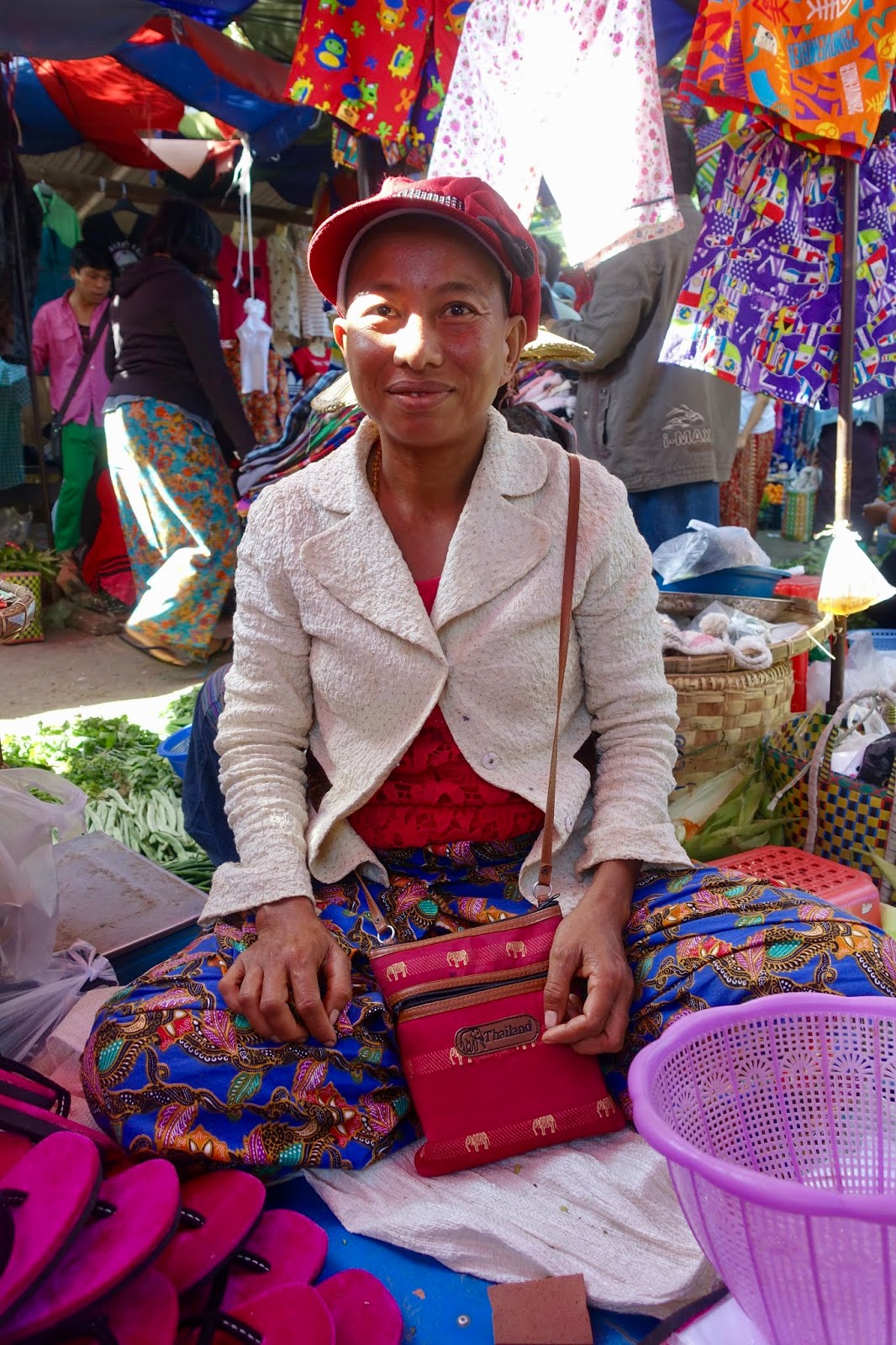
The vast majority of the stall holders are women. Many of them come from surrounding towns and villages, getting up early to bring their goods to Mandalay and to find a good position in the market. Daw Pu lives in Medaya, an outlying village. She gets up at 3 a.m. every day to take the bus to the city, carrying her stock with her and returns home in the late afternoon. I asked her if she goes to bed early, but no she stays up until 10 or 11, attending to tasks at home. She has four children, two of them at university. Several of the vendors told me they had children with degrees or studying for them and were rightly proud of this having worked hard so that the next generation can prosper. I photographed her and returned with a copy of the picture for her the next day. She insisted I take some butter beans in exchange! Several of the vendors agreed to be photographed and were a little surprised when I returned to hand them a picture. These included two very stylish young women, one selling vegetables the other selling clothes and who appeared to have recently spent some time as a nun.
A short walk from the snack maker's place I noticed an elderly man sitting outside his house. U Than Myint smiled and waved and I greeted him with one of my few words of Myanmar mingalabar meaning hello. He responded in kind and I stopped to talk to him for a while. He told me that both him and his wife are in their eighties and whilst he appeared to be in good health, she was somewhat frail. He grew up in the countryside and had worked initially as a bullock-cart driver before coming to Mandalay where his family now have a car repair business as well as selling snacks. He has four grown-up children, two boys and two girls. He went on to say that his daughters are not married and looked after him and his wife but that the sons who have families of their own were only focussed on work. I am often surprised at how candid strangers can be when talking about themselves and those near to them. I liked his kind, youthful face. He let me photograph him and I agreed to go and look for him again when I am next in the city.
On the riverside at 6.30 in the morning, I met some people who I may not be able to find next time I am here. The city authorities are undertaking a number of projects to improve the quality of life of their residents. These include working in partnership with Japanese cities to improve the infrastructure and environment. Related work is being undertaken to clean up the banks of the Ayeyarwady. Thousands of people have made their homes here for decades. Some live in makeshift structures temporarily in order to be near their place of work when crops are produced here during the dry season when the water recedes to reveal extremely fertile soil. Others live here more permanently and have nowhere else to go. As part of a beautification project many of these homes have been removed and the residents offered new, relatively cheap accommodation in purpose built flats with electricity and running water. Many have taken up the offer, others have not including a mother and her young daughter that were preparing rice for breakfast as I walked beside the river. The woman and her husband work as porters unloading goods brought down the river for sale in the markets. They have six children. The two eldest are being educated in a monastery, the two youngest are less than 18 months old. Desperately poor she still offered to share her rice with me. Where will they be this time next year I wonder.
I was up and out early that morning in order to see the monks out collecting donations. Monks and nuns are a ubiquitous presence in Myanmar. One afternoon after eating lunch at a quiet monastery near the centre of the city I noticed a large group of novice monks crowding around a snack stall. All of them were from Shan state in the north of the country and had been sent to Mandalay to study. The light was especially strong that day. Streaks of light and shadows from the trees played against the bright colours of the boys' robes and I couldn't resist a picture. I later realised that one of the young monks had turned around and smiled directly at the camera, a face in the crowd.
Arriving in Mandalay by car, I passed through an area known for its stone carving workshops. The street is filled with hundreds, possibly thousands of Buddha statues in different sizes and at different stages of production. Everywhere there is dust from the work of the artisans many of whom are themselves covered in the white particles produced by the carving and dusting of the figures. Few wear protective clothing and many do not even wear masks. I am told that they believe eating bananas after work helps offset the impact of breathing in the dust. I hope they are right. Several women are involved in the industry, primarily in cleaning and dusting the particles from the sculptures. One of them, fixing a drill, posed for a picture.
Although I spent most of my time in the city itself on this visit, I was keen to go back to Paleik, a village and archaeological site 18 kilometres south of the city. It is home to several hundred stupas, many of them ruined and some in the process of being reclaimed by nature. The village is home to several family run weaving businesses and the clacking of machines, both hand-operated and automatic can be heard everywhere. I like wandering amongst the stupas and the villagers are extremely friendly. Some of them came outside to say hello, including a deaf woman who was insistent that I should photograph one of her three children. The curly-haired little girl was wearing a beautiful coat probably made in the village.
I also met Daw Hla Hla standing outside her house which is more than 100 years old. She is 69, her husband 70 and still working in the fields. Most of their income comes from the sale of charcoal, used for cooking. They also grow and sell mangos. Daw Hla Hla was very proud of her children, one of whom is an engineer. She kindly invited me into her house to look at photographs of her when she was much younger including a beautiful picture of her and her husband at the time of their wedding. I left her standing proudly on the steps of her home, in front of the original heavy doors.
I've written this before, but Mandalay is one of those cities that fires the imagination through its very name. Much of its historical centre and mystique was destroyed in the Second World War but it retains a certain charm, full of life and possibilities. Those charms are not at first obvious but given a little time, gradually unfold and draw the discerning visitor in. Three nights was not enough. I miss the place already.
You might also like Return To Yangon or Myanmar Journey Part 2 - The Road To Mandalay
You can see more pictures of Myanmar here
 |
| The train arrives |
 |
| Daw Pu from Medaya |
 |
| Young vegetable vendor, Central Market |
 |
| Young women with a clothing stall, Central Market |
 |
| The tea man's son |
Last year in India I became very fond of Indian style tea - hot, sweet and milky. I was happy to find it being sold on just about every street corner in Myanmar and consumed significant amounts of it. The central market has a number of tea stalls and I took a little time out to enjoy a cup at one of them. The owner's young son, perhaps four or five years old sat opposite me, assiduously ignoring my efforts to engage him. To my surprise he began singing something to the tune of Frere Jacques. It turned out to be the the Myanmar (Burmese) lyrics of that very song. I decided to turn the tables on him and joined in singing the French lyrics that I learned many years ago at school. Now it was his turn to be surprised.
The fish market is a short walk from the banks of the Ayeyarwady river where at least some of the produce is caught. Walking through its pungent alleys I came across a small open fronted factory where people were making fish paste. I was struck not only by the overpowering smell but also by the visual impact of the backdrop to their work - peeling green painted walls bearing a couple of framed photographs and what appeared to be a small floral decorated shrine. I pointed the camera to take a candid shot just as one of the checked shirt clad women saw me and called out "don't show the picture to the boss, some of them are asleep in here" - much to the amusement of her colleagues. I was to come across a well-developed sense of humour throughout my time in Myanmar, something that gladdened my already won-over heart.
I was introduced to what quickly became a favourite Mandalay stopping off point during this visit - the Arkar Min tea shop. I had breakfast here twice - excellent chai-style tea (which comes with a huge pot of green tea for free!) accompanied by fried chick-peas and a very crispy version of nan bread. Delicious. Just across the road from the tea shop there is a small local market. It was there that I noticed the first of many female butchers I was to come across in Myanmar - something rarely seen in the west.
Some of the produce sold in Mandalay's markets is manufactured in small factories tucked away in the city's many narrow lanes. These cottage industries provide employment for many people, often from several generations of the same family. Some operate from relatively sophisticated premises, easily recognisable as manufacturing concerns whilst others work within the living space of the owner. I visited a number of these businesses including one selling super chewy toffee, very tasty but devilish for the fillings. Another makes fried savoury crispy snacks. This one was especially interesting as packing for distribution to shops and markets was carried out on the bedroom floor of the owner who sat regally on her bed keeping an eye on things from above. In a second room two women sat beside a stove, dropping the flour based mixture into sizzling hot oil for a few seconds before lifting them out already cooked and ready for cooling and packing. They handed me one to taste. It was so hot I almost dropped it.
The fish market is a short walk from the banks of the Ayeyarwady river where at least some of the produce is caught. Walking through its pungent alleys I came across a small open fronted factory where people were making fish paste. I was struck not only by the overpowering smell but also by the visual impact of the backdrop to their work - peeling green painted walls bearing a couple of framed photographs and what appeared to be a small floral decorated shrine. I pointed the camera to take a candid shot just as one of the checked shirt clad women saw me and called out "don't show the picture to the boss, some of them are asleep in here" - much to the amusement of her colleagues. I was to come across a well-developed sense of humour throughout my time in Myanmar, something that gladdened my already won-over heart.
I was introduced to what quickly became a favourite Mandalay stopping off point during this visit - the Arkar Min tea shop. I had breakfast here twice - excellent chai-style tea (which comes with a huge pot of green tea for free!) accompanied by fried chick-peas and a very crispy version of nan bread. Delicious. Just across the road from the tea shop there is a small local market. It was there that I noticed the first of many female butchers I was to come across in Myanmar - something rarely seen in the west.
Some of the produce sold in Mandalay's markets is manufactured in small factories tucked away in the city's many narrow lanes. These cottage industries provide employment for many people, often from several generations of the same family. Some operate from relatively sophisticated premises, easily recognisable as manufacturing concerns whilst others work within the living space of the owner. I visited a number of these businesses including one selling super chewy toffee, very tasty but devilish for the fillings. Another makes fried savoury crispy snacks. This one was especially interesting as packing for distribution to shops and markets was carried out on the bedroom floor of the owner who sat regally on her bed keeping an eye on things from above. In a second room two women sat beside a stove, dropping the flour based mixture into sizzling hot oil for a few seconds before lifting them out already cooked and ready for cooling and packing. They handed me one to taste. It was so hot I almost dropped it.
 |
| Don't show the picture to the boss... |
 |
| Female butcher near the Arkar Min tea shop |
 |
| Making savoury snacks, a cottage industry |
 |
| U Than Myint, former bullock cart driver and now businessman |
 |
| Preparing rice on the river bank |
 |
| Novice monks, a face in the crowd |
Arriving in Mandalay by car, I passed through an area known for its stone carving workshops. The street is filled with hundreds, possibly thousands of Buddha statues in different sizes and at different stages of production. Everywhere there is dust from the work of the artisans many of whom are themselves covered in the white particles produced by the carving and dusting of the figures. Few wear protective clothing and many do not even wear masks. I am told that they believe eating bananas after work helps offset the impact of breathing in the dust. I hope they are right. Several women are involved in the industry, primarily in cleaning and dusting the particles from the sculptures. One of them, fixing a drill, posed for a picture.
 |
| Woman worker, stone carving workshop |
 |
| Entrance to a temple, Paleik |
 |
| The girl with curly hair, Paleik |
I also met Daw Hla Hla standing outside her house which is more than 100 years old. She is 69, her husband 70 and still working in the fields. Most of their income comes from the sale of charcoal, used for cooking. They also grow and sell mangos. Daw Hla Hla was very proud of her children, one of whom is an engineer. She kindly invited me into her house to look at photographs of her when she was much younger including a beautiful picture of her and her husband at the time of their wedding. I left her standing proudly on the steps of her home, in front of the original heavy doors.
I've written this before, but Mandalay is one of those cities that fires the imagination through its very name. Much of its historical centre and mystique was destroyed in the Second World War but it retains a certain charm, full of life and possibilities. Those charms are not at first obvious but given a little time, gradually unfold and draw the discerning visitor in. Three nights was not enough. I miss the place already.
 |
| Daw Hla Hla, Paleik |
You can see more pictures of Myanmar here


