Showing posts with label Rajasthan. Show all posts

Sunday, 28 January 2024

Sleepless in Churu - Maharaja Ganga Singh

Seven years ago, I spent two nights in a room where every surface was covered with brightly coloured murals. Rather than sleeping, I lay in bed staring at them for much of the night. The works of art covered the walls and ceiling of Maharaja Ganga Singh's windowless room in Malji Ka Kamra, in Churu, Rajasthan, a once neglected haveli, lovingly restored as a hotel. The haveli was built in 1920 by Malji Kothari, a Jain merchant, and used by the Maharaja whenever he visited the town. It was also the setting for many important gatherings involving royalty, prominent merchants and British officers. 

I didn't think much more about the Maharaja until recently, when doing research for another writing project, I discovered that Sir William Orpen's 1919 painting of him is exhibited in the  National Portrait Gallery in London. The gallery caption referred to his distinguished military career, but Ganga Singh was also an accomplished linguist, reformer and politician. 


Maharaja Ganga Singh of Bikaner, by Sir William Orpen, 1919.


Ganga Singh ruled the former princely state of Bikaner from 1888-1943. He became Maharaja at eight years of age, when his brother died without leaving a male heir. The young royal studied at Mayo College in Ajmer - sometimes referred to as the Eton of India - where he received a western education. He was a talented student, excelling in English, speaking the language flawlessly and always winning first prize in this subject. In later life he liked to tell jokes and anecdotes while speaking in a Cockney accent. At fourteen, he left the college to study under a tutor who helped him develop riding and shooting skills and an understanding of the British system of government. In his free time, he enjoyed sports including cricket and roller skating.


The Maharaja replaced a British appointed regent in 1898, assuming full duties at the age of eighteen. Almost immediately he was met with a crisis as famine, cholera and smallpox struck his subjects. Thousands died and many others fled to the more verdant Punjab. Ganga Singh's response was to modernise his state, borrowing money to finance nine irrigation projects, two railway lines and three roads, as well as medical relief centres and the provision of interest free loans to farmers. These projects also provided much needed employment for his subjects. In 1927 his public works programme culminated in the opening of the Ganga Canal. This involved the conversion of one thousand kilometres of desert into green fields, enabling five hundred new villages to be established on previously uninhabitable land. 


His reputation as a reformer was further enhanced by his establishing a representative assembly in 1913, a High Court system in 1922 and a series of financial benefits for his employees including life insurance. He also set up a savings bank for ordinary citizens, outlawed child marriage, introduced prison reforms and established several institutions including educational facilities for women. His commitment to education was recognised in 2003 when the University of Bikaner changed its name to Maharaja Ganga Singh University. 


The Maharaja also had a distinguished military career. He founded the Bikaner Camel Corps, a force of five hundred men, that became known as the Ganga Risala. After he offered their service to the British, the Corps saw action in China during the Boxer Rebellion of 1900 and in Somaliland in 1902-1904. They also served in the First World War, and in 1915, routed Turkish forces at Suez in Egypt. Ganga Singh was much admired by the British and became a member of the Imperial War Cabinet. In 1919 he was a signatory of the Treaty of Versailles and from 1924 he represented India at the League of Nations. During this period, the movement for Indian independence gained momentum.  The Maharaja, although on good terms with the colonial authorities, also desired greater autonomy, but feared the end of the Princely State system in an independent India ruled by the Congress Party. He preferred a federal approach, combining independence with the retention of his princely powers. He failed to gain support for this approach and  after Independence, Bikaner and the other states were absorbed into a unified India.


The Maharaja’s military status and contribution was immortalised by Sir James Guthrie in another painting held by the National Portrait Gallery - Statesmen of World War One. In an imagined scene, Ganga Singh appears with the Prime Ministers of Australia, Canada, New Zealand, Newfoundland and South Africa. The then British Prime Minister, Lloyd George is also present, as are others who at one time or another fulfilled that role - Arthur Balfour, Winston Churchill, Andrew Bonar Law and Herbert Asquith. Back in Churu, his image appears on the exterior walls of the Parekh haveli, built in 1925. The murals show him using various forms of transport including a Rolls Royce and a horse drawn carriage. 


The Maharajas were famed for their lavish lifestyle and for entertaining. Ganga Singh was no exception, always well turned out, he took particular care with his facial hair. One courtier is quoted as saying: "Every day after a bath, for at least ten minutes, he set his moustache with a very fine elastic netting." Furthermore, after getting dressed, he would, "...go to the room where his shoes were all in a row, and he would pick up a long pointer like you have in school. He would just touch one of the shoes with it and that pair would be polished and brushed." Despite his love of stylish clothes and liberal approach to social matters, he held conservative attitudes about family. His wives never appeared in public without wearing full purdah and no photographs of them exist.


Ganga Singh also served opulent dinners. In his controversial book, Passion India: The Story of the Spanish Princess of Kapurthala, Javer Moro claims that when asked for the recipe of a particular dish, the Maharaja said: “Prepare a whole camel, skinned and cleaned, put a goat inside it, and inside the goat a turkey and inside the turkey a chicken. Stuff the chicken with a grouse and inside that put a quail and finally inside that a sparrow. Then season it well, place the camel in a hole in the ground, and roast it.” Clearly, camels played a significant part in the Maharaja’s life, both on the battlefield and on the dining table. Moro's book is a fictionalised version of the diaries of Anita Delgado. The Maharaja of Kapurthala fell in love with her when he saw her dancing in a Madrid café. She travelled back to India with him, changed her name to Prem Kaur and became his fifth wife. 


Ganga Singh did not live to see Independence. In his role as a full General of the British Army, he offered to go to the front in 1939 at the outbreak of the Second World War. He was rejected due to his age, but did see active service in the Middle East in 1941. Within a year, he had returned home, diagnosed with a terminal cancer to which he succumbed on the second of February, 1943. He is still remembered for his reforms and achievements, not only in Bikaner, but also in London's National Portrait Gallery.

Monday, 6 November 2023

"This peacock tattoo will take me to heaven" - The Gadia Lohar of Rajasthan

My first encounter with the Gadia Lohar was short and unexpected. On the road from Delhi to Churu in Rajasthan, camera in hand, I got out of the car, to stretch my legs. A man working at the side of the road jumped up and ran towards me, shrieking, whooping and shaking his ample belly from side to side. My driver, Naresh, horrified, told me to get back into the car. It was my first time in India, so I did as I was told and we drove off. “What was that about,” I asked him. He replied, “He has some problem sir,” and left it at that. He later explained that the man was a Gadia Lohar, a nomadic blacksmith. Lohar is the Hindi word for blacksmith, and gadia means cart - their means of travel, and their home while on the road.

Gadia Lohar woman winding the bellows, Pachewar

The five vows of the Gadia Lohar

Until 1568, the Gadia Lohar were a settled people, producing weapons for the Maharana of Mewar's army. In that year, Maharana Pratap Singh was defeated by the invading Mughals at the Battle of Chittorgarh and was forced to flee. In a show of loyalty, the Gadia Lohar also left, vowing not to return until Chittorgarh was retaken. They also vowed not to live in a house, sleep in a bed or draw water from a well and began to live the life of itinerant workers. Pratap Singh never did retake the city and they remained nomadic, traveling from place to place on their bullock carts in search of work. In 1955, Pandit Nehru visited Chittorgarh and in a filmed ceremony, released them from their vows. Despite this, many Gadia Lohar are still not settled and live in makeshift camps, at risk of being moved on with little or no notice.

Rajasthan has many diversions and I forgot about the man at the side of the road, until during one of the covid lockdowns, I discovered the Netflix documentary India's Forgotten People. Deana Uppal, a reality TV contestant turned actress and filmmaker, curious about the Gadia Lohar, befriended a group camped near Jaipur. Her film shows their problems, traditions and way of life. It also exemplifies the widespread discrimination they face. In Jaipur, when she asks about meeting them, she is warned that the Gadia Lohar are dangerous criminals and should be avoided. She later discusses their plight with officials, who although polite, fail to address any of the issues she raises with them.  

"It is hard to make a living from this work"

More recently, I met Gadia Lohar communities in Rajasthan, in Deboli and near Pachewar. The Deboli group were camped on rough ground in the centre of the city. A couple were working at the entrance to the camp, the woman winding the bellows while her husband did the hot work, heating the metal. They then worked together, wielding hammers to mould the red-hot items into shape. They toiled without protective gear, in thirty-five degrees of heat, inhaling the thick smoke from their small furnace. They make tools, knives and other kitchen implements for sale in the street, but cannot compete with the cheap, mass produced items available in the markets. An elderly man, one half of a married couple who came to speak to me said, "We are skilled but these days it is hard to make a living from this work. Our ancestors produced weapons but today people don't want the things we make." 

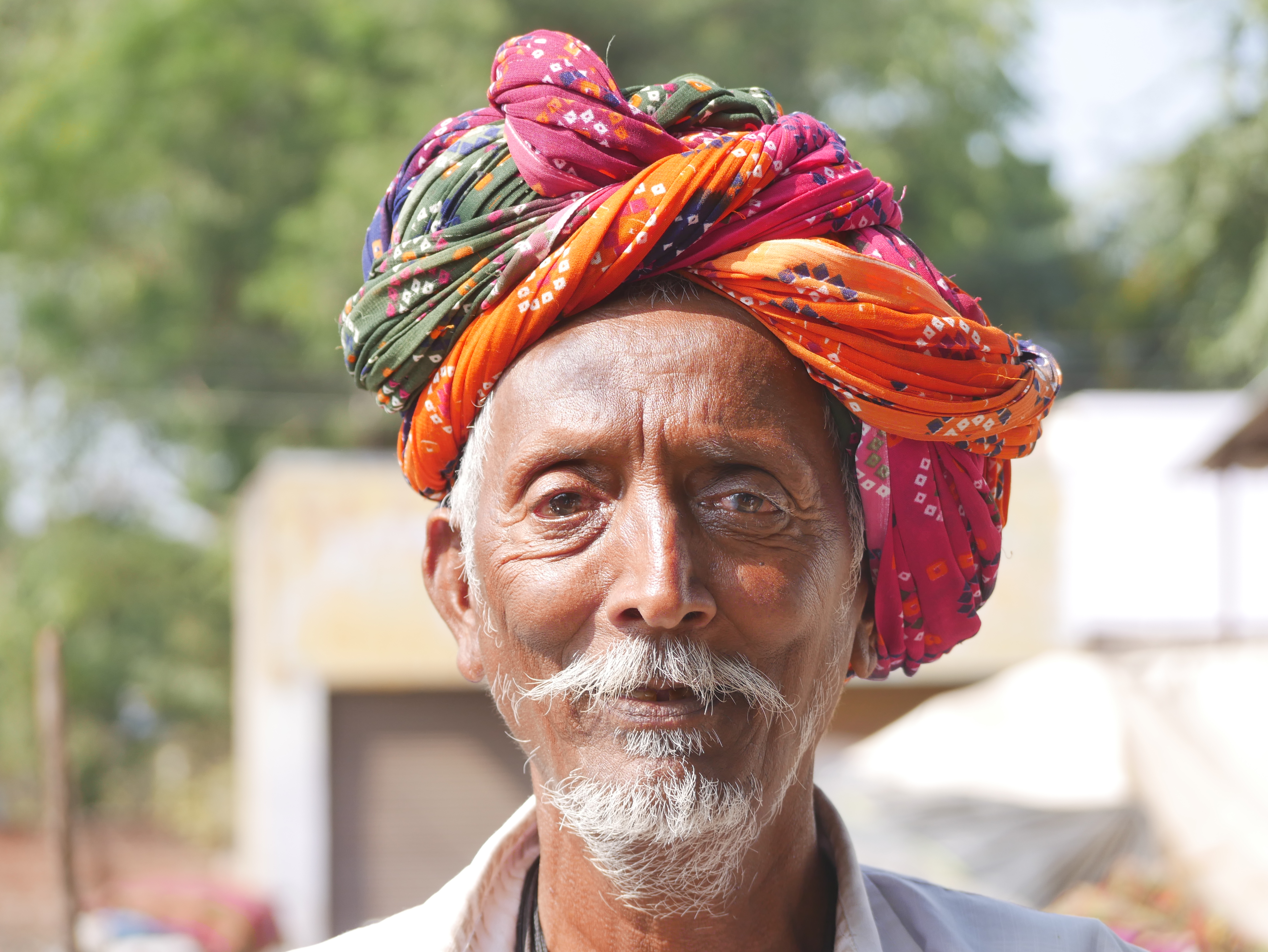
He put on his best turban for a photograph, Deboli

The Deboli group had an additional problem. They claim to have lived in this location for many years but admitted that it is an unofficial settlement. The authorities want to develop  the site and have told them to leave. He also said, "Some people have already gone to the new place, but it is not big enough for all of us and there is not enough money to build houses for everyone." Those that remained were living in tents, some large enough to accommodate an extended family and their cart. One resident proudly showed me his family's gadia, “It is fifty years old,” he said as he pointed out the brightly coloured, hand-painted decorative patterns on its sides.  

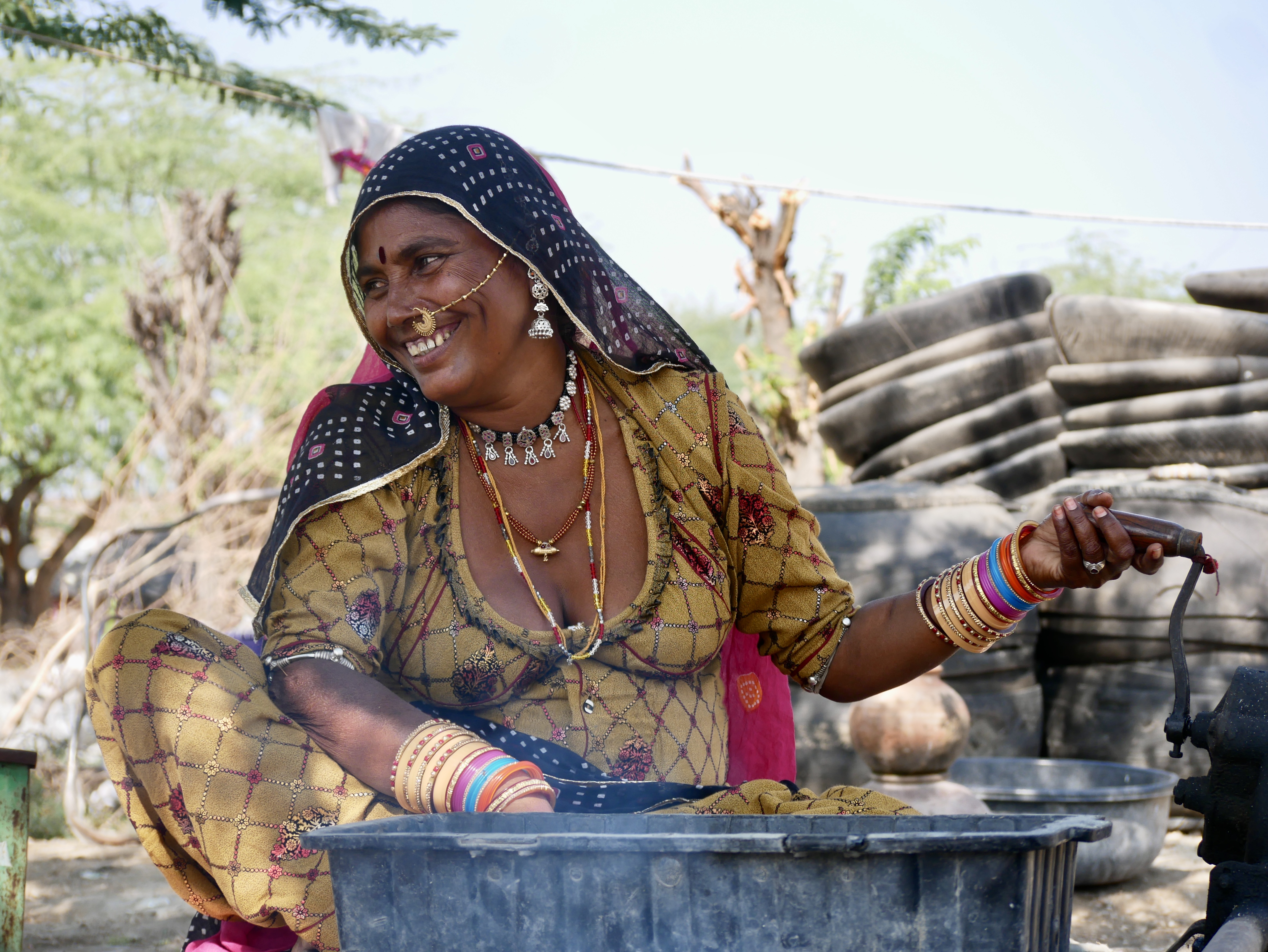
Before I left, I photographed the elderly man and his wife, but not before, at his insistence, he put on his best turban, replacing the gamcha (workers' scarf) he had been wearing when I arrived. His wife pulled her dupatta (scarf used to cover head and shoulders) further forward on her forehead and pointed out her bhanvaria (nose ring) and tattooed earlobes to me. Once ready they stood side by side, very formal, him extremely tall and her, petite. I also took individual portraits of them.

Gadia Lohar woman in Deboli, wearing the bhanvaria (nose ring) and traditional jewellery

"This peacock tattoo will take me to heaven"

I met Shankar Gadhia Lohar at a tea stall in Pachewar, a village of about nine thousand people, one hundred kilometres from Jaipur. He invited me to his settlement where he lives with his extended family, just a few kilometres away. Shankar makes kitchen utensils and small ornamental items which he then sells at the side of the road. I bought a colander from him for 50 rupees (about 50 pence), which came in useful when I visited a Bhand community on the opposite side of the road. 

Shankar is not the only craftsman in the family. His older brother, Hanuman, is an accomplished metalworker whose work has attracted awards and media attention. He has a workshop on Pachewar's main street where visitors are offered tea and snacks, but where there was no pressure to buy. His wife and daughter-in-law work with him and at the time of my visit, his children were quietly doing their homework after school. Hanuman concentrates on producing art works and I came away with two small pieces - a camel and a snake. 

One of the older women in the settlement had facial tattoos. I asked if they had a meaning. "No, no, they are just for fashion," said one of the younger men. On hearing this, the woman, who until that point had been silent, became very animated and contradicted him. "They protect us against misfortune," she said, "and this peacock tattoo will take me to heaven." She also explained that the jewellery Gadhia Lohar women wear, acts as a deterrent to the evil eye. When she finished speaking, Shankar introduced her to me as his mother.

Hanuman, Gadia Lohar artisan, Pachewar

"I used to work as a day labourer to pay for my schooling"

While Shankar's mother was speaking, Sangram Singh Gadia Lohar arrived. We drank tea together and he spoke about his efforts to secure educational opportunities for his community. He said, “I used to work as a day labourer to pay for my schooling. I completed higher secondary education and then worked for an organisation that trains people in community development. I started an open-air school for our children, but it is difficult to get regular attendance as most of the parents are uneducated and do not understand why school is important.” He also spoke about the difficulties of finding somewhere to settle, and said, “I have worked very hard to persuade the authorities to give small parcels of land so that we can build our own houses. The problem is that although we are told we can build on the land, we do not receive documentation. This means we can be moved on at short notice.” 

Sangram said, “Our traditional way of life is no longer sustainable. The young people need to be educated, to develop new skills, or to adapt our traditional craft in the way Hanuman and Shankar have.” While he was speaking a small boy came out of one of the tents. After playing with a tyre for a few minutes, he opened his father’s toolbox, took out a hammer and began hitting a charpoy (day bed), imitating the adults working nearby. I asked his father if the boy will go to school. He smiled and said, “I don’t know.”

"Will he go to school?" I asked.

You might also like "What have you brought me?" - an encounter with the Band in Rajasthan

Tuesday, 31 January 2023

"What have you brought me?" - an encounter with the Bhand in Rajasthan

Just outside Pachewar in Rajasthan we came across an encampment. As we approached, we saw that a ceremony was taking place. I was unsure about whether we should enter, but an elderly woman signalled to a teenager and chairs were brought for us. The ceremony continued. A young, shirtless man lay in the centre of the gathering with a family member, acting as a priest, speaking over him. An elderly man sat at the side of the gathering, wrapped in a blanket, shivering. The young man, trance-like, made responses to the priest before convulsing and appearing to lose consciousness. Then, the priest covered his face with a cloth, and he quickly recovered, got up and moved away from the group.  The shivering man put down his blanket, apparently cured of whatever ailed him.


"...my eyes and ears are still good, I can see and hear everything..."


The old woman, the family matriarch, said that they were members of the Bhand tribe. She explained that their settlement was a temporary arrangement while they waited for a permanent location to be identified by the government. She added, “I don’t know how old I am, maybe 80, maybe more, but my eyes and ears are still good, and I can see and hear everything”. She claimed that her group was an extended family encompassing nine generations. Quite a claim, despite the Bhand often marrying young. My friend and interpreter, Vikas, later explained that she may have been counting different branches of the family rather than generations. He also explained the ceremony. The Bhand believe that the spirits of their ancestors, who they call pitrs, can help them in times of trouble. The ceremony was performed to assist the recovery of sick family members and the voice of a particular pitr was being channelled through that of the younger man. These spirits are mentioned in Hindu texts including the Mahabarata and the Devi Bhagavata Purana. Annual homage, or shrad, must be paid to them in order to retain their favour. 


During the days of the Maharajas, the Bhand were story tellers and entertainers. At important gatherings, they would act as acclaimers, announcing the arrival of guests, showering praise upon them and their ancestors. Some would maintain family trees for the nobility. They would also perform plays and dance. Although most of their work was for the wealthy, they would occasionally put on shows for the common people during important festivals. Today they perform their traditional work at weddings, large events and festivals.


"..the priest...told a story to his perfectly silent audience"


When the matriarch spoke, all present maintained a respectful silence, but then the man with the blanket began asking us for money. She silenced him with a look and then asked us what we wanted. I explained that I am a writer and was curious about her community. On hearing this, the priest (who was her son), stood up, donned a colourful turban and told a story to his perfectly silent audience. The gist of it was that the emperor Akbar once had his Bhand executed for some argument he had with Birbal – a poet and singer appointed as a Minister. The Bhand’s son took his revenge on Birbal by using his skills in poetry and humour.

Towards the end of the story, a smartly dressed young man arrived and interrupted the priest. He announced himself as Jelabi Lal. He spoke rapidly and made the family laugh. Then he asked us for money. At this the matriarch’s smile changed to a look of anger. She spoke sharply to him in Hindi, telling him to “chup raho” – “shut up”. He did as he was told and stood looking at his very stylish shoes. She then turned to me and said, “what have you brought me”. Thinking on my feet, I handed her the colander I’d purchased from the Gadia Lohar tribe settlement on the other side of the road. She examined it closely, turning it over and over before pronouncing it “good, very good”. It seemed like a good time to leave and we went back to the road, leaving her to admire her new possession.

You might also like The rag-pickers of Jhalawar

Sunday, 15 January 2023

The rag-pickers of Jhalawar


Ayaan said he was 14 but he looked younger, perhaps 11 or 12. He was small but clearly well-fed which may have been why he was riding a decrepit looking exercise bike at the side of the road. I asked him where the bike came from. “Over there” he said, pointing to a mountain of plastic items being sorted into different bags by two young women. The women were employed by Ayaan’s father who buys waste goods from collectors, known as rag-pickers, before selling them on to more large-scale dealers for re-cycling. 

The business occupies a large site, not far from the centre of Jhalawar, formerly one of Rajasthan's princely states and now a regional centre of more than 65,000 people. The two women sorting the plastic items - Rekha and Parvati - spend their working days bent over, causing them painful back ache. Rekha was a little shy, but Parvati was amused by my presence and laughed directly into the camera after I held it up to request a picture. Ayaan's father also deals in old tyres and two men sat on the floor separating the rubber into strips which would then be used to make different items. I asked Ayaan why he wasn’t at school. “It’s morning,” he said “I go to school in the afternoon. In the mornings I help my father.” The first part of his sentence was in English, the second in Hindi. As I left, I turned back and saw him standing arms folded, looking managerial and keeping an eye on the two women who were busily sorting and bagging. Rekha looked up at him and rolled her eyes before going back to work.


Parvati


As many as four million Indians, most of them women, are employed in informal waste collection

Ayaan’s father buys his stock from collectors who gather discarded items from the street, from businesses and sometimes from garbage dumps. The collectors are widely referred to as "rag pickers". The name is similar to that given to the "rag and bone" men who collected unwanted household items from the streets of my north of England hometown during my childhood. The name came from their calling out "rag and bone" as they came through the streets, often with a pony and cart, alerting people to their presence. Indian rag pickers do not have the luxury of this form of transport and generally carry their finds on their backs.


As many as four million Indians, most of them women, are employed in informal waste collection. Their contribution to public cleansing and recycling is largely overlooked and poorly rewarded. The work is hazardous and exposes the collectors to infection, injury and in extreme cases risk of death. Saumaya Roy’s 2021 book Mountain Tales is an in-depth examination of the lives (and loves) of several families who make a living from sorting waste on a municipal rubbish dump in Mumbai. It follows the individual stories of the workers and describes in detail their work and living conditions. A few kilometres outside Jhalawar there is a rag-picker settlement of 35 families. Their makeshift camp is situated outside the city boundary, away from the residential areas and without running water or electricity.


I arrived at the camp at about half past ten in the morning. The residents were curious and perhaps a little suspicious about receiving an unexpected guest, but on seeing the camera began asking to be photographed. Some produced mobile phones and requested “selfies”. The volume of photographic requests soon became overwhelming and there was some jostling.  My friend, guide and interpreter Vikas called order, saying that we would photograph them in family groups, one by one. I also took some individual portraits, including of Eeran, a girl of perhaps twelve years. She wore her blonde-brown hair swept back under a headband and looked directly into the camera. Her expression was hard to read a mixture of curiosity and a half, almost sad smile.


Rekha


Grandmother and grandchildren. Pardhi settlement near Jhalawar


"Criminal" by birth


A young man stepped forward and began to explain that this was a settlement of Pardhi people, an Adivasi, or tribal group, originally from Madhya Pradesh. The name Pardhi comes from papardhi the Sanskrit word for hunting, reflecting their former occupation. They were traditionally forest dwellers, skilled in the use of bows and arrows, swords and hunting traps. This way of life was curtailed by the passing of the 1971 Wildlife Act which outlawed hunting.It was not the first time that legislation had significant negative impact on the tribe. The 1871 Criminal Tribes Act enacted by the British colonial government branded 150 Adivasi groups, including the Pardhi, as “criminal” by birth. This may have been in part, an act of revenge, due to their having participated in the 1857 revolt against colonial rule. The Act not only gave the police sweeping powers against those covered by its stipulations, but also ensured they were stigmatised in Indian society. Although this legislation was overturned after Independence in 1951, the stigma continues today.


An unintentional impact of the Wildlife Act was to further impoverish the Pardhi. Their traditional way of life forbidden, they now earn a living through agricultural work, the sale of food and handicraft items, and in some cases, begging. Many Pardhi can be found in Mumbai including the women who attempt to sell garlands to tourists outside high end hotels. Others, like the group near Jhalawar work as rag pickers. 


"Sometimes the dealers try to reduce the price to 25 or even 23 rupees per kilo".


I spent some time with several members of an extended family group. One of the younger men explained that the people here collect plastic and glass bottles which they then sell on to dealers who sort and sell the items on to larger companies. In return for one kilo of plastic they will receive 30 rupees – about 30 pence. I asked him, “how many bottles do you need to make a kilo?” “One hundred” he replied before adding “Sometimes the dealers try to reduce the price to 25 or even 23 rupees per kilo. We can’t do anything about this, there are many rag pickers, and the buyers can pay what they like”. For a single glass bottle, the going rate is three rupees. The Pardhi seem trapped in this way of life. Many have no formal education and although they claimed to be sending their children to school, few complete their studies. The health risks associated with the work are compounded by widespread alcohol abuse amongst the men. Despite the morning hour, many of them smelled of drink. Some had slurred speech or were unsteady on their feet.


The excitement about being photographed was widespread but one family stood back. Their home was of slightly higher quality and appeared more robust than those of their neighbours. There were other differences too. It was a family with only one child – a boy of eight or nine years, cleaner and better dressed than the other children – and the father did not smell of alcohol. They lived on the edge of the settlement, as if they had made a deliberate attempt to separate themselves. It was clear that the boy wanted to have his picture taken, and as we left, his father called me over and I photographed the two of them. The mother stood to one side, watching before going back inside their home.


Eeran


Saturday, 28 October 2017

A Postcard From India - 7, Churu, a Rajasthani secret

Three years ago whilst visiting family in Australia I came across an exquisite coffee table book - "Abandoned India The Mansions of Shekhawati". Beautifully illustrated, it told the story of the havelis (mansions) of the Shekhawati region in Rajasthan. The word haveli is thought to come from the Arabic hawali, meaning partition or private space. Their traditional layout includes specific and separate living areas for the family, their retainers and visitors as well as provision for the keeping of animals all arranged a large central courtyard. The courtyard would be used for ceremonies and rituals as well as being a place of work, particularly for women for whom its high walls provided privacy from the street.


Shekhawati was once an important stop on the trading routes between China and Western Asia. Caravans passed through carrying saffron, spices, silk, tea, tobacco, gold, opium and other valuable goods. Much of this trade was driven by the Marwaris who originated from the former princely state of Marwar also known as the Jodhpur region of Rajasthan. Marwari merchants achieved control over much of the region's trade during the 18th century, a position that was enhanced under the British who saw them as effective partners in developing commerce in India.

Many successful Marwari merchants used their wealth to built spectacular homes, ostentatiously displaying their success through their design and decoration. But this was no  vulgar display of nouveau riche wealth, rather one which employed the region's best artists and artisans to exemplify the best traditions of Indian mural painting and decorative art. These influences included Mughal style painting, but depicting scenes from contemporary life with images of industrial and household objects, cars and trains, Rajasthani royalty, Bollywood stars and even poking the odd bit of fun at the expense of the British. There are also depictions of scenes and figures from Hindu scripture and tradition.

It is estimated that there are several thousand havelis in the Shekhawati region, most of them  now uninhabited and many deserted and in a state of serious disrepair. This is due to the families having moved to Mumbai, Kolkata or other major cities several years ago and the younger generations not feeling a connection to the old home. In some cases there are also legal difficulties relating to multiple ownership of properties and responsibility for maintenance. Whilst some of the buildings are lovingly cared for and others are being carefully restored, many are beginning to crumble and there is a danger that this unique heritage could be lost in the future.

Malji Ka Kamra
Back to that book. My daughter kindly bought it for me as a surprise, and delighted, I spent hours poring over it, desperate to see the buildings for myself. Several of the photographs were of buildings in Churu, a town in Rajasthan. I was to be surprised again when I arrived there and checked in at my hotel, the Malji Ka Kamra  and was introduced to my guide who turned out to be none other than Lal Singh Shekhawati who had written the introduction to the book! Amazing India indeed. Combining Italian style with local artistic tradition, the hotel was built in 1920 by one Malji Kothari as a guesthouse for Maharaja Ganga Singh. It was the setting for many glittering gatherings with a stellar guest list that included royalty, important merchants and British officers. The Maharaja often stayed there and one of the rooms still bears paintings of him. Much of the building has been faithfully restored in recent years following a partial collapse. I stayed there for two nights - sleeping in the Maharaja's former room and admiring the stunning murals.

Lal Singh led me on a walking tour of several of the town's havelis. One of my favourites was the Tolaram Kothari Haveli. Built in 1870, this it is still inhabited and better still, the owners have cared for it and are undertaking restoration work. Entering from the street through a narrow doorway I saw some of the family and their helpers using the courtyard space. Some of the older relatives were relaxing and reading the newspaper whilst others were working on the production of small craft items for sale. They generously allowed me to walk around the external areas of their home and I was able to admire the stunning murals painted on to a special plaster that includes crushed sea shells. I also witnessed daily life within the haveli with mundane tasks such as sweeping, laundry and cooking being carried out in different areas. The restoration works have uncovered many little treasures with collections of biscuit tins, soap boxes, magazines, books, paintings and other ephemera from the first half of the 20th century having been found. These items also tell the story of daily life in this region during those years and are precious items of social and design history.

Tolaram Kothari Haveli
Inner courtyard, Tolaram Kothari Haveli
Treasure trove, Tolaram Kothari Haveli
Courtyard, Manna Lal Hanutmal Surana Haveli
The Manna  Lal Hanutmal Surana Haveli built in 1890 has also benefited from recent restoration.   It boasts a stunning doorway with an image of the Hindu deity Ganesha flanked by Mughal type scenes and fabulous art deco motifs in different shades of purple, contrasting with the surrounding greens and yellows. There are also images of important looking men - possibly family members - under the arch above the door which in turn is topped by Italianate angels straight out of a Florentine Palazzo! And then there is the door itself, studded with gold and silver coloured metals in geometric patterns. This collection of styles epitomises the beauty of haveli design with its diverse influences coming together to create a beautiful work of art. Magnificent.

Courtyard, Manna Lal Hanutmal Surana Haveli
Maharaja Ganga Singh, Parakh Haveli
We have already come across Maharaja Ganga Singh. Born in nearby Bikaner in 1880, he ruled the former princely state of Bikaner from 1888 until 1943. He achieved much during his lifetime and is remembered as a great reformer who in 1913 established a representative assembly, a High Court system in 1922 and a series of financial benefits for employees including life insurance. He also set up a savings bank for ordinary citizens, outlawed child marriages, introduced prison reforms and established several educational institutions including educational facilities for women.

The Maharaja also served in the military and saw action in the First World War when he was a member of the British Imperial War Cabinet before going on to represent India at the League of Nations in 1924. The owners of Churu's Parakh Haveli, built in 1925 had the exterior of their home decorated with images of the Maharaja using various forms of transport ranging from a Rolls Royce to a horse drawn carriage.

Parakh Haveli
Parakh Haveli
I was also able to visit the Sushil Kothari Haveli, just a short step from Malji Ka Kamra. The main courtyard is surrounded by a series of walkways and arcades all of them decorated with images of elephants, birds, floral motifs and miniature representations of important people. 

Sushil Kothari Haveli
The havelis are Churu's main attraction but the town has other architectural treasures too. Much to my surprise, Lal Singh was able to show me two fabulous 1930's buildings in the Art Deco/ modernist style. One displays style moderne features with smooth lines and limited external decoration. The other is a glorious example of art deco architecture sporting pink and blue motifs on the cream facade and delightful plaster elephant heads keeping guard on the external walls. Details of the architects and firm dates of construction of each are not known. There is also a Jain Temple in the centre of Churu. Few Jains live here now but the temple is beautifully maintained, its walls covered in scenes from Jain and Hindu scripture, gold leaf and exquisite ceramic tiles.

Art Deco villa
Style moderne villa
Jain Temple
I also spent some time walking in the bazaar area. Like most Indian towns, Churu has many small shops including jewellers, tailors, paan sellers, sweet sellers and chaiwallahs as well as countless stalls selling fresh fruit and vegetables. Cows wander the streets and one sometimes has to navigate a way through them as they gather near the food stalls or park themselves at the side of the road. They are not the only animals in the street as camels and donkeys are used for transporting goods and sometimes people from one place to another.


One of the most memorable things about my recent time in India has been the friendliness of the people. I was possibly the only foreigner in Churu at the time of my visit and was the object of some interest as I passed through the street. People called hello and were very happy to be photographed, several requesting me to take their picture or to have a picture taken with me. There was also much consuming of chai and lots of people were happy to sit and chat for a while. These included groups of older men sitting in the shade and chatting with their friends and a group of younger men with donkey drawn carts transporting enormous loads of goods around the town. I photographed one of these young men with his donkey and cart carrying a huge pile of goods. He saw me later the same day and asked me to take a nice picture of him with his hair combed and standing beside his donkey. You can see the nice picture below.


Regular readers will know of my fondness for coffee and cake. I did not find a coffee shop in Churu but I did visit have the wonderful Prajapat sweet shop that makes and sells pedi, a delicious semi-soft sweet made from khoa, sugar and a range of traditional flavourings. Lal Singh introduced me  to   the   shop and the pedi sweets. I enjoyed them so much I made a return journey to Prajapat in the evening to buy more! The shop can be found in the Bhai Ji Chow area of the town.

There is a train service between Delhi and Churu which takes about four hours, whilst it took six hours to do the same journey by car. Churu's treasures, the havelis are not yet widely known and the town currently receives relatively few overseas visitors compared to other parts of Rajasthan. It is a good idea to visit now before its secret is out. My stay here was one of the highlights of my time in India. I can't wait to return to see more.


You can see more pictures of India here.

And a few more pictures from Churu...