Showing posts with label Soho. Show all posts

Saturday, 18 August 2018

China Town Rediscovered

I have recently been spending time in Chinatown, photographing the street life and discovering things  that I'd hadn't noticed in more than 30 years of going there! I have to admit that it is some time since I last went to a restaurant there but I often partake of those long, deep fried "Chinese doughnuts" if I am there at the weekend and occasionally buy little treats including sweets made from various beans, or mangosteens, a small and delicious fruit I developed a liking for when living in Thailand some years ago.

Dansey Place grocery shop
Taking a break, Rupert Court
I have many memories of spending time in this part of London, including eating with groups of friends, once or twice attending parties in tiny flats tucked away above restaurants and even going to the Guang Hwa bookshop to purchase of Chinese books for a library service I once worked in and which had several Chinese customers. My recent forays, reading and internet research have made me appreciate Chinatown much more and have also provoked in me discomfort about its future as more businesses are forced out through hikes in rent whilst the number of gambling establishments increases.

For those not familiar with London's Chinatown, it is a collection of about nine streets clustered on the southern side of Shaftesbury Avenue. People know it for its restaurants but bakeries, supermarkets selling Asian food items, hairdressers and community organisations can also be found there. There are also a handful of Japanese and Korean restaurants offering alternatives to Chinese dishes. The main thoroughfare, Gerrard Street is always busy, especially at weekends when Chinese people come from across London and the South-East to shop and to meet friends and family. Many tourists visit and are easily spotted having their photograph taken under one of the ornamental gates before choosing a place to eat. This street is also the main focus of public cultural activity at Chinese New Year and other festival times as well as a place you might see a political demonstration by Falun Gong, Jehovah's Witnesses distributing brochures translated into Chinese or occasional buskers at the junction with Wardour Street.

Wardour Street

Deliveries, Wardour Street
London's original Chinatown was in Limehouse in the East End where most of the city's Chinese population lived at the beginning of the 20th century, many of them running businesses catering to seamen from the nearby docks. The area was heavily bombed during the Second World War and many Chinese businesses and homes suffered destruction or damage. Post-war demolitions destroyed most of what remained and a new Chinatown was gradually established around Gerrard Street in the late 1960's and early 1970's. However the Chinese presence in this part of the city predates this. In "London Nights Out: Life In Cosmopolitan London" Judith R. Walkowitz refers to Soho restaurants run by Hong Kong Chinese in the 1930's as well as other Chinese businesses bombed out in Limehouse coming here in the 1940's on extremely disadvantageous leases just to stay afloat.


Shopping in Gerrard Street
And so to my discoveries. Wong Kei in Wardour Street is one of London's best known Chinese restaurants. For years it was renowned for the rudeness of the staff who who bellow at customers "upstairs upstairs" as they entered or insist you share tables with people already seated when there was space elsewhere. I remember one famous occasion when going there to eat with a group of Chinese friends one was so incensed with the rudeness of our reception that he almost came to blows with one of the waiters. This robust welcome became part of the experience of eating at Wong Kei and people would go there to "enjoy" the experience as well as to sample the food.

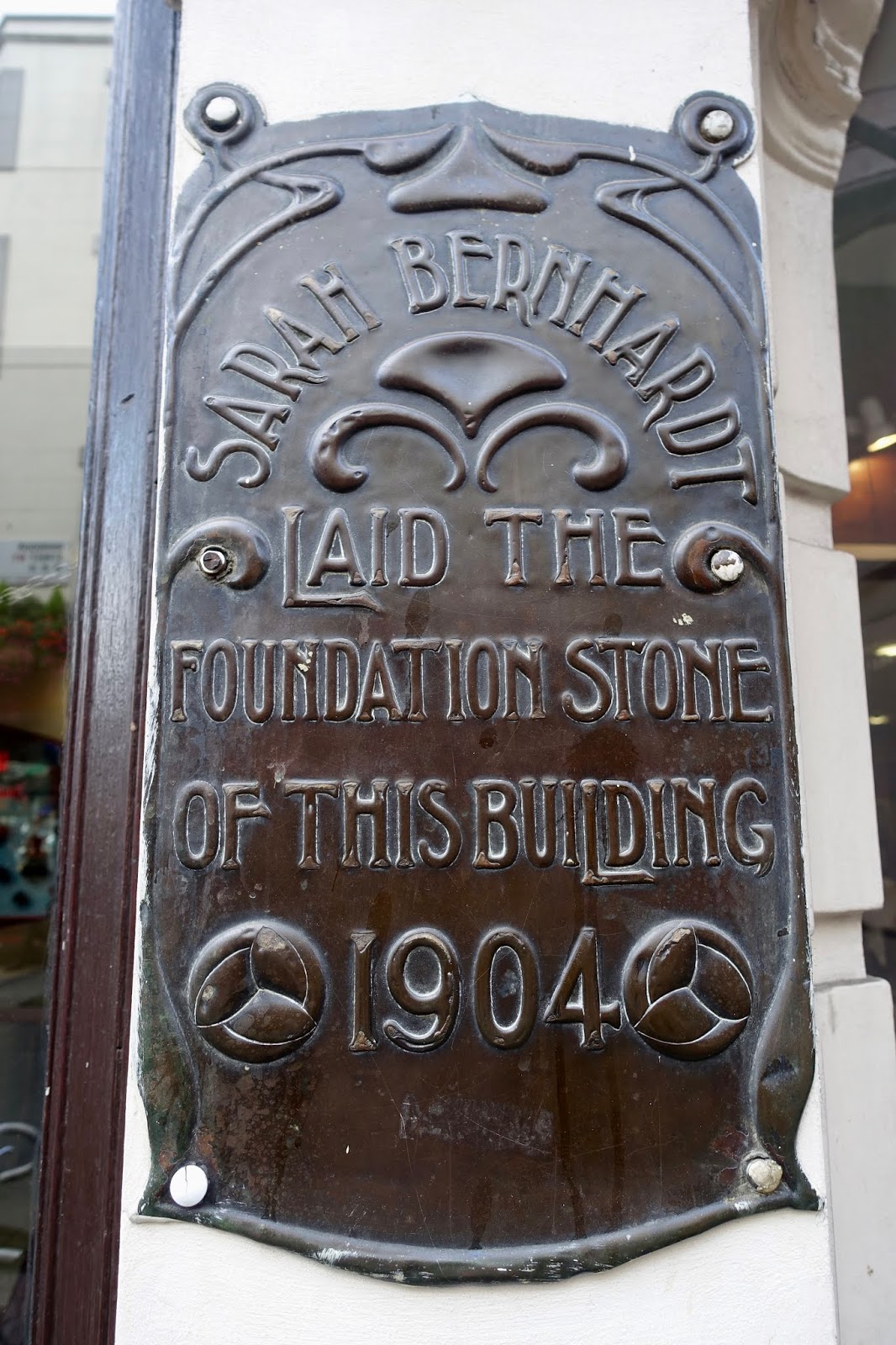
The Wong Kei building has quite a history. Built in restrained art nouveau style, the foundation stone was laid in 1904 by none other than actress Sarah Bernhardt whilst the coping stone was laid by Henry Irving. Both were extraordinary people. Bernhardt was the supreme star of the French theatre during the late 19th and early 20th century even after having a leg amputated in 1915. She also inspired several of the wonderful art nouveau posters of Czech artist Alphone Mucha. Irving was born into a working class family in Somerset, rose to become a luminary of the British theatre and the first actor to be granted a knighthood in 1895.  This building is proof that one should always look up when walking in London. I have a passion for art nouveau but entranced by the menu in the window only recently noticed the obvious architectural features and plaques to Bernhardt and Irving. For many years the building was home to William Berry "Willy" Clarkson's Wigs by Clarkson. Clarkson was not only an excellent wig maker and costumier, but also an accomplished blackmailer and fraudster. Perhaps unsurprisingly he died in suspicious circumstances in 1934.


Dansey Place
Just across from Wong Kei, there is a narrow alley that runs behind a string of restaurants. This is Dansey Place. At first site (and smell) it is neither welcoming nor attractive. However it is worth venturing in if only to visit Lo's Noodle Factory where delicious fresh noodles are made and sold  very cheaply from this "hole in the wall" operation. Peep over the counter and it is possible to see huge sheets of noodles being stretched out before cut and packed into bags ready for sale. There is also a seafood stall in the street and a small, red and green painted grocery shop.

Our friend Willy Clarkson has a connection with Dansey Place too. Before the Second World War the street was a notorious gay meeting place. Men would congregate in a public lavatory opposite Clarkson's shop and which became known as Clarkson's Cottage. It was also a haunt for blackmailers who would extort money from the men - male homosexuality being completely illegal in the UK until 1967. The facility was so notorious that when it was closed in 1945, a wealthy New Yorker bought it and installed it in his garden.

A modern conversation in Gerrard Street
Nice hoardings but another closed restaurant
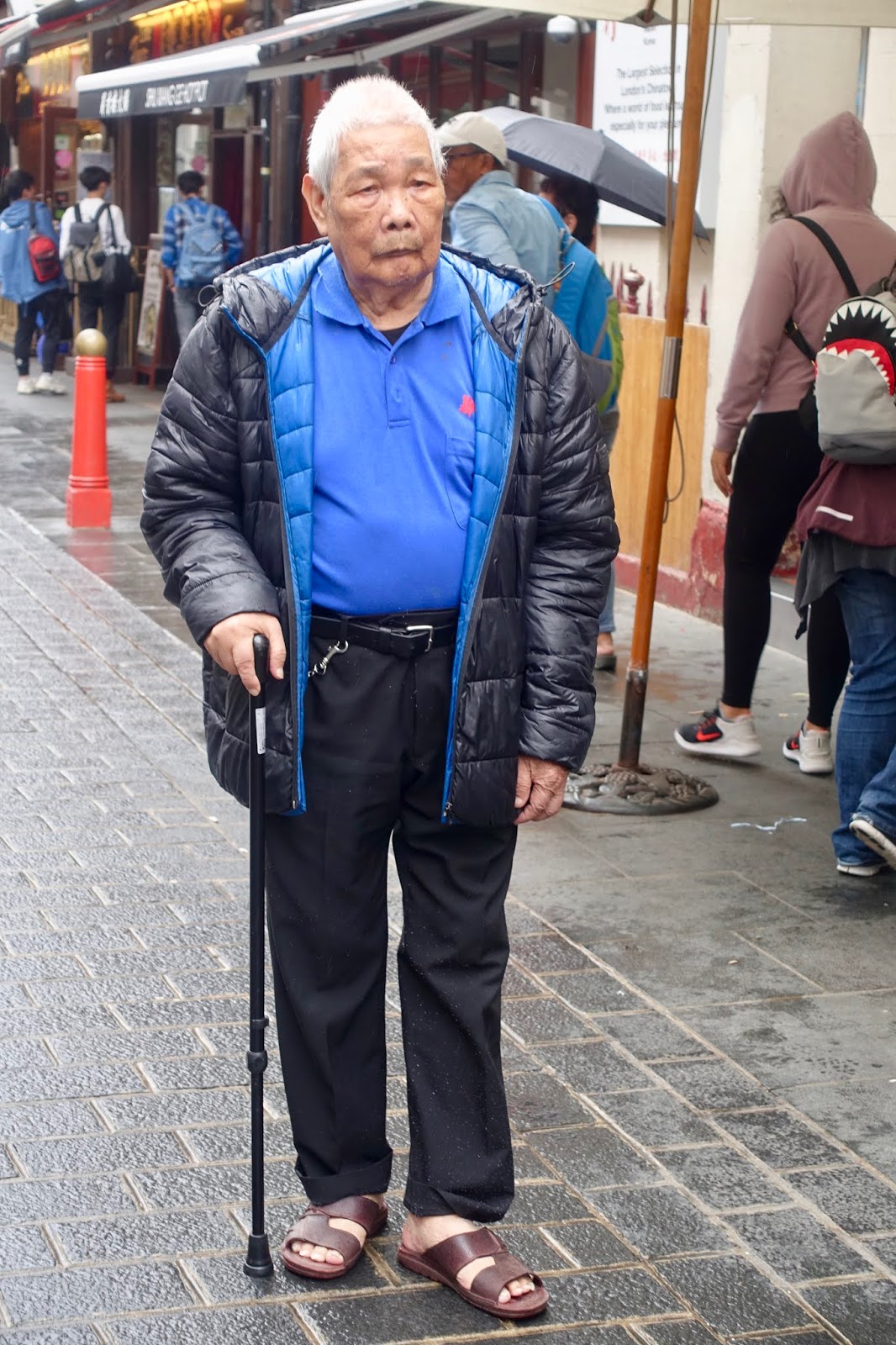
London's Chinatown is small compared to those of say New York, San Francisco, Manila or Melbourne but it is no less interesting. Whatever time you choose to wander its few streets there will be something to see including early morning deliveries to the shops and the restaurants, waiters and waitresses having quick cigarette breaks before the onslaught of lunchtime customers,  people snacking outside the bakeries and the of course occasional street trader. I recently noticed a couple of older men selling garlic and green vegetables spread out on newspaper. I bought something from each of them and asked if they would let me take their pictures. We do not have a language in common but we somehow understood each other and they agreed for me to take their portraits - both extremely amused that I should want to. I have since returned to give them hard copies of the photographs. Both of them were surprised and after looking at the pictures placed them very carefully in their wallets. One tried to give me free garlic in return! Portraits of the two gentlemen are featured in this post.

It is true that we often don't notice the things we see very day and we don't always realise their value or consider them special until they are lost. This tiny enclave in the centre of London is important not only to the various Chinese communities or as a tourist attraction but because it represents an important part of the city's history. The losses due to high rents and the encroachment of unrelated businesses is worrying. It would be shameful if these few streets lost their unique character in the way that much of the neighbouring Soho has.

Gerrard Street
Lisle Street

Thursday, 28 January 2016

Soho Survivors

The first ever post on this blog was My Soho in December 2011. It covered some of my favourite Soho haunts and made reference to the loss of the unique character of the area as many of the long established businesses closed and the international chains began to move in.

That was in December 2011 and since then a number of other establishments have either gone or are under threat. The Astoria and music venues The 12 Bar and the Black Gardenia have been gone for a few years now, victims of the Crossrail development. Madame JoJo's a London institution has closed its doors for the last time in somewhat murky circumstances and the much loved Curzon cinema is also under threat - another potential victim of Crossrail. I'm all for improving transport across London but not at the expense of the city's cultural heritage and not if it means chaos in the west end for several years. Not surprisingly, a Save Soho campaign has been established.With all of this in mind, it's timely to revisit my beloved Soho and survey some of the remains of its rich cultural heritage. Here are some of my favourite Soho survivors.


Coffee, cake and jazz are three of my passions and Soho provides the very best of all three. Devotees of  patisserie are faced with the problem of choosing either Maison Bertaux in Greek Street or the original Patisserie Valerie in Old Compton Street. Both have a superb range of cakes and pastries, stunning window displays and interesting histories. Bertaux opened in 1871 and is the oldest patisserie in the city. Started by French refugees fleeing the Prussian siege of Paris, the owners lived upstairs and baked on the ground floor. Tradition has it that a lady of the night and a tailor also lived in the building so along with the tea rooms there was something for everyone. I have to confess to being a major fan of Berteaux due largely to the cakes but also because it is one of the few remaining places in the west end where you can see what were once called "characters" and where the regulars are known and recognised by the staff. My favourite place to sit is in the downstairs room where customers make their choices from the window before taking a seat either here, upstairs or in the room next door which was added a few years ago. There is occasional theatre in the upstairs room, but the whole place is dramatic, with its collection of assorted "stuff" in the downstairs room adding to the atmosphere. Those of you who have been will know what I mean!


Patisserie Valerie is a relative newcomer in comparison with Maison Bertaux. Originally in Frith Street it was founded in 1926 by one Madame Valerie from Belgium who wanted to introduce Belgian patisserie to London. The cafe was immediately successful and remained so until the Luftwaffe put a stop to things by bombing the building during the Second World War. Not deterred, Madame Valerie relocated to the current premises in Old Compton Street which retains much of its original 1950's decor. Both Bertaux and Valerie had a reputation as venues for secret assignations and each had their loyal customers who would not set foot in the other establishment. Patisserie Valerie is now a chain with several branches across London and in other parts of the country but the original Soho branch has kept its character and still has the air of an independent cafe.

The Algerian Coffee Store is a few steps from Patisserie Valerie at 52 Old Compton Street. Walking along the street you are likely to notice the aroma of freshly ground coffee several yards before reaching the red fronted shop. Founded in 1887 by one Mr Hassan, it has been under the direction of Paul Crocetta and his family for the last 40 plus years. Inside, there are more than 80 coffees from countries as diverse as Ethiopia, Bolivia, India and Papua New Guinea.  The beans are ground in front of you and you can ask for cardamoms and other spices to be added. There are also 120 types of tea, marzipan biscuits, Turkish delight, chocolates, mints and different kinds of coffee makers. The staff are extremely knowledgeable and can advise what to choose according to your preference.


Just around the corner from the Algerian Coffee Store, Bar Italia in Frith Street is another Soho survivor and a great place to drink mind blowingly strong coffee. Opened in 1949 by Italian immigrants Lou and Caterina Polledri, the cafe is still owned by the family today. The Polledris came to London in the 1920's and established a traditional Italian cafe in Long Acre, Covent Garden during the 1930's. Lou was interned as an enemy alien during the Second World War but Caterina managed to keep things going until he came home again.

When Bar Italia opened it quickly became a focal point for the Italian community, many of whom had been interned during the war years and who needed somewhere to meet, to swop news and to hear about employment opportunities. The cafe quickly gained a reputation for excellent coffee and was part of the "espresso revolution" that swept London in the late 1950's and 1960's attracting young people, especially hordes of "mods" who would park their Lambrettas outside. Bar Italia opens at 7 a.m. each day for breakfast, stays open until 5 in the morning and is always busy. The walls are covered with photographs of visiting celebrities whilst football matches are screened on a TV screen at the back of the cafe. I remember walking through Soho during the 1994 World Cup when an Italy game was being screened whilst the cafe burst at the seams with cheering football fans! Bar Italia has retain much of its glass and chrome decor as well as the original stone floor laid by family member Torino Polledri who was a terrazzo specialist.


Back onto Old Compton Street and at number 61 there is another Italian establishment, the I Camisa delicatessen. The shop has been here since 1961 but was originally at number 66 in the same street, opening in 1929 and closing ten years later when Ennio and Isidor Camsa were interned, first at Lingfield racecourse in Surrey before being sent to Warth Mills in Bury. The  Camisas then struck lucky. They were not included in a group of Italians placed on a luxury liner for deportation to Canada. They were lucky because the ship was sunk by a German torpedo and 730 lives were lost. The Camisas were released at the end of the war and returned to Soho to reopen their store. The shop is a delight with its cheeses, fresh pasta, delicious breads, wines and other Italian foodstuffs and like its near neighbour the Algerian Coffee Store, it gives off enticing aromas that help create the long queues that can often be found in the shop.


I rarely go to pubs these days but still enjoy an occasional visit to another Soho institution - the French House at 49 Dean Street. This Soho institution opened as The Wine House in 1910 under the management of German landlord Herr Schmidt. Schmidt was deported when the First World War commenced and was replaced by French speaking Belgian Victor Berlemont. Berlemont renamed the pub The York Minster and had a reputation for dealing with "difficult" customers by saying "I'm afraid one of us will have to leave and its not going to be me". During the Second World War the pub became a gathering place for French emigres including Charles de Gaulle who used the upstairs dining room.  

After the war, the pub began to attract an artistic, theatrical and literary crowd including Lucian Freud, Francis Bacon, Brendan Behan and Daniel Farson. Farson had the distinction of being barred from the pub for behaviour he couldn't recall. Must have been something to do with the drink! The walls of the bar room are still decorated with photographs of London's culture elite from that period. In 1951, Victor's son, Gaston took over. A real Soho character with his flamboyant moustache (which young women would sometimes be invited to examine) and frequent hand kissing, he further emphasised the French connections of the pub. Like his father he was also able to deal effectively with drunks once famously intervening when a woman had thrown her drink in the face of a man who had been annoying her by saying "But madame, I see your glass is empty" and then refilling it.

The French House has not been without a racy side. In the early 1950's it came close to being closed down due to "goings-on" in the toilets. It was also here that Francis Bacon met model Henrietta Moraes and asked her to pose nude for him. Photographer John Deakin took pictures of Moraes for Bacon to work from before going on to offer copies for sale to visiting sailors. Very entrepreneurial. 

The French House is alive and well although it is sad that the upstairs restaurant is now under separate management and serves Italian rather than French food. I have happy memories of sitting in that tiny dining room which appeared twice its real size due to the mirrored walls, enjoying good food and from my window seat watching all human life pass by in the street below. Gaston died in 1999 but several of his rules have been retained, including selling only half pints and banning mobile phones in order to encourage conversation!

And finally, the best jazz club in the world. Ronnie Scott's originally opened in Chinatown's Gerrard Street in 1959 before moving to its Frith Street home in 1965, offering live jazz six nights per week. The club featured such giants of the jazz world as Ella Fitzgerald, Count Basie and Sarah Vaughan as well as emerging and avant-garde musicians. Scott, himself an accomplished saxophonist ran the club until his death in 1996. I saw him just once when visiting London as a student in 1982. I visited the club with four student friends and saw Buddy de Franco perform. We were of course broke and managed to purchase only one bottle of Laski Riesling wine between us for the then enormous sum of £7 before rustling up enough change to buy a couple of unappetising burgers to share. Scott introduced the act, told a few jokes and threatened expulsion if people spoke during the performance. And he meant it. If only the same were true these days.

The club reached a peak in the early 1970's but then suffered a decline, facing potential closure at the end of the decade until Island records owner Chris Blackwell provided an injection of cash to keep it going under Scott's management. In more recent times, Ronnie's has been totally refurbished, improved somewhat its once dreadful food and formerly poor service and continues to attract the best jazz musicians in the world. Over the last few years I have seen, amongst others, Avishai Cohen, Dee Dee Bridgewater, Nicola Conte, Ramsey Lewis, Lonnie Liston Smith and Stacey Kent perform. This is probably my favourite place in all London with its great music, thrilling atmosphere and important history. 


Old Soho is gradually disappearing and there is a serious threat from that more will be lost due to increasing rents and the Crossrail development. Despite this, several of the older, cherished businesses continue to thrive and to attract new customers as well as hanging on to their loyal older clientele - like me. When Gaston Berlemont was asked what made the French House (and in my view Soho) special he said it was about the people "…they themselves create an atmosphere. Its no use putting up a couple of plastic onions and saying you're creating a French atmosphere, it doesn't work like that. Atmosphere is a human thing concerning hearts and souls". I agree with Gaston - but people need places to meet in which to create an atmosphere. It will be a sad day for London if any of these remaining Soho survivors disappear. 


Friday, 6 March 2015

Picture post 39 : Hammer House, secret art deco in Soho


Hammer Films is one of the most well known and best loved British film studios of all time. Founded in 1934, Hammer churned out niche horror movies throughout the 1950's and 1960's with the Frankenstein and Dracula series, and the 1959 classic, The Mummy, thrilling audiences of all ages. The studio was famously associated with British actors Christopher Lee and Peter Cushing who made chills run down the spine of many a cinema goer. As well as horror films, Hammer also produced a number of science fiction and psychological thriller movies with some great titles including Maniac, Paranoiac, Nightmare, Hysteria and Fanatic. You couldn't say you didn't know what you were getting with titles like those! The Hammer brand still exists and from time to time releases films including in 2012 a version of The Woman In Black featuring Daniel Radcliffe, best known as the screen face of Harry Potter.

Hammer House at 113-117 Wardour Street in London's Soho was once the home of the film company. Hammer's original distributor, Exclusive purchased the lease on this building in July 1937, but did not  rename it Hammer House until 1949. It remained the company's headquarters until the 1980's when the their gothic movies fell out of fashion and unable to afford the rent on their part of the building, withdrew to cheaper premises. Today the building is home Tony and Guy hairdressers and a wine store on the ground floor with a range of consulting and media companies take up office space on the upper levels.

Despite the many changes over the last decade or so, Soho is still my favourite part of London largely because of its many secret treasures and hidden gems. The outer door of Hammer House hides one of the street's prettiest features - a wonderful art deco lobby complete with a beautiful peacock feather designed stained glass inner door, patterned floor tiles, elegant staircase with torch style lighting and original lifts. I have twice managed to see inside the lobby when the door has been left open and last summer I was bold enough to ask the concierge if I could take photographs. To my surprise and delight not only did he say yes, he suggested I look inside the lifts and admire the staircase too. The light was not great and some of the pictures didn't come out well, but the best ones are featured on this post. I have been unable to find out who designed the interior or who the building's architect was so if anyone does know, please leave comments. It must at least predate 1937, the year Hammer took up residence. Although losing much of its bohemian flavour and despite the influx of the chain stores and cafes, its good to know that some of its glorious past survives and is cared for.


Friday, 5 July 2013

Nights Out - Life in Cosmopolitan London


Judith Walkowitz' book Nights Out - Life in Cosmopolitan London tracks the story of Soho from the late nineteenth century up to the Second World War. Her approach to telling this gripping story is thematic rather than linear. It takes us to Soho's Italian restaurants, samples the unique culture of the Lyons Corner House, tells stories about shady nightclubs and about Berwick Street Market's once almost totally Jewish character.

The book is full of characters that have shaped this still most vibrant part of the city. These include Emidio Recchioni, anarchist, successful business man and financier of several assassination plots against Mussolini during the 1930's. A leading light in the anti-fascist element of Soho's Italian community, Recchioni was the owner of the King Bomba provisions store at 37 Old Compton Street, which became a focal point for anarchists of all types as well as artists and Bohemians from nearby Bloomsbury. its takings also funded his unsuccessful attempts on Mussolini's life.

Also from the Soho Italian community and a contemporary of Recchioni, Peppino Leoni began life in London as a waiter in the Savoy Hotel before managing to acquire his own premises in Dean Street in 1926 which today still carries the name of his restaurant, Quo Vadis. Leoni's views were different to those of Recchioni. He was a fascist and was interned in 1940 as an enemy alien - returning after the War to reclaim his restaurant and to continue to manage with a rule of iron for many years.

Women played an important role in Soho's history. The leading ladies in Walkowitz' book include the notorious Mrs. Meyrick, owner of several shady nightclubs in the twenties and thirties including the legendary 43 Club at 43 Gerrard Street with its literary patrons, "Bright Young Things", Jewish jazz musicians, "professional dancers", sexual minorities, politicians and undercover police all rubbing shoulders in the same space. Imprisoned four times for selling alcohol illegally and for bribing the police (amongst other things) she made and lost a fortune but managed to educate her children at Eton and Roedean and to marry her daughters to titled gentlemen.

But it wasn't only the notorious Mrs Meyrick who ensured women feature largely in this book. The iconic "nippies" (waitresses) of the Lyons Corner House, the women "schleppers" or touts, of Berwick Street's rag trade and the ambiguous "professional dancers" of the nightclubs all significantly influenced the character of Soho and displayed different aspects of femininity.

Lyons Corner Houses, huge cafes capable of seating hundreds of customers at any one time were a microcosm of Soho and West End life with unmarked but very clear boundaries between different types of customers including ladies in town for the day, Jewish rag trade workers and a more or less discreet gay presence. All of them wanting to pass time over tea, sandwiches, beans on toast or desserts whilst having possibly illicit assignations. All of this was managed by the vast team of nippies who had to be immaculately turned out in the regulation uniform (which they paid for themselves and which together with their hands, was inspected every day) as well as being polite but not too "familiar" with the customers. They also had to help ensure the propriety of the cafe by looking out for undesirables. One of my favourite characters who is mentioned just once in the book is one George English who was debarred from the Trocadero branch for using "filthy expressions in the new buffet".

This excellent book also looks at the commercialisation of sex in Soho with a whole chapter on the infamous Windmill Theatre - although this began long before the Windmill opened as the story about dancing girls in a Leicester Square theatre in the 1890's wearing entirely flesh coloured clothing bears out (or should that be bares out?). There is also consideration of the long established ethnic diversity of the area - including a fascinating chapter on the black clubs that evolved in the 1930's and thrived during the Second World War with the influx of black GI's.

Regular readers know I love this part of London despite the many losses of some of its more characterful places over the last several years. Judith Walkowitz manages to bring it alive with this excellent book, communicating its vibrancy, its seamier side and the absolute love of life that can still be found in Soho's streets today. Fantastic book Judith - thanks very much!

You might also like London's Best Bits and My Soho.

Monday, 26 December 2011

My Soho

Although I rarely go out in town these days, I still have a lot of affection for Soho. When I first came to London it was the place I spent most of my free time in and loved best.

Walking around Soho today I realised how very different it is from when I first came here. Some of the old favourites have survived and prospered - the Algerian Coffee shop and the original Patisserie Valerie in Old Compton Street, Maison Bertaux in Greek Street and the enduring French House in Dean Street. Some places have survived by adapting themselves. Maison Bertaux has expanded into adjoining premises but - sadly - the French House let its first floor restaurant go some time ago - it's now an Italian restaurant managed (and owned?) separately from the pub.

Algerian Coffee Stores - Old Compton Street, Soho by Yekkes

Other places have completely disappeared. Who else remembers the Old Compton Cafe in the street of the same name - a step up from a greasy spoon, but much loved by late night revellers, now replaced with a small branch of Balans? Does one street really  need two branches of Balans?

On the other hand, there is at least one example of what was once a small independent cafe taking over the world in the shape of Cafe Nero. The branch on the junction of Frith and Old Compton Streets was the first one in the west end as far as I remember and has now spread right across the city and beyond. I remember eating pretty bland slices of pizza there late at night, after having had too much to drink, then throwing down a cup of the strongest coffee you could get in London at that time.

A couple of the long time food outlets of Old Compton Street have survived - Camisa, the wonderful Italian deli at the Wardour Street end still sells onion bread, cut meat, italian rice (for risotto!) and a variety of other delicacies, and Cafe Espana the slightly run down but oh so popular Spanish cafe nearby is still with us. However, devotees of Cafe Espana may need to worry - there is a for sale sign on the front of the building advertising both the lease and the business. Another one bites the dust?

As well as eating, Old Compton Street and surrounding area has always been a spot for pretty serious drinking. My favourite has always been the French House in Dean Street. Originally called the York Minster, it took its name from the preponderance of French customers during the second world war - several of whom were linked to the then French Government in exile. It has to be one of the cosiest (yes and very small too) bars in the west end. It still attracts a theatrical crowd, in all senses of the word, who gaze up at and are gazed down on, by the many pictures of celebrity drinkers who have graced "the French" in the past.

Maison Bertaux - Greek Street, Soho by Yekkes


In rowdier days I was very fond of the old style Comptons pub, which was then ground floor only with a central, horse-shoe bar, a varied clientele and for a few years at least a terrifying and permanently inebriated Scottish landlady who took no s--t from anyone but became coy and giggly if given complements or told she'd had her name in the paper. She was typical of a number of characters who have mostly disappeared from Soho these days. Whatever happened to the spectacularly grumpy and often rude old plastic bead wearing queens who worked in Maison Bertaux, terrifying staff and customers and the actress lady who ruled the same shop with a rod of iron? Not to mention the landlord of the Coach and Horses...

Coach and Horses - Dean Street, Soho by Yekkes

I also liked to drink at the still extant Ed's Diner, on Moor Street. Ed's is primarily a burger bar - also a fairly large chain now - but used to, and probably still does sell American beers to diners late into the night. My favourite was Rolling Rock which the staff swore was Elvis Presley's favourite beer, accompanied by a strange concoction known as "wet fries" - chips in a kind of stodgy gravy. Best of all were the individual juke boxes in front of every stool at the deco-ish bar, where for 5p you could select favourite songs from the 50's and 60's, like It Might As Well Rain Until September, by Carol King, Sally Go Round the Roses by the Jaynettes and other goodies.

Ed's Easy Diner - Moor Street, Soho by Yekkes

Ronnie Scotts is still with us in Frith Street.  The best jazz club in the world has been running for more than half a century having opened in 1959 and still attracts sell out crowds for the biggest names in jazz. If I go anywhere in Soho these days, this is the place I go. It costs a fortune but its worth every penny to have seen Ramsey Lewis, Lonnie Liston Smith, Avishai Cohen, Dee Dee Bridgewater, Stacey Kent and others over the last few years. The club had a major makeover a couple of years ago and the no-smoking legislation means its very different from the first time I visited in 1982 when Ronnie Scott was still alive, hosted the evening and told bad jokes, but its still a great musical experience.

Ronnie Scott's - Frith Street, Soho by Yekkes

To prove I don't entirely live in the past, there are some really good new or newer places too. Its great to see places like Princi in Wardour Street and Yauatcha in Broadwick Street take forward the area's tradition for fantastic patisserie, albeit a bit specialist and super-expensive in the case of the latter. Food still looms large amongst the other newcomers - I love Humous Brothers in Wardour Street, (well I would) and Busaba Eatthai across the road is also a favourite, although its some time since I went.

Its interesting that the area can still support a fair number of pretty good newsagents selling a range of specialist publications. Specialist in the usual sense that is, with great coverage of the arts, overseas newspapers, fashion, music and other media, rather than "specialist"in the old Soho sense! There are two really good newsagents in Old Compton Street and a couple more in Wardour Street - I even managed to pick up a copy of a new Azeri magazine "Baku" recently without the shop keeper even batting an eyelid when I asked for it.

I wonder how much longer these hardy independent souls will be able to hang on as leases end and rents rocket? Many of the chains already have a presence in Soho - Starbucks, Pret a Manger, Paul and others - all fine with me, but what a pity it would (will?) be if and when we eventually lose all of the shops and cafes that have given the area its character for so many years.