Showing posts with label refugees. Show all posts

Friday, 24 March 2023

"Even if you are educated it is hard for Biharis to get work" - the Geneva refugee camp in Dhaka

"There's no space here. The children have nowhere to play or study and I have to cook in a small space under the stairs"said Shahana.  We were in her tiny home in in the Geneva refugee camp in Dhaka. More than 40,000 people live here in the dark, narrow alleys, in homes lacking basic services. Shahana was sitting on the steps that lead from a tiny ground floor room to two others of the same size. None of them have natural light. Fourteen people live in this house, including seven children. Her mother-in-law and her 97 year-old grandmother, Jamila, sat on the bed that fills most of the room, and her husband crouched down, talking to me through the narrow entrance to the floor above.

Early morning in Geneva refugee colony

Life in Bangladesh is often lived very publicly. It is not unusual to see people bathing in rivers or brushing their teeth in the street. In Geneva there is no choice and even the most basic human functions are carried out with little or no privacy. There are shared washing facilities and toilet blocks and water has to be queued for twice a day. Most of the residents arrived at the camp in 1971 after the War of Liberation when after a bloody conflict, what is now Bangladesh became independent from Pakistan. Many Bihari Muslims had left India in 1947 during Partition, opting for what was then East Pakistan. Their mother tongue is Urdu and during the war, most of them supported the Pakistani army against the majority Bangla (Bengali) speaking majority. Some took part in atrocities but others were also victims of violence. Figures for the number of casualties on each side vary wildly and are the subject of much dispute. After the war, and into the 1990's, many Biharis managed to leave for Pakistan. This process has now ceased, due in part to sometimes violent opposition from other Pakistani communities.

"The teachers are not friendly. We have to pay them bribes to get the children admitted"

Even in the middle of the day the camp streets are not light and are so narrow that it can be difficult to pass through them. Nazma was playing with her small grandson in one such alley. She was born in the camp and looked older than her 50 years. Before the War of Liberation, her father had a good job working for the railways. Her husband runs a small shop and her son has a car repair business. I asked her about problems with the outside community. She said "We had trouble in the past, but we don't really have those problems anymore". Then she added "But it can be difficult to get the children into outside schools. When they realise we are Bihari, they don't want them". Mohammed Ashore, a barber aged 36, expanded on this. "The teachers are not friendly. We have to pay them bribes to get the children admitted". He lives in a one room home with his wife and two children. They pay 4000 taka a month in rent. According to the World Salaries website a barber in Bangladesh can earn between 5,000 and 12,000 a month.

Nazma and her grandson

Nazma understood the importance of education as a way of breaking out of the camp. "I want my grandson to be an engineer" she said "but even if you are educated it is hard for Biharis to get work". Shahana said that her 11 year old daughter wants to be a doctor but that "my 14 year old son is not interested and doesn't want to study". For many years it was difficult for Bihari children to attend state schools. The community did not have citizenship and therefore lacked ID cards and other official documents necessary to secure employment and to access services. This changed in 2008 when the Government acknowledged their right to citizenship, perhaps recognising that the majority of people in the camp were not even born in 1971. Despite this positive step, long-standing suspicion and prejudice is harder to overcome.  

The camp has a small bazar running through one of the wider streets. Residents go there to buy fruit, vegetables, meat, fish, rice, paan and other consumables. They also go to visit the barber, get electrical items repaired and to seek advice at the office of the local community organisation. On the day of my visit a man selling rabbits from a wheeled cage was also trying to do business. I told my friend that rabbit was once a poor man's dish in the UK but is now served in expensive restaurants. He assured me that they were being sold as pets and not for consumption. 

Shahana, her mother-in-law and grandmother

"Yes, I am the malik"

Shabanah is 45 and was born in the colony. She was doing brisk business at her tea shop. I asked her if she was the malik (boss/ owner) and what she did before opening the shop. "Yes, I am the malik" she told me, then added "my husband works here with me" as she turned to look at, and indicate the man preparing snacks on a raised platform behind her. "I used to work in textiles, but I set this shop up three months ago"  she added. The shop occupies a narrow hole in the wall with a stall set up on the pathway in front. The monthly rental is 2,500 taka (about £25). I ordered a tea and as I spoke to her in my limited Hindi, a small crowd gathered, curious to know what we were talking about and in some cases, anxious to join in the conversation. She told me "My grandfather's name was Mohammed Miah. He came from Bihar but I don't know exactly where". She agreed with Nazma, Shahana and Mohammed Ashore that the main problems of living in the camp were access to good water, space and facilities for children and the generally poor living conditions. She has two children and I asked about her ambitions for them. "I want them to be able to recite the Koran in full" she said. She agreed to a photograph and covered her head in preparation. When I got up to move on, she refused to accept any payment for the tea, saying I was her guest. 
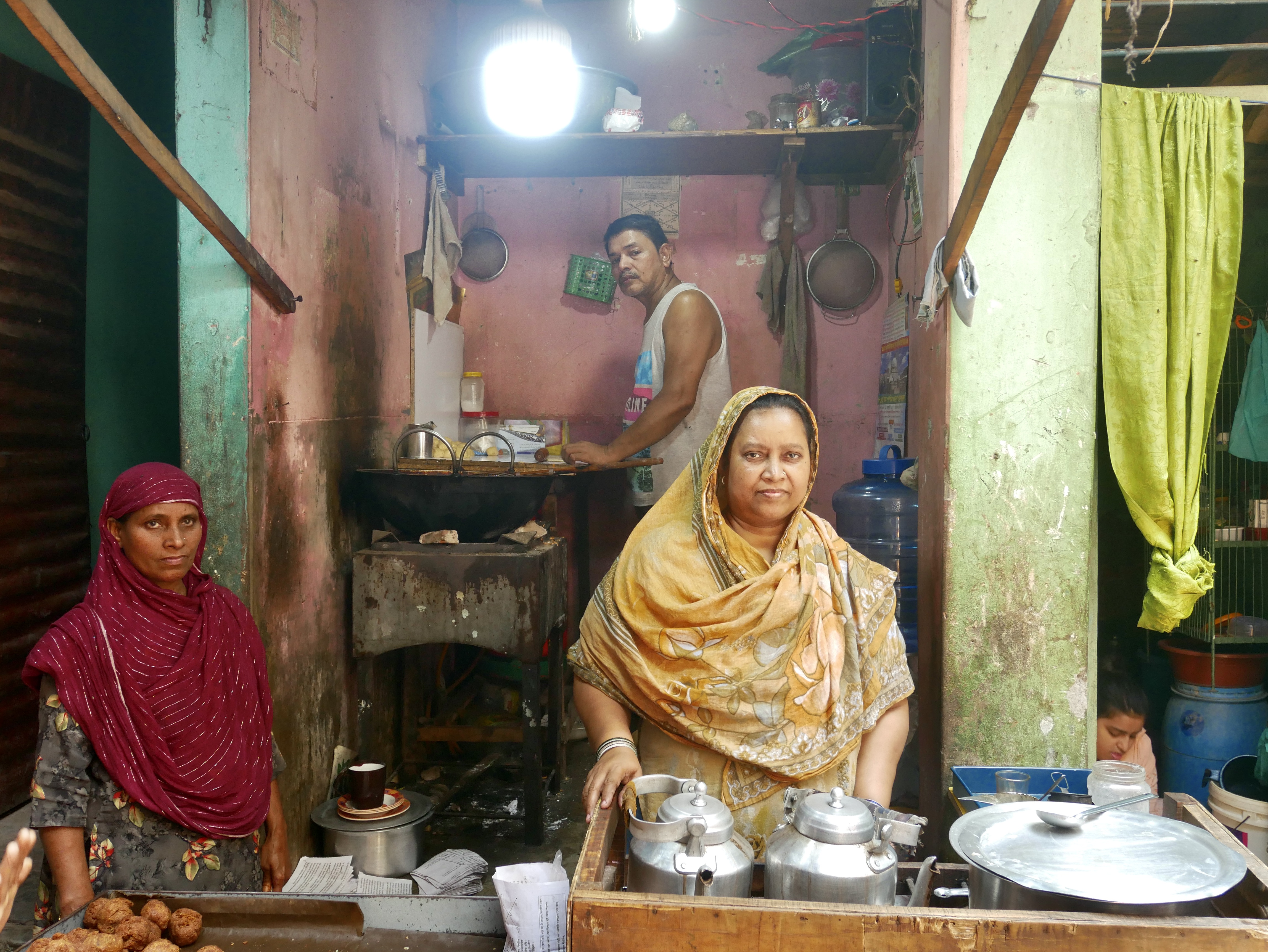
Shabanah "I am the malik"

Despite Nazma's assertions that relations with the majority community are now better, one exchange I had in the bazar showed that there is still resentment about the events of 1971. A middle-aged man approached me and asked where I am from. When I told him I am British he became very enthusiastic, praising the UK and asking me if I had been following the cricket series between England and Bangladesh. I told him  cricket isn't really my sport, but I knew that Bangladesh had done very well and had seen people celebrating their victory over England. His manner changed instantly and raising his voice, he said that he was not happy, didn't want Bangladesh to win, hated the camp and that I should go to the community association to hear the truth about 1971. Then he stopped mid-sentence, shook my hand and left.

Many residents of the Geneva camp have spent their whole lives there. Others have lived there for more than 50 years, under what they hoped and expected to be a temporary arrangement. The ongoing problems with lack of space, poor access to water and other services can only cause more resentment and frustration. In the past, there have been occasional clashes with the majority community, including at another camp in Mirpur, where in 2014 at least nine people were burned to death in their homes during disturbances. Despite this, the angry man I met in the bazar was not typical of the people I spoke to in the camp, all of whom were ambitious for their children and grandchildren and recognised the importance of education in securing a better future for their community. 

Children going to school inside the camp

You might also like "The landowner refused to pay us...we had barely enough to live on" - Delhi's Sri Ram refugee colony

Friday, 9 December 2022

"The landowner refused to pay us...we had barely enough to live on" - Delhi's Sri Ram refugee colony

The narrow alleys of Majnu Ka Tila in Delhi are full of businesses catering to the long established Tibetan refugee community. Both local and foreign tourists come to visit the Buddhist monastery and to eat in the many Tibetan, Korean and north-east Indian restaurants. A short distance from here, there is a group of less-well known refugees. The Sri Ram colony is home to Hindus who fled Pakistan, not during Partition, but in 2010.

I came upon the colony by chance when visiting a neighbouring Akhada, where traditional Indian wrestling is practised. As I left I noticed an alley leading into a cluster of buildings resembling a village. I went in and although the residents were at first surprised to see a foreigner, they were welcoming and community leader Rajesh Solanki was sent for.  He looked to be in early middle-age and wore the brown kurtha-pyjama typical of rural Sindh in Pakistan. He explained that the people living here had come on a religious pilgrimage in 2010, and then refused to leave. They cited discrimination and religious intolerance in Pakistan, as their reasons for wanting to remain in India, and staged demonstrations at Delhi's Jantar Mantar to draw attention to their plight. 

The Colony is a hotchpotch of solid, brick buildings owned by better-off families and less permanent  structures consisting of metal sheets, tarpaulins and twigs. All of the homes have been built by the residents themselves. Several are unfinished, as many residents lack the resources to complete them. Despite this, there is evidence of ongoing construction and a group of women were laying down a courtyard outside their house. Most homes lack electricity or running water and toilet provision consists of communal male and female blocks. As the colony stands on the floodplain of the Yamuna River, there is a risk of flooding during the monsoon. There are also potential health hazards from mosquitos and from  sewage regularly pumped into the river.   

Some of the more entrepreneurial residents have established small shops selling snacks and sweets. Some of the houses have small shrines attached to them. These are referred to by the residents as "temples". There are displays of religious piety throughout the colony. The Hindu greeting "Ram Ram" is given in preference to the more secular "namaste" and symbols and pictures of various deities are displayed on the exterior of the buildings. Even the name of the colony is that of Ram Ji, the central character of the   Hindu epic,  The Ramayana. 

Chander's Hanuman temple

"The landowner refused to pay us the agreed amount. We had barely enough to live on"

Badal is 39 and from the Kotri district of Sindh. Solanki asked him to show me around and answer my questions. I asked what had caused him to leave the place where he was born and to remain in India.  He said" I owned eight acres of land in Pakistan. It was not enough to support my family and I entered into agreements with a larger landowner. The contract said that we would share the expenses of seeds, fertiliser and other items 50/50 with the landlord, and that we would also share any profits in the same way. We paid our share of expenses but when there was a good profit, he refused to pay us. We had barely enough to live on". Badal also lost his eight acres of land when they were seized by local gangsters. "There were too many of them for us to resist" he said "they were armed and had friends amongst the politicians. No-one would help us".

He used to sell telephone covers and other accessories, but now has insufficient funds to buy stock. He works occasionally as a day labourer but this pays little and is unreliable. His home is in very poor condition - only partially built - and all eight residents sleep in one small room. The situation was made worse by the death of one of his five children at the age of 20, leaving behind a widow and a small child, now being cared for by Badal and his wife. Despite this, he says he feels safer in India and is happier there.

Badal

"There was no violence, no threats, but the pressure to convert was always there, every day, in every conversation"

One of Badal's neighbours, Chander, also from Kotri district, tells a similar story. He owned no land in Pakistan and worked as an agricultural labourer to support his family. Again, the landlord refused to pay the contract share and Chander felt he had nowhere to turn for help. The colony's overt religiosity made me curious about faith-based discrimination, or pressure to convert in Pakistan.  Chander said, "There was no violence, no threats, but the pressure to convert was always there, every day, in every conversation. Even in the market. People we thought of as friends would say to us 'why don't you convert? Things would be better for you' ". Chander also has problems in India. He showed me the small Hanuman temple he built at the side of his house. It is collapsing as the land subsides, possibly caused by the sewage being pumped into the Jamuna River just a few metres from his home. "I can't afford to repair this and I'm worried the house will collapse too" he said. 

Two of the women residents told similar stories about pressure to convert. Janaki sat playing with two of her grand-children whilst she prepared a chick-pea dish for their lunch. "They would always talk about converting" she said. Janaki lives in one of the better quality houses. She still has family in Pakistan. Megha, perhaps in her sixties, stood outside her house, cuddling one of her granddaughters. She has ten children of her own - five in India and five in her home town,  Mirfazal Pakistan. She was worried about her daughter-in-law. "She had an accident six months ago and is still in ICU in the government hospital. They won't let me see her. I want to give her soup and nurse her back to health" she said. 

Janaki and her grand-children

Megha and one of her ten grand-children

"...my assistant often has to go from door to door and bring the children here herself"

Most of the children go to school outside, but there is some teaching goes on inside the colony. A single, windowless room is used for pre-school learning. When I visited, the children were enjoying snacks. I'd seen food provided in a village school in West Bengal, as a way of encouraging attendance. I asked the teacher if this was the case here. "Yes" she said "It's to encourage them to come. Not all of the parents are committed to pre-school learning, and my assistant often has to go from door to door and bring the children here herself". Resources appeared limited but she spoke enthusiastically and was clearly committed to delivering the best for the children. The teacher's and assistant's salaries are paid from Central Government funds allocated to supporting the welfare of women and children.

The older children have access to additional learning in a community hall built with funds from overseas donations. Teaching is provided by NGOs and volunteer university students. The room was clean and tidy. Charts with tricky algebraic formulations and maps of India and the world were displayed on the walls. There was also a row of sewing machines, provided by a charitable organisation and used for teaching tailoring skills.  Although not a formal school, many of the children come here for tuition. I asked some of them what their favourite lessons were. Jalram, aged 11 said, in English, "I like mathematics and Hindi".  Others gave maths as their favourite subject while one said "English". Some of them gathered around the maps, locating different cities and countries. 

More than a decade after their arrival, the situation of the Sri Ram residents remains uncertain. Solanki said "We are hopeful that the new law to assist victims of religious persecution will help us". He refers to the 2019 Citizenship (Amendment) Act that provided routes to Indian Citizenship for persecuted religious minorities from Afghanistan, Bangladesh and Pakistan. Hindus, Sikhs, Buddhists, Jains, Christians and Parsis who arrived in India before December 2014 are eligible for consideration under the Act. Muslims are not included in its provisions. The application of a religious test resulted in sometimes violent demonstrations in various parts of India.

Despite their troubles, many of the people I met spoke about feeling happier in India than they had in Pakistan, and no-one expressed regret at having left. There may yet be a brighter future for Jalram, his friends and their families.

Jalram (hiding) and friends

Where did my dog go?

Some of the residents have opened small shops