Showing posts with label Picture post. Show all posts

Monday, 6 June 2022

Picture Post 73 - An Art Nouveau Warehouse in a Porto Alley


Last week in Porto, each morning at 10.30, I had coffee and a Pastel de nata at the C'alma Speciality Coffee Room on Rua de Passos Manuel. This small cafe is tucked away on the ground floor of the Porto Commercial Athenaeum gentlemen's club, established 150 years ago and which today hosts occasional concerts and group tours. On my last morning in Porto I took a different route to C'alma and discovered a piece of the city's history.

Just a few steps away from my morning coffee, I noticed a single storey building with an art nouveau facade. The Depósito de Sola e Cabedaes is the former warehouse of what was once once an extremely successful shoe parts supplier. The company was founded in 1887 by Adriano Vieira da Silva, whose name is inscribed on the decorative tiles at the top of the facade. These premises were inaugurated in 1917 and are an example of late art nouveau. The design features floral flourishes, classical references with small pillars and discs, and stained glass windows, the colours of which brighten when they watch the sun. The building incorporated modern design ideas including skylights that maximised the use of natural light and air circulation equipment which helped prevent deterioration of the stock. This approach was carried through into service and the staff were known to be polite and knowledgeable.

Da Silva was born in Santarém in 1869 and came to Porto at a young age, initially finding work as a clerk. He went on to establish a successful business and to have a career in politics. He was a member of the Portuguese Republican Party and a close friend of its leader, and three times Prime Minister, Afonso Costa. From 1919-1926, Da Silva served as administrator of the Gondomar municipality, just outside Porto. 

The April 1917 edition of the Illustraçáo Portuguesa magazine marked the inauguration of the premises saying "we can consider today that this is the biggest and most complete (shoe parts supplier) of Portugal and all of the Peninsula". An extensive range of products was offered, including leather, suede, soles, glues, laces, buckles, waxes, polishes and insoles. The company was the main supplier for cobblers, leather workers, bag makers and other artisans. 

Over time low-priced competition from overseas and the decline of the tanning industry in Portugal impacted on the business and it closed its doors for the last time in 2016. The building appears to be well maintained with only a small amount of graffiti but stands empty, in a side-alley, waiting to be brought back into use. Similar premises in Porto are now serving as cafes, restaurants or cultural venues. I'd happily have my coffee and pastry in the old warehouse on my next visit.

Friday, 26 February 2021

Picture Post 72 - Beautiful Watercolours From Myanmar

Sai Pyae Sone Aye is one of Myanmar's leading watercolourists. Born in Hkamti in the country's Sagaing region, he began painting at a very young age, receiving many prizes for his work. His original ambition was to be a cartoonist but over time he became interested in watercolours and began studying the format in 2014. 

His work includes both rural and urban landscapes of his stunningly beautiful but troubled country, with a number of recurring themes. These include the river Ayeyarwady, the iconic Shwedagon and Sule pagodas in Yangon and street scenes featuring the crumbling red brick buildings of the colonial period. More recently he has begun to produce portraits. Regular readers will know that I have a special affection for Myanmar and Sai's paintings perfectly capture many of the things I love about the place and I must admit to being the proud owner of two of his works. Sai identifies Khin Maung Than and Myint Naing as sources of inspiration for his work. 

Than is a particularly interesting character. He was born in Wetlet, Shwebo in 1942 into a family with artistic talents - his father was a goldsmith. He studied at Myoma School until grade seven before going on to the Mandalay Fine Arts School in the 1950's. He initially worked in commercial arts, producing film posters and graphic items and illustrating a number of novels and other books for high profile authors. He moved to a more fine arts approach in the 1990's and his work has been exhibited overseas a number of times.

Sai has had significant success both in Myanmar and internationally. His works have been exhibited in prestigious hotels in Yangon as well as in private galleries in the city. In 2019 he was selected to represent Myanmar at the International Triennial Watercolour and Spirit exhibition in Varna, Bulgaria. His works are available for sale. Enquiries should be directed to him through his website


All of the  pictures featured in this post are Sai's work and are currently available for sale at time of writing.

You might also like The Ahuja Family And Early Burmese Photography

Wednesday, 22 May 2019

Picture Post 72 - Adelaide Art Deco, The Capri Theatre

The Capri Theatre on Goodwood Road in Adelaide, South Australia stands out from the neighbouring buildings due to its size and a stunning Art Deco facade. Originally known as the New Star Theatre, it was completed in 1941 and opened on October 8th of that year with screenings of Florian starring Robert Young and Helen Gilbert as well as Doctor Kildare Goes Home starring Lew Ayres and Lionel Barrymore. The design was the work of architect Chris Smith who was responsible for many art deco buildings in Adelaide including the Port Adelaide Municipal Chambers, Hindmarsh Town Hall and a number of other official buildings.


Initially part of the Clifford Theatres Circuit, the cinema could originally seat 1472 patrons. In 1947, Greater Union bought out the Clifford Circuit including the New Star and in 1964 renamed it the New Curzon. Three years later Greater Union stripped out many of the original Art Deco features, reduced the seating capacity to 851 and changed the name again to the Capri Cinema. 

The Theatre Organ Society of Australia (TOSA) purchased the building in 1978, installed their Wurlitzer organ and amended the name to the Capri Theatre. TOSA managed to complete the loan repayments thanks in no small part to the film Crocodile Dundee which played to packed houses for almost a full year in 1986 enabling the organisation to own the building outright. A framed poster for the film is displayed in the lobby, acknowledging its importance to the Capri's story. 

Since then major works have been undertaken to restore the original colours and style to the exterior as well as original carpet designs and replica fireplace and mirrors on the upper level. The facade boasts a fabulous series of fins one of which carries the building's name in vertical lettering. This, together with the beautiful banding, sumptuous corner curve and occasional portholes make the Capri itself something of a showstopper.

The cinema also boasts one of the largest Wurlitzers in Australia. It is still in use including at regular nostalgia evenings when old films, newsreel and vintage advertisements are screened as well as at regular recitals of organ music. In addition to respecting and preserving the cinema's heritage, the Capri also has a commitment to the latest technology. Modern projection and sound equipment were fitted in 2012 with financial help from the State Government as well as Unley Council. There are now 782 seats, some of them branded as deluxe. This combination of old and new extends to the exterior mural which features scenes from Florian and classic Australian movies. The piece  was produced by artists Jake  Holmes and Joel van Moore and was completed last year.


The architect was an interesting character. Born in 1892, his father was a sailor and labourer and his mother is thought to have been illiterate. Smith himself trained as a master carpenter, married, had three children and enjoyed cycling, motoring and bowling. Despite having no formal architectural training, he appears in Sands and McDougall's Directory of South Australia for 1922 as an architect and structural engineer. In addition to the works already mentioned he built himself a stunning Art Deco residence in Prospect Road, Adelaide. The house retains many of its original features and may well have acted as a showroom for his clients as it includes so many deco references including the design, materials and finishes. He also remodelled the synagogue in Rundle Street in 1938, giving it the deco finish it retains until today although it ceased to be a religious building some years ago. Smith died in 1952, not quite 60 years of age,

The Capri was added to the South Australia State Heritage Register in 1990. The day to day running of the cinema is dependent on volunteers. The website has details of how to get involved.


Monday, 6 August 2018

Picture Post 70 - Dreamland Margate

Margate is a a town of just over 60,000 people on the Kent coast. Every summer it attracts thousands of day trippers, most of whom will have been greeted at the station by a representative of Dreamland, a large entertainment complex and visitor attraction on the seafront. Today Dreamland encompasses a fairground, roller room, crazy golf, concerts and shows and a range of family orientated activity. The site was originally home to the Dreamland Variety Theatre which opened in 1923 and could seat 900. Later renamed the Dreamland Cinema it was adjacent to an amusement park of the same name.


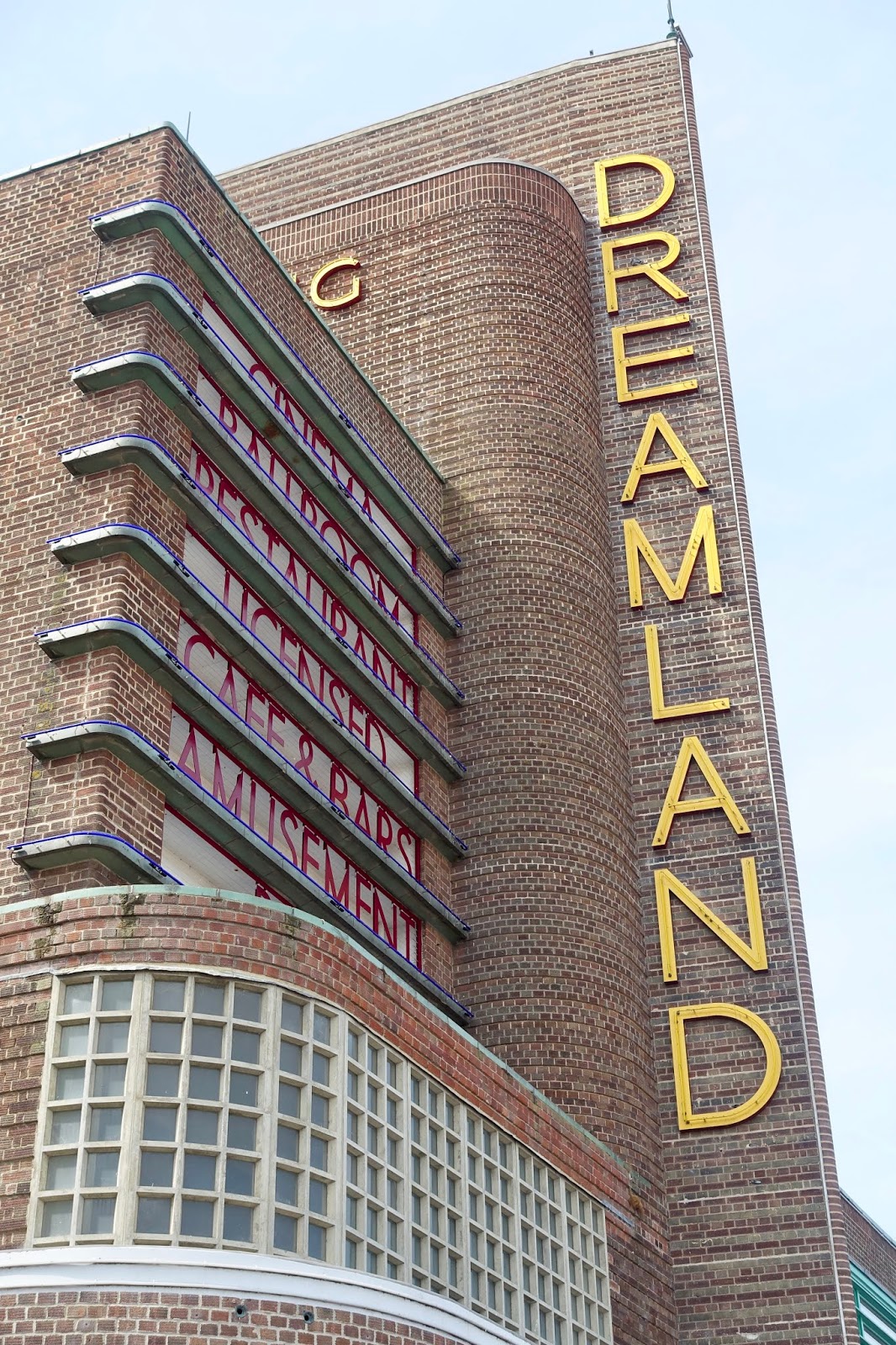
The Dreamland Super Cinema opened on the same site in 1935 and quickly became a landmark building in the town. The Painted Veil starring Greta Garbo based on the W. Somerset Maugham novel of the same name was the first film to be screened there in March 1935. Architects Julian Rudolph Leathart and W.F. Granger designed the cinema, the design of which was strongly influenced by German expressionism. Dreamland was perhaps the first art deco cinema to have a brick expressionist exterior which culminated with an 80 foot tower with a dramatic projecting fin. The asymmetrical facade also included crittal glazing and stylised lettering originally lettering applied in sans-serif with neon strips. Unfortunately this has been lost. The fin ensured that the cinema could be seen from some distance along the shoreline whilst the interior boasted an ultra modern sound system, an organ, bars, a ballroom, a 500 seat restaurant and a cafe with views out to sea. The cafe originally had a large mural of a sea serpent designed by Walpole Champneys. English heritage report the mural as being lost. 


2050 customers could be seated at any one time with 1,328 seats in the stalls and 722 on the balcony. The interior was designed by John Bird-Iles whilst  Eric Aumonier sculpted sea-nymphs set into recesses at each side of the auditorium. Bird-Iles was the son of the complex whilst Aumonier was also responsible for the kneeling archer at London's East Finchley Underground Station.

The cinema was closed in 1940 due to the Second World War. In the same year it received troops evacuated from Dunkirk. It did not reopen until July 1946. Significant changes were  made to the design in 1973 when two more screens were added in the balcony space. The stalls and stage were converted to a theatre but failed to attract audiences and closed just two years later in 1975 and was the used as a bingo hall. In 1981 a third, smaller screen was added, with seating for just 60 people. This was to operate for 12 years before closing in 1993 as part of a series of changes made by the new, Dutch owners. The bingo hall closed in 2006 whilst the other two screens managed by Reeltime Cinemas held on until the following year when they too ceased operating.

The building was awarded Grade II listed status in 1992 before being upgraded to Grade II* in 2008. Major restoration of the exterior began in 2011 and were completed in 2017. The restored building once again stands proudly on Margate's promenade and I understand that there are plans to introduce open air screenings in the complex this summer. 

Saturday, 21 July 2018

Picture Post 69 - The Former Rex Cinema, Bethnal Green.

Half way along Bethnal Green Road in East London stands a rather sad looking building, its facade partially covered in fly posted hoardings and well established weeds visible at the upper levels. This is the former Rex Cinema, one of London's many "lost" Art Deco buildings.


The site was originally occupied by Smarts Picture House which opened in 1913 and was part of a chain of several East End cinemas operated by one George Smart. The original building was the work of architect Philip Tree whose design included a large hexagonal tower, a low entrance facade and a single screen auditorium with seating for 865 patrons. Unlike many cinemas of this period there was no balcony and film goers were all seated at ground floor level. A small stage was available for other types of performance and two dressing rooms were included in the design.

The building was extensively remodelled in 1938 under the supervision of George Coles who was responsible for several cinemas in the Odeon chain of impresario Oscar Deutsch. The tower and facade were demolished and replaced with a new, streamlined design. The new look included a fabulous new tower with a fin at its centre surrounded by a semi-circular recess. Murals were added in the auditorium together with a stepped ceiling and new lighting. The cinema re-opened towards the end of the year as the Rex. The new name was displayed in neon lights at the top of the fin. St. Louis Blues starring Dorothy Lamour and Exposed with Glenda Farrell were amongst the first screenings.

The Rex operated until 1949 when it was renamed the Essoldo and became part of the chain of the same name. The chain was founded by Solomon Sheckman in Newcastle-upon-Tyne in the 1930's. The company name was made up of the first two letter of the names of his wife, Esther (ES), himself (SO) and his daughter Dorothy (DO). Sheckman also owned the former Empress cinema in nearby Hackney.


The Essoldo lasted only a little longer than the Rex had and closed in 1964. Christopher Lee's Devil Ship Pirates was its final screening. Like many other cinemas that closed in the 1960's and 70's, it was converted into a bingo hall but this too closed in 1990. After this, Frankie Trimmings, a wholesale business selling soft furnishing trimmings took over the building. At some point the former large glass fronted boxes that had displayed stills from films were removed but otherwise the building was maintained in relatively good condition until 2015 when the company moved out. Since then the interior has been gutted (and possibly part demolished) and its current condition, at least what can be seen of it, is not good. 

However, there may still be a future for the former cinema as in October last year plans were announced to convert the building into a boutique hotel using the former Rex name with a single screen cinema and a rooftop bar and restaurant. Details of the proposals can be seen here and appear to retain some of the original facade design.

There are some good internal images of the former cinema here.

Wednesday, 16 May 2018

Picture Post 68 - Tagbilaran's Tailor and Barber Shop, a postcard from the Philippines

Tagbilaran is a major town in the Philippines on the Visayan island of Bohol. A town of over 100,000 inhabitants, it is a busy place with a great indoor market, some beautiful ancestral homes and easy access to the historical churches and natural sites on rest of the island. 


During my recent stay in the Philippines I spent a few days in and around Bohol. When walking in Tagbilaran I noticed a sign advertising an unusual business combination - Syvel's Clothier and Barber Shop. I have only come across this combination once before, several years ago when I had a haircut in a dry cleaners' shop in Nandi, Fiji. Syvel's is an open fronted establishment and as I passed there was no-one in the front of the shop. I went in anyway to see if anyone would appear and a man came from behind a curtain to tell me that the barber had gone to eat but would be back soon. 

The curtain separated the salon from what at first looked like a family living room. Three young people, two teenagers and one little girl, were sitting at a table enjoying their lunch. They smiled and said good afternoon as if it was perfectly normal for a stranger to be there. There were also two men on the other side of the room, both of them sitting at sewing machines. They also greeted me before resuming their work. The first man invited me in to wait and we chatted briefly, him teasing me about whether or not I was looking for a wife. I told him I was only looking for a haircut but there was something else I would like. I am fascinated by the tailoring profession. It is an ancient, portable skill, disappearing in the west but still important in many parts of the world. One of the tailors was wearing a Tarsier t-shirt and sitting in front of a red curtain which was decorated with yellow flowers. The colourful backdrop and jolly t-shirt brightened the room which was otherwise devoid of natural light. Of course, I wanted to photograph him. He was happy to oblige. 


At this point the barber returned and showed me to the chair. Friends know that cutting my hair is not a big job but in the 15 minutes it took him to "tidy me up" as he said, he gave me a rundown on English football, Filipino basketball and one or two other sporting matters. I've been to barbers' shops in many parts of the world and almost all of them want to talk about English football. I grew up in Middlesbrough so football has no interest for me. As I was about to leave the first man reappeared and asked me to take his picture together with the barber. So I did and they were happy. 


You might also like Picture Post 66 - Faces of the Philippines.

You can see more pictures from the Philippines here.

Saturday, 3 March 2018

Picture Post 66 - Faces of the Philippines

I was always nervous of photographing people. Should I take a sneaky shot or ask their permission? What do I do if they refuse and how exactly do I ask them for a picture? It was all a bit too risky for me and so I preferred to stick to architectural scenes (which I also love) and the odd street scene, ensuring I didn't focus on an individual. 

Flora
However I like to try new things and about 18 months ago I decided it was time to face my fears of  photographing humans. I read various articles about photographing people in different countries and cultures, articles which were often contradictory and which left me still unsure. I had planned to visit Guatemala in early 2017 and when doing research for my trip found a website for Antigua Photo Walks, run by Rudy Giron, a local photographer. Rudy provides opportunities for different kinds of photography in and around Antigua and advises on technique. The walk I took with him changed everything for me as we met many Mayan people who were happy to be photographed despite the cultural issues I had read about. Of course it wasn't just a case of walking up to someone and snapping them, I learned the need to engage a little first, greet them and show interest in what they are doing in order to put them at ease. I liked my results.

A little later on during one of my many visits to Israel I did a similar walk with Laurie Cohen of Israel Photography Tours We spent several hours in the Old City of Jerusalem, a great location for photography but also potentially an ultra-sensitive one given the importance of the various religious sites and the tensions related to them. Laurie reinforced the things I had learned with Rudi and gave me some more technical tips. Again, I was happy with my results. Towards the end of the year I had a third experience of this kind in Kolkata where with Manjit Singh of Calcutta Photo Tours I spent three early morning hours in the wholesale markets taking my best pictures so far and frankly experiencing the "joy of photography!". In India I also printed a few of the better pictures I had taken and returned to give a copy to the delighted subjects.

I still take pictures of architecture, including very detailed ones of art deco buildings, which is one of my passions, but now no trip is complete without my taking pictures of interesting people. It is not just the images that I get out of it. The engagement with individuals often produces some surprising stories when they begin to talk about their lives, work and families in what may be a relatively short but very rich exchange. And of course, the stories are also in the faces where every line, expression and angle can tell a story. 

My recent time in the Philippines provided me with many opportunities to photograph people. Filipinos are generally very open to being photographed, sometimes a little shy at first but always happy to see the results. In some cases, as in India, when people see someone being photographed, they come forward and ask for their picture too and several times I was joined by large groups of children demanding "one more picture sir". I never take pictures of children without first securing the permission of a parent or older adult. This post features a small selection of the many portraits I took in the wonderful Philippines.

I noticed Flora (at the top of this post) in the Dangwa Flower Market in Manila. I was struck by the elegant, upright way that she held herself whilst working on the flowers that she was preparing for sale. She told me that she is 81 years of age and divides her time between Masbate, where she still works in the fields and Manila where she comes to sell the flowers. She likes working and said that her grandmother worked until the age of 120 and was never ill but decided that she had lived long enough and died on her birthday!

Butcher, Libertad Market, Manila
I heard the man above before I saw him, shouting and singing as he vigorously cleaned his chopping board in the Libertad Market, Manila. I indicated that I would like to take his picture and he began to assume an upright pose. That was not what I wanted at all. He seemed to realise this, resuming his noisy cleaning of the board whilst I shot a burst resulting in a great action sequence. 

Paul is a boatman. He works at Panglao, Bohol, transporting tourists between the various islands. I saw him whilst taking a 6 a.m. stroll along the beach having woken up very early. We exchanged greetings and I asked for a picture. He was a little shy and reluctant at first and asked that I photograph him with his "boss" which I did. He then relented and allowed me to take this portrait.

Paul
This man is a member of the Tabudlong family that has a small business in Dau Market at Tagbilaran, Bohol. He grinds and grates coconut, cacao, coffee, peanuts, rice and ube. I noticed him preparing chocolate discs and we fell into conversation.  He invited me behind the counter to see how the chocolate is prepared and was very amused when I asked to take his picture.

Grate and grinder, Dau Market, Tagbilaran
Jose has a stall in the Baclayon Market, Bohol. He has been selling shoes with his wife for more than 50 years. I noticed him when I entered the market building and was keen to take a portrait. He was surprised that anyone should want to photograph him and his wife was moved to laughter. I managed to get several interesting images as he went about his business. Like Flora, I am sure there are many stories in this gentle face.

Jose
A few kilometres outside of Iloilo City I noticed a group of fishermen sitting on the beach, repairing their nets and re-painting their boat. This man was sitting aside from the rest of the group, re-sewing the nets, deep in thought. I took this when he looked up for a second, still pre-occupied but with a hint of a smile.

Fisherman, Iloilo province
Roderigo is three years old. His father is a fisherman living in Iloilo City. I saw them sitting at the end of a pier, chatting with a group of other fishermen. I was struck by the obvious pride and affection of the father who was kissing the boy's head when I first approached.

Roderigo and his father
This woman makes and sells suman, a delicious dessert made from glutinous rice and coconut milk wrapped in a banana leaf. She has a street stall in Manila's San Antonio district. She looked directly at the camera and allowed me to take a series of pictures before laughing and turning her head to one side resulting in the shot below. 

Suman seller, San Antonio, Manila
I met this serious looking little girl in Quiapo, Manila. Her father was sitting outside a shop talking to a friend whilst she played on the pavement. Securing his permission to take her picture she maintained a dour expression, guarding her packet of sweets - candies shaped like little ice creams.

Don't touch my sweets, Quaipo, Manila
This butcher works at the Baclayon market in Bohol. I liked his smile, sparkly eyes and pink floral apron perhaps indicating his self-confidence.

Butcher, Baclayon Market
Lionila has a tiny kiosk outside the Public Market in Iloilo. She has been selling cigarettes and other small items for many years. I saw her a couple of times before I asked to photograph her. Each time she had smiled and wished me good afternoon so I was fairly sure she would be amenable. She is in her 70's, has no doubt had to work very hard but retains an almost regal way of holding herself. Her smile seems full of optimism.

Lionila
This woman has a small business in the Dau Market in Tagbilaran. She sells different kinds of chillies. Born in the city, she worked in Manila for many years but returned to her home town where she said life is easier, less rushed, less noisy and the people more friendly. 

Chilli seller, Dau Market, Tagbilaran
You might also like Fun, food and fortune telling - Manila, the people in the street or A Postcard from India 6 - Kolkata, the people in the street

You can see more pictures of the Philippines here and here.

Thursday, 22 February 2018

Picture Post 65 - Art Deco in Manila's Chinese Cemetery

Art deco influences can be found in every area of life - architecture, furniture, painting, clothes, transport and industry. It should not be surprising then that the style has also influenced the design of tombs and mausoleums. The Recoleta cemetery in Buenos Aires contains many art deco structures whilst others can be found in Asmara, Eritrea and Pittsburgh, USA.  I recently toured the Chinese Cemetery in Manila which is full of art deco.

Li Chay Too family mausoleum, built 1948 and recently refurbished 
The cemetery is the second oldest in the city. It was established in the 19th century in response to the Spanish colonial authorities denying Chinese Filipinos the right to burial in a Catholic cemetery. It contains Catholic, other Christian denominations and Taoist graves as well as some exhibiting symbols of more than one faith. Ton Quien Sien, also known as Don Carlos Palanca was responsible for the its establishment and fittingly there is a memorial for him here. It is one of several memorials including one to those brought here and executed by the Japanese during World War Two.  The victims included prominent artists, soldiers and community leaders, many of whom, although not all, were Chinese.

Li Chay Too mausoleum details
Li Chay Too mausoleum metalwork 
The tombs are in a range of styles and sizes. Some are maintained in pristine condition whilst others show signs of neglect or even abandon if the family has moved away or if remains have been removed and placed in a burial plot elsewhere. The dead hold an important place in Chinese culture and ancestors are held in great respect. Visitors to the Chinese cemetery may be surprised to see that some of the structures include bathroom and cooking facilities, air conditioning and even parking space for several vehicles. This is not for the benefit of the deceased but for the living who come to pay their respects and can spend a significant amount of time here during a visit.

Tomb for Bautista Napkil family (close to the nearby Jewish cemetery)
Villa Yu Tuan, Yu Tuan family mausoleum
Deco speed lines and Chinese influenced metalwork, Villa Yu Tuan 
The largest, most ostentatious structures are the plots of the wealthiest families and many of these were built from the 1920's through to the 1950's in the art deco style, which lasted longer in the Philippines than elsewhere. Little is known about who the architects were although a number of the tombs bear the name of the Oriol Marble Works company. Ivan Man Dy is Manila's art deco expert and an aficionado of the cemetery. He led me through its alleys and lanes for two and a half hours  pointing out a range of deco styles including streamline moderne, classic deco complete with speed lines, ziggurats, portholes and stylised lettering and a hybrid style incorporating Chinese influences.  He is documenting these structures as well as working on a book about Manila's art deco buildings.

Ang O Kin mausoleum, 1939.
Entrance to Eusebio Tankeh family mausoleum
Ivan leads walking tours of the cemetery as part of the Old Manila Walks programme and also runs a Facebook group dedicated to art deco in the Philippines. His tours are highly recommended.

You may also like Art Deco in the Philippines - Manila's Magnificent Metropolitan Theatre

Eusebio Tankeh Mausoleum, built 1948
Portholes, sunbursts and curlicues
Many tombs display images of the deceased. This picture is framed by a deco ziggurat.
Koh family mausoleum, streamline moderne!