Friday, 4 September 2020

Twentieth Century - Art Deco in Birchington-on-sea


Birchington-on-sea is a large village in Kent not far from the larger seaside towns of Margate, Ramsgate and Whitstable and the historical city of Canterbury. It is a short walk from the stunning scenery of Minnis Bay and home to one of Britain's most elegant Art Deco homes. 

In 1935, local builder Chas Hawkes designed and oversaw the construction of an Art Deco building in Birchington. It was to be a home for him and his wife Kathleen and would also have an office for her Minnis Bay Estate Agency. When completed it would have been the epitome of modernism with its striking white exterior, crittall windows, delightful curves and subtle decorative references to the Art Deco "rule of three". Perhaps to emphasise its modernity the couple named their new home Twentieth Century.

The Hawkes lived there for several years until for reasons unknown, they moved to another home just a short step away. They were not the only notable people to have lived in the house. In 1962 Tudor Gates, author, playwright, screenwriter and Trade Unionist acquired the property and lived there until 1986. During that time he wrote a number of TV scripts and screenplays including Vampire Lovers (1970), Lust For A Vampire (1971) and Twins of Evil (1971) - all of them for Hammer, the famed horror film company. He also contributed to the script of Barbarella (1968) and to the TV series The Avengers, The Sweeney and The Saint. Gates changed the building's name to The White House, a name it retained until just a few years ago.

As well as changes of name and ownership, the house was subject to a number of  physical alterations over the years. Kathleen Hawkes' estate agency office originally occupied what is today the breakfast room and had a door leading directly to the garden, enabling the main entry to be retained for private use only. This door disappeared at some point as did the original crittall glazing and the elegant Minnis Bay Estate Agency lettering on the office facade. The original design included stunning squared-off, wrap around windows at the front of the building and sadly these were also removed at some point. Not only this, the lintels installed to support the wall above the windows were removed making it difficult and expensive to reverse this at a later date. The house came on the market in 2011 and Wowhaus, the website devoted to Art Deco and modernist architecture wrote scathingly about the changes describing them as "how no to do it" rather than "wow". At about this time, the house became a bed and breakfast hotel.

Today the wow is well and truly back thanks to current owners Kat Webb and Spencer Stedman who purchased the property in November 2017 after having stayed there as a treat for Spencer's birthday. Both of them have been serious Art Deco collectors for several years and Kat even has an Art Deco dolls house given to her in her childhood! On taking possession they not only restored the original name to the house but undertook significant restoration work to bring it back to its original splendour. This labour of love resulted in them receiving the 2019 Raven Award from the Birchington Heritage Trust.

Today the Twentieth Century Bed and Breakfast is a wonderful place to stay, not only for Art Deco enthusiasts but for anyone wishing to explore this part of Kent with its beaches and other natural and historical attractions.  It has four themed rooms including the Baron and Lady Carson Art Deco suite which is named after the owners of the land on which the house sits. The Tudor Gates room has a collection of posters and other items related to Gates' career and the Amy Johnson room is filled with memorabilia commemorating the famous aviator. The David Bowie room is a tribute to the musical superstar who performed in nearby Margate and who is known to have visited the area as a child. The idea behind the themed rooms is that they reflect different periods with the twentieth century and commemorate people with links to the house and the area. 

Kat and Spencer have displayed items from their Art Deco collections in the common areas of the house and during my recent stay they kindly showed me their wonderful collection of photographs. These include images of the original exterior and of Chas and Kathleen Hawkes and the labourers who worked on the building. They are extremely knowledgable about Art Deco and were very happy to show me Hawkes' original architectural drawings and to share stories about the building's history. They are also wonderful hosts who serve a great breakfast which includes herbs, tomatoes and other fruit grown in their garden. Why would you want to stay anywhere else?

You can find more details about Twentieth Century on their website.

You might also like "Social" - a chance find of an iconic 1930's magazine in Havana

Monday, 24 August 2020

Whitechapel Library - University of the Ghetto


Twenty two London public libraries and cultural facilities have borne the name of Victorian journalist, philanthropist and politician John Passmore Edwards (1823-1911). His particular interest in funding public libraries may have been due to his reportedly having access to few books as a child. The first London library he funded was the former Whitechapel Library, now absorbed into Whitechapel Art Gallery at 77-82 Whitechapel High Street.

It opened its doors on 9th May 1892, the construction costs of £6454 being fully provided by Passmore Edwards but this was not the first attempt to provide a public library in this part of London. The Public Libraries Act of 1850 had followed a Select Committee report that suggested libraries could be used to steer people towards "temperate and moderate habits". Despite strong opposition to the Act from some MPs, it was eventually passed. The Act allowed for levying a charge on the rates of a half-penny in the £ in order to ensure continued funding. Such proposals had to be put to the vote locally before a free public library could be established and in 1878 the voters of Whitechapel rejected adopting the legislation, opposed to providing a facility "...wherein idle people may enjoy themselves".

Samuel Barnett, social reformer and Vicar of St. Jude's Church and his wife Henrietta, co-founder of Toynbee Hall campaigned for a library in Whitechapel but in 1891 Passmore Edwards came forward with the necessary sum.  A site was identified and architects Potts, Son and Hemmings were engaged to design the building. Initial services included a closed-access lending service, separate reading rooms for boys and girls and a reference library. Closed access meant that readers had to ask a member of staff to check the availability of books for them rather than having direct access to the stock. This was common practice in the early days of public libraries. There was also a museum of the natural history collections of the Reverend Dan Greatorex who had earlier established small collections of books on merchant ships for the use of the seamen.

Impressive hours of service were offered, including Sunday afternoons and late opening until 10pm. A programme of talks and lectures was held and schools were able to borrow items from the museum. Modern technology meant that the building had its own generator so as not be dependant on an external energy supply. Formal opening took place on 25th October 1892 with Lord Roseberry, Foreign Secretary and Chairman of the London County Council as the guest of honour.

By the end of 1892, there were 2,500 members including actors, comedians, diamond cutters, lard refiners, leather merchants, at least three journalists and my favourite, "ladies with no occupation given". This impressive list tells only part of the story of the library's role in its community which by 1914 is said to have included 90% of the total Jewish population of the UK. Evidence of its impact is borne out by the stellar list of writers, artists and future academics who made use of it during their youth. It is known that artist Mark Gertler borrowed art books from the library and practised drawing in the reading room. Fellow Whitechapel Boy David Bomberg was also a user.

Playwright Arnold Wesker used the library as a child and later spoke about borrowing and enjoying The Wind In The Willows. Fellow playwright and novelist Bernard Kops was also a regular user and loved the place so much he wrote a poem in its honour as well as a play set within the building. Child psychologist and author of The Ascent Of Man, Jacob Bronowski studied there and mathematician Selig Brodetsky learned English in the library. Born in Russia and one of thirteen children, Brodetsky had a fine career in academia. He studied at Cambridge, lectured at Bristol University, held a chair in Applied Mathematics at the University of Leeds and for a time was President of the Hebrew University of Jerusalem. East End chroniclers Simon Blumenfeld and Willy Goldman also studied there.

Perhaps the most famous former user was poet and painter Isaac Rosenberg. The child of poor Jewish immigrants from Lithuania, he was also the author of some of the most famous poetry to emerge from the First World War and was tragically killed in action on 1st April 1918. He is memorialised with a Blue Plaque on the exterior of the building. The achievements of Rosenberg and other writers and artists led to the library being referred to as the university of the ghetto.  Most of the users would have lived in dark, overcrowded and noisy conditions with no space for quiet study, reading or reflection. The library provided this and enabled some of them to go on to great things whilst to others it was a place to find peace and cultural enrichment. Lack of space at home remains one of the main reasons why people come to public libraries today and competition for study space can be fierce.

In 1900 the library came under the auspices of the former Metropolitan Borough of Stepney. Over the next few decades a large collection of Judaica was developed, lending became open access in 1922 and in 1930 a children's library was established in the basement.  Aldgate East Underground Station lies beneath the building and in 1937 a street level entrance to the Tube was inserted into the facade. The East End was severely bombed during the Second World War and damage was sustained to the second floor in 1940. From the late 1940's onwards the neighbourhood began to change with the large Jewish community moving away and being replaced by newcomers, particularly from the Sylhet region of Bangladesh which until 1971 was part of Pakistan.

Levels of use fell in the decades following the War and when I first visited in the early 1990's the building was in a poor state of repair and in need of investment. By this time, Whitechapel was under the control of the London Borough of Tower Hamlets, one of the poorest areas in the city and one whose library service was amongst the least used in London. The Council undertook a re-branding exercise, closing some libraries and opening a series of modern, purpose built Idea Stores, combining library services with adult education and expanded access to technology. Whitechapel Library was closed in 2005 and was replaced by the much larger and more strategically located Idea Store, close to Whitechapel Station, a street market and the area's main shopping facilities. On the last day of service, an evening event was held to commemorate the contribution of the library to the local community. It featured performances by Anna Tzelniker, the last active performer of the once great Yiddish theatre and a reading by Bernard Kops of  his poem, Whitechapel Library, Aldgate East.

The building received Grade II listed status in 1990. After closure it was acquired by the neighbouring Whitechapel Art Gallery which also has a long tradition of serving the local community and has exhibited works by the aforementioned Gertler, Bomberg and Rosenberg. On a personal note, most of my career was spent working in and managing public libraries. Researching for this post I realised that at different times I either worked in or was responsible for six of Passmore Edwards' London libraries. Is this a record?

Perhaps the last word should go to Bernard Kops.


Monday, 29 June 2020

Whitechapel Road - The Working Lads' Institute


It's interesting that we can walk past a building hundreds of times without really noticing it and then one day it catches the eye. I must have walked past the former Working Lads' Institute on Whitechapel Road hundreds, possibly thousands of times but only recently noticed it. It stands next to the main and currently closed entrance to Whitechapel Underground Station, a six storey red brick building, completed in 1885. Designed by Scottish architect George Baines, the facade features Portland and Ancaster stone dressings and a three sided Oriel window flanked by additional bay windows at first floor level. It was formally opened to great fanfare by the Prince and Princess of Wales on 31st October 1885. The Illustrated London News reported that "despite the rain which continued throughout the day, there was an immense assemblage of people along the roadway through which the Royal party had to pass".

The Institute began life as an organisation in 1878, in Mount Place, also in Whitechapel, and was founded by Henry Hill, a successful merchant in the City of London. Hill's objective was "to supply a counter attraction to the low music halls and other east end resorts for the young which are so fatal to their social and moral well-being". To this end a library, lecture hall, classrooms, laundry, kitchen, gymnasium and swimming baths were provided for the area's young working class men. The lecture hall could accommodate up to 600 people and boasted stained glass windows with representations of art, religion and industry as well as nine semi-circular lights with images of the seasons and sports. The main facilities were advertised by the words Lecture Hall, Gymnasium and Swimming Bath carved in stone above the two entrances at street level on Whitechapel Road. It was these signs that finally drew my attention to the building and led me to notice the much larger Working Lads' Institute sign emblazoned across the full width of the building at the upper level. How did I ever miss it? 

The total cost of the project was £12,000, a significant sum for the time. Hill did not manage to raise all of the required capital before construction started and so the works were completed in two phases. He managed to secure additional funds from Reverend Thomas Jackson who ran an Evangelical Mission in Clapton and had a history of working with the poor. Jackson was to have a long association with the Institute and eventually purchased the building in 1896, saving it from the threat of closure due to a constant lack of funds.  He was influential in increasing the organisation's work with young homeless men. From the beginning, accommodation was offered for those in need with an initial 24 beds and space to expand to 60. Additional beds were made available to young men aged 17-21 including some who were referred by the courts with Jackson sometimes acting as probation officer. However, it is important to note that not all of those who made use of the hostel had been involved in criminal activity and that some would have committed what would be considered very minor offences today.

As well as providing education, leisure and refuge to young men, the Institute occasionally hosted other activities, including in 1888 the inquests into the deaths of Mary Ann Nicholls (also known as Polly Nicholls) and Annie Chapman, two victims of the Whitechapel Murderer.  

The Institute no longer operates from Whitechapel Road and has been renamed the Whitechapel Mission. The building now contains a number of flats with retail units at ground floor level. The facade was restored in 2012 as part of a wider improvement project linked to the London Olympics. This online edition of Spitalfields Life includes pictures of some of the lads who attended activities or lived there as well as of one of the stained glass windows. It also makes reference to the Institute being one of the first organisations of its type to admit Black men and includes a photograph of Reverend Jackson with a group of Black soldiers at the time of the First World War. So much history in one building. 

Wednesday, 13 May 2020

The Ahuja Family And Early Burmese Photography.

From 1824 to 1937, Burma (today's Myanmar) was ruled as part of British India. It was then governed as a separate entity until independence in 1948. During the colonial period, many Indians came to live, work and establish businesses in the country. It is estimated that there are over 900,000 people of Indian ethnicity living in Myanmar today, many of them the descendants of those who came in the 19th and early 20th centuries. The Ahuja family arrived in Rangoon (now Yangon) in 1885 when D.A. Ahuja acquired the Kundandass and Co. photographic studio. There is a division of opinion about where the family came from. In his excellent book, Burmese Photographers, Lukas Birk suggests they came from Shikapur, Sindh in what is now Pakistan but at least one other source refers to them as Punjabis. 


1901 was an important year for the business. In addition to changing its name to the D.A. Ahuja Studio, our man published a guide to "Photography in Burmese for Amateur Photographers" and his nephew Tickamdas Naraindas Ahuja (T.N.) joined him from India. The studio thrived, attracting customers from the British community as well as from local families who came to be photographed or to buy cameras and photographic paper imported from India. The success of the business is demonstrated through the studio being located on the first floor of a building at 47 Sule Pagoda Road, in the heart of downtown Yangon. There is anecdotal evidence of the business surviving there until the 1960's.

Around 1906, D.A. acquired a number of pictures taken by German photographer Philip Adolphe Klier. The collection included architectural and highly stylised ethnographic pictures taken in different parts of Burma. Ahuja began publishing the pictures as postcards but there seems to have been some problem about how he acquired these works and in 1907, Klier took successful legal action against him. Losing the legal battle was only a temporary setback as in 1909 Ahuja purchased the archive of Italian photographer Felice Beato and also became the legal owner of Watts and Skeen, a studio established by Frederick Skeen in 1887. The Skeen family also had a photographic business in Ceylon (now Sri Lanka). Beato's archive included landscape works, stylised portraits and also war photography from Japan, China and the Middle East. Klier died in 1911 and from 1914, Ahuja resumed producing some of his pictures as postcards. He was to publish 600 cards over the next 20 years, some of which can be found at card sales or occasionally on eBay. The cards were sent to Germany to be chromo-lithographed, ensuring the best quality finishes.


The postcards cover a wide range of subjects. There are several studio shots of elegant women, slightly stiff looking family groups, important monuments, snake charmers and dancers. There is also at least one card showing prisoners in Rangoon jail queueing to collect their food which whilst fascinating is an unusual image to send to the family back home.

D.A.'s nephew, T.N. opened his own studio in 1916 with a shop at 86 Phayre Street (now Pansodan Road) where he operated as an agent for Kodak products. There is some evidence that he also served as magistrate. Business was interrupted in 1942 when the family fled before the arrival of the Japanese but they quickly returned to reopen the studio at the end of the war. In 1948 T.N.'s son, R.A. Ahuja opened another studio at 386 Dalhousie Road (now Maha Bandoola Road). The store became the sole agent in Burma for the sale of Gevaert products and operated until 2007. R.A. the last remaining member of the Ahuja family in Burma died in 2014, bringing almost 130 years of their presence in the country to an end. The date of D.A.'s death is unknown.

The images included in this post are from reprints of the cards I purchased from the Yangon Heritage Trust at 22-24 Pansodan Road in 2017. The Trust is a great source of information on Yangon's built heritage. As well as selling books, maps and postcards, it stages occasional exhibitions and guided walks.  I have a habit of buying postcards on my travels and then putting them "somewhere safe" when I get home. During the lockdown I have been sorting through my collection and rediscovered my Ahuja cards. I also turned back to the already mentioned  excellent book by Lukas Birk which has a short section on the Ahujas.  Birk is an accomplished traveller and photographer whose projects have included research into the now almost disappeared box cameras of Kabul. 


D.N. Ahuja also produced postcards featuring images from India, some of which may have been his won work. You can see some of them on the Paper Jewels website.

It is not possible to confirm which of the images featured in this post are the work of the Ahuja family or are from other photographer's archives.


You can see more pictures from Myanmar here.

Wednesday, 6 May 2020

Postcards From My Hometown - 2, The Bathing Pool

I was born and spent the first 20 years of my life in Redcar. I have fond memories of spending time in the area known as the Coatham Enclosure with its indoor swimming baths, boating lake and amusement arcade which included a large fairground ride known locally as the "mad mouse". These were the remnants of a much larger range of facilities constructed in the late 1920's when a major building programme funded by the local authority provided work for men made jobless after the General Strike of 1926. There were no state funded benefits at that time and rather than have families seek relief from the Guardians of the Poor Law, the Council established construction jobs with wages funded through the rates.


The original complex included an outdoor swimming facility called the Bathing Pool. It is astonishing to think that during the 1930's, Redcar's residents and visitors could benefit from three swimming pools. As well as the indoor baths, demolished in 1978, there were two outdoor facilities - a large one for adults and confident swimmers and a smaller, rectangular pool for children and learners. A small charge was levied, 4d for adults and 2d for children, whilst towels and swimwear could be hired at a small cost. Both pools were eventually closed. An outdoor roller skating rink was built over the larger one whilst the smaller one was built over to provide a car park for the indoor pool. I have vague memories of the closed skating rink and of trying to see over the surrounding wall with friends. This too is long gone.

The postcard featured in this piece shows an image of the Bathing Pool including swimmers, spectators and a daring diver launching himself from the highboard. When I bought the card my first thoughts were that this was an image of the Boating Lake due to the impressive buildings of Newcomen Terrace that can be seen in the background. However, a little online research and help from my brother soon uncovered the story of the long lost Bathing Pool. The site is now occupied by a youth facility know as The Hub. Whilst researching for this post I came across a couple of short films of Redcar in the 1930's the first of which includes some footage of a beauty contest at the Bathing Pool. You can see them here.

The card is post marked 8th July 1943 and was posted during the Second World War.  It was sent by one Nora to a Miss Jean Horn in Guildford, Surrey. Nora has written a chatty message saying she is on a course which apparently was "terribly stiff and means working all the time, night and day". She asks to be remembered to some friends and is anxious to make it clear that the picture on the card is from before the war "so don't think it is lovely here". She notes her temporary address on the card which suggests that Nora was in Redcar was connected to the R.A.F. so she may have served in the armed forces.

As with the card in my previous post, this one was purchased from the wonderful Saltburn Framing Company, located in Saltburn Station. More postcards coming soon.

You might also like Postcards From My Home Town 1 - The Beach, Redcar

Monday, 20 April 2020

Postcards From My Hometown - 1, The Beach, Redcar

When I travel I still like to send postcards. I know this is considered terribly old fashioned especially when Facebook, Instagram, WhatsApp and a host of other platforms offer the opportunity to immediately send a virtual postcard to scores of people. I also enjoy sharing news and pictures online but still think there's something special about receiving a hand written postcard addressed to me personally.


However sending postcards from abroad can sometimes be a challenge. A few years ago I bought some beautiful cards in Guatemala but then found that the country had suspended its postal service so I couldn't send them. I eventually posted them from Costa Rica where I had a short stopover on the way home. It felt a bit like cheating. On my first visit to the Philippines in 2016 I purchased some postcards in Vigan, a beautiful historic city and a World Heritage Site. I took them to the post office where I was greeted with a smile and the confusion as the staff explained that it was so long since anyone had sent postcards that they no longer had details of what to charge me. They very politely  told me that "everyone sends pictures home on their phone these days sir," before a nominal charge was decided and the cards handed over. 

I should explain that I don't send hundreds of cards but always try to find one for my elderly relatives, my grand daughters and one or two friends in different countries who I think will appreciate receiving them. I know my aunt has a collection of every card I have ever sent her and when my dad was alive he carefully steamed off the stamps so that he could add them to his collection. Speaking of collections I must admit that I have hundreds of postcards that I've bought at exhibitions, markets and even online. They cover a wide range of subjects - vintage advertising, Art Deco and art nouveau architecture, souvenirs from places I visited years ago and lots of those cards that art galleries sell to generate a little income. What do I do with them? They are useful research tools and sometimes come in useful for blogging but for the most part I keep them in boxes under my sofa and look at them perhaps once in a few years. Still,  I am loathe to be parted from them.

I recently bought some vintage cards from the Saltburn Frame Company, a great little gallery and framing shop inside Saltburn Station. All of them are historical views of my home town, Redcar. The first, at the top of this post is a beautiful image of fishing boats on the beach during low tide and of very stylish people strolling along the promenade or standing on the beach. The women wear long heavy skirts, the men are sporting boaters and even the boys wear caps. The woman with the white parasol standing on the beach and looking out to sea is especially elegant. Today the sea front is   quite run down but the image here shows that this was not always the case. The Royal Hotel, on the left hand side of the picture was once owned by the parents of actress June Laverick closed several years ago and has been converted into flats.

The rear of the card identifies this image as one of the famous Frith's series. Francis Frith was a pioneering photographer, born in Chesterfield, Derbyshire in 1822. He was a man of many talents. He became a founding member of the Liverpool Photography Society in 1853 (established just 14 years after the invention of the art), ran a major publishing business and was also the owner of a successful grocery store. Frith was prolific, producing not only a photographic record of Britain but also travelling extensively, practising his art in Egypt, Ethiopia, Lebanon and Syria. He died in 1898 and his photographic publishing company was taken over by his son and later by his grandson.  According to online data the picture at the top of this post, number 47993 was taken in 1901 so can't have been his own work. The postmark shows the card to have been sent at 5.30pm on July 20th but the year is not legible. The stamp bears an image of King George V whose reign ran from 1910 to 1936 but of course these stamps would have remained in circulation for some time after his death.

The card was sent to a woman called Hilda who lived not very far from Redcar in Linthorpe Road, Middlesbrough. The writing is difficult to read, even with the help of a magnifying glass, but the sender reports that it is a lovely day, very hot albeit a little cloudy and that they had been outside from 10 am until 12.45. Unfortunately his or her name is illegible but the message reminds me of the things my relatives wrote on cards sent from Torquay and Bournemouth whilst I was growing up.

Look out for more postcards from Redcar coming soon!

Monday, 6 April 2020

Picture post 73 - Purim in Mea Shearim

On March 11th I was walking the streets of Mea Shearim in Jerusalem, camera in hand, witnessing its Ultra Orthodox community celebrating Purim. A lot has happened since then and life has changed so much that rather than a few short weeks it seems like months ago. Two days later as the situation rapidly deteriorated with more and more cases of the coronavirus being reported and restrictions on movement and travel beginning to be implemented, I cut my trip short and came home. I had planned to write about my time in Mea Shearim soon after my return but I fell ill with the virus and was unable to do anything much for a couple of weeks. I am much better now and bit by bit am able to resume my normal activities.


Mea Shearim is one of the oldest Jewish neighbourhoods outside the walls of the old city of Jerusalem. The name literally translates as one hundred gates but can also be understood as one hundred fold. Founded in 1874 it was funded through a partnership of 100 share holders who purchased land outside the old city in order to escape the poor sanitation and to live in a healthier environment. The contractors for the project were Yosef Rivlin a prominent member of the Jewish community who worked with a Christian Arab to construct a courtyard neighbourhood surrounded by a wall, the gates of which were locked every evening. 


Today the area is populated almost exclusively by different groups of Haredi, ultra-Orthodox Jews who strictly maintain religious laws, wear modest clothing and generally live separately from the the rest of society. This separation includes rejecting many aspects of modernity, including as a rule, photography. However on certain occasions it is possible to enter the neighbourhood to respectfully and discretely take pictures. However to is not acceptable to take portraits without permission and if people signal that they do not wish to be photographed it is my strong advice to respect that.

Purim is one of Judaism's happier festivals, celebrating the survival of the Jews in ancient Persia and the foiling of a plan to exterminate them. It is celebrated rigorously, almost riotously in  Mea Shearim. Many people take part in the tradition of wearing a disguise or costume, the many yeshivas (schools focusing on the study of religious texts) hold mass celebratory events in the presence of important rabbis and some of the men of this normally sober community indulge heavily in the consumption of alcohol.


As I walked the streets of the neighbourhood with a photographer friend we met with a variety of responses. Some people hurried away or covered their faces when they saw the cameras. One or two called al tetzalem b'mea Shearim - do not take pictures in Mea Shearim, whilst others were curious, wanted to talk a little and in some cases were happy for a portrait to be taken. Most interesting were some of the children who having seen us, would approach, not speaking but inviting us to admire their costumes and to photograph them by standing and posing in front of us, such as the boy in the clown suit pictured above. 


Perhaps the highlight of my time in Mea Shearim was spending an hour in a particular yeshiva where hundreds of Haredi men stood swaying, chanting and singing in the open air on bleacher style seating whilst the rabbis sat at an elevated table observing the proceedings. The singing could be heard several streets away, strong, loud and beautiful. Arriving in the grounds of the yeshiva I first entered a refectory where food and copious amounts of wine were laid out on a series of tables. Several of the men looked the worse for wear including boys perhaps as young as ten or eleven, some of them collapsed on the floor whilst others had over indulged so much that they were physically ill in the courtyard. One or two became very loud from the alcohol, dancing, falling and in some cases collapsing. In the midst of this I noticed a young man wearing an immaculate kaftan (coat) and cap who had perhaps the saddest eyes I have ever seen. Standing alone he seemed preoccupied and apart from the others. He is pictured at the top of this post.

Back in the streets we came across family groups on their way to visit relatives, the children all wearing costumes. Looking up we noticed many small children playing on balconies and watching the activity below with much interest. We also met Shmuel aged 12 who was looking after a bakery but was happy to pose for us. I asked him if the bakery belonged to his father. He said it didn't and that he didn't want to say who owned it. The residents of Mea Shearim are often suspicious of outsiders which probably explains his answer.

Back home and in lockdown, I have no idea when my next expedition will take place. In the meantime readers are welcome to follow my instagram account  or Flickr page. 


Monday, 20 January 2020

Meeting the Kayan Women of Myanmar

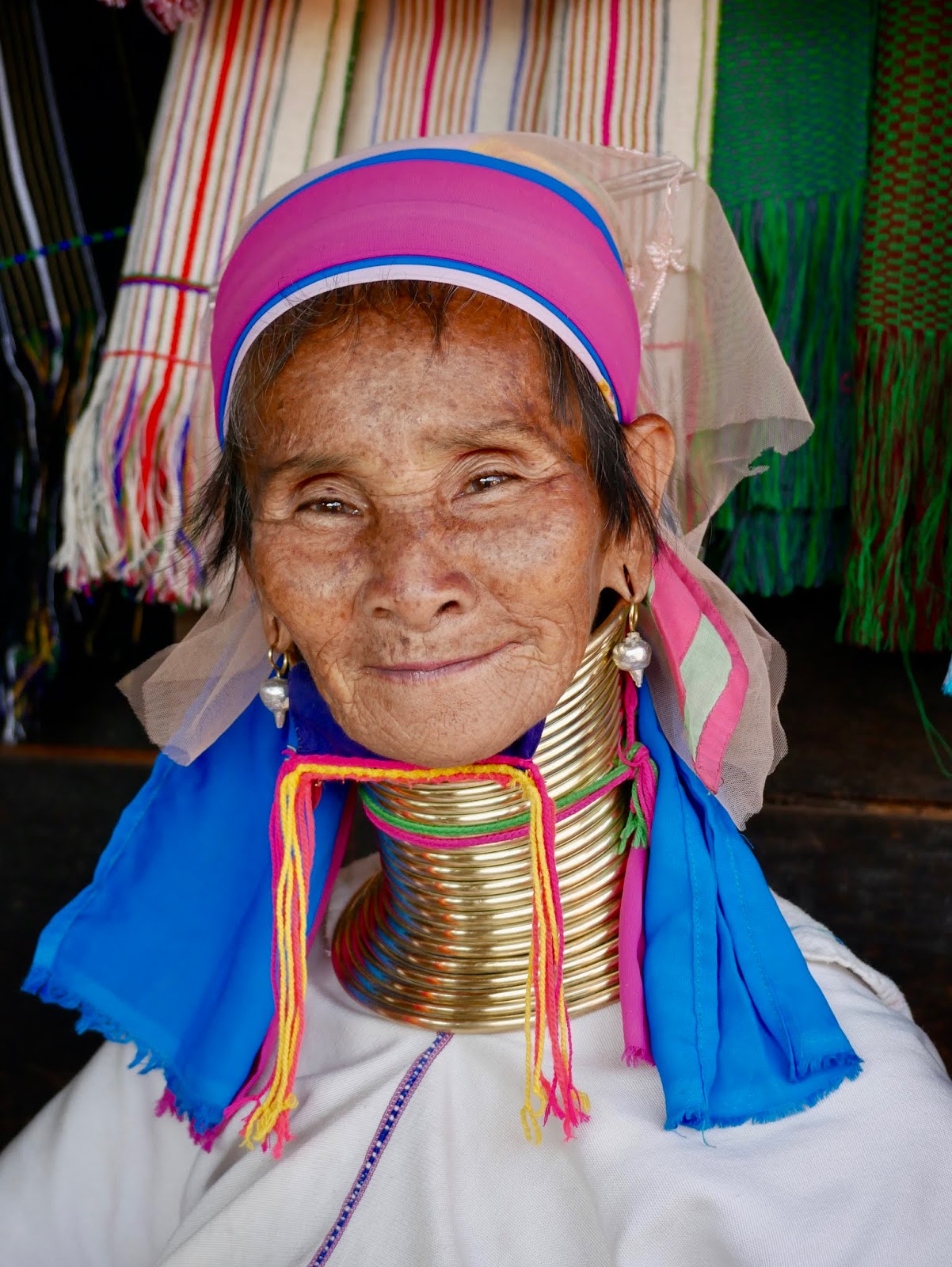
Myanmar, formerly Burma is a country about which relatively little is known in the west. The city of Mandalay is familiar to us due to Kipling's now problematic poem of the same name and also perhaps because it is mentioned in the children's song Nellie The Elephant familiar to those of us who grew up in the 1960's. There is also a widely held (although inaccurate) belief that Road To Mandalay was a title in the famous Bob Hope and Bing Crosby movie series. Initially there had been a plan for a film of this name but the final title replaced Mandalay with Singapore. Somerset Maugham and George Orwell also wrote about their experiences in the country but offer insights from a relatively narrow point of view. However, there is a particular image that many people associate with Myanmar, that of the Kayan women who wear brass coils around their necks and legs. I recall seeing pictures of these women in a set of encyclopaedias purchased by my grandparents from a traveling salesman in the 1960's. I never thought that I would get to meet them but during my recent time in Myanmar I was able to visit the village of Kasae Kum and meet some of the women who continue to wear the coils. 

Best friends, Bilot and Bilone
Muthan aged 71 welcomed me into her home with a glass of tea and invited me to sit down. Both she and her husband are artisans. Muthan spins cotton and makes and sells scarves whilst he is a woodcarver, producing small figures of Kayan women for sale to tourists. Together they had eight children, five of whom have already died, some in childhood. She explained that until fairly recently there was no access to modern medicine here and that it was difficult to reach the nearest town with no easy roads out of the village. This was a story I was to hear several times over the course of the morning. Despite this, they have 20 grandchildren, all of whom live within walking distance. One of them spent some time peeping at me from the upper level of the house before deciding that going outside was a more interesting option. 

I asked Muthan how long she has worn the coils. She told me that she first put them on at the age of five and that initially it was very painful as her muscles had not developed sufficiently to support their weight. Whilst explaining this, she lifted the coils slightly to show me a heavy dark bruise on her shoulder. They are rarely removed other than for renewing perhaps every five years or to undergo a medical examination. In recent years some women have stopped wearing them altogether. This is said to result in pain which subsides after a few days but which leaves permanent discolouration. 

Muthan


Muthan's grandson
Muthan's daughters and granddaughters do not wear the coils. She has mixed feelings about this and said that she respects their decision but is sad that the tradition is being lost. This was to be something common to the families of each of the women I met in Kasae Kum.  I asked her about the origin of the custom and how it began. There are various stories relating to this but she produced one that neither I nor my guide and interpreter had previously heard. She said that the Kayan women were told to wear them in case they should be scattered from their homeland, dispersed and unable to find each other. The coils were to be relied on as a means of identification. 

One explanation given is that they were meant to protect the women from enslavement by other ethnic groups, making them less attractive to other tribes. At the same time there is also a widespread belief that the coils enhance the beauty of the wearer, emphasising their slender necks, whilst a third explanation compares the appearance of the wearers to a dragon, a key figure in Kayan folklore as well as that of other tribes.

She also had questions for me, questions that were asked by each of the women I was to meet. They were focused mainly on my family, marital status and how many children I have. All of them were surprised that I travel alone and told me I should come again and bring my family next time. She offered me home made rice wine, the drink of choice amongst the Kayan and other communities and was a little surprised when I declined, explaining that I don't drink alcohol. She poured more tea instead and told me that she also likes beer but that it is bloating and can make you very fat! Before leaving I bought one of the scarves she makes. She placed the money inside the coils before thanking me for visiting.

Mutayant
Mutayant's busy granddaughter!
Mutayant lives a short distance from Muthan's home. She is 78 years old and a widow, She was not born in Kasae Kum but came there from her mountain village when she married a local man. The marriage produced ten children, six of whom have already died for reasons similar to those of Nuthan's. Like her neighbour she has 20 grandchildren and four great grandchildren some of whom were playing in her compound. Both Mutayant and Muthan are Animists as are many Kayans. There are also significant numbers of Christians amongst the community as well as Buddhists and people who mix Animism with another faith. Choice of religion appears to have no impact on maintaining Kayan traditions.

Mutayant put on the coils at the age of 10. She said that her daughters and granddaughters do not wear them as they "don't want to face discrimination when going out of the village to study or work". She said that she would never try to force the younger generation to wear them but had been angry with one of her daughters who had worn hers at a conference and sold them to a Chinese delegate. One of her granddaughters, two years old, was very busy playing outside the house, pulling faces, saying a few words of English, pretending to be working and generally entertaining us. It seems that her life will be very different to that of her grandmother. 

Bilot aged 73 and Bilone, 82 are best friends. Both of them widows, they spend most of their day together, talking, helping each other and enjoying the taste of rice wine. Bilot said "ask anyone in the village, everyone knows us, Bilot and Bilone". Both women had ten children. Bilot says that this is not considered excessive within the community and adds with a mischievous laugh "fortunately my husband died 32 years ago or I am sure I would be nursing another baby even today". Bilone joins her in laughing as do I, perhaps surprised at her candour. Both women put on the coils in their early teens and both wanted to wear them. Bilot said that the coils should be worn because "girls are more naughty than boys. They run around more so their parents say they need to wear them to prevent them from doing this. I used to climb trees and misbehave". Bilot is the only one of the women to give this explanation.

Bilot
Bilone
As with the other women none of their daughters or granddaughters wear the coils. I asked them how they feel about this and in response they said that if young women don't wish to wear them it is their choice. Earlier I had seen a group of eight young girls in the centre of the village, all of them wearing coils but later learned that these are not the same as those worn by the older women and are easily removed. It may be that they are being worn for the tourists. I asked the two friends what they think about people coming to see them. They said that they enjoy it. "We can't travel so people come to us. We like to hear about the outside world". They wanted to know how far I had traveled to meet them but had no concept of where I might be from. The interpreter told me that they have little knowledge of the world outside the village and would not really know where Yangon is or what it might be like.

Kayan girl, Kasae Kum village
Bilot and Bilone had several questions for me, most of them the same as those asked by their neighbours - why do you travel alone? how many children do you have? how old are you? They enjoy rice wine and drank it from a special bowl throughout the time I spent with them. They wanted to know if people drink rice wine in the UK and if I would like to try it myself. Bilot also enjoys chewing the betel nut, known as paan in India and this too was offered to me. Unfortunately I had to decline both as I don't drink and don't chew betel. She told me she chews it in order to keep her mouth fresh and laughed when I asked her if she was worried about the negative impacts it can have on the mouth and teeth, not least dyeing them bright red. She seemed genuinely happy as did Bilone whose grand children came in and out of the house as we spoke, one of them stopping for a quick cuddle with his grandma.

I enjoyed my time in the village and learned a lot not just about the lives and customs of the Kayan women but once again about how similar our ambitions are despite the differences between us. All of the women I spoke to wanted whatever was best for their children and grandchildren even if it meant abandoning some of their cherished traditions. I liked their curiosity about the outside world and their willingness to be open with outsiders. As I left I realised that they may well be the last generation of Kayan women to wear the coils and that many of their traditions will end with them.

A cuddle with grandma
Please note I refer to the women throughout as Kayan rather than the other term sometimes used - Padaung. I am advised that this is considered to be pejorative despite being used throughout Pascal Khoo Thwe's 2002 book From The Land Of Green Ghosts. I also met two women in the main market at Loikaw who used the term to describe themselves although they did not wear the coils.

You can see more pictures from Myanmar here

Wednesday, 8 January 2020

Travels With My Camera 2019 - The Best Pictures

In 2019 I visited Cuba for the first time as well as making return visits to some of my favourite places including India, Myanmar and Israel. As ever, I spent my time exploring the streets of towns and cities with a camera in my hand, attempting to capture a little of their character by photographing the the daily lives of "ordinary" people, although many of them are extraordinary. Whenever I can, I try to spend time talking to people, often with the help of someone who can interpret and who can help ease the way to some, hopefully, authentic pictures. Capturing the stories of the people I meet is as important to me as taking their pictures. It helps to give context to a photograph, hearing the stories as well as seeing them in their faces.

During 2019 I was privileged to meet many new people. Anthony lives in Melbourne. He became homeless through no fault of his own and now sits outside the Hill of Content book shop in Bourke Street each day, reading or doing the crossword. He loves talking to passers by and also has a strong liking for the capuccino sold at the  iconic  Pellegrini's Espresso Bar, a few steps from where he sits. I was able to post his picture to friends in Melbourne who took it to him, together with a pastry from South Melbourne Market. If you see him, stop to talk and buy him a coffee.

In Hong Kong I met a delightful woman in her eighties. Born in Shanghai she had memories of the Japanese occupation of her home city and then the terror that followed with the Communist takeover. She now spends her days pushing a trolley around the streets of her neighbourhood, collecting waste cardboard for sale to recyclers. She said that she does not need to do this for money, but enjoys being outside and talking to people.  Some of the shopkeepers and vendors place a small stool outside their shops so she can rest from time to time.

At the younger end of the age range I took perhaps my favourite picture of the year in Nan Hu, northern Myanmar. When walking through a village I hear someone calling out "hello hello". I turned to look and saw first one child, then two, then several standing in the window of their school room shouting and laughing. I especially like this picture for the expression of hope and joy the children wear. I hope to see them again during my current time in Myanmar.

Central market, Mandalay, Myanmar
School children, Nan Hu, Myanmar
Monks doing the morning round, Nyaung Shwe, Myanmar
Modern communication, Hong Kong
I staged my first, small exhibitions during 2019. My first show was held in the Maison Bertaux Gallery in Soho, combining two of my passions - photography and cake. I was both astonished and grateful that so many people came to my opening and this led to further shows in public libraries in Canning Town, Hornchurch and Romford, bringing my pictures to different types of audience. I also exhibited in the Fry's Gallery in Hornchurch where again I was encouraged by the response and feedback which included a double page spread and interview in the local newspaper. I am especially grateful to Havering's Libraries and Arts services for being so supportive and for giving me the chance to take part in the annual Havering Literary festival in November. The festival features dozens of events including appearances from top authors. My contribution was to run two workshops for Year 6 students involving a tour of my exhibition, discussion with the children about what they had seen and about their own travels as well as a small creative writing exercise afterwards. I must admit I was extremely nervous beforehand as it is several years since I last did anything of this nature but I thoroughly enjoyed it and the children were extremely engaging. The pictures featured in this post are amongst my best received works from various social media and from feedback from the exhibitions.

Woman in purple, Hong Kong
Luisa with cigar, Trinidad-de-Cuba, Cuba
Boy with new fan, Trinidad-de-Cuba, Cuba
Anthony with capuccino, Melbourne, Australia
Woman with red hair, ShukHaTalpiot, Haifa, Israel
In 2020 I have an exhibition planned for the Queen's Theatre in Hornchurch during July and am in discussion about shows with another library service and possibly an independent gallery in south London. Thank you if you came to any of my shows during the year, or for following me on various social media. I hope to see you again in 2020.

See more at @adrianyekkes and at flickr

If you are interested in any of these pictures please contact me at adrianpwhittle@outlook.com

The samosa boy, Daryaganj market, Delhi, India
Waiting for customers, Kolkata, India
Flood water, Patan, India
Please note: All rights reserved. None of these images may be reproduced, stored in a retrieval system, or transmitted in any form or by any means, electronic, mechanical, photocopying, recording or otherwise without my prior written permission.

Wednesday, 27 November 2019

Delhi's New Gramophone House - Albela, Bhagwan and the Delights of Classic Bollywood Vinyl


Old Delhi's New Gramophone House, a treasure trove of vinyl recordings of all genres, opened in 1947. Bhagwan Dass Rajpal opened the original store in Lahore in 1930 but moved his family and the business to India during Partition. The store can be difficult to find. It is located on the first floor of a building on the main road of the extremely busy Chandni Chowk and there are no obvious signs of its presence from the street. Visitors must pass through a different shop on the ground floor, then scale a steep set of steps that sit below a low ceiling (watch your head) before reaching their destination. But it's worth persevering as once there the vinyl fan enters paradise - a small room packed with thousands of recordings stacked on shelves and in cabinets. 

I make a pilgrimage to the shop every time I am in Delhi with the objective of adding to my small but growing collection of vintage Bollywood soundtracks from the 1940's, 50's and 60's. Regular readers will know of my love of jazz but thanks to a former work colleague I have been smitten by classic Hindi film songs. Playing them on youtube is no longer enough - I want to handle the vinyl recordings and have them in my collection.

Of course Bollywood churns out hundreds of contemporary musical productions but I do not enjoy these so much and prefer contemporary Indian dramas. In recent years Indian cinema has dealt with many social issues in films including Dangal, Dhobi Ghat and Aligarh as well as producing delightful romances like Lunch Box and suspense stories such as Aandhanhun. But you really can't beat those vintage movies and I've grown to love the films of Raj Kapoor, Johnny Walker, Madhubala, Nargis, Guru Dutt, Nadira and Bollywood's best dancer, Helen. They tell a story, tackle issues and have memorable songs performed by the classic playback singers - Mohammed Rafi, Manna Dey, Kishore Kumar, Hemant Kumar, Geeta Dutt and of course sisters Asha Bhosle and Lata Mangeshkar.


More recently I came across a film called Albela. Released in 1951 it was directed by Bhagwan Dada who also starred in the film together with Geeta Bali. It tells the story of Pyarelal the son of a poor Bombay family who needs to accumulate money to help marry off his sister, Vimla. Not only does he fail to raise the required amount but he also loses his job. The resultant quarrel with his family leads him to leave home vowing not to return until he is rich and famous. He goes on to pursue a successful career in the theatre and eventually decides to return home only to find things are not as he believed them to be. You'll need to watch the film to find out how it ends! Albela was the third highest grossing Indian movie of 1951 and its soundtrack by C. Ramchandra continues to be acclaimed today. Ramchandra performed most of the songs himself (under the name of Chitalkar), dueting with Lata Mangeshkar on several tracks and with the superstar Mohammed Rafi on one song. The film also made use of westernised style cabaret dance and choruses as well as using bongo drums, oboes, clarinets, trumpets and saxophones, little used in Indian film during that period but which still influence cinema today.

Director and leading man, Bhagwan Dada was born in Sindhudhurg, Maharashtra in 1913. The son of a textile worker, he originally worked as a labourer but had a strong ambition to work in cinema. He eventually obtained work in silent films, making his debut in a movie entitled Criminal. He went on to learn film making, co-directing his first film in 1938 and from then until 1949 he made a number of popular low budget movies. As well as producing Hindi movies, he made at least one Tamil film, Vana Mohini, in 1941. This film was significant for including an elephant as one of the leading characters! A year later he worked with prolific film actress Lalita Pawar. There is a story that he was required to slap her in one scene and that hitting her too hard he injured her eye leaving permanent damage.

In 1947 he set up his own Jagriti Studios and four years later produced his all time classic Albela. Shola Jo Badhke, the best known song from the move is still popular today and Albela is often performed by students as a high school musical. He went on to produce a few more hits in the 1950's but then his success dried up and he was forced to sell his home and cars and take on bit parts in other people's films. He was eventually reduced to living in a chawl, a one room home in a tenement block originally built to house textile workers. Bhagwan died of a heart attack in 2002. A biopic of his life, entitled Ekk Albela, was released in 2016. The original vinyl soundtrack of his masterpiece can still be found and I returned from my most recent Delhi trip with a copy - purchased at the New Gramophone House of course!

New Gramophone House , Shop No 9, opposite Moti Cinema, Main Road, Chandni Chowk, Delhi. It is also possible to browse and purchase items online here.


See pictures from India here.