Friday, 3 May 2019

Street art and selfies - Hong Kong Stories 1.

Graffiti was once considered to be vandalism. Re-invented as street art, this now respectable genre has brought international recognition for its leading practitioners and cities such as London, Paris and New York now commission work for their streets. Hong Kong also makes use of high quality street art to revitalise neighbourhoods and to attract visitors. This includes a specific programme known as HK Walls that promotes and encourages locally based artists and brings their work to new and wider audiences.


Hong Kong's best known street art is located on the corner of Graham and Hollywood roads and was commissioned by the lifestyle store, GOD (Goods of Desire). Locally based artist Alex Croft was responsible for the piece which represents the Walled City, a huge, informal housing structure that was once home to 33,000 people, over 1,000 businesses and covered 6.4 acres. Demolished in 1994, it was immortalised in the photographers Ian Lambot and Greg Girard's book, City of Darkness. The Walled City was perhaps the most well known example of the tong lau - tenement buildings, usually with commercial use at ground floor level and residential units above. An official tong lau included shared bathrooms and kitchens with rent, electricity and water charges paid on a monthly basis. Once widespread, many of these structures were demolished in the 1960's making way for more luxurious, private developments. Others collapsed due to poor construction and or maintenance, including a fifty years old five story tong lau that collapsed in 2010 killing four people. Today only a handful of these buildings remain.


But back to the street art. I recently visited Graham Street on a weekday morning and found dozens of tourists and locals taking selfies and then immediately posting them to social media. There were also small groups of young women, elegantly dressed taking turns to pose for a series of shots, sharing hats and other accessories and taking it in turns to photograph each other. This is followed by much checking and discussion of the shots before choosing which ones to share on social media.They had clearly spent time preparing for this as they went through a series of poses that would fit the pages of a fashion magazine. The lives of these young women and the tourists could not be more different to those of the former inhabitants of the Walled City and I wondered how many of them understand the significance of the work and what it relates to.


Elegant as these women were, my favourite selfie-takers were a small family group consisting of two parents and two little boys. The father held a selfie stick as they posed for a group photo. Mum smiled. Dad looked serious - trying to make sure they had a good picture. The older boy raised a hand of greeting at the camera whilst the younger one seemed a little agitated, perhaps bored and ready to move on. I had noticed the boys a few minutes earlier when their parents positioned them against the wall for another picture. Two young people stood a step away from them, one engrossed with the art the other ready to leave having taken her selfie, her sole purpose for being there. Perhaps art, like  most things, means different things to different people.


Tuesday, 23 April 2019

Tel-Aviv Tales 3 - Beit Shimon Levi, a ship on dry land


The corner of Lavanda and HaMasgar in Tel-Aviv is not the most fashionable part of the city. Many of the buildings are in poor condition and there are few facilities. The heavy traffic on HaMasgar also makes this perhaps one of my favourite city's most polluted areas. However, it is on this corner that an iconic example of Tel-Aviv's modernist architecture stands. Beit Shimon Levi (the Shimon Levi House) was built in 1934-5. It is said that Levi himself designed the house although it is also, and perhaps more accurately, credited to architect Arieh Cohen who was responsible for a number of other buildings in the city.

The building was designed in defiance of the planning laws in place during the 1930's which restricted height to no more than three storeys. Beit Shimon Levi consists of six storeys in total - a basement, a ground floor, three further floors and a small attic at the summit - double the legislated amount. Following difficult negotiations, Levi was able to secure permission from Tel-Aviv's first mayor, Meir Dizengoff, to proceed with construction and to move his family in. Unfortunately they were not to live there for very long and moved out in 1937 due to financial difficulties. In later years the house was used by the Haganah as a look-out point during the period leading to independence and at one point it also housed a synagogue. Today it is used solely for residential purposes.

The house is affectionately referred to locally as the ship building due to its ocean liner type design, narrowing at each end and rising to a significant height with both curved and squared off balconies. These nautical references were common during the 1920's and 1930's and are classic features of Art Deco and modernist architecture. The building has protected status but looks to be in need of at least external decoration. Although not on the itinerary of most tourists a visit to this part of town is well worth it as there are two more excellent examples of Arieh Cohen's work at 26 and 28 Rosh Pina Street. He was also responsible for the more centrally located 251 Dizengoff Street.

Monday, 1 April 2019

Tel-Aviv Tales 2 - Sweet Story On Matalon Street

Matalon Street is adjacent to Lewinsky, home of the famous shuk of the same name. Whilst the shuk is home to shops selling spices, herbs, olives, pastries and coffee, Matalon is the place to find everything you need for a party, not least costumes. I have passed along this street many times but only recently did I notice a small shop front with a sign behind the window reading Konditoriah Albert, 1935. 


My curiosity was aroused by the possibility of seeing a piece of Tel-Aviv history and the potential for indulging my well known passion for all things sweet. Unfortunately Albert was closed. I tried again the following day still with no luck and began to worry that the shop had ceased trading. I decided to try once more. It was a case of third time lucky and to my delight I stepped into a world that has not changed in decades. The walls were covered with press cuttings about the shop as well as photographs of impressive, smartly dressed men and women from a world that no longer exists - Saloniki in the years before the Second World War Most striking of all was a faded, sepia picture of a woman with a serious expression and large, haunting eyes and wearing a traditional Greek head covering.

I was soon to find out that the woman in the picture was the mother of Albert Yehuda who brought his family from Saloniki to Tel-Aviv in 1935. The family initially settled in the Florentin neighbourhood where he established his famous Konditoriah that 84 years later still bears his name. The business relocated to its current location in the early 1960s and is today managed by Albert's son Yakov together with his wife Lavana.  I was able to spend a little time talking to Lavana who explained that only the best natural ingredients are used to make their confectionery and that everything is made on the premises and that their processes are the same ones Albert followed back in the 1930's. Whilst she was speaking, Yehuda was hard at work in the kitchen whilst her brother carefully removed the skins of hundreds of almonds preparing them for use in their various products. Many sweet treats are on offer here including a Greek version of Kadaif, made with nuts and the famous Marzipan Kisses - two boxes of which I managed to consume over a few days. Addictive. I also enjoyed the orange jellies that I bought on my first visit to Albert's.

Albert Yehuda came to pre-state Israel because he wanted his. family to be part of the re-emerging Jewish state. Lavana assured me that both her family and that of her husband came for purely positive reasons but throughout the 1930's many Greek Jews were to leave the country of their birth due to rising nationalism which on occasion turned violent. In July 1931 at least one person was killed and many Jewish families were left homeless in Saloniki when the city's Campbell district was attacked by 2000 rioters over a period of four days. Following this, many Jews left for Eretz Israel, Haifa in particular where they sought works in the docks.

Whilst talking to Lavana we break off regularly so that she can deal with the steady flow of customers who come in person or who call in their orders by telephone. A number of businesses in the neighbouring streets are owned by families that came from Greece but Albert's is almost certainly the last Greek konditoriah in Tel-Aviv (if not in all Israel) and a real piece of the city's history.


You can see more pictures from Israel here.

Friday, 8 March 2019

Tel-Aviv Tales 1 - Sonia and Yakov


Sonia and Yakov Shmueli sell hand made velvet and lace curtains, tablecloths and antiques in Jaffa's Shuk HaPishpeshim (flea market). They opened their shop 38 years ago and have been there ever since. Like many Israeli couples, they come from very different backgrounds. Sonia was born in Drahovo a small town in the Carpathians, now part of Ukraine, but which has also been in Czechoslovakia, Hungary and the Soviet Union. Yakov was born into an Iranian family in Teheran 70 years ago.

Sonia came to Israel in 1971. A few years earlier it has been practically impossible for Jews to leave the Soviet Union and those who applied to emigrate were harshly treated as were their families. At the beginning of the 1970's, there was a relaxing of these restrictions and emigration steadily increased. On arrival in Israel Sonia worked in a religious kibbutz. "I loved it, working in the fields or the orchards. The work was hard but I was young and didn't know anything different. And every night I dreamt of a man who lived in Tel-Aviv". That man was Yakov. He had arrived much earlier, in 1949 just after the founding of the modern state of Israel. His family had a comfortable life in Iran but his father was a committed Zionist and wanted to make aliyah, despite the protestations of his wife. Yakov tells the story of how his father told her "we will go and see if we like it. If you are not happy we will come back to Iran". She agreed  to her husband's proposal but when they arrived, he kissed the earth and promptly tore up their Iranian identity papers so that return was impossible. 

The family were initially housed one of the ma'abarot, a camp designed as temporary accommodation for the hundreds of thousands of Jews who came to Israel following independence in 1948. As the new state struggled to cope with such a large influx of people and at the same time fight a war of survival against its neighbours, the ma'abarot left a lot to be desired. Accommodation was flimsy lacking heating, ventilation and modern sanitation. Yakov remembers their home - a tent - being swept away in heavy rain. His father had spent all of the family resources on the move from Iran and so it was very difficult for them to improve their situation but after six months they managed to set up home in the HaTikva neighbourhood of Tel Aviv.

After leaving the kibbutz, Sonia found work in Netanya where she became friends with a girl who often spoke about her kind, handsome brother. The two friends spent a day together in Jaffa where they were joined by Yakov and a friend of his. Sonia remembers how the friend took a fancy to her and spoke continuously. Talkative as the friend was it didn't help his case as she only had eyes for Yakov and the two of them started to meet. Her father was not happy about the relationship, saying that this young man was not a Jew because "he doesn't wear a kippah". Nonetheless  he went to meet Sonia's family one Friday, wearing a kippah and to ask for permission to marry her. The initial response was a very definite "no". Several members of her religious, Ashkenazi family objected most strongly to her marrying a Sephardi Jew. Emotional scenes followed, described by Sonia as a "balagan" and she left home on shabbat, declaring she would never return. Yakov's sister came to the rescue speaking to various parties and eventually the way was paved for them to marry. They have four children and 12 grandchildren. I asked them how much they think attitudes have changed today and they told me that of course there are still people who hold the old prejudices but that they are a small minority. Their own children demonstrate this more open attitude and are married to people from several different communities.

In the picture at the top of this post the Shmuelis hold a reproduction of a photograph of Yakov, his mother and siblings taken just before they left Iran. He is the smallest child with his mother directly behind him.

Saturday, 23 February 2019

Looking for Bangkok

Bangkok was never one of my favourite cities. I should admit that I lived here for several months almost 20 years ago but unable to settle, left and returned to London. I waited a long time before going back and then two years ago I spent a few days there on the way home from Myanmar. I wanted to challenge my view of the city and to find a more authentic Bangkok away from the office blocks, malls and hassles.

Last month I was again in Myanmar and decided to spend four nights in Bangkok before coming home. I had enjoyed my stay in 2017 but still felt that I had not found the real Bangkok. In preparation for my visit I read a lot and spent a long time on the internet in the hope that I would leave feeling better disposed towards the city and with a good photographic record of my search. With this in mind I kept away from the "delights" of Silom and Sukhumvit and instead spent my time wandering through Khlong Toei, Thonburi and Chinatown.

Fun with grandma, Khlong Toei
Khlong Toei is one of the poorest areas of the city, located on land owned by the Port of Thailand. Many people moved there in the 1950's to take advantage of cheap land rental and to look for work. The rapid growth of the city's population from the 1970's onwards coupled with lack of investment in cheap accommodation meant that the settlement grew into what is now one the largest slums in Bangkok and home to an estimated 100,000 people. The term slum does not do justice to what is an established, seemingly cohesive community where shops, food stalls and other businesses have been established but it stands on low lying swampy land that is prone to flooding during the rainy season. The impact of this is made worse by the fact that many, although by no means not all, of the  homes are fragile and make-shift and that there are problems with waste disposal, sanitation and health.

I spent a few hours walking through the neighbourhood and met several of the very friendly and welcoming residents who without exception were happy to talk a  little and to be photographed. It helped that I was accompanied by someone based in the city and who has a good command of Thai but also, to my surprise, by my being able to recall rather more of the language than I expected. I have no doubt that that was a tribute to the skills of my teachers from two decades ago rather than any linguistic capability on my part.

The recycling lady, Khlong Toei
"Be careful where you put your feet" Khlong Toei
Friends, Khlong Toei
Amongst the many people I met was an elderly woman who collects recyclable materials for a living. Not only this, her house is made entirely from recycled items. This reminded me of my experience of traveling in India where in many communities, nothing is wasted and everything is recycled or re-used. It is interesting to see the very practical application of recycling, so different from the seemingly more sophisticated but more bureaucratic and complicated approach at home.

As I visited the Khlong on a weekday, most of the people I met were either elderly or very young.  In many cases grandparents were looking after young children whilst their own parents worked. I stopped to say hello to an elderly woman sitting on the step of her home when two very small children appeared behind her, peeping over the safety gate to see who was there. As she turned around to them, a look of absolute delight crossed her face. The happy trio are pictured in the photograph at the top of this post.

Considering the difficulties many of the residents of Khlong Toei face, I encountered many smiles and some moments of humour. A small girl stopped to say hello and to stand for a picture. Whilst I crouched to photograph her she kept trying to tell me something. Too late I realised that she was saying that a dog had left something on the pavement close to my feet. Much to her amusement I had already stepped in it. She laughed again when as I began to move on, she decided to smack me on the behind with one of the two empty plastic bottles she was carrying. A girl with a sense of humour. Further on I came across a trio of boys, probably aged between 7 and 11, all barefoot and holding small toys that they were keen to show me. The smallest one became very excited and began performing a dance routine with some impossible looking stretches, hand stands and a big big smile. And of course, people offered to share their food with me. As ever, the people with the least material wealth seemed to be the most generous.

I can dance too - Khlong Toei
Driving lesson- Khlong Toei
Khlong Toei is a complicated place. In the heart of one of the biggest cities in the world, parts of it appear almost rural as some residents have tried to beautify their living spaces with plants and small gardens. A railway line runs through one part of the settlement, just a few feet away from people's front doors, but even beside the line there is a sense of peace and quiet during the day and greenery lines the tracks. In addition to efforts made by the locals, a number of organisations have undertaken work there to support the health and well-being of the community. In addition to the daily struggles, another threat hangs over Khlong Toei. The land is extremely valuable. In the centre of the city, it is attractive to developers and would realise enormous sums were it to be sold. From time to time there have been threats of demolition and clearance which would bring this long established community to an end. 

On the lines - Khlong Toei
Lunch time, Khlong Toei
Thonburi is sometimes referred to as being on the "other side" of the Chao Phraya river, away from the busy streets of the main business district. For 15 brief years during the 18th century it acted as the Thai capital after the fall of Ayutthaya and before the establishment of what is now Bangkok. Moving away from the river Thonburi has many narrow streets and lanes lined with local markets, small shops and solid looking homes. Strolling through the neighbourhood it is still possible to see a number of traditional crafts being practiced, such as the making of flutes in the Baan Lao village and several tailoring businesses.

As in Khlong Toei, the residents of Thonburi were happy to be photographed and to talk a little. Some had clearly been photographed before. Passing a tailoring shop I noticed a fabulous floral lace shift dress displayed on a mannequin. A pink appliqué flower completed the look and as I raised my camera to capture it, one of the seamstresses, a Chinese woman, stood up and began to pose beside it, rightfully proud of her work. Fabulous.

Proud seamstress, Thonburi
Khun Somnung, Thonburi
Market vendor, Thonburi
Thonburi is home to a significant Muslim community and a little further along I met Khun Somnung, an elderly, grey haired lady who saw me looking at a picture of the previous King, displayed on the front of her neighbour's house. The photograph had been taken when he was very young and was studying in Switzerland. She was delighted to tell me all about this and very happy to be photographed. However she took me by surprise when she asked me to wait and produced a hijab from inside her bag, put it on and signalled that she was ready to proceed. Somnung was a great model and knew where and how to stand in relation to the light.  She allowed me to take many pictures. My favourite is the one above showing her smiling as she writes her address in my notebook so that I could send some pictures to her. She should have received them by now. I hope she likes them.

Wandering through Thonburi's back lanes, I came across numerous Buddhist temples, including the small but exquisite Chao Mae Aniew Chinese shrine. The doors to the main shrine are stunning examples of Thai/ Chinese craftsmanship, deep red with female figures guarding the entrance. The friendly keeper of the temple opened the doors for me and stood between them for a picture.

Chao Mae Aniew Shrine, Thonburi
Elderly lady relaxing in the shade, Thonburi
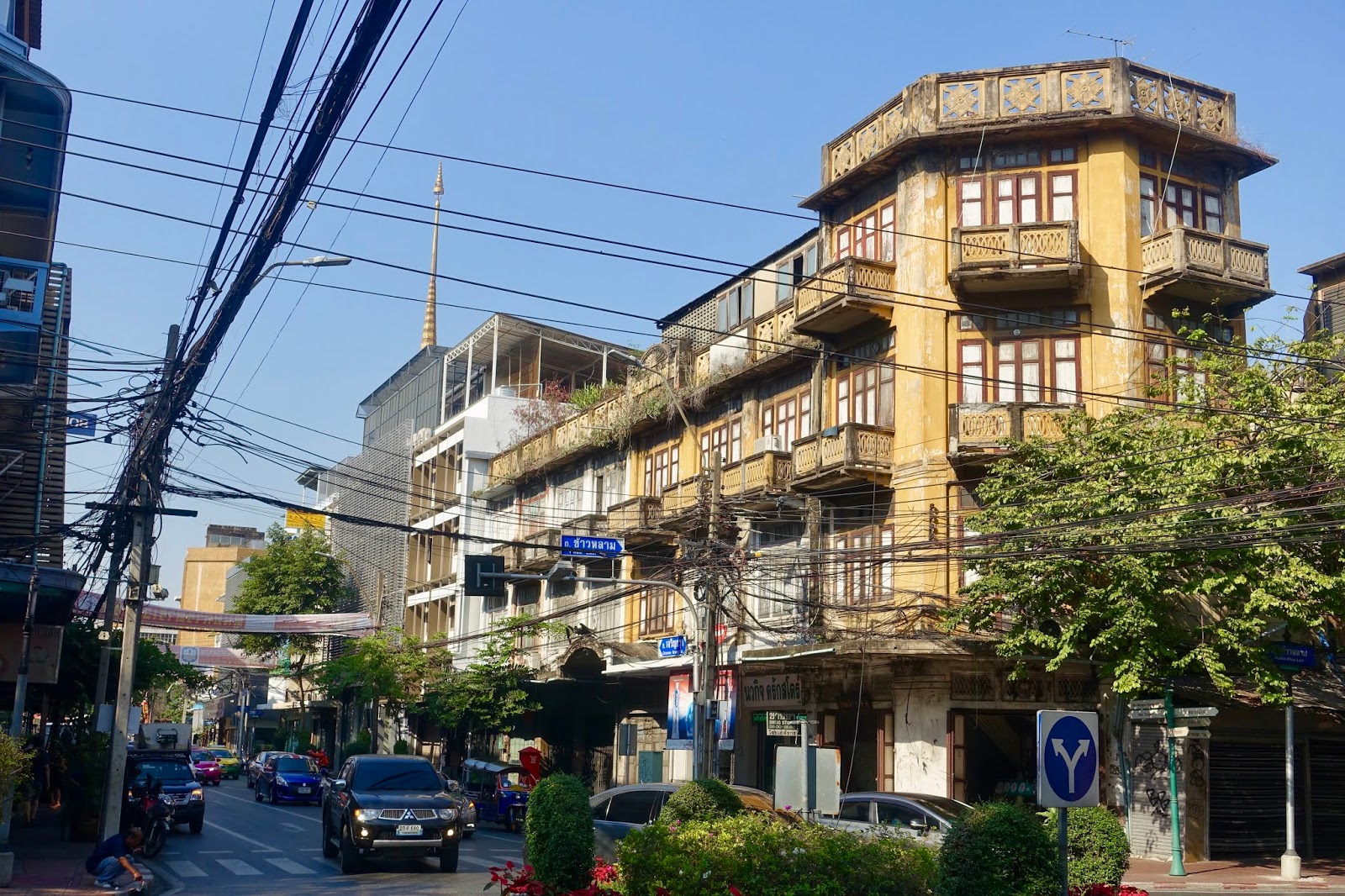
Bangkok's Chinatown was founded in 1782 and is one of the oldest parts of the city. It attracts both locals and tourists who come to shop in the street markets, to eat or to visit one or  more of the many temples. I preferred to head for the quieter streets where Art Deco influenced buildings, warehouses, traditional medicine shops and cafes can be found as well as the trendiest of bars, a smattering of boutiques and some interesting street art featuring Chinese calligraphy. There are also a few streets lined with mechanics repair shops where the working class traditions of the neighbourhood linger on.

So do I feel differently about the city? I certainly enjoyed my few days there and am finally convinced that it is much more interesting than I had previously thought. Have I found the real Bangkok? I wouldn't presume to answer that question as I have hardly scratched the surface of Khlong Toei, Thonburi and Chinatown and need to explore them in more detail. I could easily spend a whole day in Khlong Toei's famous market and I have yet to explore the communities that live on the riverside in Thonburi. And of course there will doubtless be other areas that I have yet to discover. I know I will be in Myanmar again which means I should be back in Bangkok too...

And to close, some pictures from Chinatown and my favourite image from Thonburi - friends relaxing in a quiet lane.

Art Deco influenced building, Chinatown 
Calligraphy as street art, Chinatown
Khun Ooan runs a food stall in Chinatown
Archway, Chinatown
Relaxing, Thonburi

You might also like Return To Yangon

You can see more pictures from Bangkok here.

Tuesday, 12 February 2019

Great Coffee, A Long Bike Ride and A Face Full Of Stories - More From Myanmar

School children, Nan Hu village, Inle
Two years ago I had a memorable journey from Mandalay to Pyin Oo Lwin when I spent  two and a half hours on the back of a motorcycle in order to visit this former hill station. That's two and a half hours each way, so five hours in all. I enjoyed the great views from the motorcycle but not the saddle-soreness the next day. This time I arrived by car and spent two days exploring the city in more detail. After wandering around the market and surrounding streets I was craving coffee. The town centre has many old style cafes that serve good tea but I was in need of good strong coffee. Not sure where to go, I asked for advice in Parami, an excellent Indian sweet shop and was directed to Cafe May Myo. I was not disappointed. The cafe is small enough to be cosy but designed to give a feeling of space. It also has outside seating. There are books and magazines to browse and old pictures of the city line the walls. The coffee used here is grown locally and customers can buy packs to take home. Perhaps best of all is the service provided by the very friendly, attentive and knowledgeable young staff one of whom made my French Press at my table using the latest technology. Regular readers know that I have a sweet tooth. Cafe May Myo also has a good range of fresh cakes and pastries including a fabulous fresh banana bread, an excellent accompaniment to the best coffee in town (and possibly the best in Myanmar). It is the kind of place where you can linger, use the wi-fi, relax or chat with friends.

Cafe May Myo, best coffee in town!
One of the best things about Myanmar is the hospitality and friendliness of the people. Pakoku is a market town, a short drive from Bagan. After visiting the market I noticed a large monastery and looking through the gates I saw hundreds of young monks. Some of them were chatting to each other, others were earnestly studying. An official noticed me and invited me in, explaining that there were indeed lots of monks there - 1334 to be exact, all of whom were about to sit a written examination. Before the exam they would be given lunch, seated at separate small, numbered tables bearing the name of an individual monk. An hour after lunch they would return to these tables for the more serious business. To my surprise I was invited to walk around, photograph anything I wanted to and to return once things got underway. I cannot imagine anywhere else that would have allowed such access without prior arrangements. 

Monks waiting to take an examination, Pakoku
Inle Lake is one of Myanmar's most popular tourist attractions. Most visitors spend time on the lake, visiting the homes on stilts, the floating gardens and pagodas and photographing the famous fishermen. As this was my second time in Myanmar I chose to do something a little different and cycled a round trip of almost 20 kilometres along narrow tracks in order to reach a remote farmers' market. Cycling through breath taking scenery I stopped several times to watch the workers in the fields and to chat briefly with people on their way to and from the market, women weeding a garlic field and a family that grows and harvests sugar cane for use in making molasses in their small factory.

Weeding the garlic, Inle
Molasses factory, Inle
The market itself was large, busy and full of interesting people buying fruit, vegetables, fish, meat, household goods and of course the ubiquitous betel leaf. Many of the people are members of the Pa-O ethnic group, easily spotted by their black clothing and brightly coloured head coverings - usually orange or red. This wearing of dark clothes began in the reign of King Anawratha in about 1000 BCE when the Pa-O were enslaved and forced to give up their previously colourful clothing. Their tradition holds that they originate from a relationship between an alchemist and a female dragon.

As well as the many stalls, the market has a pub frequented mainly by agricultural workers, all of them men. I spent a little time sitting with a small group enjoying their day off. Significant amounts of rice wine were being consumed accompanied by a variety of meat based snacks, cheroots and of course, much chewing of the betel leaf. They were interested to know about life in London, my family, home and other everyday matters. I disappointed them a little when confessing that football is not one of my passions as they included keen supporters of Arsenal and Manchester United! It seems that wherever one travels, even in the least likely places, people are followers of English football. I am reminded of two small boys playing football in the courtyard of a Yangon temple, pretending to be the same two teams and calling out the scores in English. I restored my credibility in the pub by buying a few more bottles for my new friends before I left.

When leaving the market, I noticed an elderly man with an interesting face. He told me that he makes and sells herbal medicines that can be sued to relieve muscle pain, headaches and other ailments. As he spoke he used his hands to express himself, smiling and looking more thoughtful depending on my question. I wanted to give him something and so offered him some sweets I had purchased in the market. He accepted them but insisted I take a small sample of his medicine "in exchange".

Traditional medicine maker, Inle
Pa-O woman with cheroot, Inle
The man who looked after my bicycle, Nyaungshwe
Pa-O woman, fruit and vegetable vendor, Nyaungshwe market
Nyaungshwe is a busy town adjacent to Inle Lake. It is used as a base from which to explore the water and the surrounding area. However, it is an interesting place in its own right with several very good cafes and restaurants and a number of temples. I cycled into the centre of town at 6.30 one morning to look for the monks leaving one of the monasteries for the daily collection of rice and other donations. It was cold, grey and misty and yet still they walked barefoot in single file stopping only when people stepped forward to make an offering. Several of them were very young as were the nuns I had seen earlier who were so cold that they pulled their robes over their shaved heads in an attempt to warm up a little.  After photographing the monks, I stopped off at the central market where the usual range of goods are sold and where many of the traders are Pa-O. Not wanting to take the bicycle into the narrow lanes of the market I asked a young man if he would keep an eye on it for me. When I went back to collect it I he refused to accept anything from me in return. I eventually managed to persuade him to take a single orange to give to his small child, carried on his back and wrapped up against the cold in thick woollen clothing.

Monks collecting the rice, Nyaungshwe
Nuns on a cold morning in Nyaungshwe
This young man was yet another example of the generosity and openness of I encountered in Myanmar. Time and time again people offered to share food with me or gave me extra fruit after I'd paid for my purchases - steadfastly refusing to accept further payment. Many of them were also happy to talk about their lives, sharing both success stories and misfortunes. Several women who had spent their lives working in the fields or selling in the market had been able to send one or two of their children to university and rightly expressed a quiet pride in this. One woman in Kalaw told me that after graduating her daughter had secured a job in Japan and that she had been there to visit her. The life of another woman in Kalaw had been less happy. She had suffered for many years at the hands of her husband who was both an alcoholic and prone to violence but assured me that her life was better now as the husband had died a few years previously. She said that had been the happiest day of her life. This openness can sometimes come as a surprise but seems  refreshing compared to the very different approach to life in Europe.

A face full of stories
Vegetable vendor, Kalaw
Pa-O woman, Kalaw market. her daughter works in Japan.
Danau woman, vegetables vendor, Kalaw
This openness generally includes a willingness to be photographed. This applies to people of all ages who happily stood for pictures or smiled when realising I had taken a more candid picture. It is almost impossible to choose but perhaps my favourite character was an elderly man I met who holds the keys for a temple a few kilometres from Pakoku. My first sight of him was as he stood on the banks of the river Ayeyarwady, wearing a crisp white shirt, lungyi and a patterned head covering whilst smoking a cheroot. At 82 years of age he walks five kilometres to and from the temple every morning in order to open it for visitors. Despite his age he is very fit and it was difficult to keep up with him as he led me from the river to the temple. He has a wonderful, heavily lined face, full of stories and framing a wonderful smile. At the other end of the age range I photographed a young mother and her baby through the window of a train traveling from Kalaw to Shwenyaung. Standing on the platform I noticed the child's worried expression as he  looked out of the window, perhaps wondering where he was. His mother nodded assent to a picture and was delighted when I showed her the results before I jumped back on the train to continue my journey.

Have we missed our station?
Myanmar is a wonderful place for photography and for anyone interested in people. Showing even a little interest in someone here can bring the most surprising rewards with life stories shared, friendships formed and memories created. I cannot wait to make a third visit, to again wander the streets of Yangon, to tease and be teased by the vendors in the markets of Mandalay, Pakoku and Nyaungshwe, to make new friends and to capture it all on my camera. The photograph at the top of this post illustrates everything I love about Myanmar and its people - the colours, the smiles, the open window on the lives of the people and most of all, despite all of their problems and difficulties, the joy of being alive.

I can't finish without including a picture of an Inle fisherman. Sure, it has become a bit of a cliche and some of these men might now earn more from posing for the tourists than they do from fishing but it's still a terrific scene and I can't resist it. I'm off to make myself a cup of coffee, purchased in Cafe May Myo...

Photogenic fisherman, Inle Lake
You might also like Mandalay Mandalay and Return To Yangon.

You can see more pictures of Myanmar here.

Thursday, 31 January 2019

Travels with my camera 2018 - The Best Pictures

During 2018 I was fortunate enough to visit several countries. The most important piece of luggage I carry with me is my camera. It helps me to interact with people and places, to construct a visual record of my travels and to collect and preserve memories for the future. I use my pictures to illustrate my writing, hopefully adding visual impact to that of the written word. I share them on various social media platforms in order to receive feedback, provoke discussion and in some small way promote the places I've been to so that others may decide to go too. 

Next month, from February 4th-11th there will be a small exhibition of some of my pictures at Maison Bertaux, the famous patisserie in Greek Street, Soho, right in the heart of London. It will feature photographs from India and Mozambique whilst the accompanying limited edition catalogue will include additional images from the Philippines, Peru, Guatemala and Israel. This post highlights the ten photographs that received the most positive feedback on social media during 2018. They include one or two pictures from both the exhibition and the catalogue. I present them here with captions only, but over the last year I have written about all of them on this blog. 

If you like these pictures please come along to Maison Bertaux during the week of the exhibition to have a look at some more of my work...and to enjoy the superb patisserie in the cafe! Regular readers of my blog know that cake is one of my passions and will not be surprised at the choice of venue!

See more at @adrianyekkes and at flickr

If you are interested in any of these pictures or the catalogue, please contact me at adrianpwhittle@outlook.com

Please note: All rights reserved. No parts of this publication may be reproduced, stored in a retrieval system, or transmitted in any form or by any means, electronic, mechanical, photocopying, recording or otherwise without my prior written permission.

Serene salesman and sleepy shopper, Ahmedabad
Juana, artisan, Cusco
Waiting for the shop to open, Mafalala, Mozambique
"Photo photo" Butcher, Libertado Market, Manila
The chicken man, Mumbai
The pain of memory, Jerusalem
Yolanda, selling peppers, Trujillo
The tailor, Tagbilaran, Philippines
Morning, Ahmedabad

Friends, Ilha de Moçambique