Saturday, 25 April 2015

Picture Post 42 - Boris Anrep's mosaics at the National Gallery


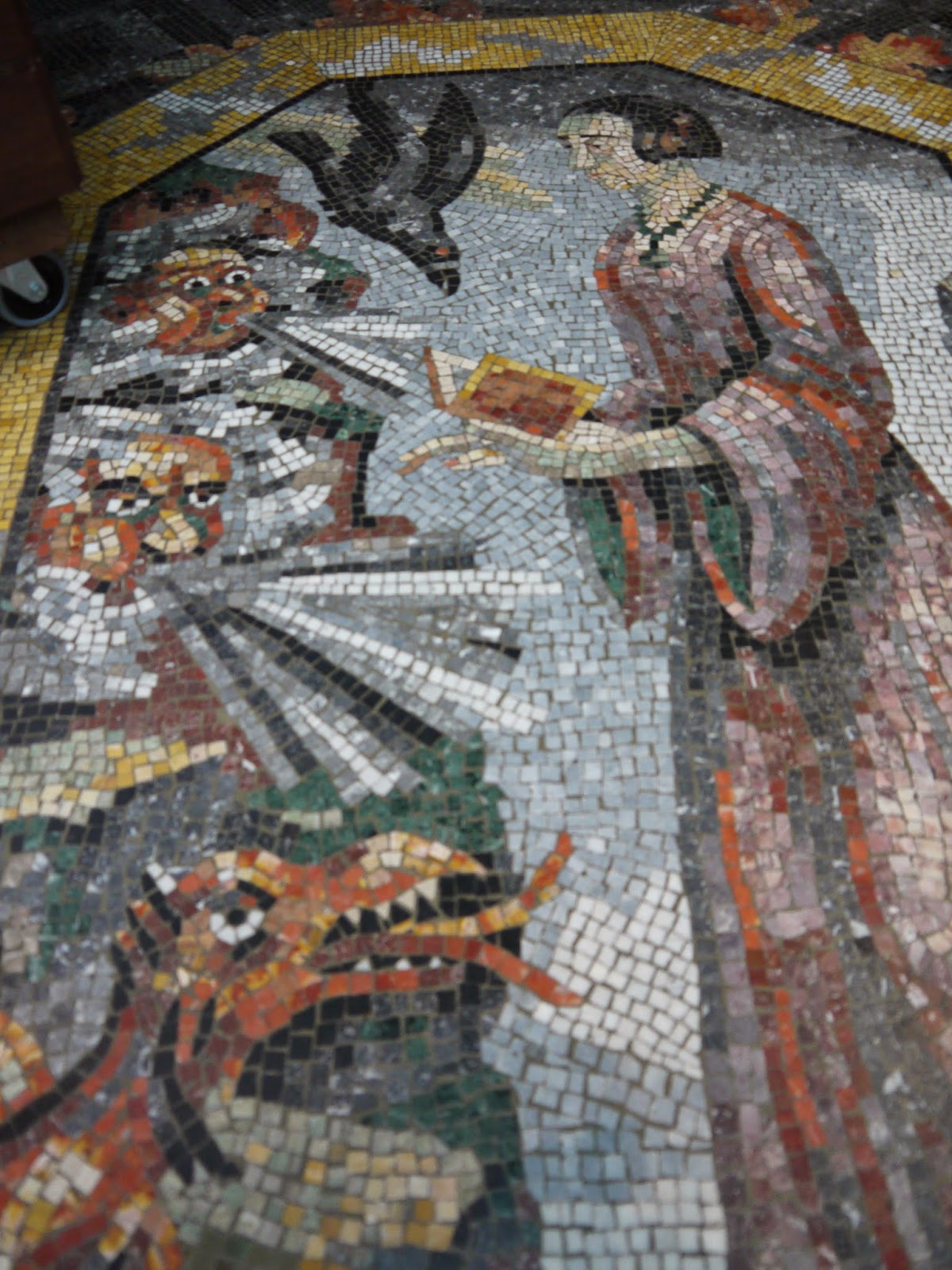
It's good to look up when strolling through cities as often the  most interesting sights are above street level. When entering London's National Gallery in Trafalger Square you should do the opposite and look down. Every day thousands of visitors walk across some of London's most beautiful mosaics - the work of Russian emigree Boris Vasilyevich Anrep, born in St. Petersburg in 1883 and who arrived in the United Kingdom in 1910.

The National Gallery commissioned Anrep to produce and lay two mosaic floors in the vestibule of its main hall based on the themes The Labours of Life and The Pleasures of Life. He completed this task between 1928 and 1933. The Gallery must have liked the results as in 1952, he was commissioned to produce a third mosaic entitled The Modern Virtues.  

Anrep was associated with the Bloomsbury Group and a number of its members appear as characters in his work as did a number of other prominent people of the time. Examples of this include Winston Churchill as Defiance and Great Garbo is the muse Melopeme, whilst in the pictures featured here, we can see ballerina Dame Margot Fonteyn as Delectation, poet Edith Sitwell as the Sixth Sense and my favourite astronomer Fred Hoyle as Pursuit. I particularly like Pursuit with its image of a young Hoyle, climbing his way up towards the stars, wearing glasses that would make him extremely fashionable today and carrying what looks a little like a laptop! Anrep was clearly forward thinking.

Originally studying to be a lawyer, he abandoned this for art and studied in Paris before enrolling at the Glasgow School of Art for the year 1910-11. He met British artist Augustus John whilst in Paris and soon  became familiar with other British artists including Roger Fry, Lytton Strachey and Virginia Woolf. His Russian background also helped open doors for him in London and in 1912 he was asked to take charge of the Russian section in Roger Fry's second post-impressionist exhibition. Exhibitors in this section included Natalia Goncharova, Mikhail Larionov and Nicholas Roerich. He also maintained a life long friendship with the Russian poet Anna Akhmatova. Akhmatova is the subject of the current exhibition at London's Pushkin House, part of which examines her links with Anrep.

It is possible to see more of Anrep's work in London by visiting Westminster Cathedral in Victoria where he designed the mosaics in the Blessed Sacrament Chapel or Saint Sophia's Greek Orthodox Cathedral in Bayswater. He also completed commissions at the Church of Christ the King in Mullingar, Ireland. Its free to see the mosaics in the National Gallery, but remember to look down!


Saturday, 18 April 2015

Ella Leya - The Orphan Sky, a brilliant first novel


One of the hits of this year's Jewish book week, Ella Leya is an accomplished musician playing both jazz and classical music. The Orphan Sky is an excellent first novel capturing the complicated manoeuvrings of life in the final decade of the Soviet Union through the experiences of Leila Badalbeili, a talented young pianist from Baku, Azerbaijan.

The book captures the atmosphere of Baku's old city with its narrow lanes, sites and smells, and most of all its iconic Maiden Tower. The Tower is the source of many stories, some of which overlap with Leila's own experiences as she navigates her way through her teenage years, discovering art, music and even love - much of which is forbidden during the Soviet period in which the story is set. 

Leila is a committed member of the Komsomol, the Communist youth organisation, but becomes disillusioned after meeting Tahir, a young man from the once prominent Mukhtarov family who introduces her to a world beyond that permitted by the authorities. Gradually, she begins to see and understand the deceit, corruption and hypocrisy inherent in the Soviet regime with party officials lining their own pockets whilst others live in poverty. This extends all the way to her beloved father, who moves in the upper levels of Soviet Azeri society, and who she realises is not above receiving bribes in return for favours. Her awareness of how deceitful those in authority are grows until she discovers her father's ultimate betrayal, which I won't reveal here (!), but which results in a series of catastrophic events leading all the way to the final denouement and a kind of deliverance.

The Orphan Sky has a wonderful cast of characters. Our heroine Leila wins our support, respect and sympathy but, happily, is no angel herself, making mistakes and compromises as she struggles between the urge to survive and the desire not to compromise herself. Her best friend Almaz is both survivor and victim whilst Sonia, her mother, is a brilliant surgeon but turns a blind eye to her husband's indiscretions even when they come very close to home. I especially liked her music teacher, Professor Sultan-zade, initially drawn as a cold, stern character but who is developed through the course of the story as considered, capable and eminently human and who also has emotions. The female characters demonstrate very clearly the position of many women in Soviet society who had to live up to the requirements of both the regime and more traditional roles assigned to women in some cultures and communities. 

I visited Azerbaijan in 2012 and The Orphan Sky took me back there, especially to Icheri Sheher, the old city of Baku. Indeed, it made me want to visit again. Ella Leya's love for music is displayed throughout the book, through her descriptions of Leila's performances, immersing the reader in emotional journeys through pieces by Mozart and Rachmaninov using references to art, the elements and to the music of Billie Holiday in order to convey her feelings. This is no surprise given her own jazz background and that rhere is a bit of a jazz tradition in Azerbaijan.  During the Soviet period it was seen as the music of dissent. The great Azerbaijani jazz pianist Vagif Mustafazade who suffered at the hands of the Soviet regime is now revered and his former home is a museum. The book also contains many references to traditional Azeri poems and lyrics and to the traditional Azeri mugham form of music. 

Ella Leya was born in Baku and received asylum in the United States in 1990. She lives between Laguna beach in california and London-  where she is the wife of a rabbi! You can find out more about her music here.

Wednesday, 15 April 2015

Picture post 41 - Middlesbrough's Iconic Transporter Bridge


Middlesbrough's transporter bridge is one of just three of its kind remaining in the UK and is both a much loved iconic image of the town and a reminder of the area's industrial past.  

The idea for a bridge was first mooted in 1872 by one Charles Smith, manager of the Hartlepool Iron Works, who suggested a scheme to Middlesbrough Corporation. His idea was rejected and it was not until 1911 that the bridge was built as a result of an Act of Parliament passed in 1907. It cost 68,026 pounds, six shillings and eight pence to build which translates to about 6,300,000 pounds today. Construction was completed by Sir William Arrol and Co. of Glasgow using steel made by local company Dorman Long (forerunners of British Steel) and replaced ferry services across the river. Local labour employed at Dorman Long also produced the steel used to construct the Sydney Harbour Bridge. The foundation stones were laid by Mayor of Middlesbrough Thomas Gibson-Poole and Alderman Joseph McLauchlan, whilst the towns citizens turned out in huge numbers to welcome Prince Albert of Connaught on 17th October 1911 when he came to open the bridge.

The bridge is 851 feet long - the longest remaining transporter bridge in the world. The cantilever construction has three main bridge parts and a gondola which runs on a wheel and rail system 160 feet above the Tees. The transporter has seen some drama over the years. It was hit by a bomb in the Second World War, whilst in 1953, the gondola became stuck half way across and was lashed by gale force winds that brought the river to within inches of the platform. It has also featured in films and TV series including Billy Elliot and the Boys from the Backstuff, whilst scenes of its apparent dismantling and transportation to Arizona during Auf Wiedersehen Pet resulted in calls from worried citizens  to the Council, protesting the seeming loss. The TV company had to include a clarification at the end of the series that the scenes were purely fictional! A real drama occurred in 1974 when actor Terry Scott thought he was crossing a toll bridge and drove off the edge, landing in the safety netting below - and I just about remember this from the local newspaper - the Evening Gazette

The bridge straddles the river Tees between the former St. Hilda's area of Middlesbrough and Port Clarence on the Stockton-on-Tees side of the river. St. Hilda's was home to a range of industries connected to the docks as well as to a residential community. Almost all of both are now gone, cleared by the demolition ball over a number of years with only a few exceptions -  two pubs (one derelict), the old dock clock and the former town hall, the latter of which was famously painted by L.S. Lowry in 1959. Referred to as "over the border" due to being on the riverside of the railway line, St. Hilda's had a reputation for being a bit scary during my younger days as well as being a bit risqué due to the (possibly assumed) activities that took place in some of the pubs! 

The area has been renamed "Middlehaven" and is now home to part of the town's university campus, it's college and Middlesbrough FC's stadium. There are also plans to redevelop the area with housing, shops and cafes, re-connecting the town to the river and bringing new life to this historic area. I like the idea of bringing it back to life - but its a shame that so much of what was there before has gone. The transporter bridge was given grade II* listed status in 1983, protecting it from a similar fate, but its real protection comes from its continued use and more importantly from the attachment that locals continue to feel for this example of engineering ingenuity.


The transporter bridge seen through the remaining wall of the former salt works.
You might also like Picture Post 28 - Middlesbrough Empire Palace of Varieties and Memories of Middlesbrough and days long gone

Wednesday, 25 March 2015

Picture post 40 - iconic art nouveau in Vienna


Vienna boasts many architectural treasures. The city is especially well known for its art nouveau buildings, also reffered to as the jugendstil or secessionist style. One of my favourites of this genre is the Engel Apotheke (Angel Pharmacy) at Bognerstrasse 9 in the city centre. The building itself is unremarkable, but the facade is decorated in stunning art nouveau style, featuring two glass mosaic angels that give the pharmacy its name.

The angels, dressed in vibrant purple and gold dresses, stand on stone pedestals raising healing potions with the snake of aesclepius, the ancient Greek god of medicine wound around their arms,  signifying the purpose of the store. The golden theme is repeated in the ringlets of both figures and in the sunflower freeze embedded in the wall above the large upper level windows. These windows are also decorated with a leaf freeze and wrought iron bars.  

Built between 1901 and 1902, the building, including its facade, was designed by Oskar Laske, a pupil of the great Otto Wagner. His decorative portal which spreads over the two lower levels of the pharmacy was intended to attract customers. It almost certainly did in 1901 when it would have been the height of modernity at a time when Klimt, Wagner, Hoffman and many others were at work in the city. Today it attracts art and architectural enthusiasts and historians, tourists and people needing prescriptions! 

Laske was involved in designing at least one other building of note in this style - the Nachtlicht, a cabaret where actors, dancers and musicians rubbed shoulders with the likes of architect and designer Adolf Loos and writers Karl Kraus and Peter Altenberg. I haven't been able to locate any pictures of Laske's work there and the club ran for only one year from 1906-7 before closing, upstaged by the legendary Cabaret Fledermaus. He went on to concentrate on painting rather than architecture, unsurprising given the beauty of his work at the Engel Apotheke. He worked primarily in water colours, recording his travels in Europe and North Africa, as well as being a book illustrator and graphic artist. Born in Czernowitz in 1874, then part of the Austro-Hungarian Empire and today part of the Ukraine, he served in the First World War and died in Vienna in 1951.

If you are visiting Vienna and go to view this lovely facade, I also recommend a visit to the shop next door - Zum Schwarzen Kameel,  (The Black Camel) an elegant patisserie selling delicious Viennese sweets, cakes and biscuits. Believe me, I know about these things. There has been a restaurant and shop there since the seventeenth century but the current building dates from 1901 and also has some art nouveau features.


Sunday, 15 March 2015

Elizabeth Is Missing - a story of memory and loss


This is a book about memory and loss. Emma Healey's first novel tells two stories, that of Maud, an elderly woman who believes her friend Elizabeth is missing and can't get anyone to believe her and also that of Maud's sister, Suki who disappeared years earlier. It examines the meaning of memory and of loss as Maud is engulfed by dementia.

It is the second book I have read in the last year that examines this most cruel of diseases and the impact it has on the lives of sufferers and those around them. I re-read Linda Grant's Remind me Who I Am Again last year as a way of finding out more about dementia when it suddenly affected my own circle. It tells the story of her elegant and very proper mother, her struggles with the disease and how the lives of her friends and relatives were affected as they struggle to cope, to get help or in the case of some, fall away and break contact. I recognised many scenes in Grant's book from my own experience, thinking several times that I wished I had noticed the things she describes when they happened instead of realising their significance now.

Elizabeth Is Missing examines this subject from a  different angle, that of the sufferer. Maud is the narrator of this story and describes in frightening detail the terror of not being able to remember, of being overwhelmed by the noise, colours and movement in the street, of writing hundreds of little notes to "remember" things and then struggling to understand what they mean later on. She also lets the reader in on how it feels when the world seems to be at odds with you - asking you strange questions, denying your dignity and being impatient with you to the point of anger. There is one particular scene that particularly struck me. Catching the bus, Maud can't work out what she needs to do before she can sit down and the driver and the other passengers seethe with impatience before someone finally shouts out to let her on "…can't you see she's old…" Impatience and patronisation feature a lot in this book - in shops, from the doctor even from the police at one point - the causal impatience and patronisation applied to people who are 

Maud is a collector. As a young woman she collected small items that had once belonged to her sister - a comb, bits of jewellery, clothes, even a broken finger nail as a way of preserving Suki's memory following her disappearance. In the same way, as dementia strips away more and more of her memory she uses notes to herself to try to preserve what she can as well as collecting flotsam from the street or the garden, often confusing it with items she had collected as a girl.

As well as memory, dementia often destroys language and throughout the story, Maud begins to lose words from her lexicon. She loves toast and early on in the book refers to the toaster. A little way in this becomes the thing that makes the bread brown. Cigarettes become things that you light and carrier bags become orange balls. There are also moments of near comedy, not least when she tries to place an advert in the local newspaper's missing column where the woman dealing with her thinks she is referring to a cat rather than her friend Elizabeth!

The dual storyline works well and holds the reader to the very end as we worry about what will happen to Maud, wonder where Elizabeth could be and fear what may have befallen her sister. The search for the two women makes this a very unusual detective novel, episodic, well observed and rich in detail. Its also a damn good story as evidenced by its winning of the Costa Book Award in 2014. We need more stories about people like Maud and we need more books from Emma Healey. Ms. Healey has a qualification in bookbinding, which is the art of putting a book together. She does that beautifully in binding two stories together in Elizabeth Is Missing.  Recommended.

(I found out about this book by following the recommendations of the wonderful Book Corner bookshop in Saltburn-by-the-sea. You can see what is being recommended by following the Book Corner's Facebook site).

Friday, 6 March 2015

Picture post 39 : Hammer House, secret art deco in Soho


Hammer Films is one of the most well known and best loved British film studios of all time. Founded in 1934, Hammer churned out niche horror movies throughout the 1950's and 1960's with the Frankenstein and Dracula series, and the 1959 classic, The Mummy, thrilling audiences of all ages. The studio was famously associated with British actors Christopher Lee and Peter Cushing who made chills run down the spine of many a cinema goer. As well as horror films, Hammer also produced a number of science fiction and psychological thriller movies with some great titles including Maniac, Paranoiac, Nightmare, Hysteria and Fanatic. You couldn't say you didn't know what you were getting with titles like those! The Hammer brand still exists and from time to time releases films including in 2012 a version of The Woman In Black featuring Daniel Radcliffe, best known as the screen face of Harry Potter.

Hammer House at 113-117 Wardour Street in London's Soho was once the home of the film company. Hammer's original distributor, Exclusive purchased the lease on this building in July 1937, but did not  rename it Hammer House until 1949. It remained the company's headquarters until the 1980's when the their gothic movies fell out of fashion and unable to afford the rent on their part of the building, withdrew to cheaper premises. Today the building is home Tony and Guy hairdressers and a wine store on the ground floor with a range of consulting and media companies take up office space on the upper levels.

Despite the many changes over the last decade or so, Soho is still my favourite part of London largely because of its many secret treasures and hidden gems. The outer door of Hammer House hides one of the street's prettiest features - a wonderful art deco lobby complete with a beautiful peacock feather designed stained glass inner door, patterned floor tiles, elegant staircase with torch style lighting and original lifts. I have twice managed to see inside the lobby when the door has been left open and last summer I was bold enough to ask the concierge if I could take photographs. To my surprise and delight not only did he say yes, he suggested I look inside the lifts and admire the staircase too. The light was not great and some of the pictures didn't come out well, but the best ones are featured on this post. I have been unable to find out who designed the interior or who the building's architect was so if anyone does know, please leave comments. It must at least predate 1937, the year Hammer took up residence. Although losing much of its bohemian flavour and despite the influx of the chain stores and cafes, its good to know that some of its glorious past survives and is cared for.


Saturday, 28 February 2015

East End Modernism

Commercial Road is a long windswept major traffic artery in the East End. At first glance it is largely characterless with ugly blocks of flats built after the extensive bombing damage of the Second World War. There are also a fair number of equally ugly buildings from more recent times housing educational establishments of different kinds, small shops and an assortment of greasy spoons, curry houses and kebab joints. However, a closer, more considered look will reveal that there are still many interesting,  even beautiful buildings. There are a couple of still working synagogues - remnants of the once very large Jewish presence in this area - the Nelson Street and The Congregation of Jacob synagogues on Commercial Road itself - both with beautiful interiors. I love the old school in Henriques Street with its byzantine style brickwork and side entrance marked "cookery and laundry". There are a few small cafes that might warrant exploration and I recently discovered that there are several art deco and modernist buildings.

Gwynne House, Turner Street
Turner Street runs off Commercial Road and is an interesting mixture of residential properties, businesses and parts of the London Hospital. It also boasts two fine examples of modernist architecture. Gwynne House is an apartment block built in 1934 and designed by architect Hume Victor Kerr. This block would not look out of place in Miami, Tel Aviv or any of the other major art deco/ modernist cities. It is a little surprising to find it here in the east end! Those walkway/ balconies are reminiscent of the Bauhaus, whilst the stylised lettering and sloping windows in the curved stairwell also add character. 

Formerly serving as subsidised accommodation for nurses and trainee doctors, the block was renovated in 2012 and is now a very desirable private address with two bedroomed flats selling for up to 400,000 pounds. Interestingly the Zoopla property website quotes 791,000 as the average price of a two bedroomed property in the E1 post code at the moment so Gwynne House is a bargain. Who would have thought it? At these prices the least the management company could do is repair the peeling paintwork on the stairwell!

Gwynne House, Turner Street

Gwynne House, Turner Street

Comfort House, Turner Street
Our friend Hume Victor Kerr was also responsible for Comfort House which stands on the corner of Turner Street and Nelson Street. Completed in 1932 as a factory and showroom for gown manufacturer M. Levy, the building retains its links with the rag trade today with commercial units on the ground floor and residential properties above. The original windows have gone which is a shame but Comfort House still has a striking presence with its white rendering, tall square cut towers, sharp angled corner and slightly projecting bands of windows with curved ends. There is a recessed "works entrance" in Turner Street, labelled with stylised lettering.

Comfort House, Turner Street
Back on Commercial Road, at the junction with Philpott Street stands another gem from the 1930's. Cheviot House was designed by G.G. Winborne for textile merchants Kornberg and Segal. Completed in 1937, by 1948 the company had gone and the building became Stepney Town Hall for several years. Although badly neglected now, it is still possible to imagine how grand this building must have looked in the 1930's with the squared off glazed edges, concrete panels between floors and decorative wave details around the doors. Shamefully unlisted, Tower Hamlets Council considered demolition a few years ago to make way for a new residential development. That seems to have gone quiet now, but the Council has a poor record of caring for the built heritage having demolished another deco gem, Eden House, a few years ago. Cheviot House requires a suitable, sustainable use and a sympathetic restoration if it is to survive.

Cheviot House, Commercial Road
The Troxy cinema at 490 Commercial Road opened in 1932 with 3,520 seats, a revolving stage, a wurlitzer organ and a cafe/ restaurant located on the circle foyer level. It's first screening took place on 11th September 1933 and featured Fay Wray in King Kong. As well as screening Hollywood blockbusters, it also hosted live performances by such stars as Vera Lynn and the Andrews Sisters. Closed as a cinema in 1960 due to declining audiences as the community drifted away to other parts of the city,  the final screening was The Siege of Sidney Street with Donald Sinden. Sidney Street is of course a short step from the Troxy. The building then lay empty for a few years until the London Opera Centre took it over from 1963 to 1976. As with many large old cinemas, the Troxy went on to serve as a bingo hall before closing again in 2006.

Designed by George Coles and once part of the Gaumont group of cinemas, the Troxy was listed as with Grade II status in 1991 and retains some of its original features although others have been lost. The exterior features include decorative "vegetation" as well as black and gold panelling and two large fans on each side of the entrance. The fans are disappointingly made of unattractive plastic and are clearly not original. Nowadays the former cinema is a hireable venue and only open when events are taking place. However, it is possible to peep through the front windows and see the very nicely preserved lobby and former ticket counter.

The Troxy, Commercial Road
Moving away from Commercial Road, across Whitechapel High Street towards Spitalfields there is another art deco beauty, the former Godfrey Phillips and Son Tobacco Works, designed by W. Gilbee Scott and B.W.H. Scott. Now known as The Exchange, 132 Commercial Street (not road!) dominates the northern end of the street through its sheer size. It has been  revitalised in recent years with residential on the upper floors and a range of shops at ground level. Its faience frontage which has been described as "restrained art deco" gives it an air of sophistication that would make it seem at home in Manhattan or in the Berlin of the early 1930's. The main entrance has an impressive arch and is topped with a clock. 

The Exchange, Commercial Street
I have also found two other interesting examples of art deco in this part of London. The first is a building in Liverpool Street about which I have been unable to find any information. Like the Exchange building it has a faience facade - although only at the upper level. It also has a clock - in the same style as the Exchange, so perhaps they are contemporaries of each other. Does anyone know anything about it? 

And finally, on Brick Lane, there is still a glimpse of the now long gone Mayfair Cinema. It opened in 1936, operating as an Odeon from 1950 until 1967 when it began to show Bollywood movies. It has since been a shop and an indoor car park (!) before being almost completely demolished in 1990 and emerging as Indian restaurant Cafe Naz, also now closed. All that remains is the original sign. Let's hope the other buildings in this post don't meet the same fate. 

Mystery building, Liverpool Street
Former Mayfair Cinema, Brick Lane
You might also like The Genesis, best cinema in the East End and A Cold Sunday in Spitalfields

Tuesday, 24 February 2015

A rediscovered classic, the art of the possible, the world in 1946 and looking after the family silver - Jewish Book Week 2015!

This year's Jewish Book Week began at the weekend in the superb Kings Place venue and once again is proving to be the highlight of the literary year. On Sunday I spent four consecutive hours listening to a range of authors, commentators and experts on a range of subjects. 


First up, Rabbi Julia Neuberger and award winning author Linda Grant discussed the recently republished GB Stern novel The Matriarch, variously described as a less serious Buddenbrooks, a forgotten feminist classic and a genre of Jewish literature no longer seen. The book is the first of a series of novels based on the author's own family, the characters being partially assimilated Jews with origins in Central Europe and living in London's fashionable West End. Anastasia Rakonitz, the matriarch of the title rules over her family with a rod of iron and is one of several strong female characters who maintain appearances even when the family's fortunes fade. Both Grant and Neuberger spoke about the dominance of domestic detail in the book, an obsession with food and clothes, witty descriptions of the daily life of the bourgeois Rakonitz family and the general weakness of the male characters. Both also made interesting points about swish wealth and knowledge needing to be portable in the event of regular flight from program and persecution with clothing (tailoring) representing the ultimate portable  and sustainable skill.

Although set in an earlier decade, the book was first published in 1924 and in the UK was originally entitled Tents of Israel. Of its time, the book includes a number of anti-Semitic comments including from the Rakonitz family members, ambivalent about their own Jewishness, including a reference to one character as "fat and oily…a nose that really was Jewish…an aggressive arriviste…" The original title is interesting as during the late nineteenth and early 20th centuries, many established British Jewish families preferred to refer to themselves as Israelites rather than Jews. Daughter Toni in particular longs to break away from the societal restrictions of being Jewish and it is thought that the character is based on the author herself, who ambivalent about her ethnic and religious origins, converted to Catholicism after the Second World War. 

Gladys Bronwyn (originally Bertha) Stern was a best selling writer of her time. She published over 40 novels, several plays, short stories and other works and mixed with the great and the good of the inter-war literati, numbering Rebecca West, Noel Coward, H.G. Wells and Somerset Maugham amongst her acquaintances.  Despite this she is practically unknown now, as Linda Grant said "a dark warning from the past" that literary fame can soon fade away once the books stop coming.

From 1920's bourgeois fiction I moved on to an interview with Barbara Winton, daughter of Sir Nicholas Winton who arranged the rescue of 669 mostly (but not entirely) Jewish children from Czechoslovakia in 1938 and 1939 before the outbreak of war prevented him bringing even more out. Winton spoke of her father's belief in helping those who are helpless, no matter what their ethnicity, religion or background and of the great lengths he went to, to secure appropriate homes in the UK for the children he managed to get out. He was a modest man who did not seek recognition for his work which was little known until Esther Rantzen ran a TV feature on him in the 1980's, surprising him  with a reunion with several of the now middle-aged to elderly children. Ms Winton has recently published a biography of her father If Its Not Impossible which is a reference to a statement made by he made in relation to the rescue. 

The sessions included the opportunity to view the heart breaking photographs of children saying goodbye to their parents at the station in Prague before boarding the trains for Britain. Very few of them would ever see their family members again as 89% of Czech Jews and 83% of Slovak Jews were murdered in the Holocaust, figures only exceeded by the devastation to the Polish, Baltic and German/ Austrian communities. The parents clearly understood what was in store for them, many even agreeing to give their children up to non-Jewish homes in order to save their lives. 

Barbara told the audience that her father's original family name was Wertheim, being of German Jewish origin but that the family had converted in the previous generation. She also let us in on a a secret. Her father was to be given the freedom of the City of London the next day, February 23rd. This is a particularly poignant honour given that he had resigned his post as a broker in the stock exchange back in the 1930's and had been active in left wing circles prior to the outbreak of war. Described by his daughter as a private and relatively unemotional man, he is now 105 years old and still interested in politics, meeting from time to time with his MP - Theresa May, Secretary of State and the Home Office and telling her his views on her policies!


Next up was Victor Sebestyen, interviewed about his excellent book (I know this because I've read it!), 1946: The Making of the Modern World. He explained that it began as a book about the beginnings of the Cold War, but quickly developed into a wider review of the world in the immediate aftermath of the Second World War, the continuing conflict in many parts of the world and the impact of some of the decisions taken then, some of which is still being seen now. 

Sebestyen reminded us that although Germany and Japan were defeated in 1945, civil wars continued in the Ukraine and in Greece, claiming 75,000 and 150,000 lives respectively. His book examines these two conflicts but also looks at the Sovietisation of Eastern Europe in the immediate post war period, the pragmatic (for which read cynical) abandonment of the de-Nazification process in Germany (and its complete avoidance in Austria) and the success of the Marshall Plan in Japan. The latter two developments carried out with the sole intention of preventing communism from gaining ground in these two countries.

His comments in relation to the ultra right wing General McArthur were especially interesting. McArthur had astonishing powers in Japan following the country's surrender. His imposition of democracy on what had been a feudal society, including redistributing the land to the peasants was  described by Sebestyen as more left wing than some of the things the Soviets were doing! 

Many of the events described in 1946 echo today, not least the situate in the Ukraine. When asked if he thought Putin was another Stalin and trying to re-Sovietise Eastern Europe he replied that he thought not, rather that he is just "an old fashioned nasty Russian nationalist, offering no intellectual difference in lifestyle…this is not an ideological thing at all". Interesting. I hope he's right.

Finally, architectural and built heritage historian, Sharman Kadish warned us of the very real risk of losing many of our older synagogues in the inner cities as congregations decline, close or move away to the suburbs or other cities. A number of our finest buildings have become neglected, left vacant and vandalised including some real treasures. 

Sharman talked us through the experiences of Singers Hill synagogue in Birmingham and Princess Road in Liverpool both at risk of closure just a few years ago but now restored with reviving congregations and playing important roles in the lives of both the local Jewish and wider communities. She offered pragmatic solutions to maintaining large, costly buildings in small and declining communities and spoke of the importance of maintaining a visible Jewish presence that welcomes outsiders to its buildings especially during these dark times. Her session was extremely interesting with both good news stories and things to worry about. it also inspired me to visit a number of our architectural treasures in Bradford, Manchester and other cities. Ms Kadish is the author of several books on Jewish religious architecture and has a new edition of her excellent Jewish Heritage In England An Architectural Guide, coming out soon. 


As ever, this year's Jewish Book Week offers a diverse and engaging programme that will attract Jewish and non-Jewish audiences alike. Where else could you get such a varied and high quality literary programme over the course of a single evening on a cold, dark, wet and windy February Sunday? And there are still four days of events to come!

Sunday, 8 February 2015

London's Michelin House - nouveau, deco or neither?


Michelin House stands proudly on the junction of Fulham Road, Pelham Street and Sloane Avenue. This ultra fashionable part of London is home to several top end designers, multi-million pound town houses and stylish 1930's apartment blocks, but nothing matches the style and presence of the Michelin building.

Many people will know the building as the home of the swanky Bibendum restaurant and the Conran shop. However, it started life as the headquarters and tyre depot of the Michelin Tyre Company Ltd. which explains the stained glass representations of the Michelin man, Bibendum (hence the name of the restaurant).  Constructed from white tyres he is familiar to all of us who saw him in TV adverts from the 1970's.  The building opened in January 1911 and was designed by Michelin employee Francois Espinasse in a style that defies categorisation. A little too late to be art nouveau, although displaying some features of that style, it is too early to be truly art deco - although again, it displays features of that genre with its stylish motoring adverts, interior chrome bannisters and decorative mosaic features. Little is known about Espinasse other than that he may also have designed the French headquarters of Michelin and that he is thought not to have had formal training in architecture.


Rightly known for its decorative features, Michelin House was also significant for some of its then ultramodern technical features including automatic doors into the entrance hall and a weighing bay in the fitting area allowing customers' cars to be weighed in order to ensure the correct level of tyre pressure. It was also one of London's concrete buildings, constructed using Hennebique's ferro-concrete system. As well as enabling speedy construction the material is also fire resistant which was extremely important due to the large volume of flammable items that were stored there.

But of course, its the decoration that stands out. Approaching from South Kensington station and reaching the crossroads, visitors are met with a stunning visual display - a riot of colour with blues, greens, reds and yellows set against a white tiled background. In addition to the huge stained glass windows the facade features stylised floral designs composed of tiles in different shades of green as well as decorative metal work above the entrance. The tiled panels on the external walls feature cars and drivers from famous long distance road races, including Paris-Vienna in 1902 and a race around Belgium's Ardenne in 1904, presumably using Michelin tyres! There are 34 such panels in total including several in the entrance lobby, now the Oyster bar and restaurant reception.


The building was extended a couple of years after it opened and again in 1922 when it rose to a third floor. In 1927, Michelin opened a factory in Stoke-on-Trent, moving its headquarters there in 1930. I wonder what the employees thought of that? The company retained use of the basement and ground floor  leaving the greater part of the building empty with occasional use as a warehouse and workshops and eventually offices for the Air Ministry. In 1940 the decorative stained glass windows were removed for fear of bomb damage. Three of the windows did not return and reman lost today despite strenuous efforts to locate them.

The facade was given listed status in 1969 but this did not prevent planning permission being granted for almost total demolition, retaining only the front entrance and replacing the rest with a ten storey office block. Thankfully Michelin decided to put their money to better use and this treasure is still with us today - at a time when London is losing many of its iconic and much loved buildings to make way for Cross Link or expensive flats. In recent months we have lost the Earls Court exhibition centre, the Astoria in Charing Cross Road, the Paolozzi murals in Tottenham Court Road Station and may lose the much loved Curzon Soho cinema.

Michelin eventually sold the building in 1985 when it was jointly purchased by Terence Conran and Paul Hamlyn, owner of Octopus Publishers. Permission was secured for an extension extend, whilst significant restoration work was also undertaken. Much of this involved producing replicas of missing features with the assistance of drawings and photographs from the time of construction. The House re-opened in 1987. Octopus moved out in 1990 but Conran's shop and restaurant are still there and it is possible to wander into the lobby/ oyster bar for a good look around as well as to admire the exterior. 

So, is it nouveau or is it deco? It has something of both styles. Perhaps it doesn't matter. The important thing is it is still there, still used and continues to add a big slice of style and glamour to this part of our city. 


Wednesday, 4 February 2015

Bolt - return of a banned ballet at London's GRAD gallery


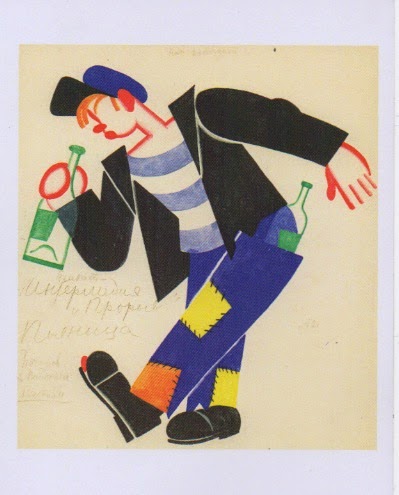
Costume design for a drunkard
The GRAD gallery in London's Little Portland Street is continuing its excellent record of exhibiting Russian art from the Soviet period with its current show The Bolt, featuring Tatiana Bruni's costume designs for Shostakovich's ballet of the same name. The ballet was performed just once before being banned by the Soviet authorities, anxious about anything that might not fit their view of the world and deeply suspicious of artists generally.

The Bolt premiered on the 8th April 1931 at the Academic Theatre of Opera and Ballet in that was then Leningrad and is now St. Petersburg. Choreographed by Fyodor Lopukhov, it tells the story of  Lenka Gulba (which is Russian for lazy idler), who with the help of an anti-Soviet priest attempts to sabotage the work of a Soviet factory by placing a bolt in the machinery. The feckless Lenka is foiled by a group of young communists from the Komsomol. You might wonder why the Soviets didn't like this tale of young socialists saving the day. It seems the "good" characters were deemed too boring and the baddies too interesting - the lazy worker, bourgeois women and drunkards being too attractive for the censors. It was not only the story that bombed with the authorities, they didn't like the score - too western and they didn't like the choreography either, describing it as "grotesque". The opening night's audience was divided with both applause and catcalls throughout. Well you can't win 'em all. 

Shostakovich attracted much official criticism during his career, his 1948 From Jewish Folk Poetry song cycle not being performed until 1955 due to it incurring displeasure during a period of state-sponsored anti-semitism. He also produced another ballet with Lopukhov - The Bright Stream - in 1935. If the authorities didn't like The Bolt, they hated Bright Stream. The librettist ended up in Siberia, Lopukhov lay low in Tashkent and Shostakovich was shaken enough to cancel the premiere of another new piece. Still, it could have been worse as thousands of artists of all kinds were executed during Stalin's reign - the theatre suffering particularly badly. Of course, this makes the stunning achievements of artists working under the former Soviet regime even more impressive.

Costume design for a friend of Kozelkov
Costume design for a petit-bourgeois woman
But back to the exhibition and Tatiana Bruni's designs which are on loan from the St. Petersburg State Museum of Theatre and Music. Wonderful examples of the Soviet avant-garde period, they are extremely stylised, colourful, humorous and leave the viewer in no doubt about the inclinations of the characters they were designed for. The petit-bourgeios woman's costume is frivolous, fussy and impractical. The costume for the young communist woman is serious, sporting and red. Kozelkov's female friend is dressed in a revealing outfit held together by a huge pink bow denoting frivolity and perhaps loose morals whilst the drunkard has patched clothes and shoes on the verge of collapse, showing the wasteful, disorganised nature of the character. Perhaps the most inventive costumes are those for the actors playing the parts of the American navy and the Japanese navy, with ships around their waists, "capitalist" style shoes and trousers and in the case of the US navy, a torpedo for a cigarette!

Bruni faired rather better than her colleagues involved in the production of The Bolt, going on to design for many other ballets as well as opera and drama, producing costumes and other works for more than 200 different productions working in the Soviet Union for several decades. The Bolt did not return to the stage until 2005 when the Bolshoi Ballet performed it in Moscow. You can see clips from the ballet in the exhibition at the GRAD and some of the costumes themselves in addition to Bruni's designs. The score seems very modern and accessible and the titles of some of the pieces are irresistible. I am particularly taken by "The Dance of the Women in Shabby Coats" and "The Installation of the Machines Pantomime", both of which might lead one to believe that Shostakovich might just have been   having a very risky laugh at the authorities.

Costume design for the American navy
Costume design for a Komosomolka
In the years London has seen some superb exhibitions of Russian art from the Soviet period at the GRAD, at the Pushkin House and also at the  Victoria and Albert Museum where until March 15th, you can still see Russian a vant-garde theatre - war, revolution and design - much recommended. The Bolt runs at the GRAD until February 28th - don't miss it. And it's free too.

A clip from The Bolt...


You might also like Collaborators at the National Theatre - It's Man versus Monster Mikhail and Soviet Posters of the Silent Screen at London's GRAD