Friday, 24 March 2023

"Even if you are educated it is hard for Biharis to get work" - the Geneva refugee camp in Dhaka

"There's no space here. The children have nowhere to play or study and I have to cook in a small space under the stairs"said Shahana.  We were in her tiny home in in the Geneva refugee camp in Dhaka. More than 40,000 people live here in the dark, narrow alleys, in homes lacking basic services. Shahana was sitting on the steps that lead from a tiny ground floor room to two others of the same size. None of them have natural light. Fourteen people live in this house, including seven children. Her mother-in-law and her 97 year-old grandmother, Jamila, sat on the bed that fills most of the room, and her husband crouched down, talking to me through the narrow entrance to the floor above.

Early morning in Geneva refugee colony

Life in Bangladesh is often lived very publicly. It is not unusual to see people bathing in rivers or brushing their teeth in the street. In Geneva there is no choice and even the most basic human functions are carried out with little or no privacy. There are shared washing facilities and toilet blocks and water has to be queued for twice a day. Most of the residents arrived at the camp in 1971 after the War of Liberation when after a bloody conflict, what is now Bangladesh became independent from Pakistan. Many Bihari Muslims had left India in 1947 during Partition, opting for what was then East Pakistan. Their mother tongue is Urdu and during the war, most of them supported the Pakistani army against the majority Bangla (Bengali) speaking majority. Some took part in atrocities but others were also victims of violence. Figures for the number of casualties on each side vary wildly and are the subject of much dispute. After the war, and into the 1990's, many Biharis managed to leave for Pakistan. This process has now ceased, due in part to sometimes violent opposition from other Pakistani communities.

"The teachers are not friendly. We have to pay them bribes to get the children admitted"

Even in the middle of the day the camp streets are not light and are so narrow that it can be difficult to pass through them. Nazma was playing with her small grandson in one such alley. She was born in the camp and looked older than her 50 years. Before the War of Liberation, her father had a good job working for the railways. Her husband runs a small shop and her son has a car repair business. I asked her about problems with the outside community. She said "We had trouble in the past, but we don't really have those problems anymore". Then she added "But it can be difficult to get the children into outside schools. When they realise we are Bihari, they don't want them". Mohammed Ashore, a barber aged 36, expanded on this. "The teachers are not friendly. We have to pay them bribes to get the children admitted". He lives in a one room home with his wife and two children. They pay 4000 taka a month in rent. According to the World Salaries website a barber in Bangladesh can earn between 5,000 and 12,000 a month.

Nazma and her grandson

Nazma understood the importance of education as a way of breaking out of the camp. "I want my grandson to be an engineer" she said "but even if you are educated it is hard for Biharis to get work". Shahana said that her 11 year old daughter wants to be a doctor but that "my 14 year old son is not interested and doesn't want to study". For many years it was difficult for Bihari children to attend state schools. The community did not have citizenship and therefore lacked ID cards and other official documents necessary to secure employment and to access services. This changed in 2008 when the Government acknowledged their right to citizenship, perhaps recognising that the majority of people in the camp were not even born in 1971. Despite this positive step, long-standing suspicion and prejudice is harder to overcome.  

The camp has a small bazar running through one of the wider streets. Residents go there to buy fruit, vegetables, meat, fish, rice, paan and other consumables. They also go to visit the barber, get electrical items repaired and to seek advice at the office of the local community organisation. On the day of my visit a man selling rabbits from a wheeled cage was also trying to do business. I told my friend that rabbit was once a poor man's dish in the UK but is now served in expensive restaurants. He assured me that they were being sold as pets and not for consumption. 

Shahana, her mother-in-law and grandmother

"Yes, I am the malik"

Shabanah is 45 and was born in the colony. She was doing brisk business at her tea shop. I asked her if she was the malik (boss/ owner) and what she did before opening the shop. "Yes, I am the malik" she told me, then added "my husband works here with me" as she turned to look at, and indicate the man preparing snacks on a raised platform behind her. "I used to work in textiles, but I set this shop up three months ago"  she added. The shop occupies a narrow hole in the wall with a stall set up on the pathway in front. The monthly rental is 2,500 taka (about £25). I ordered a tea and as I spoke to her in my limited Hindi, a small crowd gathered, curious to know what we were talking about and in some cases, anxious to join in the conversation. She told me "My grandfather's name was Mohammed Miah. He came from Bihar but I don't know exactly where". She agreed with Nazma, Shahana and Mohammed Ashore that the main problems of living in the camp were access to good water, space and facilities for children and the generally poor living conditions. She has two children and I asked about her ambitions for them. "I want them to be able to recite the Koran in full" she said. She agreed to a photograph and covered her head in preparation. When I got up to move on, she refused to accept any payment for the tea, saying I was her guest. 
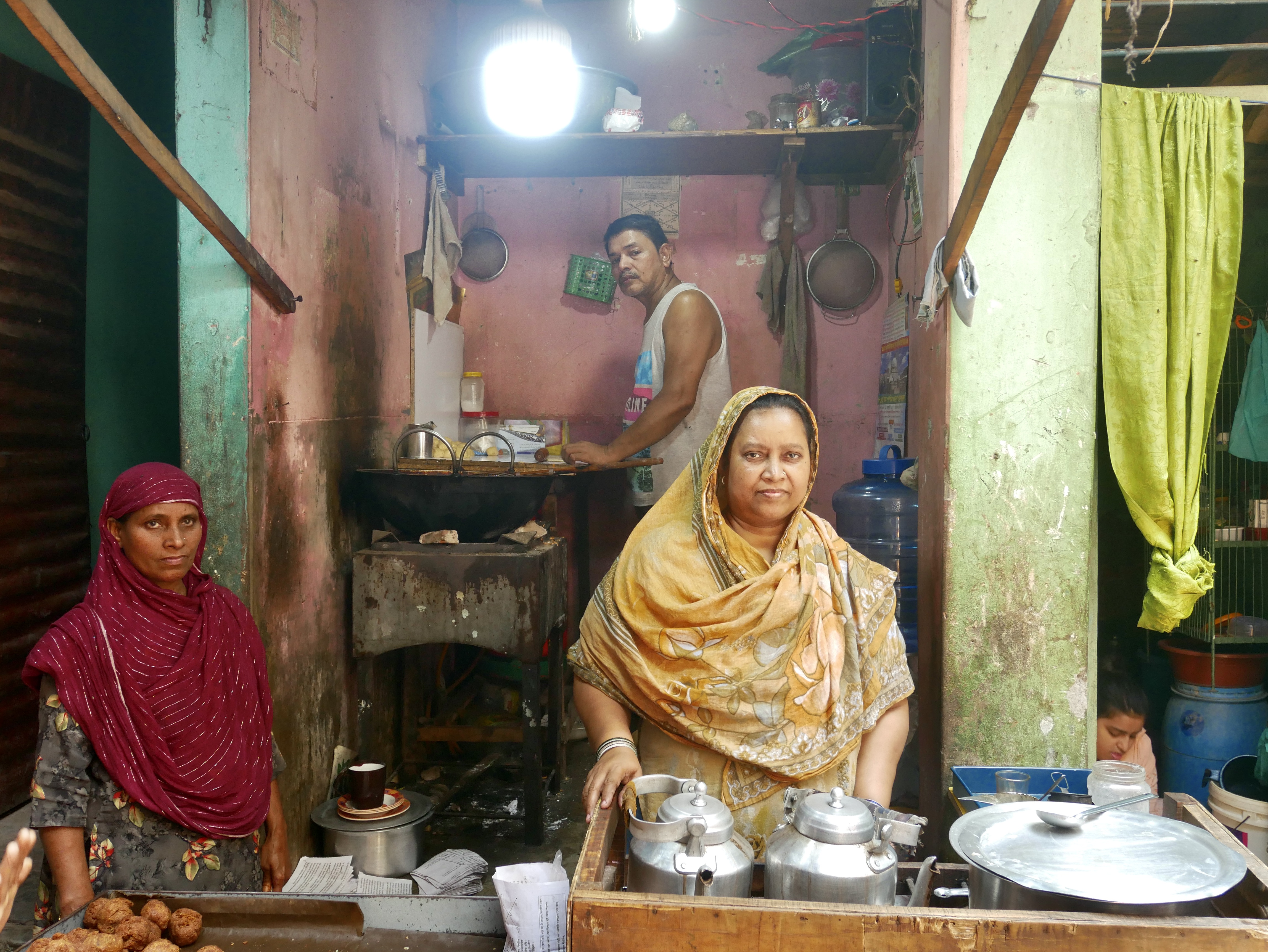
Shabanah "I am the malik"

Despite Nazma's assertions that relations with the majority community are now better, one exchange I had in the bazar showed that there is still resentment about the events of 1971. A middle-aged man approached me and asked where I am from. When I told him I am British he became very enthusiastic, praising the UK and asking me if I had been following the cricket series between England and Bangladesh. I told him  cricket isn't really my sport, but I knew that Bangladesh had done very well and had seen people celebrating their victory over England. His manner changed instantly and raising his voice, he said that he was not happy, didn't want Bangladesh to win, hated the camp and that I should go to the community association to hear the truth about 1971. Then he stopped mid-sentence, shook my hand and left.

Many residents of the Geneva camp have spent their whole lives there. Others have lived there for more than 50 years, under what they hoped and expected to be a temporary arrangement. The ongoing problems with lack of space, poor access to water and other services can only cause more resentment and frustration. In the past, there have been occasional clashes with the majority community, including at another camp in Mirpur, where in 2014 at least nine people were burned to death in their homes during disturbances. Despite this, the angry man I met in the bazar was not typical of the people I spoke to in the camp, all of whom were ambitious for their children and grandchildren and recognised the importance of education in securing a better future for their community. 

Children going to school inside the camp

You might also like "The landowner refused to pay us...we had barely enough to live on" - Delhi's Sri Ram refugee colony

Friday, 17 March 2023

The rag-pickers of Sylhet

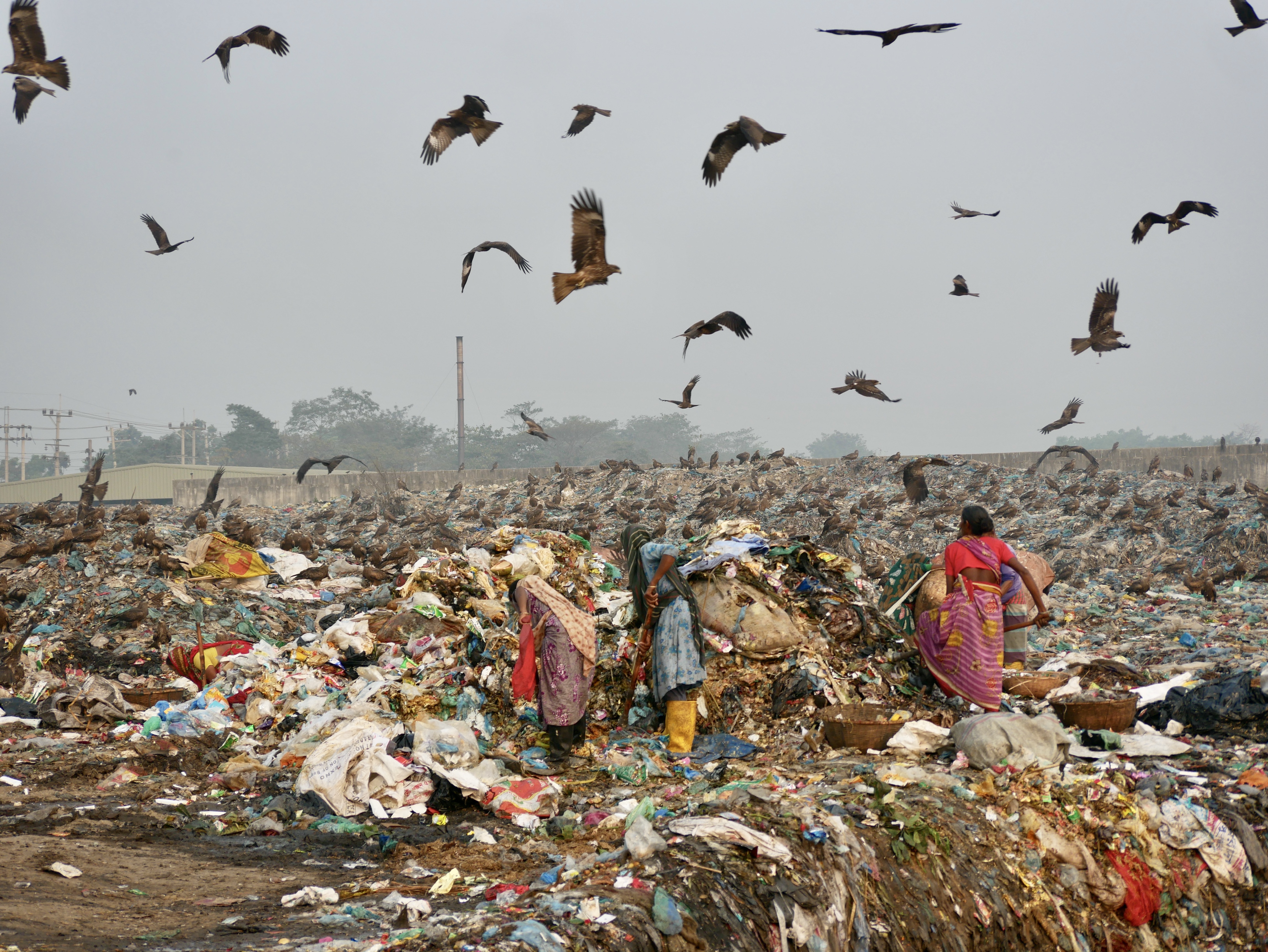
It's the birds that you notice first. They are everywhere, perched on the diggers, sitting amongst the rubbish and circling above the forty or so, mostly women, workers picking through the waste. Several women are at the summit of the dump, looking for plastic and other recyclables. It takes a moment or two to realise that there are other workers further down, surrounded by the rubbish, almost devoured by it. And all the time the birds watch.

This scene takes place near Sylhet, capital of the Bangladeshi province of the same name. The city has many modern shops, restaurants and hotels but to the rag-pickers, (the generic term applied to those doing this work) it is merely the pace they go to sell  items they salvage from the dump. I spoke to Rubi aged 56. She is originally from Moulvibazar, just south of Sylhet and has been here for ten years. I asked her what she did before she began this work. "We were not a rich family" she said. "I had no father and my mother had to do farm work. Then I got married and I was a housewife, but we needed more income to cover the cost of food and accommodation so I came to work here with my husband". Her daughter Fahima also works here. "She's 12 years old" said Rubi, "I'd like to send her to school but who will pay for her books and how will we cover the money she earns that helps to buy food and clothes?"  They sell the plastic items they collect to a recycling company in the city. For one kilo of plastic they receive just 5 taka, about five pence. This is substantially less than the amount the rag-pickers I met in Rajasthan receive for the same weight. Rubi says that on a good day the family can make 200 taka (£2). One kilo of lower quality rice in Sylhet ranges from 55 to 70 taka. Basmati is definitely off the menu at around 350 per kilo.

Fahima is not the only child working here. Johir Islam is also 12. He said "I began working here two years ago. I have no father and I need to earn money to help my mother". He only completed first grade at school and is unable to read or write. Johir was working with another boy, also aged 12. We had just begun talking when a truck arrived carrying new garbage. The boys broke off, picked up their plastic sacks and ran towards it, hoping to find the best items before the other workers got there.

Apart from the odd pair of wellingtons. no-one was wearing protective gear. Rubi, who had by now been joined by several of her colleagues, curious to know what we were talking about, claimed never to have been injured at work. She said that she had never had a skin disease from handling the garbage, despite not wearing gloves. She seems anxious to emphasise this and the others nodded in support of her assertion. I had not mentioned specific diseases. Despite Rubi's claim, a recent report says that as many as 80% of child rag-pickers in Bangladesh have been injured at work, mostly with cuts of different kinds. It also mentions the prevalence of dog and insect bites and respiratory problems from inhaling chemical fumes and airborne dust. Eczema, itching and fungal infection are listed as being widespread amongst this group. 

Although Rubi and her colleagues denied having accidents, they went on to list the various hazards of their workplace. These included dogs, "rats as big as cats", needle sticks and occasionally, snakes. I had a close encounter with four dogs when I arrived. They ran towards me growling and showing their teeth before one of the older women chased them away. They retreated to watch from a distance but did not bother me again.

From time to time, the authorities issue statements about banning rag-picking and then go quiet again. But as Rubi asked "what will we do if this happens? How will we survive?". It reminded me of the occasional proposals to end hand-pulled rickshas in Kolkata and the subsequent protests of the ricksha men, worried that they will be unable to find alternative employment. Rubi's final words before returning to work were "I would like the Government to do more to help people like us. We want to educate our children but we also need to feed ourselves".

As I prepared to leave I saw that the boys had gone into the distance, searching for items away from the main dump. I also noticed Fahima amongst a group of older women workers. She was looking into the distance, perhaps wishing to be somewhere else. But she was in the garbage, picking through the city's  waste under a dark, grey sky, with the sickly smell of decay and under the threatening gaze of those birds.

You might also like The rag-pickers of Jhalawar

Saunaya Roy's book Mountain Tales gives a detailed account of the lives of a community of rag-pickers in Mumbai.

Tuesday, 28 February 2023

Night train to Chittagong

The carriage was full and two men were occupying our seats. "Those are our seats" said Dev (my guide) in English, forgetting to switch languages after speaking to me. "Speak in Bangla" spat back the older of the two men, annoyed at having to move. Dev repeated himself in Bangla and reluctantly, very reluctantly they moved.  Seats secured, the next challenge was to find somewhere to put the luggage. Just like the train from Kings Cross to Darlington there was insufficient storage space. After much moving of other people's belongings Dev managed to force my suitcase on to the overhead rack. It was some way from our seats and about one third of it hung over the head of those sitting below.  I spent the first hour of the journey convinced the full 16kg (according to airline check-in) would come crashing down on their heads before eventually relaxing and then worrying again in case it disappeared if I slept.

We had arrived early at the station and sat in the waiting room where we found one man already sleeping - full-length on the metal seats, smelling of alcohol and grumbling in his sleep. Dev recognised him as one of Sreemangal's misfits, born to a rich family but spending much of his time drunk in the street. He wore trousers that looked a bit like a set of my checked pyjamas, a filthy once-white shirt and a tatty tie. After ten minutes or so he woke up and began trying to charm two very small children, members of a Hindu family waiting for the same train as me. The kids looked a bit scared, edged closer to their mother and pretended to not be there. Giving up, he wished me "good morning" in English and went outside. 

The 11pm train from Sreemangal to Chittagong didn't have sleeper accommodation but it boasted a dining car. At least that's what it said on the side of one of the carriages. If it did have one, much of its business was being taken by dozens of vendors who invaded the train at each station selling water, juice, cooked food, crisps (or chips as they insist here), nuts, boiled eggs and other items. Most of the vendors were older teenagers who carried their goods on their heads and ducked past each other as they tried to cover the whole train during the ten to twenty minutes spent in every station. Inevitably there were younger vendors too. One very small boy selling water at 1.30 in the morning can have been no older than ten and possibly less. 

There were also vendors who remained on the train for most of the journey, selling tea and coffee made from a large thermos flask, tea bags or jars of Nescafe. They appeared every 20-30 minutes, calling out "tea coffee tea coffee" until about 4 am by which time most of the passengers were at least pretending to be asleep. I was tempted by the astonishing selection of items on offer and the not displeasing aromas, but having just recovered from a bout of food poisoning decided it was best to resist. 

The seats have been designed to ensure maximum discomfort

I find it hard to sleep on trains and flights and I didn't expect to sleep on the eight hours journey to Chittagong. My expectations were fulfilled. The seats are designed to ensure maximum discomfort. They are angled - too sharp to be able to recline and too far back to be able to sit upright. They are not adjustable. I tried various positions, including resting my head on the drop down table on the back of the chair in front, but again the angle of the seat made it impossible.  I took my shoes off to feel a bit more cosy (and because my mam always says your feet swell at night if you keep your shoes on - I'm more like her than I care to admit) - and then I put them back on. I put them on again because I couldn't put my sock clad feet on the ground without stepping in detritus including discarded pieces of food, tissues, a comb and some cigarette ends. There were also several plastic bottles that rolled underneath my seat when the train hit a particular speed. The latter explained the presence of a young woman rag-picker on the middle part of the journey. It didn't explain the presence of two pairs of Hijra who got on at different stations to collect "donations". 

Hijra is the name given to the various third-gender communities found in India, Pakistan, Bangladesh and Nepal. Traditionally they have earned a living from giving "blessings" to newborn babies or at weddings, often demanding huge sums. They can be seen in the street soliciting money from passers-by or from the occupants of stationary vehicles. People generally give them a small amount of money in order to avoid any unpleasantness. If refused or otherwise upset they can sometimes become abusive and occasionally threatening. The first pair were good natured and received small notes from many the passengers. I usually "donate" and they were very happy with my 50 thaka, (about 50 pence) even providing me with change from a 100 thaka note and giving me a blessing which consisted of tapping me on the shoulder twice. 

"Na? Na? What is this na?"

When the second pair got on, they had a harder time as people didn't wish to give again. This led to some sharp exchanges, culminating in one with one of a group of inebriated young me sitting behind us. He  refused to give, offering a short "na" (meaning no) when asked. "Na? Na? What is this na?" asked the very offended taller of the pair, with her teased back hair and heavy make-up. He continued to refuse and things quickly deteriorated, him suggesting she take part in certain sexual practises and her alleging that his wife entertained other "husbands" when he wasn't there. The rest of the exchange escaped me, but it went on for a few minutes until the Hijra, satisfied she'd had her say went off to the next carriage.

Around 4am things quietened down a lot, though there were still occasional murmurings from behind. I dropped off shortly afterwards but woke at 5.45 just as the light began creeping through the window. An hour later we pulled into Chittagong and my fellow passengers alighted in a surprisingly orderly fashion. Dev and I agreed to wait until last so as to avoid struggling through the carriage to recover my suitcase which was still there and still partially hanging over the heads of the people sitting below. At about one, he'd put his cap on, taken out one of those neck-rest things and a blindfold that people use on flights and gone to sleep. Or at least I thought he had. As we wheeled our luggage along the platform I asked if he'd slept much. "No. Not at all" he said. "I heard everything all night". "Oh" I said, as while avoiding the touts and taxi drivers, we stepped out of the station and into the Chittagong traffic. 

Tuesday, 31 January 2023

"What have you brought me?" - an encounter with the Bhand in Rajasthan

Just outside Pachewar in Rajasthan we came across an encampment. As we approached, we saw that a ceremony was taking place. I was unsure about whether we should enter, but an elderly woman signalled to a teenager and chairs were brought for us. The ceremony continued. A young, shirtless man lay in the centre of the gathering with a family member, acting as a priest, speaking over him. An elderly man sat at the side of the gathering, wrapped in a blanket, shivering. The young man, trance-like, made responses to the priest before convulsing and appearing to lose consciousness. Then, the priest covered his face with a cloth, and he quickly recovered, got up and moved away from the group.  The shivering man put down his blanket, apparently cured of whatever ailed him.


"...my eyes and ears are still good, I can see and hear everything..."


The old woman, the family matriarch, said that they were members of the Bhand tribe. She explained that their settlement was a temporary arrangement while they waited for a permanent location to be identified by the government. She added, “I don’t know how old I am, maybe 80, maybe more, but my eyes and ears are still good, and I can see and hear everything”. She claimed that her group was an extended family encompassing nine generations. Quite a claim, despite the Bhand often marrying young. My friend and interpreter, Vikas, later explained that she may have been counting different branches of the family rather than generations. He also explained the ceremony. The Bhand believe that the spirits of their ancestors, who they call pitrs, can help them in times of trouble. The ceremony was performed to assist the recovery of sick family members and the voice of a particular pitr was being channelled through that of the younger man. These spirits are mentioned in Hindu texts including the Mahabarata and the Devi Bhagavata Purana. Annual homage, or shrad, must be paid to them in order to retain their favour. 


During the days of the Maharajas, the Bhand were story tellers and entertainers. At important gatherings, they would act as acclaimers, announcing the arrival of guests, showering praise upon them and their ancestors. Some would maintain family trees for the nobility. They would also perform plays and dance. Although most of their work was for the wealthy, they would occasionally put on shows for the common people during important festivals. Today they perform their traditional work at weddings, large events and festivals.


"..the priest...told a story to his perfectly silent audience"


When the matriarch spoke, all present maintained a respectful silence, but then the man with the blanket began asking us for money. She silenced him with a look and then asked us what we wanted. I explained that I am a writer and was curious about her community. On hearing this, the priest (who was her son), stood up, donned a colourful turban and told a story to his perfectly silent audience. The gist of it was that the emperor Akbar once had his Bhand executed for some argument he had with Birbal – a poet and singer appointed as a Minister. The Bhand’s son took his revenge on Birbal by using his skills in poetry and humour.

Towards the end of the story, a smartly dressed young man arrived and interrupted the priest. He announced himself as Jelabi Lal. He spoke rapidly and made the family laugh. Then he asked us for money. At this the matriarch’s smile changed to a look of anger. She spoke sharply to him in Hindi, telling him to “chup raho” – “shut up”. He did as he was told and stood looking at his very stylish shoes. She then turned to me and said, “what have you brought me”. Thinking on my feet, I handed her the colander I’d purchased from the Gadia Lohar tribe settlement on the other side of the road. She examined it closely, turning it over and over before pronouncing it “good, very good”. It seemed like a good time to leave and we went back to the road, leaving her to admire her new possession.

You might also like The rag-pickers of Jhalawar

Sunday, 15 January 2023

The rag-pickers of Jhalawar


Ayaan said he was 14 but he looked younger, perhaps 11 or 12. He was small but clearly well-fed which may have been why he was riding a decrepit looking exercise bike at the side of the road. I asked him where the bike came from. “Over there” he said, pointing to a mountain of plastic items being sorted into different bags by two young women. The women were employed by Ayaan’s father who buys waste goods from collectors, known as rag-pickers, before selling them on to more large-scale dealers for re-cycling. 

The business occupies a large site, not far from the centre of Jhalawar, formerly one of Rajasthan's princely states and now a regional centre of more than 65,000 people. The two women sorting the plastic items - Rekha and Parvati - spend their working days bent over, causing them painful back ache. Rekha was a little shy, but Parvati was amused by my presence and laughed directly into the camera after I held it up to request a picture. Ayaan's father also deals in old tyres and two men sat on the floor separating the rubber into strips which would then be used to make different items. I asked Ayaan why he wasn’t at school. “It’s morning,” he said “I go to school in the afternoon. In the mornings I help my father.” The first part of his sentence was in English, the second in Hindi. As I left, I turned back and saw him standing arms folded, looking managerial and keeping an eye on the two women who were busily sorting and bagging. Rekha looked up at him and rolled her eyes before going back to work.


Parvati


As many as four million Indians, most of them women, are employed in informal waste collection

Ayaan’s father buys his stock from collectors who gather discarded items from the street, from businesses and sometimes from garbage dumps. The collectors are widely referred to as "rag pickers". The name is similar to that given to the "rag and bone" men who collected unwanted household items from the streets of my north of England hometown during my childhood. The name came from their calling out "rag and bone" as they came through the streets, often with a pony and cart, alerting people to their presence. Indian rag pickers do not have the luxury of this form of transport and generally carry their finds on their backs.


As many as four million Indians, most of them women, are employed in informal waste collection. Their contribution to public cleansing and recycling is largely overlooked and poorly rewarded. The work is hazardous and exposes the collectors to infection, injury and in extreme cases risk of death. Saumaya Roy’s 2021 book Mountain Tales is an in-depth examination of the lives (and loves) of several families who make a living from sorting waste on a municipal rubbish dump in Mumbai. It follows the individual stories of the workers and describes in detail their work and living conditions. A few kilometres outside Jhalawar there is a rag-picker settlement of 35 families. Their makeshift camp is situated outside the city boundary, away from the residential areas and without running water or electricity.


I arrived at the camp at about half past ten in the morning. The residents were curious and perhaps a little suspicious about receiving an unexpected guest, but on seeing the camera began asking to be photographed. Some produced mobile phones and requested “selfies”. The volume of photographic requests soon became overwhelming and there was some jostling.  My friend, guide and interpreter Vikas called order, saying that we would photograph them in family groups, one by one. I also took some individual portraits, including of Eeran, a girl of perhaps twelve years. She wore her blonde-brown hair swept back under a headband and looked directly into the camera. Her expression was hard to read a mixture of curiosity and a half, almost sad smile.


Rekha


Grandmother and grandchildren. Pardhi settlement near Jhalawar


"Criminal" by birth


A young man stepped forward and began to explain that this was a settlement of Pardhi people, an Adivasi, or tribal group, originally from Madhya Pradesh. The name Pardhi comes from papardhi the Sanskrit word for hunting, reflecting their former occupation. They were traditionally forest dwellers, skilled in the use of bows and arrows, swords and hunting traps. This way of life was curtailed by the passing of the 1971 Wildlife Act which outlawed hunting.It was not the first time that legislation had significant negative impact on the tribe. The 1871 Criminal Tribes Act enacted by the British colonial government branded 150 Adivasi groups, including the Pardhi, as “criminal” by birth. This may have been in part, an act of revenge, due to their having participated in the 1857 revolt against colonial rule. The Act not only gave the police sweeping powers against those covered by its stipulations, but also ensured they were stigmatised in Indian society. Although this legislation was overturned after Independence in 1951, the stigma continues today.


An unintentional impact of the Wildlife Act was to further impoverish the Pardhi. Their traditional way of life forbidden, they now earn a living through agricultural work, the sale of food and handicraft items, and in some cases, begging. Many Pardhi can be found in Mumbai including the women who attempt to sell garlands to tourists outside high end hotels. Others, like the group near Jhalawar work as rag pickers. 


"Sometimes the dealers try to reduce the price to 25 or even 23 rupees per kilo".


I spent some time with several members of an extended family group. One of the younger men explained that the people here collect plastic and glass bottles which they then sell on to dealers who sort and sell the items on to larger companies. In return for one kilo of plastic they will receive 30 rupees – about 30 pence. I asked him, “how many bottles do you need to make a kilo?” “One hundred” he replied before adding “Sometimes the dealers try to reduce the price to 25 or even 23 rupees per kilo. We can’t do anything about this, there are many rag pickers, and the buyers can pay what they like”. For a single glass bottle, the going rate is three rupees. The Pardhi seem trapped in this way of life. Many have no formal education and although they claimed to be sending their children to school, few complete their studies. The health risks associated with the work are compounded by widespread alcohol abuse amongst the men. Despite the morning hour, many of them smelled of drink. Some had slurred speech or were unsteady on their feet.


The excitement about being photographed was widespread but one family stood back. Their home was of slightly higher quality and appeared more robust than those of their neighbours. There were other differences too. It was a family with only one child – a boy of eight or nine years, cleaner and better dressed than the other children – and the father did not smell of alcohol. They lived on the edge of the settlement, as if they had made a deliberate attempt to separate themselves. It was clear that the boy wanted to have his picture taken, and as we left, his father called me over and I photographed the two of them. The mother stood to one side, watching before going back inside their home.


Eeran


Wednesday, 21 December 2022

"We have three million posters, but we don't really know what we've got" - Baazi and the last Bollywood poster painter


"We have about three million posters, but we don't really know what we've got"

I stood in Poster Stuff, a tiny shop in Mumbai's Chor Bazar, trying to decide which of two vintage Bollywood posters to  buy, Baazi or Albela  While I struggled to make my choice, Kaleem, whose grandfather started the business 22 years ago explained that only a tiny proportion of the collection is held in the store. The remainder of it is kept outside the city in Badlapur. I asked him if the shop has a website or a catalogue. "No, he said "We have about three million posters, but we don't really know what we've got". Putting off my decision a little longer, I asked him how his grandfather had managed to acquire so large a collection. He said "He would get to know when a cinema was closing and then ask if they would give him their old posters. Most of them did not appreciate their value and were happy to hand them over. Sometimes he was too late and found that they had already been destroyed".

Kaleem is extremely knowledgeable about old films, although he said he prefers modern cinema. I ran through my list of 1940's, 1950's and early 1960's movies, and he was able to either locate a poster for me or to tell me that it had been sold or sent for auction. "A lot of our business is with overseas dealers" he explained. "We've even sold some at the big art auction houses in London. We also get approached by dealers and collectors to verify that posters are originals and not copies. The National Museum of Indian Cinema in Mumbai recently asked for our advice". 

Chor Bazar is undergoing major change. Many of the old shops have been demolished and replaced by  new structures with residential units above. Some businesses will not reopen when the re-development is complete. I asked Kaleem about the future of the store. He said "If this part of Mutton Street is demolished, we have been promised a new store on the same spot". I hope that promise is kept.

"It's the work of Sheikh Rehman, the last of the hand-painted poster artists"

I made my mind up and chose the poster for Baazi, a Hindi film released in 1951. It was the first crime noir film to be made in India and is acknowledged as a classic of the genre and influenced many films in later years. It was directed by Guru Dutt, who also starred in, wrote, produced and choreographed many classic Hindi films from this period. Baazi, which means "gamble" starred Dev Anand, Geeta Bali of Albela fame, and Kalpna Kartik. It was the second highest grossing Indian film of 1951. At least two other Hindi films, made in 1968 and 1995 bear the same name but tell different stories.

While I arranged to have the poster delivered to my hotel, Kaleem said "actually this is not a poster, but a painting. It's the work of Sheikh Rehman, the last of the hand-painted poster artists", and pointed to the artist's signature. I had heard of Rehman before, but enamoured with the deep reds, blues and downward brush strokes of his work, I hadn't picked up on his name. 

Sheikh Abdul Rehman - better known as S. Rehman - began helping his poster painting father at the age of ten and has continued with this work for more than 50 years. His painting led him to establish friendships with Mother India director Mehboob Khan and Bollywood superstar actor Shashi Kapoor. He also worked with artist MF Husain, one of the founders of the Bombay Progressive Artists Group who was later forced to leave India following controversy over his depictions of female Hindu deities. A 2015 documentary film,  Original Copy, showed Rehman at work in his studio right behind the screen at the Alfred Talkies cinema. The German made film showed various aspects of his personality - a bit prickly, fond of robust language but with a good sense of humour.

Alfred Talkies was open for business but there was no warm welcome

Kaleem confirmed that Alfred Talkies still existed and was not too far from Chor Bazar,  so with my friend and guide, Ranjana, I made my way to the cinema in Grant Road. This area was once an entertainment hub with many single screen cinemas attracting large audiences for the latest Hindi films. Today few remain and those that do, tend to show re-runs of old movies rather than the latest hits. This part of the city also has a long history of prostitution. As we walked along the road in the early afternoon, many women were on the street looking for customers.  SM Edwards, noted in his 1924 book Crime In India,  that the Ripon Theatre, the precursor of the Alfred, charged a special rate to prostitute patrons - one rupee. This was four times the amount charged to other women. The writer Saadat Hasan Manto lived in this neighbourhood before Partition, writing screenplays and working as a columnist for various film magazines. No doubt several of his characters were inspired by the people he met in these streets.

The cinema stands at the end of Grant Road East, and before we reached it, we passed New Roshan Talkies, another single screen cinema. It is now closed, and at least externally, in poor shape. Despite this, it was easy to imagine its former splendour as the brightly coloured detailing and Art Deco influenced metalwork of the ticket windows has survived. 

Alfred Talkies was open for business, but there was no warm welcome. Just inside the lobby, three grim faced men, arms folded, sat on wooden chairs and told us we couldn't come in, take any pictures or make any films. This was backed up by a series of "don't..." notices displayed on the walls of the once very grand lobby. Stained glass, wooden panelling and several less off-putting vintage notices have survived, but unfortunately I have no photographic record of them. Ranjana explained we were interested in the story of the cinema and would like to have a peep inside the main hall. Despite her best efforts she received a firm "no". She tried again with the ticket sellers, one of whom eventually gave in and allowed us to look into the hall from the doorway, but once again warned us against photography and filming. Inside, the all male audience were watching the 1989 film Ram Lakhan. Tickets are priced at just 20 rupees, about 20p. Unfortunately this was reflected in the poor print and the appalling sound quality. All of the house lights were on, and the restless audience called repeatedly for them to be turned off, which they eventually were. We asked about seeing the balcony but were told it was closed because there were not enough customers.

We were soon bustled outside again and crossed the road to get a better view of the exterior. The cinema was built in 1880, originally as the Ripon Theatre, and the old name can still be seen, engraved on the windows at the upper level. It was one of the first theatres in the city to put on plays in local languages. In the 1930's, in line with changing tastes, it was modified to become a cinema and the name was changed to Alfred Talkies. It is now one of very few single screen cinemas in the city. Many of the older buildings on the opposite side of the road have been flattened and replaced with large, often ugly, "developments" that seem to threaten, rather than to attract. How long will it be before the art works from the Alfred become part of Poster Stuff's collection? 

Alfred Talkies - 174-180, Pathe Bapurao Marg, Grant Road East, Khetwadi, Girgaon, Mumbai.

Poster Stuff - 113 Mutton Street, below Qutbi Masjid, Ajmer, Kumbharwada, Mumbai

Friday, 9 December 2022

"The landowner refused to pay us...we had barely enough to live on" - Delhi's Sri Ram refugee colony

The narrow alleys of Majnu Ka Tila in Delhi are full of businesses catering to the long established Tibetan refugee community. Both local and foreign tourists come to visit the Buddhist monastery and to eat in the many Tibetan, Korean and north-east Indian restaurants. A short distance from here, there is a group of less-well known refugees. The Sri Ram colony is home to Hindus who fled Pakistan, not during Partition, but in 2010.

I came upon the colony by chance when visiting a neighbouring Akhada, where traditional Indian wrestling is practised. As I left I noticed an alley leading into a cluster of buildings resembling a village. I went in and although the residents were at first surprised to see a foreigner, they were welcoming and community leader Rajesh Solanki was sent for.  He looked to be in early middle-age and wore the brown kurtha-pyjama typical of rural Sindh in Pakistan. He explained that the people living here had come on a religious pilgrimage in 2010, and then refused to leave. They cited discrimination and religious intolerance in Pakistan, as their reasons for wanting to remain in India, and staged demonstrations at Delhi's Jantar Mantar to draw attention to their plight. 

The Colony is a hotchpotch of solid, brick buildings owned by better-off families and less permanent  structures consisting of metal sheets, tarpaulins and twigs. All of the homes have been built by the residents themselves. Several are unfinished, as many residents lack the resources to complete them. Despite this, there is evidence of ongoing construction and a group of women were laying down a courtyard outside their house. Most homes lack electricity or running water and toilet provision consists of communal male and female blocks. As the colony stands on the floodplain of the Yamuna River, there is a risk of flooding during the monsoon. There are also potential health hazards from mosquitos and from  sewage regularly pumped into the river.   

Some of the more entrepreneurial residents have established small shops selling snacks and sweets. Some of the houses have small shrines attached to them. These are referred to by the residents as "temples". There are displays of religious piety throughout the colony. The Hindu greeting "Ram Ram" is given in preference to the more secular "namaste" and symbols and pictures of various deities are displayed on the exterior of the buildings. Even the name of the colony is that of Ram Ji, the central character of the   Hindu epic,  The Ramayana. 

Chander's Hanuman temple

"The landowner refused to pay us the agreed amount. We had barely enough to live on"

Badal is 39 and from the Kotri district of Sindh. Solanki asked him to show me around and answer my questions. I asked what had caused him to leave the place where he was born and to remain in India.  He said" I owned eight acres of land in Pakistan. It was not enough to support my family and I entered into agreements with a larger landowner. The contract said that we would share the expenses of seeds, fertiliser and other items 50/50 with the landlord, and that we would also share any profits in the same way. We paid our share of expenses but when there was a good profit, he refused to pay us. We had barely enough to live on". Badal also lost his eight acres of land when they were seized by local gangsters. "There were too many of them for us to resist" he said "they were armed and had friends amongst the politicians. No-one would help us".

He used to sell telephone covers and other accessories, but now has insufficient funds to buy stock. He works occasionally as a day labourer but this pays little and is unreliable. His home is in very poor condition - only partially built - and all eight residents sleep in one small room. The situation was made worse by the death of one of his five children at the age of 20, leaving behind a widow and a small child, now being cared for by Badal and his wife. Despite this, he says he feels safer in India and is happier there.

Badal

"There was no violence, no threats, but the pressure to convert was always there, every day, in every conversation"

One of Badal's neighbours, Chander, also from Kotri district, tells a similar story. He owned no land in Pakistan and worked as an agricultural labourer to support his family. Again, the landlord refused to pay the contract share and Chander felt he had nowhere to turn for help. The colony's overt religiosity made me curious about faith-based discrimination, or pressure to convert in Pakistan.  Chander said, "There was no violence, no threats, but the pressure to convert was always there, every day, in every conversation. Even in the market. People we thought of as friends would say to us 'why don't you convert? Things would be better for you' ". Chander also has problems in India. He showed me the small Hanuman temple he built at the side of his house. It is collapsing as the land subsides, possibly caused by the sewage being pumped into the Jamuna River just a few metres from his home. "I can't afford to repair this and I'm worried the house will collapse too" he said. 

Two of the women residents told similar stories about pressure to convert. Janaki sat playing with two of her grand-children whilst she prepared a chick-pea dish for their lunch. "They would always talk about converting" she said. Janaki lives in one of the better quality houses. She still has family in Pakistan. Megha, perhaps in her sixties, stood outside her house, cuddling one of her granddaughters. She has ten children of her own - five in India and five in her home town,  Mirfazal Pakistan. She was worried about her daughter-in-law. "She had an accident six months ago and is still in ICU in the government hospital. They won't let me see her. I want to give her soup and nurse her back to health" she said. 

Janaki and her grand-children

Megha and one of her ten grand-children

"...my assistant often has to go from door to door and bring the children here herself"

Most of the children go to school outside, but there is some teaching goes on inside the colony. A single, windowless room is used for pre-school learning. When I visited, the children were enjoying snacks. I'd seen food provided in a village school in West Bengal, as a way of encouraging attendance. I asked the teacher if this was the case here. "Yes" she said "It's to encourage them to come. Not all of the parents are committed to pre-school learning, and my assistant often has to go from door to door and bring the children here herself". Resources appeared limited but she spoke enthusiastically and was clearly committed to delivering the best for the children. The teacher's and assistant's salaries are paid from Central Government funds allocated to supporting the welfare of women and children.

The older children have access to additional learning in a community hall built with funds from overseas donations. Teaching is provided by NGOs and volunteer university students. The room was clean and tidy. Charts with tricky algebraic formulations and maps of India and the world were displayed on the walls. There was also a row of sewing machines, provided by a charitable organisation and used for teaching tailoring skills.  Although not a formal school, many of the children come here for tuition. I asked some of them what their favourite lessons were. Jalram, aged 11 said, in English, "I like mathematics and Hindi".  Others gave maths as their favourite subject while one said "English". Some of them gathered around the maps, locating different cities and countries. 

More than a decade after their arrival, the situation of the Sri Ram residents remains uncertain. Solanki said "We are hopeful that the new law to assist victims of religious persecution will help us". He refers to the 2019 Citizenship (Amendment) Act that provided routes to Indian Citizenship for persecuted religious minorities from Afghanistan, Bangladesh and Pakistan. Hindus, Sikhs, Buddhists, Jains, Christians and Parsis who arrived in India before December 2014 are eligible for consideration under the Act. Muslims are not included in its provisions. The application of a religious test resulted in sometimes violent demonstrations in various parts of India.

Despite their troubles, many of the people I met spoke about feeling happier in India than they had in Pakistan, and no-one expressed regret at having left. There may yet be a brighter future for Jalram, his friends and their families.

Jalram (hiding) and friends

Where did my dog go?

Some of the residents have opened small shops


Thursday, 18 August 2022

Kaunas Modernism

Kaunas in Lithuania has been designated European Capital of Culture for 2022, together with Esch-sur-Alzette in Luxembourg and Novi Sad in Serbia. This post which draws on my earlier articles about Kaunas' extensive collection of modernist architecture and appears in the current edition of Spirit of Progress - the magazine of the Art Deco and Modernism Society of Australia.

Until the 1920’s Kaunas was a relatively small city, characterised by wooden houses and baroque churches. A construction boom during the 1920’s and 1930’s changed this and left many new civic and commercial buildings as well as stylish apartment blocks. This was partly due to the city acting as temporary capital for Lithuania from 1918-1940. Today’s capital, Vilnius, was under Polish rule and Kaunas needed to acquire the trappings of a national capital. Unfortunately, this new found confidence and period of growth was not to last as the 1940 Soviet invasion, and then the German occupation of 1941-45, preceded incorporation into the Soviet Union. Independence was not regained until 1990. In the intervening period, many outstanding buildings fell into disrepair, were significantly altered, or even demolished. Despite this, Kaunas has one of the largest collections of modernist buildings in any European city. I first became aware of this about ten years ago and managed to visit the city in 2017. 

Former Post Office, Laisvés 102


Although examples of modernist architecture can be found all over Kaunas, several of them cluster on Laisvės, a tree-lined avenue pedestrianised during the Soviet period and today a place where people come to shop, stroll, sit outside the many cafes or ride along the green coloured cycle path. The former Central Post Office at Laisvės 102, was built in 1931. Feliksas Vizbaras’ design combined elements of folk architecture with the principles of modernism, including wide modern windows, convex glass on the façade’s corners and internal murals depicting Lithuanian postage stamps. The interior also features stained glass with heraldic symbols and figurative compositions. During the Soviet occupation, some of the original stained-glass works were removed and replaced with images of zodiac signs. The tiled lobby and main hall floors also reference folk art. The façade features curves, a flat faced clock in the central section and squared off towers to each side. Each of these elements rise to different heights. The building currently stands empty. Discussions have been held about using it for a museum of architecture but no date has been set for this.


Laisvés 53


Laisvės 53 is another Vizbaris designed building, designed for the Pažanga (progress) publishing company and was completed in 1934. It was owned by the then ruling National Union Party who produced their newspaper, books and journals here. It also had a second-floor snack bar and restaurant open to the public, accessed by a lift and a roof terrace. The upper floors were accessed by a lift and the large basement contained a meeting room with natural light from skylights made from glass bricks.


As with the Post Office, the façade has varying depths and heights. The central part features three balconies with decorative metal railings that combine folk art with art deco motifs. It is flanked by curved and sectioned windows leading to loggias running the length of the building. The ground floor has large shop windows reflecting its use as a retail space and mirrors the curved elements of the upper floors. Some original features have been lost, including the skylights. In 2017, the upper levels were occupied by Vytautas Magnus University, but today the building is unoccupied.


Vizbaris was born in 1880 and is known to have lived in Ukraine from 1909-1918 where he worked as a construction engineer and an architect. From 1922-25 he headed the construction department of the Kaunas municipality. He later worked on the extension of the port of Klaipėda before emigrating to Germany in 1944.


Former headquarters of milk processing company, Laisves


The building next door to Pažanga was the former headquarters of Lithuania’s milk processing company. It was designed by Vytautas Landsbergis and built from 1931-32. The exterior is defined by its interactions between vertical and horizontal elements. Each level is marked by uninterrupted panels running the length of the building. The rounded corner has convex glazing descending to the ground floor and main entrance, which is shaded by a wide illuminated ledge, reminiscent of Parisian department stores. This may have helped it to win the Bronze Medal at the 1937 International Exposition des Arts et des Techniques in the French capital. The entire structure is built around a reinforced concrete frame. As with the Pažanga building, there was a large basement, this one equipped with an icehouse. 


The ground floor originally contained the Dairy Centre shop, a café, milk bar and the rather fabulous sounding, Muralis men’s hairdressing salon, which extended over two floors. A few pictures of the salon’s interior have survived and show a crisp, functionalist environment with barber’s chairs, large mirrors, screens and wall mounted lighting. The salon was designed by Arnas Funkas, a prominent architect of the period. The administration functions were spread over two floors with apartments at upper levels – three units to each floor. Several prominent people lived here, including Dovas Zaunius, one time Minister of Foreign Affairs and Vincė Jonušaitė, his opera singer wife.  


Romuva Cinema, Laisves 54


During the 1930’s cinema design was heavily influenced by modernism. The Romuva cinema at Laisvės 54 was completed in April 1940. At the time, it was the biggest cinema in Lithuania, seating 687 people and benefitted from the most modern technology including mechanical ventilation and state of the art screen equipment. An oval shaped auditorium, special wall coverings and a vaulted reinforced concrete ceiling were included to enhance the acoustics. A circle was omitted from the auditorium for the same reason.


The tall, glazed tower on the exterior of the cinema was intended to be illuminated in changing colours. The Second World War had already commenced by the time construction was completed and the device needed to provide this feature was held up en-route and so this design element was not realised. The main part of the façade is divided by moulded frames and has two rows of different sized windows. The original plan was to use the upper level for advertising, but instead, windows were installed to light the office spaces. Numerous changes have been made to the original structure including moving the ticket office, increasing the slope of the hall and reducing the number of seats to 482. 


Brothers Antanas and Petras Steikūnas, members of the Lithuanian Businessmen’s Union commissioned architect Aleksandras Mačiulskis to design their cinema which is still in use today. Kaunas’ other modernist cinemas have not fared so well. The former Daina cinema at Savanoriu 74 is in very poor condition. When I visited the main entrance was bricked up and the façade covered in grime. It was operating as a “gentleman’s club” and scowling security staff stood guard at the entrance. 


Resurrection Church,  Žaliakalnis Hill


The Resurrection Church on Žaliakalnis Hill is one of Kaunas' best known buildings. In 1928, a competition was held to design a new church to commemorate the Lutheran revival. The entry from Karolis Reisonas, head of the city’s construction department, was chosen, despite his only placing third in the competition. His original proposal included an 82 metres high spiral tower with a statue at the summit, but was rejected on grounds of complexity and cost, and a simpler plan adopted. The church is an imposing white structure, supported by 1,200 reinforced concrete pillars. It has towers of differing height, a roof top chapel and can hold more than 5,000 people. For a small fee visitors may take a lift to the roof terrace and enjoy views across the city. Most construction took place between 1933 and 1940. The church was nationalised after Lithuania’s incorporation into the Soviet Union in 1940 and during the German occupation it was used as a paper warehouse. The returning Soviets converted it to a radio factory in 1952, but worse was to come. Stalin demanded demolition of the taller tower and chapel – fortunately this was not followed through. It was not until 1990 that the church returned to its original purpose following Lithuania’s regaining independence.


Jonas Jablonski Primary School, Ausros and Žemaičiu streets


The Jonas Jablonski Primary School is opposite the Resurrection Church on the corner of Ausros and Žemaičiu streets. It was the first school in Lithuania to make use of functional zoning, with the sports hall and auditorium located in an inner yard away from the classrooms. It was also the first school in Lithuania to have a swimming pool. Four handicraft classrooms were used to help children acquire skills for working in the craft industries and for managing their future households. The inclusion of these specialist rooms may also have been part of a general commitment to preserving traditional Lithuanian crafts. There was also a large canteen and a private apartment for the head teacher.


The school has an asymmetrical, rectangular configuration with one wing substantially longer than the other. The main junction has a stepped projecting turret – emphasising the corner location – as well as a small balcony above the main entrance which acts as a canopy. The façade is interrupted by a series of wide, red framed windows, contrasting with the blank rear wall of the auditorium. New sections were added during the Soviet period. Today the building is known as the Jonas Jablonski Gymnasium, serving an older age group than the original primary school which was completed in 1932 and designed by architect Antanas Jokimas.


Donelaičio 63


The once elegant apartment building at 63 Donelaičio Street looks a little faded today. It was built in 1932, to the designs of Jewish architect, Geršonas Davidavičius, who was responsible for designing several residences in Lithuania. The block was commissioned by the brothers Dovydas and Gedalis Ilgovskis, who were also Jewish and had a successful construction business.


The symmetrical main façade is animated by rounded corner windows, a long central balcony at first floor level and two smaller balconies with metal railings at the next level up. Towards the summit there is a decorative cornice topped by a parapet. Each floor originally contained two apartments with corridors separating private and common areas. The apartments contained built-in wardrobes as well as servants’ quarters located beside a rear staircase. It is believed that the Ilgovskis brothers maintained a construction office in the building.


Davidavičius, who was also known as Gerson Davids, escaped the fate of most Lithuanian Jews by leaving for South Africa in 1935. Shortly after arriving, he had a serious accident that resulted in the loss of an eye, but he continued working and designed several residential and commercial buildings before emigrating again, this time to Canada in 1959.


A programme of events has been designed to celebrate Kaunas' European Capital of Culture status, offering visitors from all over the world the chance to discover and enjoy the city's busy cultural life and architectural heritage.  Visitors may wish to obtain a copy go the superb book, “Kaunas Architectural Guide” edited by Julia Reklaitė, published in 2017 by Architektūros Fondas, which includes many outstanding modernist buildings. 


I would like to note my thanks to Kastytis Rudokas for his help, support and advice in 2017 and with this article.