Sunday, 1 October 2017

Mumbai Art Deco

Mumbai has one of the world's largest collections of art deco architecture. This includes apartment blocks, offices, cinemas and hotels built from the early 1930's until the beginning of the 1950's. The style lasted a little longer here than in many other countries. In recent years, interest in these buildings has grown, in no small part due to the excellent work of Art Deco Mumbai - an organisation devoted to documenting, promoting and where possible, protecting this part of the city's built heritage.

Fairlawn, details unknown
During the 1930's Mumbai's expanding population, particularly that of its educated middle class, created demand for new housing. One response to this pressure was the Backbay Land Reclamation Scheme, carried out between 1928 and 1942, reclaiming land from the sea and stimulating extensive building programmes.  Many of the new homes were built in the Art Deco style and clustered Marine Drive (now renamed Nataji Subhas Chandra Bose Road) and Queens Road (now Maharishi Karve Road) in Churchgate. Planning regulations of the City Improvement Trust ensured a uniformity of height and materials whilst architects expressed their creativity through incorporating classic Art Deco elements representing modernity as well  as motifs from the ancient world.

Many of the residential units were commissioned by wealthy Mumbai merchants and industrialists as well Indian princes and other aristocrats who visited the city for shopping, to attend important events or as a departure point for travel abroad. The heyday of Art Deco coincided with the first generation of Indian born architects, many of whom had trained abroad, including in London where they received accreditation from the Royal Institute of British Architects (RIBA). These young Indians were responsible for many Art Deco structures whilst others were designed by their British contemporaries working in India.

Decay but with signs of hope on Marine Drive
I recently visited Mumbai and was able to see some of these wonderful buildings. It was encouraging to see how many of them have been lovingly cared for but also worrying to see the poor condition of others. Deterioration is due to both environmental and economic issues. Marine Drive in particular is exposed to the climatic challenges of the Arabian Sea, requiring regular and robust maintenance which in a number of cases has not taken place. Many of the large apartment blocks facing the sea have also been subject to "improvement" or "modernisation". This includes replacing original windows with more robust, cheaper materials and closing off balconies, presumably to gain additional internal space and to protect the interior from the elements and noise from the street.

Another issue for the apartment blocks in particular is the existence of fixed rental agreements dating back decades. These make it very difficult if not impossible for the owners to raise sufficient capital to carry out large-scale  maintenance. However, it is not all bad news as strolling the length of Marine Drive I saw much evidence of restoration and repair. Also, some buildings have been sold to major companies or Government Departments who now use them as office accommodation. Whilst it is sad to see the loss of the original residential purpose, at least the new owners have the ability to appropriately maintain their new properties.

Court View at 126 Queens Road is one of my favourite Mumbai Art Deco buildings. Built between 1933 and 1939 it was designed by Maneckji Dalal, working for Merwanji Bana and Co. This partnership was responsible for many of the city's Art Deco riches. The facade is stunning with marble pillars at each side of the shaded entrance and a fabulous "frozen fountain" motif above. A symbol of eternal life, the frozen fountain was revived by Rene Lalique  whose designs at the 1925 Paris Exposition were partly responsible for the world wide explosion of interest in the Art Deco style. This motif was often used by Merwanji Bana and Co. I was able to sneak a look into the lobby and admire the geometric terrazzo floor which I believe has different patterns at each level, the rhythmic motifs on the balustrade and the deco details on the lift doors.

Court View, 1933-39, Maneckji Dalal
Court View, detail of balustrade
Green Fields, 1933-39, architect unknown
Green Fields, zig-zag motifs on balconies
Green Fields is another apartment block, just a few doors away from Court View at 134 Queens Road. Built between 1933 and 1939, the architect is unknown. Again, the entrance is impressive with stylised lettering and a stepped panel above the main door but the outstanding features here are the narrow balconies on the facade with their zigzag motifs.

Rajjab Mahal, 1933-39, Merwanji Bana and Co.
Rajjab Mahal - glazed stairwell
Rajjab Mahal - motifs on balustrade and windows
Rajjab Mahal - geometric sunburst motif on facade
Still on Queen's Road, Rajjab Mahal at number 144 is another stunner. Built between 1933 and 1939, it was also the work of Merwanji Bona and Co. The facade includes geometric sunburst panels echoed in the windows as well as two sets of blue and green stripes that rise from just above the entrance canopy all the way to the summit. The stripes stand at each side of the glazed stairwell which in turn features the frozen fountain motif. Fabulous. 

Next door at number 146, Shiv Shanti Bhivan makes impressive use of its corner location with a series of decorative features on the building's curve. These include green chevrons on a yellow background, semi-circular discs above the windows that also provide a little shade from the brilliant sunshine and a batwing design beneath the sills. Unfortunately these delights have been somewhat compromised by the addition of several air conditioning units just underneath the discs - although I do understand why the residents would want this facility! The block was constructed between 1934 and 1935 and is yet another example of Merwanji Bana and Co's work.

Shiv Shanti Bhuvan, 1934-35, Merwanji Bana and Co.
Shiv Shanti Bhuvan - corner decorative details
Empress Court, 1937-38, Ganjanan B. Mhatre
Empress Court, decorative balconies.
Empress Court at 142 Queens Road was built in 1937-38 and was the work of Gajana Baburao Mhatre. Mhatre was a significant influence in the development of modern Indian architecture. Born in 1902 into a relatively ordinary family, he studied architecture first in India under the direction of Claude Batley. This British architect was a modernist devotee sensitive to Indian architecture who introduced Mhatre to the concept of combining the two. Mhatre undertook further studies in London where he obtained RIBA accreditation before returning to India in 1931. He then began working for the Billimoria and Poonegar Company, making a major contribution to their design work. He was responsible for many residences in Mumbai including the spectacular Empress Court. A corner building, it uses its location to dramatic effect with a decorative glazed stairwell sweeping from the canopy above the main doorway to the summit, flanked by tiny almost Bauhaus style balconies at each level.

Still on Queens Road, Palm Court at number 152 is another of Mhatre's works. Currently undergoing renovation it was built between 1933 and 1939 and has an impressive entrance with semi-circular pillars, stylised lettering carrying the building name and colourful tiles in the lobby. Just above the entrance canopy, rows of chevron motifs form a concrete ventilation grill.  Two doors away at number 156, Sunshine, built at the same time as Palm Court was also designed by Mhatre. Its name is announced in both stylised lettering and by the image of the sun above the main entrance.

Palm Court, 1933-39, Ganjanan B. Mhatre
Sunshine, 1933-39, Ganjanan B. Mhatre
Moving away from Queens Road and on to Marine Drive,  Framroz Court at number 205 is one of my Mumbai favourites. Built between 1936 and 1943 and designed by Merwanji Bana and Co, the exterior has seen better days, is badly stained and in need of some tender loving care. Help may be at hand as there were signs of repair going on at one side of the building. Framroz has a dramatic and decorative glazed stairwell flanked by bay windows at each level and with sea facing balconies on one side. A number of these have now been enclosed. Day dreaming that I would like to have a flat here I went online to see how much it would set me back. I found a 3000 square feet apartment being offered for rental at 4.5 lakhs per month. If I'm not mistaken that is something in the region of £5,000. Ahem. Better start buying the lottery tickets again.

Framroz Court, 1936-43, Merwanji Bana and Co.
Regal Cinema, 1933, Charles Stephens.
Like many other cities Mumbai has a number of Art Deco cinemas. There are fewer than before as some have been demolished in favour of more lucrative developments. Others have been "modernised". This usually means gutting the interior of these single screen cinemas and transforming them into multiplex establishments, sacrificing the internal details but retaining the facade. Others are covered in hoardings for various products, making it difficult to admire their beauty but at least they are still there. 

The Regal on S.P. Mukherjee Chowk ( formerly Regal Circle) was one of the city's earliest Art Deco structures. Designed by British architect Charles Stephens it opened in 1933. Stephen's cinema was the epitome of modernity, constructed entirely from reinforced concrete, was fully air conditioned, and had an underground car park and lifts to bring patrons up to cinema level. Construction work was carried out by the Indian owned company Framji Sidhwa. The interiors were spectacular with sunray motifs and extensive glazing - all the work of Czech artist Karl Schara. The first film to be screened there was Laurel and Hardy's The Devil's Brother. A little faded looking today, the Regal still has a commanding presence on a busy junction, its vertical signage, stepped parapet and theatrical sculptures still striking despite the addition of large billboards.

Liberty Cinema, 1947-50, M.A. Ridley Abbott and John B. Fernandes.

The Liberty Cinema in New Marine Lines was built in 1947 at the very end of the Art Deco period in Mumbai. Its owner Habib Hoosein chose the name because construction coincided with Indian independence. The cinema remains in the ownership of the Hoosein family but struggles today due to competition from multiplexes and part of it is now rented out for office use. The interior has many deco details and the original wood panelling, mirrors and other features have been retained. Externally there is a magnificent corner fin, the bas relief of which resembles the keys of a piano. They really don't make them like this any more. Construction was initially under the direction of British architect M.A. Ridley Abbott who died one year into the project. Local architect John B. Fernandes took over and the work was completed according to Abbot's design. Waman M. Namjoshi designed and executed the interiors ready for the grand opening in 1950.

Several of the city's Art Deco cinemas were undergoing renovation or other works at the time of my visit. A good reason to return and see how things turned out.

A note on street names - Queens Road is now known as Maharashi Karve Road and Marine Drive has ben renamed Netaji Subhas Chandra Bose Road. I have used both versions in this post but primarily the old names to reflect the heyday of Mumbai's Art Deco style.

If you want to know more about Mumbai's Art Deco heritage, try Navin Ramani's superb book - Bombay Art Deco Architecture A Visual Journey (1930-53). I have relied on it for many of the details in this post.


You can see more pictures of India here.

Tuesday, 26 September 2017

A Postcard From India 5 - A Morning in Old Delhi


Old Delhi. Narrow streets. Very narrow streets, heaving with people, rickshaws, motorcycles, wheelbarrows, cows and donkeys. Noisy. Dirty. Magnificent. Off every narrow street there are several even narrower alleys. At first they seem a little dark and forbidding but inside many of them lie treasures - 18th century havelis, Jain temples, the best chaiwallah or snack seller in Delhi or someone who wants to tell you a story.

One man with a story is Mister Ramesh, owner of the New Gramophone House shop on the main Chandni Chowk Road. His family established the business in Lahore in 1930 but moved to Delhi in 1947 during partition when their home city became part of Pakistan. Old fashioned gramophone players are sold on the ground floor whilst the tiny first floor room is packed with vinyl records from days gone by.

I went there to look for some favourite Bollywood songs from the 1950's and early 1960's. He had them all. Very formal at first, once he realised that I was genuinely interested, he warmed up, drinks were sent for and he explained that after several hard years, business is showing sings of improvement. This is due in part to the efforts of several older Bollywood stars who no longer receive royalties from their films but can receive payments from sales of the soundtracks. He was very proud of his collection saying "If you can't find what you want here, you won't find it anywhere". I did find what I wanted and left with copies of the soundtracks of Pyaasa and Mr and Mrs 55 as well as a recording of some of Geeta Dutt's most famous songs.

Mr Ramesh, New Gramophone House
The School Run, Old Delhi style
Moving away into the lanes, the atmosphere changes. The streets are still crowded and it can be difficult to pass through them but perseverance brings rewards. Everywhere there is colour from the piled-up goods, window displays and the blue, pink, green and yellow painted walls that form the backdrop to street stalls. Even a humble banana stall can be a thing of beauty with the bright yellow of the fruit contrasting with the pale pink wall and the brightly coloured packets of snacks hanging behind. Taking a rickshaw ride though the lanes of Old Delhi is a great way to see all of this as well as to experience the friendliness of the people.  Expect lots of waving and shouts of "hello". One family squeezed onto a scooter looked up at my rickshaw and called out "good morning sir have a nice day" as they passed by. And speaking of rickshaws, look out for groups of school children piled onto them at various times of day as they go to and from school.  

Bananas with pink background
Green shirts and blue doors
Pink walled snack stand
Haveli Khazanchi
The shady lanes or "galis" leading from the old city's main arteries conceal some of its best kept secrets such as Haveli Khazanchi. Despite its terrible condition, this haveli (mansion), tucked away in the tiny Gali Khazanchi remains an impressive site. Once home to the Mughal Emperor's accountants, known as khazanchis, its central courtyard once boasted a marble pool. This is now drained but still overlooked by a series of beautiful balconies. Influential people including members of the royal family would have been received in the courtyard whilst accountants worked in the surrounding ground floor rooms. Today the haveli is crumbling but still striking due to its blue painted courtyard. One descendant of the khazanchis is said to still live in one of the ground floor apartments whilst others have been rented out, evidence of this being the several lines of washing on display! 

The entrance to the haveli is through two huge carved wooden doors, left open to the street. On the morning of my visit, the bright Delhi sunlight spilled through the door, casting pools of light into the dark alley to reveal two figures - a young man using a mobile phone in the courtyard itself and a street trader crouched in the alley, preparing his huge basket of poppadoms before hoisting it onto his head and moving on to begin the day's business. Old and New Delhi together.

Hawker outside Haveli Khazanchi
Nau Ghara
Nau Ghara
Nau Ghara is another small lane in the old city, leading off Kinari Bazaar Road. It contains nine beautifully maintained havelis (Nad Ghara means nine homes) all belonging to Jain traders and merchants. The Jains are a religious minority, whose beliefs include non-violence, non-absolutism and non-attachment to worldly goods. They were originally invited to Delhi by the Mughals due to being known for their enterprise skills. 

The homes in Nau Ghara feature traditional latticed balconies, marble staircases and imposing wooden doorways. The entrances are painted pink, blue and yellow and have  beautifully decorated surrounds featuring flowers and fruits in the Persian style. The three-storeyed Jewellers Temple stands at the end of the lane. It is perhaps the most beautiful of all the buildings in Nad Ghara, its walls covered in gold filigree and murals showing life in the Mughal courts as well as scenes from various scriptures. Photography is not permitted inside the temple. This and a list of other rules is handed by the caretaker to visitors for reading before they enter. The list is laminated and framed and includes instructions about smoking and removal of shoes as well as the forbidding of photography. Despite this, he was extremely friendly and wanted to chat about where I was from and what I was doing in India as well as telling me that he has a friend who lives near Queen Elizabeth!

The desire to chat politely with visitors was something I experienced throughout India in huge cities and in small villages where I stopped for tea en route to somewhere else. Some of the artisans and traders in Old Delhi were also keen to chat and to talk about their work. This included a pair of silversmiths working in one of the alleys adjacent to an excellent chaiwallah's stand where I enjoyed masala chai and a savoury snack whilst admiring their work. These craftsmen were proud of their skills, happy to be photographed and in return expected only my interest and response. It really is worth taking the time to stop and chat for a few minutes and to see something outside of our normal experience. For example, one trader removes the tiny coloured glass pieces sewn into clothes as decoration and uses them to make jewellery and other items. People sell their old clothes to him to make a little money and he in turn recycles the glass to earn his own living.

Entrance to Jain compound
Roof top restaurant
Nau Ghara is not the only Jain enclave within the old city. Noticing an open doorway leading into a tiled courtyard I was curious about what might be inside. Venturing in I entered an open courtyard surrounded by several three floors of apartments probably dating from the 19th century. The central courtyard was a shared area and the building was managed by a superintendent who kept a room on the ground floor from where he watched comings and goings. A list of rules for residents was displayed in the corridor leading to the courtyard including exhortations about paying the rent and not being noisy. Not much different to being at home then. Although not as grand as Nau Ghara, the courtyard was decorated with beautiful  ceramic tiles, imported from Europe according to contemporary tastes at the time of construction. The superintendent told me that there was a restaurant on the roof and to go and have a look. On reaching the summit, I was welcomed by a group of young people preparing lunch according to Jain requirements which are not only vegetarian, but also forbid the consuming of garlic, onions, potatoes and eggplants.

Jain compound courtyard
Courtyard tiles
It would be very easy to spend several days wandering through the lanes and bazaars of Old Delhi, enjoying the contrast between the bustle of the main streets and the tranquility of the lanes. The pictures below contrast those two extremes. I left the old city greedy for more. I will have to return.


You might also like A Postcard from India 2 - The People of Spice Alley, Mumbai's Lalbaug Market

You can see more pictures from India here

Friday, 22 September 2017

A Postcard from India - 4, Calcutta's Art Deco Metro Cinema


Calcutta's Chowringhee Road was once one of Asia's most exclusive addresses. Lined with impressive hotels and clubs facing the Maidan, the huge green expanse at the heart of the city it was the entertainment centre of Calcutta. Despite continuing to attract thousands of shoppers every day, Chowringee (now Jahawarlal Nehru Road) has seen better days. With the notable exception of the Oberoi Grand Hotel, many of the buildings have fallen into disrepair. The ground floor of several of them and the footpath in front have been taken over by hawkers and stall holders selling cheap goods of all kinds including jewellery, clothing, shoes, mobile telephones and household items. You name it, you can get it here.

The Metro at number 5 was one of Chowringhee's most important entertainment buildings and one of several Art Deco single screen cinemas in this part of the city. Built for the Metro-Goldwyn-Mayer (MGM) company, it opened in 1935 with the purpose of promoting their films to the large and receptive English language audience then resident in Calcutta. The architect responsible was the British born but American based Thomas W. Lamb, who also designed the Mumbai Metro cinema. The first screening was of Way Out West, a comedy starring William Haines and Leila Hyams. 


The cinema attracted large numbers of British, Jewish and Armenian customers. Jael Silliman wrote about the importance of the Metro to the Jewish community in her book  Jewish  Portraits Indian Frames. - "Western movies were very popular and Jewish youngsters often attended the cinema in large groups. Flower and her cousins the Joshuas, had a fixed weekly reservation for the entire year at the Metro cinema".

These communities left India in large numbers after independence but the Metro remained successful until the 1970's, changing its focus from Hollywood to Bollywood films. However, during the 1990's, the cinema was not properly maintained and the arrival of multiplexes during the 2000's was to be a fatal blow. The doors finally closed in 2011. Three years later, the Metro appeared in the Bollywood movie Gunday when the lead characters attended a film there. Works are currently being undertaken to convert the building to a shopping mall and multiplex cinema. All that will be retained of the original design is the facade with its spectacular waterfall style columns, stylised lettering and fin which also bears the cinema's name. Whilst it is sad to see the original interior disappear, the Metro has at least avoided the fate of a number of other cinemas in Calcutta that have been completely demolished and furthermore, it will continue to operate as a cinema. 

A note on names - Calcutta is now known as Kolkata and Chowringhee's official name is Jahawarlal Nehru Road. I have used both versions in this post but primarily the old names to reflect the heyday of the Metro.


More pictures from Kolkata/ Calcutta

Saturday, 16 September 2017

A Postcard From India 3 - Mr Tikam Chand, Jaipur's famous street photographer

Every year when I was growing up I would be taken to a photographic studio with my brother and sometimes cousins for a family photograph. It was an occasion. Few people had cameras then and photography was a serious, professional business. Today it seems that anyone can be a photographer. Mobile phones snap away millions of times a day and images are quickly circulated on Facebook Twitter, Instagram and whatever other channels I have yet to catch up with. Few people bother to print hard copies of pictures, preferring to stick to digital files, understandable in a way as millions of images can be kept electronically without the need for any physical space. But convenient as all of this may be, it has none of the romance of having your photograph taken in the old way.


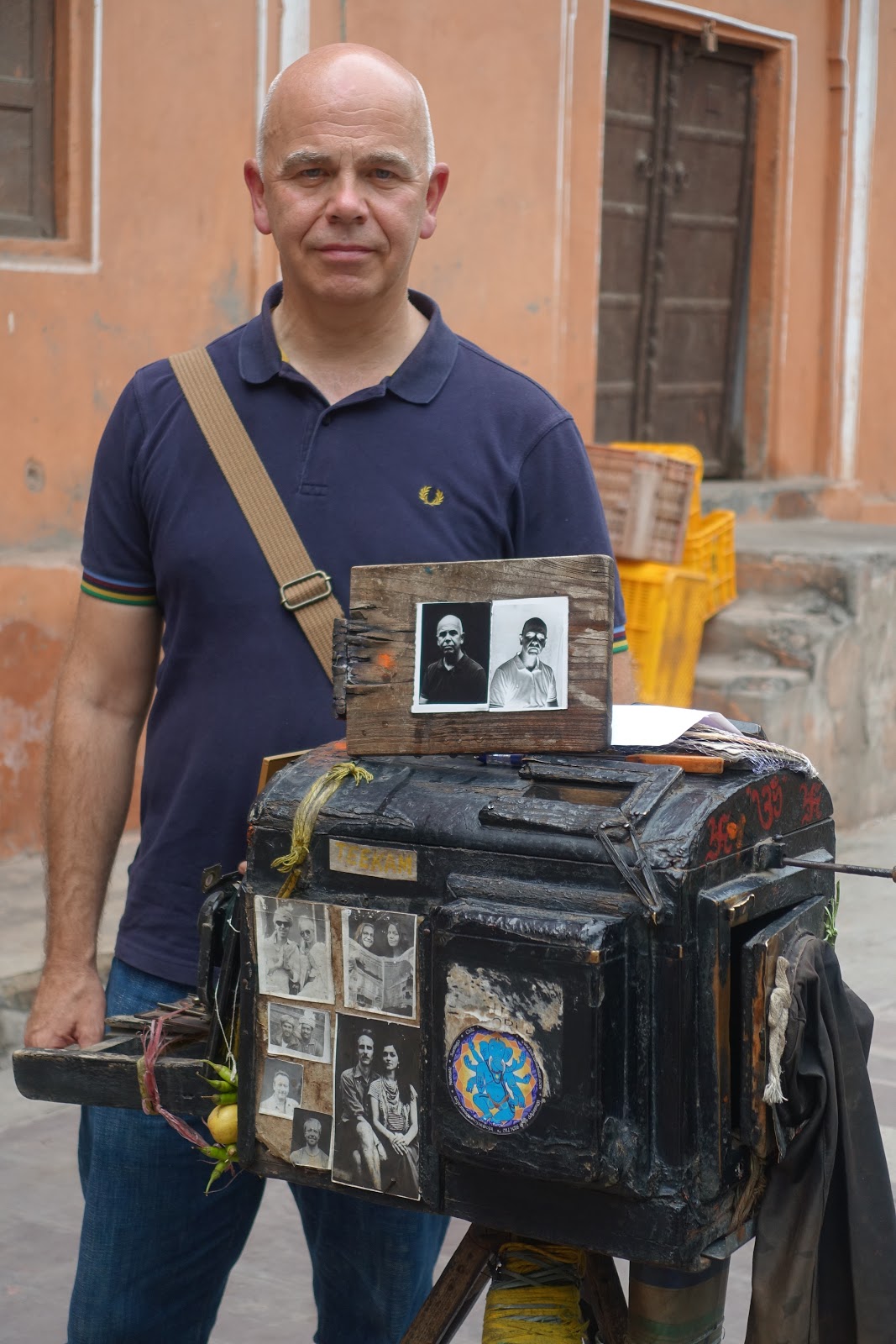
Today in Jaipur I stepped back into the glorious past of photography and took advantage of the excellent services of Mr Tikam Chand, a third generation street photographer who, since 1977 has been using his grandfather's 160 years old German Zeiss camera. Pahari Lal (the grandfather) and then his father occupied the same spot outside shop 120 on Hawa Mahal Road in the old city. Examples of his work are attached to the side of the camera, whilst pictures of the previous two generations of photographer are affixed to the wall behind him. These include a picture of his father, strikingly handsome with a mop of wavy black hair. 

The process is not rushed. Mr Chand explains a little about the camera. Then he positions clients on an 80 years old black metal chair, also purchased by the grandfather, disappears briefly under the hood and makes sure all is well before removing the lens cover for just a few seconds in order to take the picture. Black and white images are developed immediately using a bucket, water and various chemicals to complete the process. Sepia pictures can also be produced but take 2-3 days to be developed. This kind of business is always a tough one and as time goes on more challenges are presented.  He can no longer obtain the chemicals he needs in India and has to import them from France at some expense.


As I waited for the picture to develop, Mr Chand spoke to passing tourists, inviting them to look at the camera with its internal darkroom, developer and fixer. He also asked me to re-take the seat so that they could see me "upside down". Many of them are too young ever to have had their picture taken in this way and few will have much experience of seeing black and white photography. 

In just a few minutes my picture is ready. For just 300 rupees - about £3.40 I am handed a black and white image together with a negative. Using my camera, Mr Chand kindly took a picture of me standing beside these two images. I am delighted. I was also delighted by his proximity to Pandit Kulfi - a little shop selling this delicious Indian dessert. For just 30 rupees - less than 50p - I enjoyed a very satisfying almond and pistachio kulfi on a stick. Only in India.


If you visit Jaipur, don't just come and see the camera - have your picture taken. Mr Chand also has a Facebook page - the Old Photography

My picture cost 300 rupees. Three sizes of photograph are available at varying prices.

With the exception of his portrait, all the pictures on this post were taken by Mr. Chand.

Wednesday, 13 September 2017

A Postcard from India 2 - The People of Spice Alley, Mumbai's Lalbaug Market

Mumbai's Lalbaug neighbourhood was once home to several mills employing many workers in a range of industries. Today, the mills are gone and many of the chawls, communal housing built to house workers who moved to the city are being demolished and replaced with expensive high rise apartment buildings. However, some of Lalbaug's more interesting characteristics have survived, including the wonderful market with its spice alley of shops and stalls selling every spice you could ever want.

I visited Lalbaug in the afternoon after the main business of the day was concluded. Most of the  stalls were still open although one or two of the owners were napping on sofas or mats set out in the shops. I normally enjoy watching the drama of busy markets, watching people haggle about the price, choose and reject items or stand and gossip with the shop keepers and each other. However, visiting during the quiet time brings other delights - the possibility of more time to talk to the merchants and to walk freely without struggling through the crowds.


Strolling along the alley, you can see chillies being prepared for sale, with the non-usable parts being stripped away from the red or green fruit. This is done by hand. It is hard work and can result in painful burns if not done carefully. Most of this work is done by women who sit at the front of the stalls where the chillies will later be offered for sale. Once the customers have bought their spices, they take them to one of the small businesses at the rear of the market for mixing and grinding. I saw a young man heating a huge cooking pot before adding chillies and other spices under the watchful eye of the gentleman who had just bought them, stirring and folding them in the fierce heat.

In this part of the market, there is a constant loud, industrial, pounding noise as the cooked and mixed spices are then ground by young men operating powerful machinery. This results in spectacular red, yellow and other coloured ground spices ready for use in Mumbai's kitchens. The smell is intoxicating.


As with other markets, Lalbaug offers many opportunities for candid photography. The content looking  vested man sitting in the front of his store reading the newspaper made me think of a character from a Narayan novel whilst the man with the small general store noticed me taking his picture and responded with what must be the biggest smile in the market. Of course sometimes I ask for permission before clicking as I did with the lady separating the parts of the chillies. She gave her permission with a smile but then assumed a very serious pose for the camera before laughing when I showed her the result. 

Lalbaug also has a fish market which begins early in the morning and was practically concluded at the time of my visit. A number of cats were prowling the fish section, looking for any leftover treats. I noticed what might be the smallest kitten in the world, asleep beside a discarded chappel which might just have been a little bit bigger than the cat. Whilst looking at the kitten a man seated on a stone bench pointed out other kittens, took one on his lap and smiled into the camera.

Just across from the man with the kitten a woman was frying fish, liberally adding spices no doubt obtained from the alley. Not only did she say hello she also offered me some of her cooking. Sadly I had to decline. Disappointed at first, she understood when I explained my vegetarian leanings. She explained that she was not selling cooked food but was preparing a dish for her helpers now that the day's work was completed. An older man in a yellow and purple bandana sat beside her, grinding garlic and onion with a wooden mallet. When he saw me photographing his boss he moved towards me and positioned himself for a picture too.


Despite its name, the alley offers more for sale than spices. You can pick up your supply of paan - a combination of betel leaf and areca nut combined with herbs, spices and sometimes tobacco and then chewed and either spat out or swallowed. It is widely used in Asia although it can be injurious to health depending on the level of use and on what is included in the mixture. Other shops offer earthenware jugs for keeping liquids cool during the summer or grinding of wheat to make flour. Everything is laid out to attract the attention of shoppers. They goods are fresh and of high quality and the alley is clean unlike many similar markets across the world.

The spice market at Lalbaug is something to treasure in a city that is rapidly changing. Let's hope the creeping gentrification of the area does not impact adversely on this wonderful slice of old Mumbai. 


You can see more pictures from Mumbai here.

Friday, 8 September 2017

A Postcard From India 1- Mumbai's Cafe Britannia

It is believed that the first Parsis came to India some time between the 8th and 10th centuries, fleeing persecution in what is now Iran. Together with the Iranis, the Parsis are one of two groups practising the Zoroastrian faith. They have been extremely successful in India, particularly during the period of British rule when several members of the community achieved positions of prominence including in science, industry and the military. In recent decades the community has declined significantly in number due to emigration and an extremely low birth rate, but their presence is still felt though their historical achievements, the remaining Parsi temples and through their contribution to the city's cuisine.

Boman Kohinoor, proud owner of Cafe Britannia and fan of the Royal family
During the middle decades of the 20th century, Mumbai was home to several hundred Parsi/ Irani cafes serving authentic dishes including sali boti (mutton pieces cooked in a special gravy), fish patra, berry pulav and Parsi chapatis. Whilst most of these cafes have disappeared, some have survived through reinventing themselves as places to drink beer and to have snacks and a few have clung on to their roots. 

Cafe Britannia is one of the few remaining authentic Parsi cafes in the city. Founded in 1923 by Rashid Kohinoor, a Zoroastrian immigrant from Iran, it was originally established to serve continental dishes to British officers during the colonial period. Rashid's son, Boman, the current owner and still working despite being in his 90's tells a story that the name of the cafe was chosen because eating places needed to be licensed by the British and his father thought the name might encourage them to deal quickly and positively with the application. He was proved right and the cafe has been operating since then.

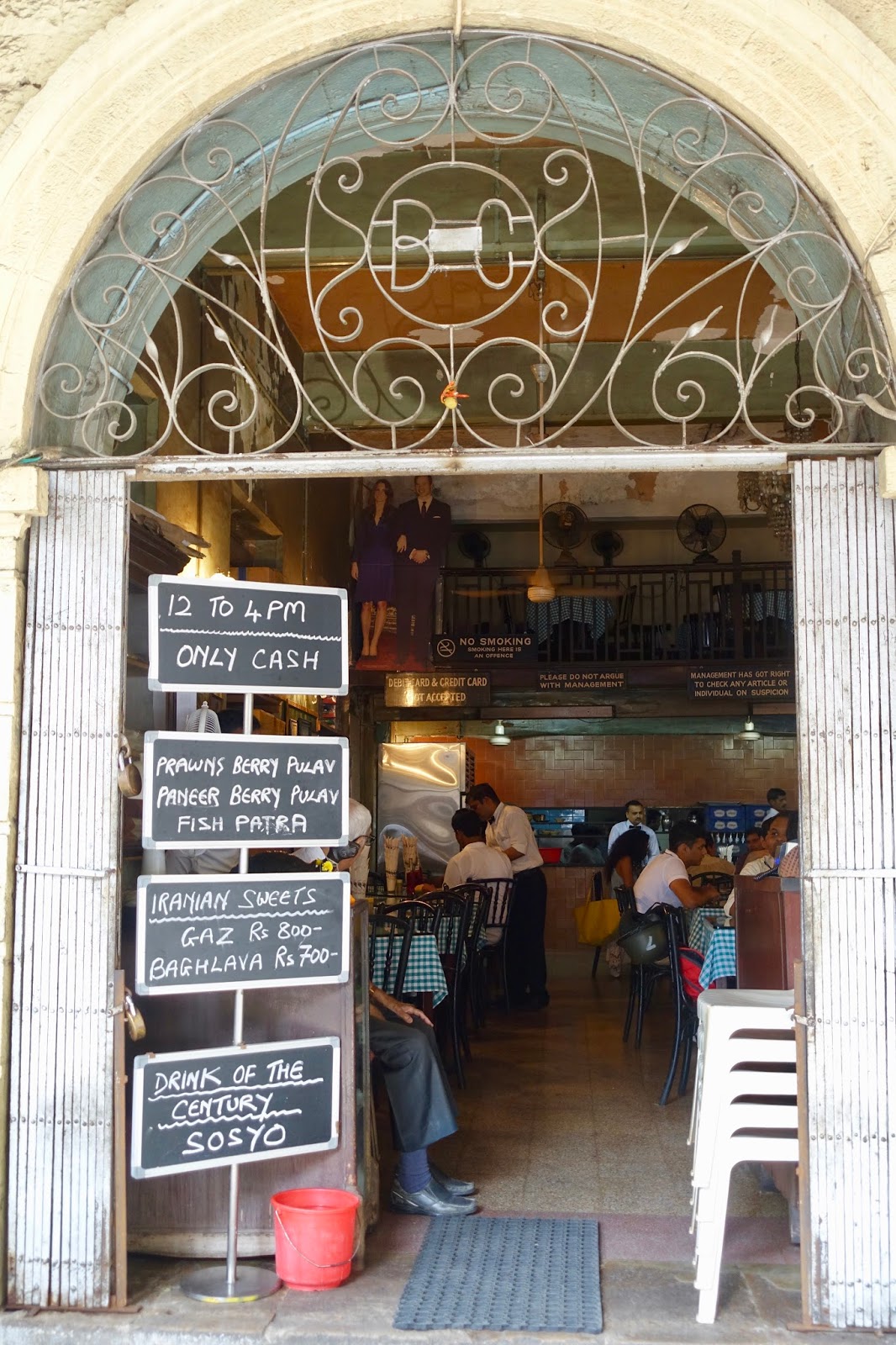
Some of the keynote dishes are advertised at the entrance
I ate lunch there a few days ago. I was charmed by the peeling paint, the beautiful bent wood chairs imported from Poland decades ago and the idiosyncratic rules and regulations displayed on the wall and on the menu all of which give a glimpse of a world almost disappeared. The rules include sensible stuff such as not allowing outside food to be brought in and a requirement to vacate seats as soon as you have paid to allow others to sit down but my favourite was a little less expected - do not argue with the management. I wish I'd thought of that when I worked with the public.

My food was delicious - vegetable biryani with a lemon soda - but perhaps the most memorable part of my visit was meeting Boman Kohinoor. He took my order, asked me where I am from and said I'll be back. A few minutes later he returned to the table saying I am back before proceeding to show me a number of laminated press clippings picturing him with Prince William and Kate Middleton as well as other articles about the cafe.  He is a devoted royalist and recently made the press when he was invited to meet the Royal couple when they visited the city. The invitation came as a result of a video appeal he made explaining how thrilled he would be at the opportunity to meet them in Mumbai. He continued to come and go from the table to speak to other customers, but always saying I'll be back and I'm back at the appropriate point before telling me a little more or even teasing me a little about where I come from. So are you from England, Britain, Great Britain, the British Isles or the United Kingdom he asked me. I told him London and he agreed that this was a good answer. Before I left he asked me for three favours - to ask the Queen to visit Mumbai, to kiss the children of William and Kate when I see them (!) and to come back and eat there again. I will definitely deliver on the third request, the first two will be more difficult.


Cafe Britannia can be found at Wakefield House, 11 Sport Road, 16 Ballard Estate, Mumbai 400038. Note - the cafe opens only between 12 and 4 and payment must be made in cash.