Thursday, 4 May 2017

Return to Bulgaria

I last visited Bulgaria in 1986. That's 31 years ago. My daughter was just two years old. She now has three children of her own, the youngest older than she was then. The country still had a communist regime. The restaurants had lengthy menus but most of the items listed were not available and choice was limited to  something called 'kavarna" - a watery stew and the famous Shopska salad with its salty white cheese. We ate lots of pizza purchased at a stall in the street as well as delicious fresh plums and apples being sold by elderly women at the side of the road. "Corecon" shops sold what were termed "luxury goods" consisting mainly of poor quality chocolate, cigarettes and drink purchasable only by tourists with foreign currency.

Alexander Nevsky Cathedral, Sofia.
There was constant pressure to change money at amazingly advantageous black-market rates but as there was so little to spend it on, taking the risk seemed pointless. This didn't deter the touts although telling them we were carrying Irish currency seemed to do the trick, producing a contemptuous response but peace at last. I have memories of clean beaches with plenty of space and an old lady who came every two days to clean our chalet and to change the towels. She was very taken with my daughter and brought her treats of fruit or nuts each time she came which were shyly accepted and then devoured.

I returned this year, due mainly to having discovered that Bulgaria has a large collection of modernist buildings from the 1930's and 40's and I have written separately about this here. In 1986, I spent most of my time in what was then the quiet seaside resort of Sunny Beach, now, I am told, massively over developed and flooded by young visitors from Western Europe each summer. I recall days trips to Varna, Sozopol and Burgas but not a great deal about what I saw there. Well, it was a long time ago and I had a two year old to entertain.

Bulgaria in 2017 is a very different place. The communist regime fell in 1989 and the country slowly liberalised, opening up to private enterprise before joining the European Union in 2007. Today, Sofia, Plovdiv and Varna offer the range and quality of cultural activity available in similar sized cities across Europe. There are many good quality restaurants offering local and international menus and although there is still poverty it is not as obvious as it was in 1986. In 2019, Plovdiv has a fantastic opportunity to show off its cultural splendours as it has been selected European Capital of Culture for the year. I spent three days in that city and have already written about its delights here

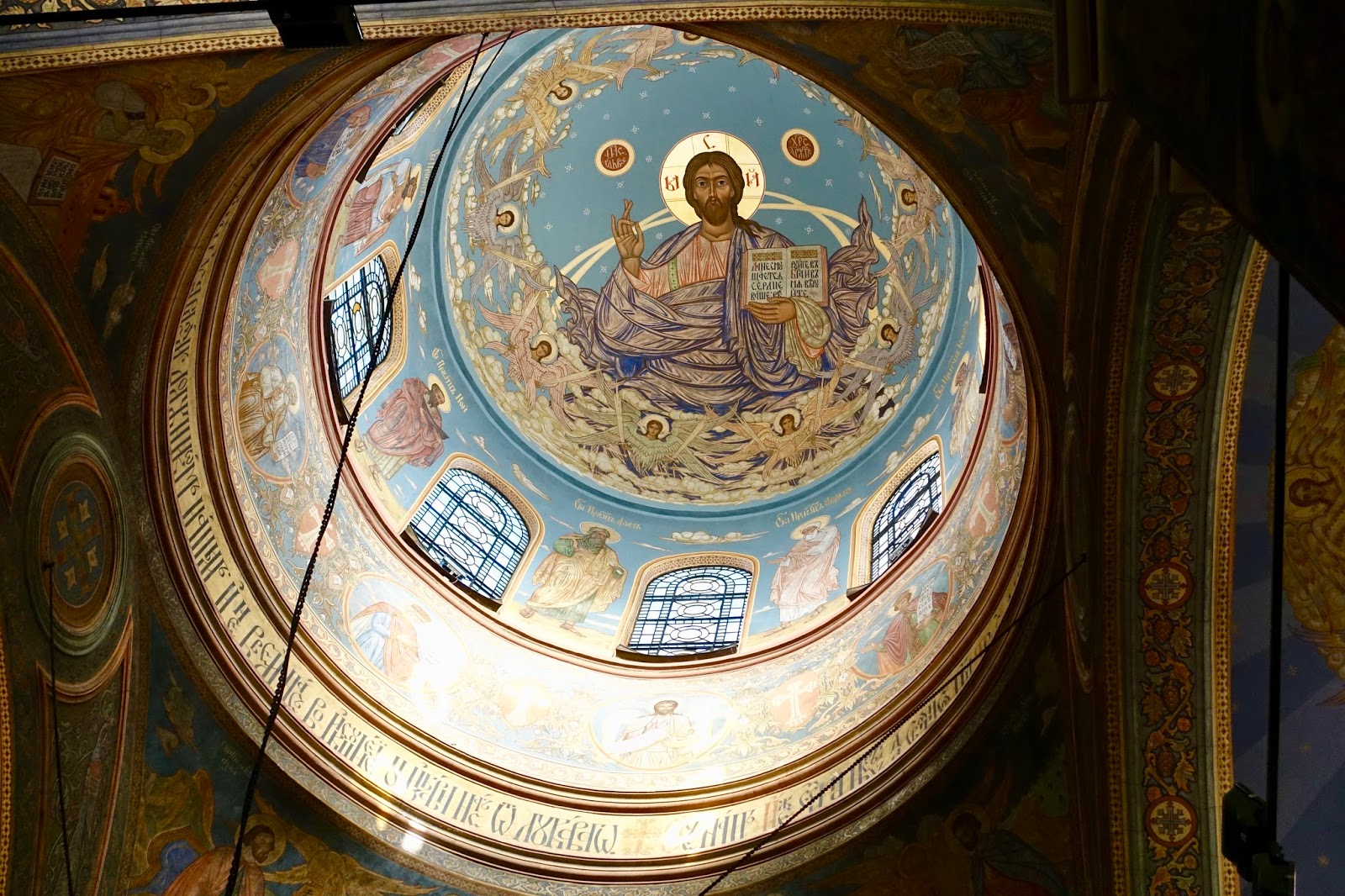
Interior detail, Alexander Nevsky Cathedral, Sofia.
I began my trip in the capital, Sofia which is just over two hours flying time from London. It is a city that does not have the immediate appeal of say Prague or Budapest but one which grows on the visitor, gradually revealing its delights which include not only the spectacular modernist architecture already referred to, but a superb National Gallery, the iconic Alexander Nevsky Cathedral, some interesting markets and several stylish cafes.

The Cathedral is a symbol of both Sofia and Bulgaria. Occupying a massive site it can accommodate up to 10,000 people. The interior is decorated with Brazilian onyx and Italian marble whilst the main dome is gold plated and stands a towering 45 metres high, with the bell tower eight metres above it. The interior walls are covered with murals depicting various biblical scenes whilst the Lord's Prayer is inscribed around the central dome. The Cathedral is named for a Russian prince, Saint Alexander Nevsky in honour of the Russian soldiers who died in the Russo-Turkish War of 1877-78 which resulted in Bulgarian independence from Turkey. Work began on the construction in 1884 but was not completed until 1912. Russian Alexander Pomerantsev was the main architect. He also designed a church in Moscow of the same name as Sofia's Cathedral as well as several civic buildings.

The city is also home to Europe's largest synagogue although it was not open for visitors whilst I was there. Bulgaria, despite being an ally of Germany, resisted pressure to deport the country's Jews during the Second World War due in no small part to the intervention of the Orthodox Church. There are a few thousand Jews in the country today, the vast majority having left for Israel in 1949. A small museum, tucked away behind the synagogue tells the story of Bulgarian Jewry.

Flower stall, Women's Market, Sofia
Book themed seat, Book Market, Sofia
Sofia has a number of markets. Close to the well-kept Central Market Hall there is a lively street market originally called the Women's Market. Sofia's citizens come here to buy fresh fruit and vegetables, meat and fish,  olives, herbs and spices, flowers, household items and cheap clothes. Fruit and vegetable stall holders spray their produce with water throughout the day to keep it looking as fresh as possible and to try to get an edge on the fierce competition with neighbouring traders. There is also an open air Book Market in Slaveikov Square, where the stalls offer an eclectic mix of academic books, second hand novels in Bulgarian and a smattering of other languages, publications to help learn another language and children's books. There are also a few stalls here selling stationery and cheap gifts.

As in most European capital cities, there is plenty to see if you just wander. Sofia's streets provide a stage for many musicians whilst in the City Garden Park during good weather, chess enthusiasts gather to play on the specially designed tables or on the park benches, often attracting groups of spectators and supporters. The more serious players even bring their timing devices with them. Stepping away from the main streets brings rewards too like the fabulously colourful housing unit pictured below.


A surprise in a Sofia side street.
Street musicians, Sofia

Bulgarian art is little known outside of the country This is a pity as in addition to older religious works, Bulgaria produced some superb artists during the 20th century including Jules Pascin (often mistakenly thought of as French due to having been part of the Montparansse group) and modernist painters Vera Nedkova and Bencho Obreshkov, the latter of whom studied under Oskar Kokoschka. The huge National Gallery just across from the cathedral exhibits pictures by each of these artists together with hundreds of other works charting the history of Bulgarian art.

The Sofia History Museum is also worth visiting. It tells the story of the city through displays of objects, photographs and films. Some sections are more interesting than others but the final gallery with its tram carriage, shop signs, advertisements and film of the city in the first part of the twentieth century is great. The exhibitions are to some extent upstaged by the building which was once the Central Mineral Baths. The exterior is especially attractive due to its red, white and yellow stripes and decorative ceramic details.

Sofia History Museum
Winter Garden staircase, Bulgaria Complex, Sofia
I have already mentioned my lack of culinary experiences during my 1986 visit. Things are very different now. I was even able to find a couple of restaurants specialising in vegetarian food. Dream House  is a small, friendly restaurant with daily specials and some good soups and salads. It is a little hard to find at the top of a flight of stairs in a multiple occupancy building but its worth the effort. Veda House has an interesting menu with Indian and Middle East influences including good humous (hooray). Regular readers know that I search out good patisseries and bakeries. Sofia has many cake shops but I especially enjoyed my tiramisu at the cafe in the Bulgaria Ccomplex where they also allowed me a peek at the winter garden and its fabulous staircase, deco details and retractable roof. The complex includes a concert hall and book shop and was completed in 1937 to the designs of Stancho Belkovski and Ivan Danchov.

The Rila Monastery is a couple of hours drive from Sofia. Surrounded by the Rila mountains it is a symbol of Bulgaria and possibly the country's major tourist attraction. I visited in April before the main visitor season starts and arriving early in the morning had the place more or less to myself for the first hour. 

Rila Monastery
Rila, external murals
The monastery is protected by austere fortress style walls designed to deter bandits, robbers and others who jealously eyed its wealth during its long history. The walls are the only austere feature of the monastery as upon entering the courtyard, visitors are overwhelmed with the astonishing, vibrantly coloured external wall paintings of the Church of the Nativity of the Virgin Mary, the black and white Byzantine style stripes of its arches and the brilliant white three storey living quarters of the monks. Add the snow capped mountains as a backdrop and you have what must be one of Europe's most beautiful views. 

The interior walls of the church are completely covered in frescos depicting the triumph of good over evil whilst one of the external works depicts the various circles of hell as a warning to transgressors.  The paintings were the work of Bulgarian artist Zahari Zograf. There is also a beautiful iconostasis made from walnut, decorated with gold leaf and featuring carvings of flowers, fruits and birds. Photography is not allowed inside the church but you can take as many pictures as you like in the courtyard.

The current monastery was completed in 1335 under the patronage of Stefan Hrelyo Dragovol, a boyar or nobleman, but was named for the hermit Ivan Rilski who founded the original hermitage a few centuries earlier. A major fire in 1833 was followed by significant rebuilding and restoration which included making use of Bulgaria's greatest artists and craftsmen. 

The drive from Rila to Plovdiv took three hours and passed tough many small villages where life remains much the same as it has for centuries. It was not unusual to see a horse and cart being used to transport goods and people. The road passes through vineyards and other crops and because it was spring I also saw many storks and their nests perched on top of telegraph poles.

Varna, by the Black Sea
Art nouveau, Varna
Art nouveau, Varna
I visited Varna in 1986. It was supposed to be a day trip with the dolphinarium in the morning (ok not my thing either but my daughter enjoyed it), followed by museum visits in the afternoon. Shortly after entering the dolphinarium torrential rain began and continued for the rest of the day resulting in the other visits being cancelled, so this was the first time I had a proper look at the city. I was not disappointed. Sitting on the Black Sea shore, it has a similar feel to Odessa with its architectural and cultural richness complemented by clean beaches and a very relaxed atmosphere. 

A few weeks after my early April visit, Varna's beaches would become crowded with visitors from Western Europe but as with Rila, I had the beach pretty much to myself and although I needed to wear a sweater and light jacket, it was sunny enough to sit outside a beach cafe enjoying the strong coffee and homemade strawberry ice cream. Just to help the local economy of course. My hotel was just a few minutes from the beach across the elegant Sea Garden that separates the city from the Black Sea. Founded as a very small affair in 1862 towards the end of the Ottoman period, the Garden was massively expanded under Mihail Koloni, the first Mayor after liberation. Over the years it has been extended and improved and includes a planetarium, observatory and zoo as well as many cafes, bars and restaurants. Cosmonaut Yuri Gagarin planted a silver fir there in 1961 in the Alley of the Cosmonauts.

The city's main attraction is the Roman bath or thermae, established in the second century and one of the largest in Europe at more than 7,000 square metres. It is still possible to see the remains of the changing rooms, cold, warm and hot pools and a large social area. The heating was provided by a hypocaust, an underground system of pipes. The baths remained in use for about a century before being abandoned as the Roman Empire faded. During the 14th century, craftsmen used the structures as workshops and today the site is a major open air museum.

Roman Thermae, Varna
Cathedral dome, Varna
Popular Bank, Varna
Varna's architectural richness runs from Roman ruins to baroque and Art Deco apartment blocks, some fabulous modernist buildings from the 1930's and of course, the Dormation of the Mother of God Cathedral. The unusual name was chosen in honour of the former Empress Consort Maria Alexandrovna of Russia, a relative of the Bulgarian royals. Completed in 1886, it is one of Varna's most iconic images with its several domes and beautiful interior where, as with Rila, every surface is covered in frescos. And then there is the stunning interior of the main dome with its central Christ figure surrounded by saints against a blue background. Spectacular.

Much as I love the cathedral, my favourite Varna building is the modernist apartment block on Primorksi Boulevard designed by Stefan Benedikt-Popov and completed in 1933. Known as "The Beach" it has the appearance of an ocean liner with long balconies at each level and a squared off tower that continues the nautical theme. There are many other modernist buildings in the city including the very cool Popular Bank designed by Zhelyazko Bogdanov and built from 1938-39, and a charming apartment building in San Stefano Street, the details of which are unknown.

"The Beach" apartment block, Varna
Modernist apartment block, details unknown, Varna.


I doubt it will be another 31 years before I return to Bulgaria.

You might also like Bulgarian Modernism - A Well kept Secret or A Few Days In Plovdiv

You can see more pictures of Bulgaria here.

Tuesday, 25 April 2017

Picture Post 62 - Cholmeley Lodge, North London Modernism

It takes just ten minutes to walk from Archway Station up Highgate Hill to the High Street of the same name.  Highgate Hill is one of London's highest points and it is a steep climb from the station. However, those who persevere are rewarded with the site of one of the country's finest 1930's apartment blocks.


Completed in 1935, Cholmeley Lodge was the work of Guy Morgan who also designed Florin Court in the City of London. The Lodge shares some features with Florin Court, in particular  the wave of three curved crescents on the facade. Awarded Grade ll listed status in 2003 for architectural and historical interest, the building was constructed with yellow bricks and cast stone with steel horizontal bar casement windows. There are four entrance doorways with fluted surrounds and a curved canopy, each bearing the name of the block in stylised lettering. Boldly projecting, squared off balconies on every floor enhance the overall impact.

Each of the delightful crescents have staircase towers leading to a flat roof, designed as a sundeck and which must offer spectacular views over the city. Reflecting both the modernity and the class divisions of the 1930's, the Lodge was designed with a series of lifts for residents and staircases for trades purposes - at the rear of the building of course. The listing status refers to 54 flats in the block, although according to a 2006 Haringey Council report on the Highgate Conservation Area there are only 48.


If things had gone as planned, Cholmeley Court would never have been built in London. It was originally intended for Bournemouth but was rejected by the local planners as they found the ultra-modern design too stark and demanded that Smith soften the elevation with Tudor timber work! Thankfully, Morgan refused to comply and Bournemouth's loss became Highgate's gain. The block is in a very pleasant side street and is surrounded by very well kept gardens. I checked to see if any of the units are currently for sale. None are but a three bedroomed apartment was recently sold for £1.3 million. Better start saving. In the meantime, the schlep from Archway Station to Cholmeley Court is well worth the effort and it's good exercise too.


You can see more pictures of London's art deco buildings here.

Saturday, 22 April 2017

A Few Days In Plovdiv

Plovdiv is one of the oldest cities in the world. Its long history includes being conquered by Philip of Macedon in 341 BC, capture by the Romans in 46 AD, attacks by the Goths and Huns and five centuries of Turkish rule under the Ottomans.  Evidence of its long history is everywhere with Roman remains, Byzantine churches, two mosques, a synagogue, superb Bulgarian Revival architecture and some wonderful modernist buildings from the 1930's. This long history together with a vibrant contemporary cultural scene has resulted in Plovdiv being selected as European Capital of Culture for 2019. I recently spent a few days there. Here are some of the highlights.

Bulgarian Revival architecture - The Ethnographical Museum, Old Town
Bulgarian Revival Museum, Old Town
The old town is a treasure house of Bulgarian Revival architecture much of which has been restored in recent years. Several of the buildings are now museums including the Museum of the Bulgarian Revival housed in the former home of wealthy merchant Dimitur Georgiadi. The museum details Bulgaria's struggle to free itself from 500 years of Turkish rule via a number of small exhibitions spread across the museum's three floors. Paintings, artefacts, maps and other documents are used to tell this harrowing story but the building itself is possibly the main attraction with its symmetrical and ornamented red facade, beautiful wood carved ceilings and huge reception room at first floor level. There is also a pleasant garden at the rear of the building.

The Hindliyan House, Old Town
Ceiling, Hindliyan House, Old Town
Alfranga, Hindliyan House, Old Town
Several other Revival style houses are open to the public. The Hindliyan House, completed in 1835 for Stephen Hindliyan, an Armenian merchant, is arranged over two levels. It has beautiful carved ceilings, intricate wall decorations that make use of geometrical and floral motifs and a collection of paintings depicting different cities. Decorative alcoves called alfrangas are key features of many of the Bulgarian revival houses. They are intended to create the illusion of a window with gardens, landscapes and other views painted on to them. The house has several exquisitely decorated alfrangas whilst the first floor also has a Turkish bath and steam room, emphasising the wealth and prominence of the Handliyan family. You can buy a single ticket at most of the houses in the Old Town and use it to visit five buildings of your choice from a list of several. 

Old Town Street Scene
Books for sale, Old Town
Traditional carriage holding items in antique shop, Old Town
The Old Town also has many craft and antique shops. I especially liked the shops around Saborna and Tsanko Lavronov streets where there are on treasure troves of books, ephemera and Bulgariana. I was very tempted by a number of items and came away with a 1930's postcard promoting a Bulgarian brand of shoe polish (!) and some colourful advertising works on paper. There are artists' workshops lining the steep, narrow, cobbled lane leading to the peak of the Old Town. These include the ceramics workshop of Tsvetana Videva who will demonstrate her work to visitors as do neighbouring weavers whilst opposite I came across another find - the tiny antique shop of musician "Peter Pan". Peter will play you a tune on a variety of instruments whilst you browse the wooden items, vintage toys and other items in his eclectic collection. Continuing along the lane to the top, you will be afforded views across the city, making the climb all the more worthwhile.

Tsvetana Videva, ceramicist, Old Town
Roman Theatre with views of the city and hills
Roman Theatre - The Stage
The Roman theatre is perhaps Plovdiv's star attraction. Built into the hillside with 4,000 seats it is still in use with an extensive programme of opera and classical music. Built in the First Century AD during the reign of Emperor Trajan, it originally seated 7,000. Some sympathetic restoration work has been undertaken to ensure the safe use of the theatre which was rediscovered and excavated in 1972.  Anyone performing here will have to be good because they are in competition with spectacular views of the city and the surrounding hills. 

Plovdiv also boasts another significant Roman site - the former stadium in the commercial heart of the city which is easily accessible from the street. This is the city's main shopping and entertainment area with many shops, cafes, restaurants, theatres and galleries. Busy night and day, it also draws aspiring musicians and strolling along the main drag you can hear music of various genres including traditional music played on the Bulgarian bagpipe. Excavation and restoration work is currently being undertaken on a third ancient site - an enormous 5th Century Basilica where exquisite early Christian mosaics have been uncovered. It is anticipated that the works will be complete by the end of 2018.

Bulgarian Bagpipe player
Street art, Kapana
Kapana street scene and the Dzhumaya Mosque
The Kapana quarter, adjacent to the commercial centre and a short walk from the Old Town is Plovdiv's edgy, artsy quarter filled with cafes, bars, independent shops and contemporary art galleries. Kapana itself is a huge art gallery, with interesting and sometimes challenging street art covering many of the walls or shop shutters.

Established in the 16th century during the Ottoman period, Kapana was originally home to merchants and craftsmen and this is reflected in some of the street names - Zhelezarska Street (Blacksmiths' Street), Zlatarska Street (Gold Street) and Kozhuharska Street (Furriers' Street). The neighbourhood was redeveloped in the 1920's as a residential area, evidenced by the late art nouveau, neo-classicist and occasional modernist buildings in Kapana's network of streets. In later years, the area declined and many shops and homes stood vacant before the Municipality, recognising the area's potential began a programme of restoration and encouraged small businesses to move in. Today it is a busy area especially popular with young people who fill the tables of the street-side cafes on sunny days and come to enjoy the upbeat atmosphere in the evenings.

Street art, Kapana
Cafe, Kapana
Street scene, Kapana
I have already written here about Plovdiv's superb collection of modernist architecture from the 1930's but can't resist adding a couple of pictures in this post to illustrate the city's architectural diversity. And because I love modernist architecture!

9 Archimandit Damaskin Street, 1937, architect- Svetoslav Grozev
Modernist building, central Plovdiv, details unknown.
Plovdiv boasts many good quality restaurants and I had no problem in finding places serving good vegetarian dishes. The restaurant of the Hebros Hotel in the Old Town was recently voted Bulgaria's best. It serves traditional Bulgarian food and has very good soups and desserts. The hotel is in a Bulgarian Revival building which adds to the atmosphere of dining there.  Atlas in the commercial centre is a modern restaurant offering a good list of pastas, salads and more substantial dishes. I enjoyed a delicious (and filling) pasta dish at one of the alfresco tables. The service here was very good too. The third place I ate at was Pizza Verdi in Nayden Gorev Street where the food is simple but tasty and here there are also outside tables. Again, the service was good with friendly and attentive staff. It is possible to eat well for comparatively little cost in all of Bulgaria.

It takes about 90 minutes to drive from Sofia to Plovdiv and there are also trains and buses that link the two cities. It is a great, compact city, easy to navigate and packed with interesting and unusual things to see and do. It is also a great location from which to explore the surrounding countryside and the Rhodope mountains with their many monasteries and villages. Plovdiv's well-deserved selection for European Capital of Culture 2019 will showcase the city's many attractions as well as a special programme of high profile concerts, exhibitions and sports events and offer the chance to experience the more local, "cosy" Plovdiv, its arts, crafts and cuisine. But you don't have to wait until then to go...

You might also like Bulgarian Modernism - A Well Kept Secret or Novi Sad - Another Serbian Surprise

A series of Plovdiv walking routes have been published under the "Alternative Plovdiv" heading. You can use them online or download hard copies here.

You can see more pictures from Bulgaria here

Sunday, 16 April 2017

Bulgarian Modernism - a well kept secret

The modernist architecture of Paris, Prague, Vienna and Rotterdam  is well known whilst more recently, cities in Eastern Europe have begun to be recognised for their contribution to the genre. Bucharest and Kaunas are good examples of this but perhaps it is Bulgarian modernism that has been the continent's best kept secret and which is only now beginning to receive attention. This is largely due to the superb Facebook Group - Bulgarian Modernist Architecture - which carries many examples of the style together with, where known, details of the dates of construction and architects responsible.  It is no exaggeration to say that this Facebook page was responsible for my re-visiting Bulgaria after a gap of 31 years. The page is the work of Vasil Makarinov and Theodor Karakolev. On my recent visit Vasil was kind enough to give me a tour of some of Sofia's best examples of the style.

 48 Vitosha Boulevard, Sofia. 1937-38, Radoslav Radoslavov and Konstantin Djangozov 
It is important to note that Bulgaria's modernist buildings are not limited to Sofia. Examples can be found in many towns and cities including Plovdiv and Varna which I was also able to visit. As elsewhere, the architecture from this period has not always been recognised for its importance and a number of buildings have already been lost. But, as Vasil explained, the greatest threat to preservation comes from "renovation" which in many cases really means removal of important original features and making unsympathetic additions to the extent that the building loses its original character and becomes unrecognisable. Unfortunately this is a global problem and the examples of near vandalism in Bulgaria are replicated in many cities and countries.

Many of the buildings also suffered significantly during the Communist period. Property was removed from private ownership, the owners ejected or forced into a small part of their former homes and proper care of the buildings became extremely difficult if not impossible. Since the fall of the former regime some properties have been restored to the original owners but this is a complex and lengthy process and whilst it is played out there is further deterioration

Karadzhata  building, 3 Moskovska Street, Sofia. C1930, Krustan Gechev and  Peter Karasimeonov
Bulgaria's route to modernism was a little different to that of other countries. Independence from Turkish rule was not achieved until 1878 following 500 years of Ottoman rule during which Bulgarian culture was largely suppressed. Soon after came the the Balkan Wars of 1912-13 and the First World War 1914-18 neither of which went well for Bulgaria and perhaps because of this, the period between the 1920's and 1940's was one of great change economically, socially and culturally.

With the onset of industrialisation many people moved to the cities, specially Sofia, Plovdiv, Varna and Burgas, creating an urgent need for additional housing as well as public buildings. This brought good opportunities for architects but Bulgaria's first university architectural and engineering course was not established until 1942. Until then, architects working in the country were either foreign or had been educated in Paris, Vienna, Berlin or Prague. This resulted in modernist influences from other parts of Europe impacting on Bulgaria, including the use of concrete, steel and glass whilst the ideas of the Bauhaus School, Le Corbusier and others about hygiene, separation of living and sleeping spaces and access to fresh air gained ground here too. Little has been published in English about the architects responsible for these buildings but Vasil was able to provide some details for me to supplement my own findings.

Viktoria Angelova-Vinarova was born in Veliko-Tarnovo in 1902. Her father was a British educated merchant who apparently named her after Queen Victoria. The Bulgarian Viktoria studied at Vienna's University of Technology and then Dresden Polytechnic before returning to Sofia at the age of 24 to work as an intern at the Ministry of Public Works. She married another architect, Boris Vinarov in 1933 and they set up a practise together. Their home was destroyed in the Allied bombing of Sofia in 1944 and they moved to Veliko Tarnovo where Viktoria became ill with pneumonia from which she recovered only to die when the illness returned in 1947.

37 Moskovska Street, Sofia. 1937, Viktoria Angelova-Vinarova.
As well as working in the neo-classical style, she was responsible for a number of modernist buildings including the apartment block at 37 Moskovska Street, Sofia and the fabulous Sea Casino in Burgas. Her Moskovska Street building is just a short step from the iconic Alexander Nevsky Cathedral.  The austere grey facade is outstanding due to its series of balconies over the top five levels. Completed in 1937, each of these floors has three balconies, a semi-circular central one flanked by two more in the "Bauhaus" style with each one apparently accessed through a set of floor to ceiling windows. Several of the windows have been "modernised" but some originals remain. 

Angelova won the Sea Casino commission through an open competition and designed a thoroughly modernist building with Art Deco influenced portholes and a roof terrace overlooking the sea as part of a general nautical theme. It opened to great fanfare in 1938 but was abandoned in the 1990's and left to deteriorate. It has since been restored, reopening in 2011 and now operates as a cultural centre with a programme of concerts, theatre, cinema, classes and other activities. The restoration received Bulgaria's Building of the Year Award in 2011. I was unable to visit Burgas during my recent trip but it is on my list for next time!

63 Vitosha Boulevard, Sofia. 1946, Vasko Vassilev.
Vasko Vassilev was born at the beginning of the 20th century and came from a family of architects, his father having been the Chief Engineer of Sofia. Vasko studied architecture in Linz, Austria and began practising in the 1930's. He was known to mix with leading artists and had a collection of paintings received as gifts from some of the leading Bulgarian painters of the day. Vassilev was responsible for designing several apartment buildings in which he demonstrated a commitment to streamline design principles and which even today have a contemporary feel to them. Unfortunately, his career was cut short in 1948 when the Communist authorities banned private enterprise and his architectural office was forced to close. One of his buildings stands at 63 Vitosha Boulevard on Sofia's main pedestrianised shopping street. A late example of the modernist style it was built in 1948 as a housing association apartment block. It has retail on the ground floor with residential units above. Standing on a corner plot, it has superb curved windows, narrow balconies running the length of the facade and a rooftop terrace which must afford fantastic views of the mountains that surround the city.

48 Vitosha Boulevard, Sofia. 1937-38, Radoslav Radoslavov and Konstantin Djangozov
59 Vitosha Boulevard, Sofia. 1938-39, Radoslav Radoslavov and Konstantin Djangozov
Office building central Sofia. 1937, Konstantin Djangozov.
Vitosha Boulevard is home to two more excellent modernist buildings that face each other across the pedestrian walkway. Both were designed by the uncle and nephew team of Radoslav Radoslavov and Konstantin Djangozov who like other Bulgarian practitioners had studied abroad this time in Paris under the direction of Auguste Perret. Perret was himself responsible for a number of modernist and Art Deco buildings constructed throughout the 1920's and 30's. Radoslav also attended lectures with Le Corbusier and it is known that they continued to correspond following the former's return to Sofia. Back to Vitosha Boulevard. The Nedkov Apartment building at number 48 was built in 1937-38. It is striking for its red and white facade and the glazing that runs the length of each floor, but for me the outstanding features are those exquisite white corner balconies that protrude from the edge of the building, drawing our gaze upwards and giving the building such a Mediterranean feel. 

The Urumov building at number 59 has the same red and white facade with squared off balconies and a roof garden. It was completed in 1938-39. Imagine how desirable these apartments must have been back in the late 1930's...and how much they are now. The two architects also completed separate commissions. I particularly like Djangzov's office block in central Sofia. Occupying a corner plot, it is supported on stilts, has a roof terrace and trademark glazing running the length of the facade  which  ends in a superb curve.

Former Assicurazioni Generali building, 5 Moskovska St, Sofia.1938-40, Asen Mihaylovski.
38 Vassil Levski Boulevard, Sofia. Circa 1929, architect unknown
In addition to the Facebook group, Vasil has worked with a number of friends to produce an exhibition focusing on 25 key Bulgarian modernist buildings with information in both Bulgarian and English perhaps making it possible for the exhibition to be seen overseas in future. It is also encouraging to note that some of Plovdiv's key modernist buildings are being promoted through the Alternative Plovdiv mapping project. Perhaps more well known for its Roman theatre and stadium and for its Bulgarian Revival buildings in the old town, Plovdiv also has some superb modernist buildings. 

The white painted house at 9 Archimandit Damaskin was built in 1937 for Dragomir Tsankov, an industrialist and Chair of the Plovdiv Chamber of Commerce from 1938-43. Designed by Svetoslav Grozev it would not look out of place in Tel Aviv. Despite the peeling paint, overgrown garden and heavy duty security fencing surrouning the house, it remains supremely elegant with its roof top terrace, glazed stairwell and side balcony which must have once looked out over a pristine garden. Today it is flanked  by a busy dual carriageway but at the time of building it would have been on the edge of the city with cafes and shops on Otets Paisiy Street and fields on the other side.

9 Archimandit Street, Plovdiv. 1937, Svetoslav Grozev.
18 Tsar Alexander Street, Plovdiv. 1930's, Stefan Todorov.
Industrial School, Plovdiv. 1930's, Svetoslav Grozev and Dimitar Popov.
The apartment block at 18 Tsar Alexander Street was built in the 1930's and designed by architect Stefan Todorov. It has a delightful scoop at the rear with a concave walkway/ balcony at each of the upper levels as well as a loggia at the front of the building. In addition to this there is a glazed stairwell and a curved staircase drawing visitors to the front door. Despite needing a little loving it really is a show stopper. Just across the road at 70 Gladstone, there is another modernist building - the Professional High School of Interior Design and Wood Processing, better known as the Industrial School. Also built in the 1930's it was designed by Svetoslav Grozev (who also designed the Tsankov House) and Dimitar Popov. A red brick structure, it has a spectacular glazed stairwell, a tiny balcony on the corner of the facade which mirrors the shape (although not the size)  of the canopy beneath.

Finally to Varna,  Bulgaria's third city which stands beside the Black Sea. I like Varna very much. It has the upbeat atmosphere of a popular seaside town, a delightful Sea Park and a range of architectural styles including ancient Roman ruins, art nouveau, baroque and of course, modernism. There are numerous modernist apartment blocks throughout the city, but perhaps the most striking, and possibly my favourite is the fabulous apartment block at 59 Primorski Boulevard. Known as "The Beach" and built in 1933, the architect responsible was Stefan Benedikt-Popov. It has the appearance of an ocean liner with long balconies at each level, beautiful original windows (at some levels) and a squared off tower which continues the seafaring theme. The upper levels have spectacular views across the park and over the Black Sea. 

59 Primorski Boulevard, Varna. 1933, Stefan Benedikt-Popov
I need to thank Vasil once again for his time and help in Sofia as well as for answering my many questions about dates and architects for the buildings featured in this post. It was great to meet someone with so much enthusiasm and tenacity. Let's hope that over the next few years Bulgarian modernism will become as widely known as that of other European countries. The forthcoming exhibition will certainly help. We just need him to write a book now...

And to finish -  a bit of an Art Deco treat,  the dramatic staircase from the Winter Garden at Sofia's Bulgaria Hotel and Concert Hall complex, built in 1937 and designed by Stancho Belkovski and Ivan Danchov. Fabulous.


You can see more pictures from Bulgaria here.