Saturday, 20 July 2019

Edificio Solimar - Havana's Modernist Masterpiece

Havana is home to many art deco buildings. They range from the pure "deco" style to later modernist and streamlined structures, often with a local touch added to the mix. One of the city's finest streamline structures stands in the otherwise modest Calle Soledad at the junction with Calle San Lazaro in the Havana Centro neighbourhood. Edificio Solimar was completed in 1944 and designed by architect Manuel Copado. A seven storey apartment building, it consists of 50 units and occupies about 1130 square metres. 


I was lucky enough to see the building for myself during my recent time in Cuba. Spectacular as the images I'd seen on the internet are, nothing quite prepared me for turning the corner from San Lazaro and coming face to face with the spectacular recessed and undulating facade, so reminiscent of the waves from the nearby Caribbean Sea. This effect is achieved by what appear to be balconies running the length of building at each floor but which are in fact passageways providing access to the front doors of the apartments. The balconies are much more discrete and tucked away at the rear of the building. The spectacular curves of the facade contrast sharply with the rectilinear design of the remainder of the street. Not only that, the upper floors stand out clearly from the rooftops of the El Vedado quarter, delightfully incongruous compared to the surrounding buildings.


The main entrance to the Solimar is surprisingly decorative, metal with ornate flourishes suggesting floral motifs. Directly opposite the building there is another apartment block - Caracas. Much starker than the Solimar, it does however boast some rather stylish lettering over the main entrance. An extensive internet search has failed to turn up further information about either Edificio Solimar or its architect. It would be interesting to know more about him as well as stories about the building's residents, both past and current. Readers with other details are very welcome to share them!


You can see more pictures of Cuba here.

Friday, 28 June 2019

Tel Aviv Tales - 4 Change and tradition in the Jaffa Fleamarket

If Tel-Aviv is my favourite city then Jaffa is probably my favourite neighbourhood. I love the faded grandeur of its main street - Jerusalem Boulevard, the quiet lanes and galleries of the old city, the smell of the sea and the possibility of stories on every corner.

Most of all I love the flea market - the Shuk HaPishpeshim. Known for its antique, carpet and furniture shops, the Shuk has seen many changes in recent years. As older traders have retired or died, their premises have been acquired by new, mostly independent cafes, bars, restaurants and design shops, making for an eclectic mix and attracting a new, younger audience reflecting the gentrification to the area. This has resulted in a new night time economy with many of the new businesses staying open into the evening, some of them offering live music at the weekend. Whilst this is new in the Shuk it is not new to Jaffa which in the 1960's and 70's had a thriving nightlife with legendary clubs including the Hammam, the Ariana and the El Dorado the latter of which was to give its name to a gangster thriller movie shot in Jaffa in the 60's. These places are now long gone but perhaps the new bars are reviving this tradition.


Reuven Sinai, carpet and vintage clothing dealer
Mikhail, antiques dealer
Despite these changes a number of older businesses survive, especially on the Shuk’s main street, Oley Zion and the surrounding alleys. I was recently able to talk to some of the older traders, to hear their stories and to find out what they think about recent developments. It quickly became apparent during these conversations that change is not something new in the Shuk. Reuven Sinai explained that when he first began working here, most of the traders were Ashkenazi Jews, many of whom repaired and sold shoes. He particularly remembered a woman Holocaust survivor whose family had all been killed in Poland. She sold shoes and had many Arab customers. Reuven has two shops in the Shuk, one where he repairs and sells rugs, the other a vintage clothing shop. I first met him about five years ago when I noticed him working outside his shop and asked to take his picture. He kindly agreed and later showed me an extensive collection of photographs that tourists had taken of this most photogenic of gentlemen! Now aged 68, he was born in Isfahan, Iran and made aliyah in 1962. His father sold clothes in Iran but a friend advised him that it was possible to make a living from buying and selling rugs and so he bought their shop in 1965.

Today most of the traders are Sephardi, many of them coming from Iran or Afghanistan. I knew that many of the carpet merchants were from "Paras" the Hebrew name for Persia or modern day Iran but had incorrectly assumed that most of them came to Israel following the fall of the Shah in 1979. Time after time they told me that their families had come to Israel in the 1940's, 50's and 60's due to their commitment to Zionism and that whilst life had been good in Iran the desire to make aliyah and to help build the state was more important to them.


Yaron Larian, carpet dealer
Some of the more established traders were unhappy about the decline of traditional businesses but all accepted that that change is inevitable and that if they wish to survive they must adapt as many have. Yaron Larian, aged 60 repairs and sells carpets in his shop on Oley Zion.  He speaks nine languages and has worked in the Shuk for 35 years. Some of his customers have been buying from him for more than two decades. He says "they have bought perhaps 100 rugs from me". Talking about his success he emphasised the need to be honest in business and to ensure both the salesman and the customer are satisfied saying that if someone regrets a purchase they will not return. When asked about change he said "we have to fit in with what people want. In the past they only wanted antique carpets. Now they want modern, cheaper rugs. They don't want to spend, to invest”. He explained that the old rugs are based on natural vegetable dyes and the colour is permanent. The new ones are synthetic and although the colours may be more shiny they will fade.

Yaron was born in Shabazi, Tel-Aviv but his family came from Mashhad in Iran. Previous generations lived publicly as Muslims but in reality were Anusim and practised Judaism behind closed doors. This meant they were constantly at risk of being discovered. His grandfather even made the Haj but later when visiting Hebron he was recognised as a Jew by one of the guards at the Machpelah (Tomb of the Patriarchs) and forbidden from progressing beyond the third step.

Several of the traders tell stories about their ancestors having visited Jerusalem, including those who made what is referred to as the "aliyah b'regel" or the aliyah on foot. Mikhail who was born in Herat, Afghanistan explained that Jews from Bukhara (and fro other cities) would visit Jerusalem, making the journey on foot or by camel - a journey that could take three months. On returning to Bukhara these Jews were considered to have made the equivalent of the Muslim Haj to Mecca and some were given certificates to mark their journey.

Miriam Scheuer, vintage clothing dealer
Miriam Scheur's parents came from Czechoslovakia and Germany in the 1930's. Her father dealt in leather goods. She sells vintage clothing from a small shop in one of the indoor lanes behind Oley Zion. She has had this unit for 35 years but has worked in the Shuk for closer to 50. She described herself as a self-taught expert in vintage clothing of the 1920's-50's but says that young people now want clothes from the 70's, 80's and 90's and she has changed her focus accordingly. She describes the arrival of the bars, cafes and restaurants as being a response to market forces and to changing tastes saying "If I decide to sell my shop someone will turn it into an ice cream parlour". There are already three ice cream parlours in the Shuk, all of them busy from morning until closing time.

Back on Oley Zion, Shlomo Mazlomian has worked in the Shuk for 45 years. His family made aliyah from Teheran in 1971 and were initially housed in a reception centre in Kfar Saba. He learned to repair carpets from an early age. His father taught him to repair carpets from an early age. He can often be seen sitting outside his shop, working on repairs or keeping his antique carpets clean. I have known him for several years now and always spend time talking and drinking strong, muddy Turkish coffee with him when I visit the Shuk. He speaks candidly about how things have changed over the years and whilst understanding that everything changes he is sad at the loss of tradition saying "there is a loss of authenticity, things are different now".

Shlomo Mazlomian, carpet dealer
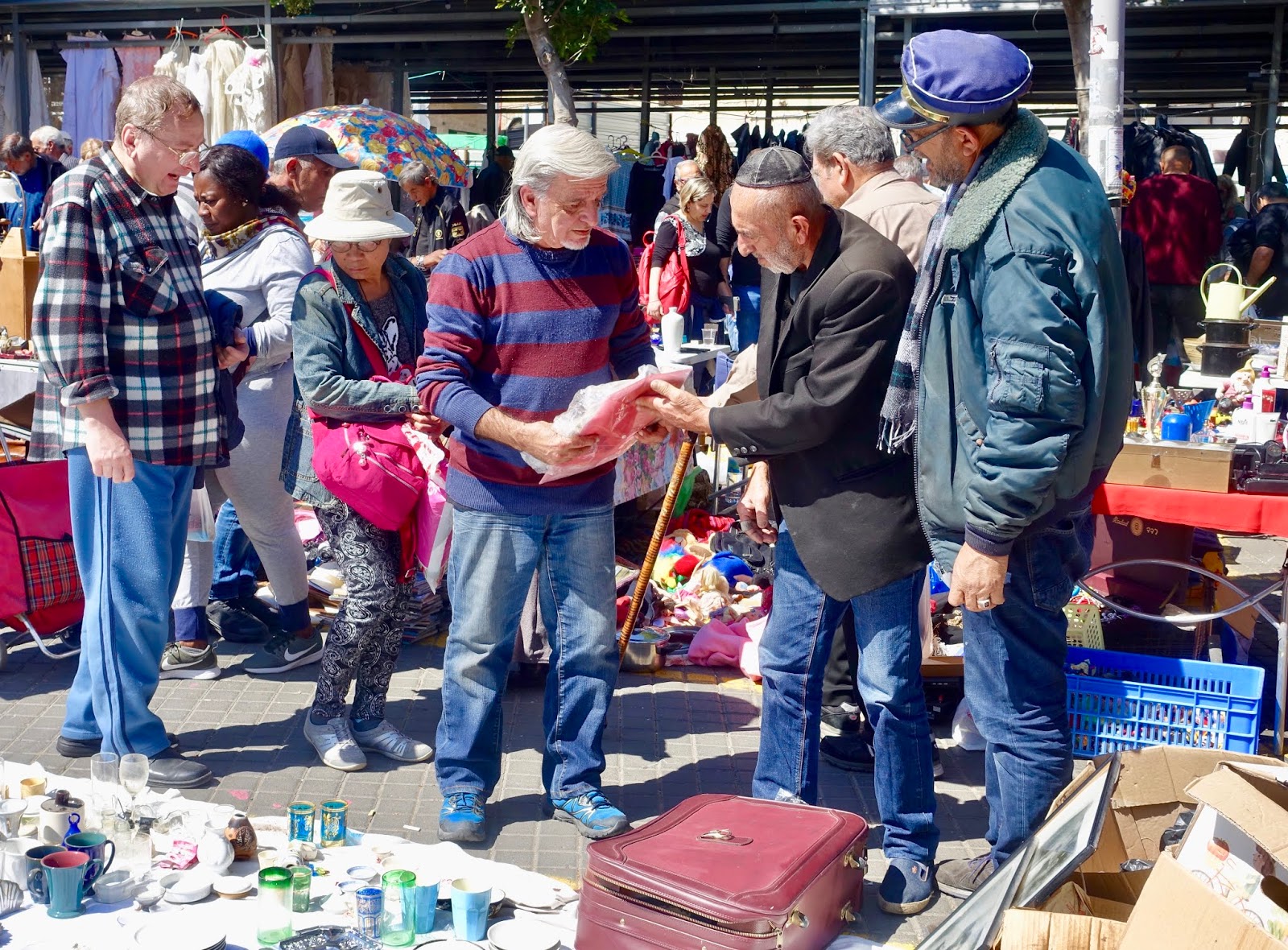
One part of the Shuk is relatively unchanged. Behind Oley Zion there is a piece of open ground where traders come and spread out their goods on trestle tables or in a number of cases on the floor. You can find just about anything here – books, antiques, clothes, dolls, games, CDs and vinyl, electrical goods, hand-made jewellery, pictures, old photographs strewn on the floor or in boxes - people's life stories being offered for sale. I often look at them and wonder who these people were and what happened to them. The customers here are as diverse as the goods and include secular and religious Jews, Arabs, overseas workers from Africa, China and the Philippines as well as tourists all of whom come in the hope of finding a treasure. I enjoy watching the bargaining that takes place here, including unexpected exchanges such as a Filipino woman bargaining down the price of some second hand Barbie dolls – in perfect Hebrew. But even here there is a hint of change. On Fridays in particular it is not unusual for professional photographers to turn up accompanied by models who strut amongst the customers and pose beside piles of old clothes. 


Bargaining in the informal part of the shuk
Coffee is another Jaffa tradition
Music in Friday morning
Friday is the busiest day in the Shuk. The streets fill up with locals and tourists who come to shop, eat and enjoy the street entertainers including impromptu performances by mime artists and musicians. The streets are filled with haunting Persian and Middle Eastern music played on the oud, saz and kamancheh. These young musicians bring the rich musical heritage and traditions of Mizrahi Jews to a new, primarily young audience. Also on Friday, in the midst of all of this activity, young Lubavitcher men work from a small stall and invite Jewish men to put on tefillin and pray in the street. Open air prayers are not limited to Fridays. Many of the longer established traders are religious and it is not unusual to see an open air minyan during the week.

For the moment the Shuk will retain its attractive mixture of old and new, traditional and modern but as Reuven, Yaron and Miriam say, further change is inevitable. Most of the children of the carpet repairers and antique sellers prefer different careers and many of them work in the professions. Whilst it is sad that some of the old skills and traditions will eventually disappear perhaps the new arrivals are really part of another tradition in the Shuk - that of change, but change mixed with respect for the past.

Hezzi Motada, craftsman at work

Trying before buying
Friday photo-shoot

You can see more pictures from Israel here.

Sunday, 16 June 2019

Mahjong, Street Walkers And A Mania For Permed Hair - Hong Kong Stories 3

Five years ago I spent a few nights in Hong Kong on my way to and from Australia. I went to a jazz concert, visited some temples and a beautiful synagogue and took the ferry to Macau. I enjoyed my short stay but didn't really engage with the place and left not really having seen the real Hong Kong. This year I decided to revisit and spent a total of six nights there, once more using Hong Kong as my stopover on a visit to Australia. I decided to take a different approach this time, avoiding the well known monuments and attractions and concentrating instead on discovering what remains of the old Hong Kong. 

Calligrapher, Sheung Wan
I have already written that this visit was to a large extent inspired by the iconic photography of Fan Ho and by Sunset Survivors the recent book by Lindsay Varty that  documents some of Hong Kong's disappearing crafts and traditions. I carried out my search for the world of Fan Ho in the streets of Hong Kong in what proved to be a rich and sometimes surprising experience.

Despite the encroachment of modernity, glimpses of old Hong Kong can be seen almost everywhere. This includes groups of people playing mahjong or traditional card games, often for money in narrow alleys, courtyards of tenement buildings or in cafes and teashops.  The arrival of an outsider does not perturb the players and on numerous occasions I was asked if I would like to pull up a chair. I can play a little but did not wish to lose my money so would politely decline. Most gambling is illegal here but for the more serious players there are legal mahjong parlours where vast amounts of money can be won or lost in a single session. 

Whilst gambling is proscribed, prostitution is not. I was surprised to see young women tout for business in the street. They are particularly numerous in the area around Temple Street market but also work in other parts of the city. During the day they stand around looking bored and making half hearted attempts to attract interest before the more serious business of the evening. It is easy for misunderstandings to occur in the streets around the market. Between the massage parlours and brothels (which are illegal) there are other establishments displaying pictures of women in the window. It turns out that these are karaoke bars. The women in the pictures are featured singers and customers can pay to sing a duet with them. Something quite different to the service being sold in the street. The standard of is going is variable but these places are packed with locals almost every night.

Quartering the fish, North Point
Temple Street has a night market largely frequented by tourists these days but for me the neighbourhood markets used by locals are more interesting. Fresh meat and fish are on sale everywhere. And I mean fresh. It is not unusual to see the fish still moving. Several times I saw fish put up strong resistance to getting the chop, jumping and trying to slither away from the fishmonger's knife. However, resistance is futile and always ends in defeat but even then, severed heads can be seen breathing, hearts pumping and sectioned eels wriggling. Whole pigs are delivered to butchers, dumped on the pavement at the entrance to the shop and then hauled in with a huge skewer. They are immediately quartered, sold and probably eaten before the day is out. There are many butchers and competition is fierce. Red metal lamp shades hang over the stalls to enhance the appearance of the meat, enriching the colour, emphasising its freshness and attracting customers. Some vendors sell tiny live frogs. These are also for consumption and I am advised some customers take them home still live and kill them themselves. Hong Kong's markets are not for the feint hearted. I am a vegetarian. 

Food and its consumption is a social activity in Hong Kong. Almost every street has at least one neighbourhood style cafe or restaurant and little groups of fiends or relations can be seen sitting, eating and talking together. Even where people eat alone jokes and comments are shared between table. I stopped in several such places to snack and drink tea but unfortunately couldn't share the jokes not being able to understand Cantonese and the humour can be lost in translation. These little local places are in stark contrast to the skyscrapers and high powered business premises that dominate the skyline here and which represent Hong Kong for so many people. However I have no doubt that the skyscrapers provide many of the restaurants' customers.

Delivering whole pigs to the butcher
Sunday brunch, Tsim Sha Tsui
If I am traveling for more than a few days I like to visit a local barber. I do not care for modern salons and prefer a more traditional service. In London I have used the same Turkish barber shop for a number of years. The service includes a wet shave, hot towel, head and neck massage, threading and other painful activities all in the pursuit of male beauty. It also involves drinking copious amounts of Turkish coffee. I knew that a few, not dissimilar Shanghainese establishments still survive in Hong Kong and so visited the Kiu Kwun Barber Shop on Java Road in North Point. The ground floor has a long row of chairs each of them attended by a septuagenarian barber wearing a white coat and a mask covering mouth and nose. The chairs face long mirrors that enable the customer to see not only the barber but all of the comings and goings around him. A little surprised to see me, the manager asked who I was. Once he understood that not only was I a serious customer but also interested in the shop itself he asked me to come and see the first floor room. I climbed a narrow staircase and emerged to be greeted by the turned heads of a few older women sitting under enormous hair dryers, nursing magazines and looking slightly less than pleased to see me. Like the men, they sat in front of long mirrors encased by tiny colourful tiles that probably date from the 1950s. 

I was shown around by Gao Tak Tin who arrived in Hong Kong in 1959 and initially lived in a squatter village. He began learning the trade at the age of 14 and practised on a watermelon so as not to hurt his customers and has now been a barber for almost 60 years. Mister Gao has seen many changes in style including at one time a mania for permed hair. Mercifully that style is long passed. Kiu Kwan is the largest remaining Shanghainese barber shop in Hong Kong and has 14 employees, not one of them below the age of 70. When the business finally closes a piece of history will be lost. I had a haircut and shave for just 70 dollars. That's about £7. Quite a bit more than my London barber charges.

Mister Gao Tak Tin in the Kiu Kwan barber shop
Gao's style of barbering may be dying out in Hong Kong but other traditions linger on. The villain hitters are a group of elderly women who practice a form of sorcery under the Canal Road flyover between Causeway Bay and Wan Chai. As well as attracting people like me who want to observe and photograph them they continue to receive many local visitors who believe in their powers. They attempt to place a curse on the individual of one's choice by beating a paper effigy with a shoe whilst chanting about breaking their arms and legs. The ceremony ends with the burning of a paper tiger and the tossing of wooden dice to see if the spell has worked. Not wanting to cause trouble for anyone I elected instead to have any curses placed on me removed. I was invited to write my name of a piece of paper before bowing and waving three incense sticks three times at a small shrine. I then sat perfectly still whilst burning paper was circled three times around my head before the villain hitter declared me curse free and lucky. Throughout the whole process people were passing by, getting on and off buses and generally going about their business completely disinterested.

Still on the subject of effigies, I made a visit to Au-Yeung Ping Chi's shop. He hand makes paper representations (effigies) of the favourite items of  deceased relatives that are then burned at their funerals in order to ensure they have everything they need in the next life. In the past families requested effigies of favourite pets, food, drink, mahjong sets, radios and other every day items. Au-Yeung says that today people ask for more luxurious goods including smartphones, designer clothes, luxury cars, palatial homes and the latest IT equipment. Looking around his shop I saw examples of several of the items as well as an aquarium complete with paper fish, made to order for someone whose passion had been collecting them. The hand made effigy business is now threatened by the import of mass produced items from China. This particular shop will close when the owner retires as he is not married and has no children.

Villain hitter, Canal Road
Au-Yeung Ping Chi at work in his effigy shop
About 16% of Hong Kong's population are 65 or older. They have a visible presence in the streets. streets - working, shopping, sitting with friends or looking after small children. I have already written about the elderly people who collect discarded cardboard in the streets and then sell it for recycling.  In North Point I noticed an elderly woman sitting beside her collection of cardboard,  almost certainly waiting for a dealer to come and take it from her. She seemed tired and bored. Despite this and the nature of her work she was smartly turned out in a patterned blue/ purple jacket and I couldn't resist a candid shot of her. As I clicked she looked up from her place in front of the fly posted walls and saw me. I smiled and to my delight she smiled back and waved. I went across to her but without a language in common we couldn't speak. She took my hand for a moment, indicated that it was OK to take her portrait and broke into a stunning smile.

Many of the older people I met were still working. Some, like Mister Yung who has a small stall in the jade market, explain that they don't need to work these days but do like to have "something to do" with a chance to socialise and pass the time. This was something I came across several times, often at the end of more harrowing stories about the past. People spoke freely about having survived the Japanese occupation of Shanghai in the Second World War only to have to flee China after the revolution. Not all the stories had happy endings and more than one included relatives having been shot or sent to re-education camps following failed attempts at escape. In some cases there was also a nostalgia for the 1980's and 1990's coupled with concern for the future.

Lady in blue, North Point
The smile of a generous heart 
Mister Yung, stallholder in the Jade Market 
My time in Hong Kong passed too quickly. I left wanting to continue my search for the old city and for the disappeared world of Fan Ho. As I wrote at the beginning of this post, there are glimpses of that world everywhere, not just in the alleys and side streets but also in the faces of the Sunday strollers in Sai Ying Pun, the antique hunters and street artists of Sheung Wan and the shoppers in the markets of North Point and Mong Kok. Did I feel as if I'd seen the real Hong Kong? Oh yes, but I left with a desire to see still more and hoping that despite rapid change it will still be possible to find it on my next visit.

As ever, I can't resist including a little more...

Sunday strollers, Sai Ying Pun
Saturday ballet students, Sai Ying Pun
Quarrel between friends, Sai Ying Pun
Sense of humour, North Point
Walking the dogs, Sai Ying Pun
You might also like Looking for the old City - Hong Kong Stories 2 or Street Art and Selfies - Hong Kong Stories 1

You can see more pictures of Hong Kong  here.

I would like to note my thanks to Eric Wan who was tireless in tracking down people and places for me in Hong Kong and to Emily Gilman of Ampersand who made many of the practical arrangements including securing Eric's excellent services! Thanks both.

Wednesday, 22 May 2019

Picture Post 72 - Adelaide Art Deco, The Capri Theatre

The Capri Theatre on Goodwood Road in Adelaide, South Australia stands out from the neighbouring buildings due to its size and a stunning Art Deco facade. Originally known as the New Star Theatre, it was completed in 1941 and opened on October 8th of that year with screenings of Florian starring Robert Young and Helen Gilbert as well as Doctor Kildare Goes Home starring Lew Ayres and Lionel Barrymore. The design was the work of architect Chris Smith who was responsible for many art deco buildings in Adelaide including the Port Adelaide Municipal Chambers, Hindmarsh Town Hall and a number of other official buildings.


Initially part of the Clifford Theatres Circuit, the cinema could originally seat 1472 patrons. In 1947, Greater Union bought out the Clifford Circuit including the New Star and in 1964 renamed it the New Curzon. Three years later Greater Union stripped out many of the original Art Deco features, reduced the seating capacity to 851 and changed the name again to the Capri Cinema. 

The Theatre Organ Society of Australia (TOSA) purchased the building in 1978, installed their Wurlitzer organ and amended the name to the Capri Theatre. TOSA managed to complete the loan repayments thanks in no small part to the film Crocodile Dundee which played to packed houses for almost a full year in 1986 enabling the organisation to own the building outright. A framed poster for the film is displayed in the lobby, acknowledging its importance to the Capri's story. 

Since then major works have been undertaken to restore the original colours and style to the exterior as well as original carpet designs and replica fireplace and mirrors on the upper level. The facade boasts a fabulous series of fins one of which carries the building's name in vertical lettering. This, together with the beautiful banding, sumptuous corner curve and occasional portholes make the Capri itself something of a showstopper.

The cinema also boasts one of the largest Wurlitzers in Australia. It is still in use including at regular nostalgia evenings when old films, newsreel and vintage advertisements are screened as well as at regular recitals of organ music. In addition to respecting and preserving the cinema's heritage, the Capri also has a commitment to the latest technology. Modern projection and sound equipment were fitted in 2012 with financial help from the State Government as well as Unley Council. There are now 782 seats, some of them branded as deluxe. This combination of old and new extends to the exterior mural which features scenes from Florian and classic Australian movies. The piece  was produced by artists Jake  Holmes and Joel van Moore and was completed last year.


The architect was an interesting character. Born in 1892, his father was a sailor and labourer and his mother is thought to have been illiterate. Smith himself trained as a master carpenter, married, had three children and enjoyed cycling, motoring and bowling. Despite having no formal architectural training, he appears in Sands and McDougall's Directory of South Australia for 1922 as an architect and structural engineer. In addition to the works already mentioned he built himself a stunning Art Deco residence in Prospect Road, Adelaide. The house retains many of its original features and may well have acted as a showroom for his clients as it includes so many deco references including the design, materials and finishes. He also remodelled the synagogue in Rundle Street in 1938, giving it the deco finish it retains until today although it ceased to be a religious building some years ago. Smith died in 1952, not quite 60 years of age,

The Capri was added to the South Australia State Heritage Register in 1990. The day to day running of the cinema is dependent on volunteers. The website has details of how to get involved.


Saturday, 11 May 2019

Looking for the old city - Hong Kong Stories 2.

A few years ago I became familiar with the work of Fan Ho - a photographic genius who recorded the Hong Kong of the 1950's and 60s. His black and white images of hawkers, shoppers and children at play captured the every day life of a world now largely disappeared. And more than this, his way of capturing light and shade not only adds atmosphere to his pictures but also transports the viewer back 60 years to the streets of old Hong Kong. I recently visited Hong Kong for a few days en route to Australia. Hong Kong today is almost unrecognisable from the place that Fan Ho knew but I set out to look for echoes of his time and the remnants of his world that linger on amongst the skyscrapers, shopping malls and highways.

The lady in the purple suit
I have written before about the chance encounters of wandering the streets of a city. Whilst walking through the Sham Shui Po neighbourhood after having visited the excellent Mei Ho Heritage House museum I noticed an elderly woman gathering discarded pieces of cardboard from outside shops and loading them onto a small cart. This is a common site in Hong Kong. Many people, particularly the elderly, do this as a source of additional income, receiving payment from dealers according to the weight of the cardboard collected. This lady stood out - slim, straight backed and elegant in a traditional Chinese suit made from purple material. Something about her demeanour made me want to know more about her and if possible to photograph her. I wasn't certain that she would agree to being photographed as a number of older people I'd encountered earlier had been happy to chat but not to pose.

After taking a few candid shots, I was able to have a conversation with her through my excellent guide, Eric Wan. She told us that she was born in mainland China 85 years ago and came to Hong Kong in 1960. She has lived through tremendous historical events and spoke a little about surviving the revolutionary years in China saying "we ate just a few spoonfuls of rice a day". Happily she is comfortable now. She said that she has enough to live on and collects cardboard to stop herself from being bored and not because she needs the money. She covers only a few local streets in her search and takes breaks to sit and chat with her friends. Although she held a cigarette whilst talking to us  she wouldn't let me have a close up of her smoking saying that it is a bad habit and that she didn't want to encourage others. 

Although she was happy to be photographed, the lady in purple was a little surprised that I was interested in her. I had a similar response from a very elegant woman who turned out to be the manager of the dried noodle store outside which the older woman was sitting. Perhaps in her 40's I noticed that she too had a very upright stance, wore a black lace blouse underneath her work overall and wore make up to work. At first she misunderstood my request for a picture, thinking I wanted to photograph the dried goods. When realising it was her I wanted to photograph she became a little shy and laughed but soon agreed and let me take several shots. She then spent some time looking at the  results whilst her employees teased her about them.

Elegance in the noodle store
Chan Lok Choi, bamboo cage maker
Chan Lok Choi has been making bamboo bird cages since he was 13. Now in his 70's he has a shop in Yuen Po Street where he makes and sells the only hand made cages in the bird market. He can be seen working outside the shop, bending the bamboo into place, carving letters or patterns on to it and finally adding paint to finish. It takes him several months to complete a single cage. None of his children wish to learn the trade and although he would be happy to take an apprentice from outside the family it seems that no-one is interested.   

Keeping birds as pets is a long established tradition in Hong Kong and until fairly recently it was possible to see older Chinese men taking their caged birds "for a walk". This would involve taking them to parks, hanging the cage from trees and listening to their song or sitting with friends to talk, read the newspaper or play mahjong. Although a few older men carry on this tradition, the avian flu of 2012 has largely curtailed the tradition as birds are now banned from public transport.

I was able to meet and photograph Mr Chan due to his being included in a wonderful book Sunset Survivors a book produced by writer Lindsay Varty and photographer Gary Jones which records the people keeping Hong Kong's traditional industries alive. I told him that after seeing his picture in the book I was keen to meet him. He was happy to hear this and told me that he has copies of the book for sale.

Leung Lo Yik - one of the last letter writers of Hong Kong
Leung Lo Yik, also known as Chen Yau, came to Hong Kong from Vietnam in 1972. On arrival he secured work as a barman but in Vietnam he had worked as an accountant. He is highly educated and fluent in English, French and Chinese and after some time a customer suggested he could obtain work as a letter writer. Today he can be seen siting in the Jade Market where he still uses his 1970's typewriter to write letters or to complete forms and applications for his few remaining customers. Again I was able to find him due to the Sunset Survivors book. He had no customers at the time of my visit and seemed preoccupied if not a little depressed as he sat in his corner of the market, wearing a mesh vest and thin trousers in order to cope with the heat and humidity. His once lucrative business has diminished due to the development of technology and also by the much improved literacy rates in Hong Kong. In the 1950's and 60's as little as 60% of the population were competent in reading and writing. Today that rate is steady at 99%.

As already mentioned some older people were reluctant to be photographed. I watched one group of elderly people playing cards in the courtyard of their block of flats. They were happy to talk, asked about where I was from and what I was doing in Hong Kong and joked about winning and losing at the game. It would have been a wonderful shot of them gathered around the small table but unfortunately they declined. Gambling is illegal outside of strictly controlled licensed venues and although they played for just a few coins they were concerned about photographs potentially being used as "evidence".

Other elderly people were happy to be photographed including Mister Yeung who was born in Macao and opened his small tailoring shop in the Sheung Wan neighbourhood more than 50 years ago.  He repairs clothes and makes cheongsam (a traditional Chinese dress) to order. He said that the rent is now vey high but although business is not as good as it once was he has enough work to live from. he learned his trades an apprentice when he was paid just $20 Hong Kong per month. That's about £2 today and even back then it was a very small amount. Mister Yeung was happy to be photographed sitting outside his shop beside an example of his work.

Earlier in the day I met Mister Law. He is 70 years of age and sells gardening items in an underpass in Sham Shui Po.  He smiled and nodded and I stopped to buy some lotus buds from him. I was taken with his kind expression and pink fan decorated with Chinese calligraphy.

Mr Yeung, tailor of Sheung Wan
Mr Law, gardening materials vendor
King Yip printers
Shortly after meeting Mister Yeung in Sheung Wan, I had the pleasure of visiting the King Yip printing company in Tai Ping Wan street. This business was originally established in different premises in 1954 by the father of the current owner. He arrived in Hong Kong from Guangdong Province and learned the trade as an apprentice to a master printer. Unfortunately his employer had to let him go due to a downturn in business but provided him with an excellent reference, setting out the reasons for terminating his contract and saying he would happily re-employ him should the situation improve. This letter together with various other documents charting the development of the business, is proudly shown to visitors who are interested and a demonstration of hand set printing can be given if booked in advance. Sadly this is another art that has been overtaken by new technology but the King Yip company has cleverly adapted and generates income by welcoming tourist groups, school groups and people interested in the process of hand printing.

Craftsman at work, King Yip Company
My interest in the older, long established businesses almost inevitably means that I met many older people, but Hong Kong's streets also teem with the younger generation. Just as anywhere else in the world, they can be seen engaging with technology, fashion and art. Below are some examples of this whilst the final picture returns to the old Hong Kong with a small boy standing in the doorway of a tenement block waiting for someone to return or something to be delivered. I took this picture not far from the Yau Ma Tai vegetable market. I hope to explore that area in depth on my way home from Australia when I will again be in Hong Kong, looking for echoes of Fan Ho's city.

 Modern communication
Art and the selfie, Sheung Wan
Waiting, Yau Ma Tai.
You can see more pictures from Hong Kong here.

There is a short video explaining why Lindsay Varty produced her book Sunset Survivors.

Friday, 3 May 2019

Street art and selfies - Hong Kong Stories 1.

Graffiti was once considered to be vandalism. Re-invented as street art, this now respectable genre has brought international recognition for its leading practitioners and cities such as London, Paris and New York now commission work for their streets. Hong Kong also makes use of high quality street art to revitalise neighbourhoods and to attract visitors. This includes a specific programme known as HK Walls that promotes and encourages locally based artists and brings their work to new and wider audiences.


Hong Kong's best known street art is located on the corner of Graham and Hollywood roads and was commissioned by the lifestyle store, GOD (Goods of Desire). Locally based artist Alex Croft was responsible for the piece which represents the Walled City, a huge, informal housing structure that was once home to 33,000 people, over 1,000 businesses and covered 6.4 acres. Demolished in 1994, it was immortalised in the photographers Ian Lambot and Greg Girard's book, City of Darkness. The Walled City was perhaps the most well known example of the tong lau - tenement buildings, usually with commercial use at ground floor level and residential units above. An official tong lau included shared bathrooms and kitchens with rent, electricity and water charges paid on a monthly basis. Once widespread, many of these structures were demolished in the 1960's making way for more luxurious, private developments. Others collapsed due to poor construction and or maintenance, including a fifty years old five story tong lau that collapsed in 2010 killing four people. Today only a handful of these buildings remain.


But back to the street art. I recently visited Graham Street on a weekday morning and found dozens of tourists and locals taking selfies and then immediately posting them to social media. There were also small groups of young women, elegantly dressed taking turns to pose for a series of shots, sharing hats and other accessories and taking it in turns to photograph each other. This is followed by much checking and discussion of the shots before choosing which ones to share on social media.They had clearly spent time preparing for this as they went through a series of poses that would fit the pages of a fashion magazine. The lives of these young women and the tourists could not be more different to those of the former inhabitants of the Walled City and I wondered how many of them understand the significance of the work and what it relates to.


Elegant as these women were, my favourite selfie-takers were a small family group consisting of two parents and two little boys. The father held a selfie stick as they posed for a group photo. Mum smiled. Dad looked serious - trying to make sure they had a good picture. The older boy raised a hand of greeting at the camera whilst the younger one seemed a little agitated, perhaps bored and ready to move on. I had noticed the boys a few minutes earlier when their parents positioned them against the wall for another picture. Two young people stood a step away from them, one engrossed with the art the other ready to leave having taken her selfie, her sole purpose for being there. Perhaps art, like  most things, means different things to different people.