Showing posts with label Delhi. Show all posts

Friday, 9 December 2022

"The landowner refused to pay us...we had barely enough to live on" - Delhi's Sri Ram refugee colony

The narrow alleys of Majnu Ka Tila in Delhi are full of businesses catering to the long established Tibetan refugee community. Both local and foreign tourists come to visit the Buddhist monastery and to eat in the many Tibetan, Korean and north-east Indian restaurants. A short distance from here, there is a group of less-well known refugees. The Sri Ram colony is home to Hindus who fled Pakistan, not during Partition, but in 2010.

I came upon the colony by chance when visiting a neighbouring Akhada, where traditional Indian wrestling is practised. As I left I noticed an alley leading into a cluster of buildings resembling a village. I went in and although the residents were at first surprised to see a foreigner, they were welcoming and community leader Rajesh Solanki was sent for.  He looked to be in early middle-age and wore the brown kurtha-pyjama typical of rural Sindh in Pakistan. He explained that the people living here had come on a religious pilgrimage in 2010, and then refused to leave. They cited discrimination and religious intolerance in Pakistan, as their reasons for wanting to remain in India, and staged demonstrations at Delhi's Jantar Mantar to draw attention to their plight. 

The Colony is a hotchpotch of solid, brick buildings owned by better-off families and less permanent  structures consisting of metal sheets, tarpaulins and twigs. All of the homes have been built by the residents themselves. Several are unfinished, as many residents lack the resources to complete them. Despite this, there is evidence of ongoing construction and a group of women were laying down a courtyard outside their house. Most homes lack electricity or running water and toilet provision consists of communal male and female blocks. As the colony stands on the floodplain of the Yamuna River, there is a risk of flooding during the monsoon. There are also potential health hazards from mosquitos and from  sewage regularly pumped into the river.   

Some of the more entrepreneurial residents have established small shops selling snacks and sweets. Some of the houses have small shrines attached to them. These are referred to by the residents as "temples". There are displays of religious piety throughout the colony. The Hindu greeting "Ram Ram" is given in preference to the more secular "namaste" and symbols and pictures of various deities are displayed on the exterior of the buildings. Even the name of the colony is that of Ram Ji, the central character of the   Hindu epic,  The Ramayana. 

Chander's Hanuman temple

"The landowner refused to pay us the agreed amount. We had barely enough to live on"

Badal is 39 and from the Kotri district of Sindh. Solanki asked him to show me around and answer my questions. I asked what had caused him to leave the place where he was born and to remain in India.  He said" I owned eight acres of land in Pakistan. It was not enough to support my family and I entered into agreements with a larger landowner. The contract said that we would share the expenses of seeds, fertiliser and other items 50/50 with the landlord, and that we would also share any profits in the same way. We paid our share of expenses but when there was a good profit, he refused to pay us. We had barely enough to live on". Badal also lost his eight acres of land when they were seized by local gangsters. "There were too many of them for us to resist" he said "they were armed and had friends amongst the politicians. No-one would help us".

He used to sell telephone covers and other accessories, but now has insufficient funds to buy stock. He works occasionally as a day labourer but this pays little and is unreliable. His home is in very poor condition - only partially built - and all eight residents sleep in one small room. The situation was made worse by the death of one of his five children at the age of 20, leaving behind a widow and a small child, now being cared for by Badal and his wife. Despite this, he says he feels safer in India and is happier there.

Badal

"There was no violence, no threats, but the pressure to convert was always there, every day, in every conversation"

One of Badal's neighbours, Chander, also from Kotri district, tells a similar story. He owned no land in Pakistan and worked as an agricultural labourer to support his family. Again, the landlord refused to pay the contract share and Chander felt he had nowhere to turn for help. The colony's overt religiosity made me curious about faith-based discrimination, or pressure to convert in Pakistan.  Chander said, "There was no violence, no threats, but the pressure to convert was always there, every day, in every conversation. Even in the market. People we thought of as friends would say to us 'why don't you convert? Things would be better for you' ". Chander also has problems in India. He showed me the small Hanuman temple he built at the side of his house. It is collapsing as the land subsides, possibly caused by the sewage being pumped into the Jamuna River just a few metres from his home. "I can't afford to repair this and I'm worried the house will collapse too" he said. 

Two of the women residents told similar stories about pressure to convert. Janaki sat playing with two of her grand-children whilst she prepared a chick-pea dish for their lunch. "They would always talk about converting" she said. Janaki lives in one of the better quality houses. She still has family in Pakistan. Megha, perhaps in her sixties, stood outside her house, cuddling one of her granddaughters. She has ten children of her own - five in India and five in her home town,  Mirfazal Pakistan. She was worried about her daughter-in-law. "She had an accident six months ago and is still in ICU in the government hospital. They won't let me see her. I want to give her soup and nurse her back to health" she said. 

Janaki and her grand-children

Megha and one of her ten grand-children

"...my assistant often has to go from door to door and bring the children here herself"

Most of the children go to school outside, but there is some teaching goes on inside the colony. A single, windowless room is used for pre-school learning. When I visited, the children were enjoying snacks. I'd seen food provided in a village school in West Bengal, as a way of encouraging attendance. I asked the teacher if this was the case here. "Yes" she said "It's to encourage them to come. Not all of the parents are committed to pre-school learning, and my assistant often has to go from door to door and bring the children here herself". Resources appeared limited but she spoke enthusiastically and was clearly committed to delivering the best for the children. The teacher's and assistant's salaries are paid from Central Government funds allocated to supporting the welfare of women and children.

The older children have access to additional learning in a community hall built with funds from overseas donations. Teaching is provided by NGOs and volunteer university students. The room was clean and tidy. Charts with tricky algebraic formulations and maps of India and the world were displayed on the walls. There was also a row of sewing machines, provided by a charitable organisation and used for teaching tailoring skills.  Although not a formal school, many of the children come here for tuition. I asked some of them what their favourite lessons were. Jalram, aged 11 said, in English, "I like mathematics and Hindi".  Others gave maths as their favourite subject while one said "English". Some of them gathered around the maps, locating different cities and countries. 

More than a decade after their arrival, the situation of the Sri Ram residents remains uncertain. Solanki said "We are hopeful that the new law to assist victims of religious persecution will help us". He refers to the 2019 Citizenship (Amendment) Act that provided routes to Indian Citizenship for persecuted religious minorities from Afghanistan, Bangladesh and Pakistan. Hindus, Sikhs, Buddhists, Jains, Christians and Parsis who arrived in India before December 2014 are eligible for consideration under the Act. Muslims are not included in its provisions. The application of a religious test resulted in sometimes violent demonstrations in various parts of India.

Despite their troubles, many of the people I met spoke about feeling happier in India than they had in Pakistan, and no-one expressed regret at having left. There may yet be a brighter future for Jalram, his friends and their families.

Jalram (hiding) and friends

Where did my dog go?

Some of the residents have opened small shops


Wednesday, 27 November 2019

Delhi's New Gramophone House - Albela, Bhagwan and the Delights of Classic Bollywood Vinyl


Old Delhi's New Gramophone House, a treasure trove of vinyl recordings of all genres, opened in 1947. Bhagwan Dass Rajpal opened the original store in Lahore in 1930 but moved his family and the business to India during Partition. The store can be difficult to find. It is located on the first floor of a building on the main road of the extremely busy Chandni Chowk and there are no obvious signs of its presence from the street. Visitors must pass through a different shop on the ground floor, then scale a steep set of steps that sit below a low ceiling (watch your head) before reaching their destination. But it's worth persevering as once there the vinyl fan enters paradise - a small room packed with thousands of recordings stacked on shelves and in cabinets. 

I make a pilgrimage to the shop every time I am in Delhi with the objective of adding to my small but growing collection of vintage Bollywood soundtracks from the 1940's, 50's and 60's. Regular readers will know of my love of jazz but thanks to a former work colleague I have been smitten by classic Hindi film songs. Playing them on youtube is no longer enough - I want to handle the vinyl recordings and have them in my collection.

Of course Bollywood churns out hundreds of contemporary musical productions but I do not enjoy these so much and prefer contemporary Indian dramas. In recent years Indian cinema has dealt with many social issues in films including Dangal, Dhobi Ghat and Aligarh as well as producing delightful romances like Lunch Box and suspense stories such as Aandhanhun. But you really can't beat those vintage movies and I've grown to love the films of Raj Kapoor, Johnny WalkerMadhubala, Nargis, Guru Dutt, Nadira and Bollywood's best dancer, Helen. They tell a story, tackle issues and have memorable songs performed by the classic playback singers - Mohammed Rafi, Manna Dey, Kishore Kumar, Hemant Kumar, Geeta Dutt and of course sisters Asha Bhosle and Lata Mangeshkar.


More recently I came across a film called Albela. Released in 1951 it was directed by Bhagwan Dada who also starred in the film together with Geeta Bali. It tells the story of Pyarelal the son of a poor Bombay family who needs to accumulate money to help marry off his sister, Vimla. Not only does he fail to raise the required amount but he also loses his job. The resultant quarrel with his family leads him to leave home vowing not to return until he is rich and famous. He goes on to pursue a successful career in the theatre and eventually decides to return home only to find things are not as he believed them to be. You'll need to watch the film to find out how it ends! Albela was the third highest grossing Indian movie of 1951 and its soundtrack by C. Ramchandra continues to be acclaimed today. Ramchandra performed most of the songs himself (under the name of Chitalkar), dueting with Lata Mangeshkar on several tracks and with the superstar Mohammed Rafi on one song. The film also made use of westernised style cabaret dance and choruses as well as using bongo drums, oboes, clarinets, trumpets and saxophones, little used in Indian film during that period but which still influence cinema today.

Director and leading man, Bhagwan Dada was born in Sindhudhurg, Maharashtra in 1913. The son of a textile worker, he originally worked as a labourer but had a strong ambition to work in cinema. He eventually obtained work in silent films, making his debut in a movie entitled Criminal. He went on to learn film making, co-directing his first film in 1938 and from then until 1949 he made a number of popular low budget movies. As well as producing Hindi movies, he made at least one Tamil film, Vana Mohini, in 1941. This film was significant for including an elephant as one of the leading characters! A year later he worked with prolific film actress Lalita Pawar. There is a story that he was required to slap her in one scene and that hitting her too hard he injured her eye leaving permanent damage.

In 1947 he set up his own Jagriti Studios and four years later produced his all time classic Albela. Shola Jo Badhke, the best known song from the move is still popular today and Albela is often performed by students as a high school musical. He went on to produce a few more hits in the 1950's but then his success dried up and he was forced to sell his home and cars and take on bit parts in other people's films. He was eventually reduced to living in a chawl, a one room home in a tenement block originally built to house textile workers. Bhagwan died of a heart attack in 2002. A biopic of his life, entitled Ekk Albela, was released in 2016. The original vinyl soundtrack of his masterpiece can still be found and I returned from my most recent Delhi trip with a copy - purchased at the New Gramophone House of course!

New Gramophone House , Shop No 9, opposite Moti Cinema, Main Road, Chandni Chowk, Delhi. It is also possible to browse and purchase items online here.


See pictures from India here.

Saturday, 14 September 2019

Chawri Bazaar - a Delhi delight

Chawri bazaar is a sprawling shopping area in Old Delhi. You can find just about everything here but the traditional specialisms have been copper and brass items, especially statues of Hindu deities as well as paper, cards and wallpaper. Over time the choice of goods has expanded to include electrical items, machine parts, glass, medicine, clothing, fruit and vegetables. There are also many small stalls and shops selling tea and snacks to the bazaar's thousands of workers. From morning to night the streets are packed with people selling and shopping whilst porters carry impossible loads from one place to another. As I stood watching one man lift a large package on to his back, his colleagues told me it weighed 75 kilograms. With a little help from his friends he pulled it onto his back, smiled and went on his way.


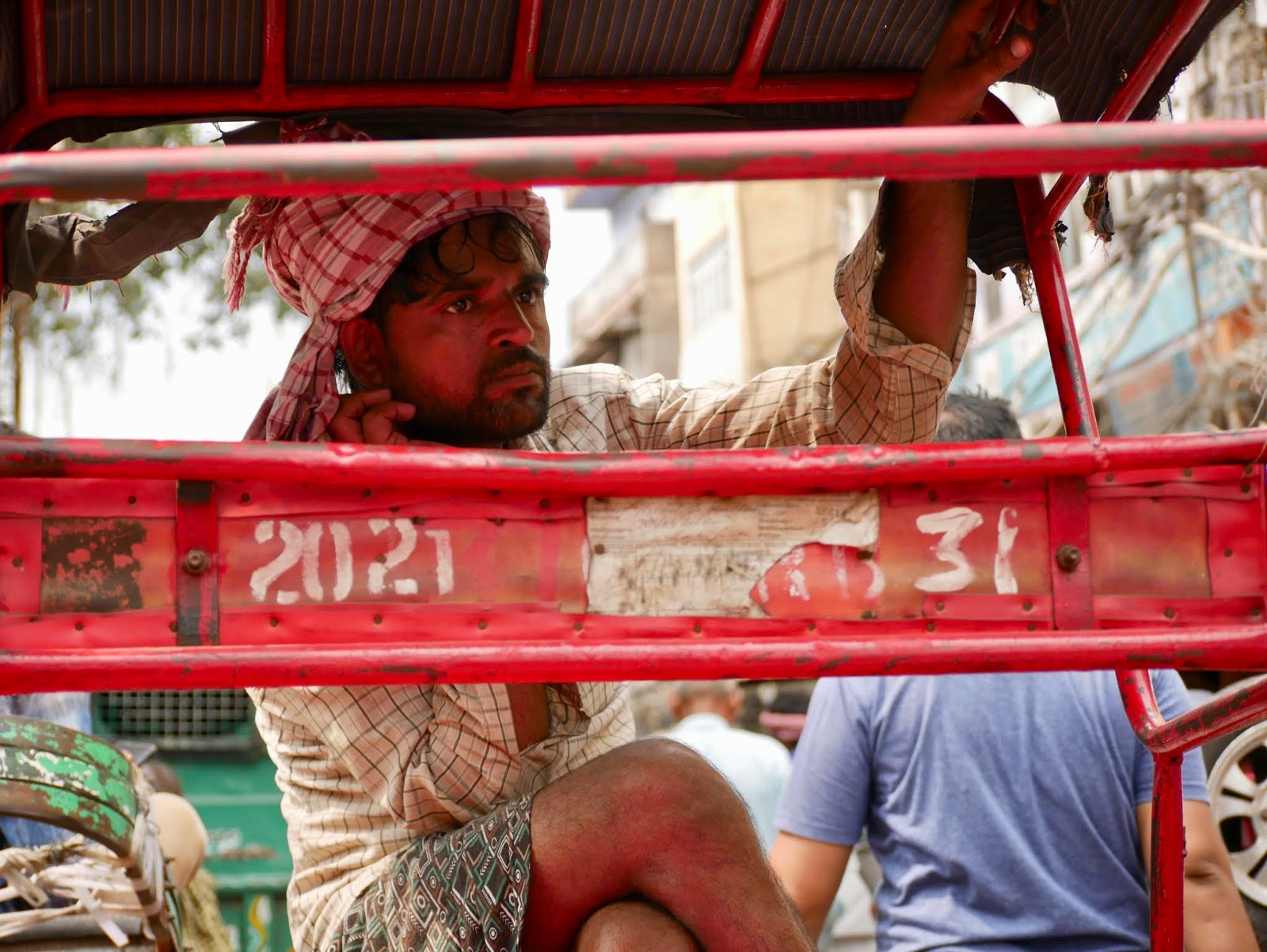
The bazaar's streets are narrow and busy - clogged with rickshaws, scooters, motorbikes, carts, small vans, bicycles and the occasional school transport vehicle. Although cars are not supposed to pass through, they sometimes do, adding to the chaos that inevitably comes to a crescendo in the afternoon when drivers struggle to avoid bumping into each other and workers step into the melee directing drivers wanting to reverse, go forward or u-turn in order disentangle themselves from the crush. Sometimes tempers fray but things calm down very quickly when the traffic starts moving again. Friends in Delhi think I am a little strange but I love traveling through Chawri in a rickshaw, watching the traffic and occasionally engaging in friendly chatter with people in adjacent vehicles when things grind to a halt. On my recent visit I was even offered a bite of a burger by a young couple enjoying a take-away lunch in the next rickshaw. 


The bazaar has quite a history. Founded in 1840, it was the first wholesale market in Delhi and originally boasted many fine mansions. It was also a centre for Tawaif culture. Tawaif were high class courtesans, skilled in music, dance, theatre, good manners and Urdu literature. They served the Indian nobility in the way that Geishas served their Japanese counterparts. Extensive study was required before the young women were brought into service and when this training was complete a celebration known as missi took place during which their teeth would be blacked out. Some of the Tawaif rose to positions of influence, especially in Lucknow which was also an important centre of their culture. However things deteriorated during the period of British rule, the mansions disappeared and prostitution became widespread on the upper floors of the Chawri.

Today the bazaar is a photographer's dream but is also extremely challenging with only a second to get a candid shot before someone or something blocks your view or needs you to move so that they can make a delivery. Last year I concentrated on talking to and photographing some of the casual workers who spread their tools on the pavement, waiting for customers to come and offer them day work as carpenters or decorators. This time I gave up trying to get clear shots and settled instead for glimpses of life in the bazaar. It was my first attempt at something like this so I had lots of unusable images but also a few that I was happy with. Shooting the passenger traffic as it passed also allowed me to capture images of women, noticeably missing from the portraits I took here, mainly due to the absence of women in the street in this part of the city - other than passing through in rickshaws. And speaking of rickshaws I was taken by surprise on one of my forays in here when I noticed none other than Munaji, who I met and wrote about last year, calling and waving to me from one of these ubiquitous vehicles as she went by. Recognised in Chawri Bazaar. Fantastic!


Last year I was able to give several of the labourers a copy of their photographs. This time I again looked for some of those I'd been unable to find but was unsuccessful. Change is a constant in such a large city and people come and go so it was unlikely that I would find all of them again. However, one constant is Aslam, the friendly owner of the Vespa Glass Service on the edge of the bazaar. I photographed him last year and in his absence handed the picture to his son the next day. I passed by the shop again on my most recent visit He saw me, smiled, took the photograph from his desk and waved it at me. He still has the best smile in the market. Both Aslam and Chawri really are Delhi delights.


You might also like The Labourers of Old Delhi

You can see more pictures from India here.

Tuesday, 18 September 2018

I Have Food, Water and Clean Clothes What Else Do I Need - Muna of Delhi

To be Hijra is to be neither male nor female but to possess elements of both. In India Hijras are recognised in law as a third gender and may adopt what is widely held to be female dress and behaviour. They have traditionally earned a living by collecting alms and by giving blessings and performances at weddings, births and festivals. Drawn from all religious groups, their devotion to Bahuchara Mata, a mother goddess comes before observation of any other faith they might follow. India's Hijra community has a recorded history of over 4,000 years.They are mentioned in ancient literature including the Ramayana and other important texts.  During the Mughal period some of them held high positions in the court and would be called upon for advice on religious matters or to give blessings during important ceremonies.


Muna is 70 years old and Hijra. She was born into a respectable Syed Muslim family, close to the Jama Mosque in Delhi.  Feeling different from an early age, she chose to leave the family and to live separately. Last week, together with my guide/ interpreter I had the privilege of spending an hour with her and hearing her story. For the first few minutes she was a little cold, sitting on the floor outside her home, rinsing out clothes and looking away from us as she spoke. As time went on she became more comfortable, spoke more freely and looked us in the eye. 

Muna is a guru and highly respected in the Hijra community. In the past she had students who would accompany her about the city, learn from her and eventually become gurus themselves, operating in different parts of Delhi. The former students still visit from time to time but do not provide any material support. She seems a solitary figure and when asked about family says that she has only superficial contact with them but wants nothing more. Due to her age she is eligible to receive a small amount of financial support from the government but has yet to do so. Despite this she describes herself as rich "I have water, food and clean clothes. What else do I need?".

This simple yet wise approach to life was displayed when during the course of the discussion we sent a small boy to bring tea from the chaiwallah. My guide asked him to bring 4 teas, one for each of us and another for the rickshaw wallah who had brought us to the meeting. Muna objected saying that we only needed 2 teas and 4 cups. She maintained that 4 teas is extravagant and chided us that we would not be able to look after our families if we "waste money on tea".

Muna is critical of what she describes as "fake Hijeras" involved in drugs, prostitution or crime. She says that they fear her when she walks in the red light areas and come to touch her feet and to give her respect and because of this she does not make trouble for them. Many of them come to her for blessings at festival times and on other important occasions. Respect is something that Muna talks about a lot. Although born a Muslim she respects all religions, is happy to give blessings to people of all faiths and will eat the food of any religious group if called upon to attend a wedding or some other ceremony. The only exception she makes is that she will not eat at the home of a family that consumes pork. Religion remains important to Muna but her devotion to Bahuchara Mata is of the greatest importance.

Towards the end of our time together she explained the reason for her initial disinterest. She is suspicious of outsiders many of whom come to her in order to make money and write or say disrespectful things about her. Some have promised help to complete an application in order to receive señor citizen's allowance but that help has not materialised.

As we stood to leave, Muna got up to give us a blessing, placing water on our foreheads and asking that we be safe and protected. I am not someone who could be described as spiritual but I felt a certain calmness from her, despite, or perhaps because of her direct way of speaking. Although there has been legislation to recognise the Hijras, abuse and discrimination is still widespread. It easy to change the law but not so easy to change attitudes and beliefs. I understood her preoccupation with respect.

Several writers say that the word "Hijra" has an Arabic source and means leave or migrate and interpret the word as being one who has left their tribe. Although Muna left her family and community many years ago she still lives close to the Jama mosque, part of a different tribe but not so very far from her previous one. I hope to meet her again.

Friday, 14 September 2018

The Labourers of Old Delhi

Delhi is one of the largest cities in the world with a population of more than 24 million. A city of two parts, New Delhi boast spacious tree lined boulevards and some grandiose buildings whilst the old city has narrow streets clogged with traffic and teeming with people. Whilst New Delhi is impressive and represents modern India it is the old city that has my heart.

Lost in thought, a carpenter waiting for work
Regular readers will know of my fondness for architecture, art and fine cafes but they will also know that for me the thing that makes a city is its people and the stories that they have to tell. Amongst the millions of people in the old city's streets there are many working men - porters, rickshaw drivers, shoeshine men and day labourers including plumbers, carpenters and men who are willing and able to do "odd jobs" and are employed directly from the street.

In the early part of the day groups of porters and rickshaw drivers stand or sit in groups, waiting for the calls to come from Delhi's various bazaars and once they begin they will go on throughout the day and into the evening. But that first part of the day offers the chance for camaraderie, talking to friends, playing cards or sitting in quiet reflection waiting for the working day to commence. These men know that there will be work each day but the more casual day labourers have no guarantee of work - ever. They gather at various points in the old city, lay out the tools of their trade on the ground in front of them and wait to be chosen.

Waiting for work in Old Delhi
Shakeel (in shorts) and some of his rickshaw drivers
Friends, two porters from Rizwan's team
Over the last few days in Delhi I have been able to speak to several of these men and to learn a little about their lives. Many of them are not Delhiwales (natives of Delhi) but have come to the city from Lucknow, Bihar and elsewhere in order to earn a living. They have been easy to talk to and happy to tell me about their work. Nazim in his thirties is a porter and a Lakhnavi (native of Lucknow). He told me that he weighs 47 kilos but can carry 55 on his head. He said that porters can earn good money - several thousand rupees a week making them the aristocracy of Delhi's manual labourers, but the work is hard and tiring. Nizam is part of a group led by a Rizwan, a fellow Lakhnavi. They share living quarters, cook together and some have members of their family living in the city, others are alone. Just across the road from Rizwan's crew there is a group of rickshaw drivers under the captaincy of Shakeel, also form Lucknow and they share similar stories.

Rizwan (in the pale blue shirt) and some of his group
Rambaksh, shoeshine
Salim 35 is a rickshaw driver - not of the hand pulled variety found in Kolkata but a cycle rickshaw. He rents his vehicle for 50 rupees a day and on a good day can make up to 1,000 falling to 500-600 when there is less business, particularly when there are fewer tourists. He likes the work describing himself as his own boss despite having to work from 8am to 8pm seven days a week. I asked him about the customers and he said that they are mostly fine, the exception being some local women who bargain very hard about the fare!

Shafiq and Mustafa are two young men who practice the trade of the khan bharia. They are ear cleaners and tour the streets of the old city advertising their trade through their distinctive headgear in  which long pins, the tools of their trade are held. I met them standing outside a barber shop offering their services to customers stopping for a haircut or a shave. When I asked to photograph them Shafiq was keen, Mustafa less so until he saw his friend's picture and then changed his mind.

Rambaksh is a shoeshine as was his father, Aged 60, he was born just outside Delhi. He has been doing this work for 40 years and sits under a picture of the deity who is the patron of shoeshines. I used his service and can confirm that he is both very good at his job and charges a fair price.

Salim, cycle-rickshaw driver
Shafiq, Khan Bharia
Mustafa, Khan Bharia
One of the privileges of meeting these men was being able to see them during their quiet moments, not hurrying through the streets with heavy loads on their heads or driving their rickshaw. Many of them sit smoking beedis the local roll-ups, interact with their friends or sit quietly, lost in thought. The picture of the man smoking at the top of this post is one such moment, his face covered in the mist of exhaled smoke, perhaps wondering how long he will wait for his next job or thinking about his family elsewhere. Perhaps my favourite picture is that of the man taking a break, shoes discarded, cup of tea in hand and the already smoked cigarette thrown to the ground. His friend, pictured in the white vest against a blue background sat with an half-smoked unlit cigarette in his mouth, about to relight it or say it for later.

Before leaving Delhi I had some of these pictures printed and did my best to find the men again and to give them a copy. All were surprised and all seemed pleased but perhaps the happiest of all was Mister Khan, a painter and decorator. I had photographed him sitting on a motorbike waiting for work and sure enough he was in the same spot when I went back to find him earlier today. He will have something to share with his family tonight.

Shoes off and a cup of tea
About to relight
Mr Khan, painter and decorator

Tuesday, 26 September 2017

A Postcard From India 5 - A Morning in Old Delhi


Old Delhi. Narrow streets. Very narrow streets, heaving with people, rickshaws, motorcycles, wheelbarrows, cows and donkeys. Noisy. Dirty. Magnificent. Off every narrow street there are several even narrower alleys. At first they seem a little dark and forbidding but inside many of them lie treasures - 18th century havelis, Jain temples, the best chaiwallah or snack seller in Delhi or someone who wants to tell you a story.

One man with a story is Mister Ramesh, owner of the New Gramophone House shop on the main Chandni Chowk Road. His family established the business in Lahore in 1930 but moved to Delhi in 1947 during partition when their home city became part of Pakistan. Old fashioned gramophone players are sold on the ground floor whilst the tiny first floor room is packed with vinyl records from days gone by.

I went there to look for some favourite Bollywood songs from the 1950's and early 1960's. He had them all. Very formal at first, once he realised that I was genuinely interested, he warmed up, drinks were sent for and he explained that after several hard years, business is showing sings of improvement. This is due in part to the efforts of several older Bollywood stars who no longer receive royalties from their films but can receive payments from sales of the soundtracks. He was very proud of his collection saying "If you can't find what you want here, you won't find it anywhere". I did find what I wanted and left with copies of the soundtracks of Pyaasa and Mr and Mrs 55 as well as a recording of some of Geeta Dutt's most famous songs.

Mr Ramesh, New Gramophone House
The School Run, Old Delhi style
Moving away into the lanes, the atmosphere changes. The streets are still crowded and it can be difficult to pass through them but perseverance brings rewards. Everywhere there is colour from the piled-up goods, window displays and the blue, pink, green and yellow painted walls that form the backdrop to street stalls. Even a humble banana stall can be a thing of beauty with the bright yellow of the fruit contrasting with the pale pink wall and the brightly coloured packets of snacks hanging behind. Taking a rickshaw ride though the lanes of Old Delhi is a great way to see all of this as well as to experience the friendliness of the people.  Expect lots of waving and shouts of "hello". One family squeezed onto a scooter looked up at my rickshaw and called out "good morning sir have a nice day" as they passed by. And speaking of rickshaws, look out for groups of school children piled onto them at various times of day as they go to and from school.  

Bananas with pink background
Green shirts and blue doors
Pink walled snack stand
Haveli Khazanchi
The shady lanes or "galis" leading from the old city's main arteries conceal some of its best kept secrets such as Haveli Khazanchi. Despite its terrible condition, this haveli (mansion), tucked away in the tiny Gali Khazanchi remains an impressive site. Once home to the Mughal Emperor's accountants, known as khazanchis, its central courtyard once boasted a marble pool. This is now drained but still overlooked by a series of beautiful balconies. Influential people including members of the royal family would have been received in the courtyard whilst accountants worked in the surrounding ground floor rooms. Today the haveli is crumbling but still striking due to its blue painted courtyard. One descendant of the khazanchis is said to still live in one of the ground floor apartments whilst others have been rented out, evidence of this being the several lines of washing on display! 

The entrance to the haveli is through two huge carved wooden doors, left open to the street. On the morning of my visit, the bright Delhi sunlight spilled through the door, casting pools of light into the dark alley to reveal two figures - a young man using a mobile phone in the courtyard itself and a street trader crouched in the alley, preparing his huge basket of poppadoms before hoisting it onto his head and moving on to begin the day's business. Old and New Delhi together.

Hawker outside Haveli Khazanchi
Nau Ghara
Nau Ghara
Nau Ghara is another small lane in the old city, leading off Kinari Bazaar Road. It contains nine beautifully maintained havelis (Nad Ghara means nine homes) all belonging to Jain traders and merchants. The Jains are a religious minority, whose beliefs include non-violence, non-absolutism and non-attachment to worldly goods. They were originally invited to Delhi by the Mughals due to being known for their enterprise skills. 

The homes in Nau Ghara feature traditional latticed balconies, marble staircases and imposing wooden doorways. The entrances are painted pink, blue and yellow and have  beautifully decorated surrounds featuring flowers and fruits in the Persian style. The three-storeyed Jewellers Temple stands at the end of the lane. It is perhaps the most beautiful of all the buildings in Nad Ghara, its walls covered in gold filigree and murals showing life in the Mughal courts as well as scenes from various scriptures. Photography is not permitted inside the temple. This and a list of other rules is handed by the caretaker to visitors for reading before they enter. The list is laminated and framed and includes instructions about smoking and removal of shoes as well as the forbidding of photography. Despite this, he was extremely friendly and wanted to chat about where I was from and what I was doing in India as well as telling me that he has a friend who lives near Queen Elizabeth!

The desire to chat politely with visitors was something I experienced throughout India in huge cities and in small villages where I stopped for tea en route to somewhere else. Some of the artisans and traders in Old Delhi were also keen to chat and to talk about their work. This included a pair of silversmiths working in one of the alleys adjacent to an excellent chaiwallah's stand where I enjoyed masala chai and a savoury snack whilst admiring their work. These craftsmen were proud of their skills, happy to be photographed and in return expected only my interest and response. It really is worth taking the time to stop and chat for a few minutes and to see something outside of our normal experience. For example, one trader removes the tiny coloured glass pieces sewn into clothes as decoration and uses them to make jewellery and other items. People sell their old clothes to him to make a little money and he in turn recycles the glass to earn his own living.

Entrance to Jain compound
Roof top restaurant
Nau Ghara is not the only Jain enclave within the old city. Noticing an open doorway leading into a tiled courtyard I was curious about what might be inside. Venturing in I entered an open courtyard surrounded by several three floors of apartments probably dating from the 19th century. The central courtyard was a shared area and the building was managed by a superintendent who kept a room on the ground floor from where he watched comings and goings. A list of rules for residents was displayed in the corridor leading to the courtyard including exhortations about paying the rent and not being noisy. Not much different to being at home then. Although not as grand as Nau Ghara, the courtyard was decorated with beautiful  ceramic tiles, imported from Europe according to contemporary tastes at the time of construction. The superintendent told me that there was a restaurant on the roof and to go and have a look. On reaching the summit, I was welcomed by a group of young people preparing lunch according to Jain requirements which are not only vegetarian, but also forbid the consuming of garlic, onions, potatoes and eggplants.

Jain compound courtyard
Courtyard tiles
It would be very easy to spend several days wandering through the lanes and bazaars of Old Delhi, enjoying the contrast between the bustle of the main streets and the tranquility of the lanes. The pictures below contrast those two extremes. I left the old city greedy for more. I will have to return.


You might also like A Postcard from India 2 - The People of Spice Alley, Mumbai's Lalbaug Market

You can see more pictures from India here