Showing posts with label Israeli Cinema. Show all posts

Sunday, 16 November 2014

Gett: the trial of Vivian Amsalem at the UK Jewish Film Festival


Viviane Amsalem, the woman at the centre of this film says very little for the first one and half hours of this gripping film. She sits in the religious court assembled to hear her petition for divorce from a husband she can no longer bear to live with. The three judges are men. Her husband, Elisha, is represented by a man - his Rabbi brother, and Viviane's legal representative is also a man. When through frustration and despair she eventually turns on the judges she is told "woman know your place" which well describes the position of Jewish women in these situations,  where their husbands have the authority to grant or deny a divorce and their freedom.

Ronit Elkabetz plays Viviane as well as co-directing with her brother, Shlomi Elkabetz, whilst Simon Akbarian plays Elisha. We have met these two before in previous movies - To Take A Wife and then Shiva, both studies of family life in more traditional Moroccan-Israeli families with a strong patriarchal tradition. Let's be clear. Elisha is not violent, he provides for her and the family, but he is cold towards her and they have not lived together for the best part of three years. Some of this is driven by his firm religious commitment whilst Viviane has become more secular and at the same time he appears to have limited powers of empathy. 

Various witnesses are paraded through the courts - relatives, neighbours and supposed friends of the couple. All sing the praises of Elisha before having their assertions called into doubt by Menashe Noy in the role of Carmel Ben-Tovim, Viviane's Brief. Although the men have the authority and are permitted to speak at length, it is the women characters that particularly struck me. Viviane's sister, although something of a caricature, tells it like it is saying its better for a woman to stay with a husband she doesn't love rather than be single and treated like an outcast - her assertiveness being way too much for the judges. She even causes Viviane to laugh openly at the shock on the faces of the judges unused to being spoken to in this way. 

Viviane's neighbour, the slightly older Donna Abecassis appears in court with her husband trying to answer on her behalf and although clearly  fearful of him, she tries to help the woman she describes as her friend. Her performance was especially moving and her own regrets are played out during her questioning. It is interesting that these characters appear towards the end of the film as the story reaches its denouement following interminable delays by the husband and the unsympathetic judges who are more annoyed by Elisha's failure to appear at some of the hearings and by Carmel's failure to wear a kippah than by the unhappiness visited on Viviane.

The film says much about the predicament of Jewish women in Israel who can only secure a divorce (called a Gett) through this method. There are a number of cases where husbands have either disappeared or refused over a number of years to grant the Gett and so the women remain married and unable to move on, indeed they are referred to as "agunah" or "chained".

Gett is one of 95 films featured in this year's UK Jewish Film Festival which runs until 23rd November. Tonight's screening at JW3 was introduced by Festival Founder and Executive Director, Judy Ironside, who said that if anyone had told her she would sit through almost two hours of a film located entirely in a religious court she might have had trouble believing them. I might have been inclined to agree with her, but Gett is a gripping, disturbing even shocking film that held the audience as might a fast moving courtroom drama right to the very end. At the same time it was hard not to feel the claustrophobia of being in that same barren, leaking courtroom month after month, year after year - the physical condition of the room perhaps reflecting the drama being played out there. There are also some very gentle touches - I liked the short piece when Viviane notices that Carmel's shirt collar is not straight and tells him to re-arrange it. A nice touch.

As ever, Ms Elkabetz is outstanding. For me this might be her best performance so far, whilst Sasson Gabai as ever, is excellent as Rabbi Shimon Amsalam, Elisha's brother and representative in a much less sympathetic role than he might normally play.  Good performances too by Menashe Noy and Evelin Hagoel, wonderful as Donna Abecassis. Another Elkabetz triumph and a film that lives the audience thinking a long time after the credits have rolled. Let's hope for a wider release. Oh,  and go  to see some of the films in this year's Festival - its a great programme. 

Saturday, 9 November 2013

Fill the Void - a Haredi Jane Austen?


This film was screened earlier this year as part of the Seret Israeli Film Festival. I had a ticket but was ill and could not go. The film was screened again this evening at the Tricycle in Kilburn as part of the UK Jewish Film Festival and I am happy to report good health because I wouldn't want to have missed this a second time.

Directed by Rama Burshtein, it tells the story of Shira Mendelman, a young Haredi (ultra-Orthodox Jewish) woman who looks set to be married when her older sister dies in childbirth causing the wedding to be postponed as the family is plunged into grief. The child survives and Shira's mother not wanting baby Mordechai to be lost to her begins to think that Shira could marry the widower. The film plays out the struggles each of the leading characters has with this idea.

It is important to note that Director Burshtein is herself a member of a Haredi community and although we have seen other films about the Haredim (Ushpizin, My Father My Lord, Eyes Wide OpenKadosh), this is the first one to have been directed by a member of that community - and a woman at that. Her insights are without doubt the reason that the female characters are so interesting and engaging. We see Shira's mother steering day to day practicalities in the household as well as taking the lead in potential marital arrangements. We also see her aunt, a disabled woman who does not have arms, forcefully putting her point across and playing a formidable part in a key moment. 

Anther interesting character is the rabbi. He is shown to be many things to his community - an advisor, a source of occasional financial help, a listener to those in distress and to be astute enough to not direct his congregants into taking actions that they are not ready for. There is a particularly touching scene when a distressed old woman arrives at his court whilst he is dealing with the problems of the films's main family. When she won't take no for an answer from his assistant he asks her to come in, interrupting the meeting. Her request for help with a domestic matter may seem small but he realises she has no-one to help her and adjourns to provide advice. This is an extremely (and unusually) sympathetic portrayal of a haredi rabbi. Interestingly he does not seem to need to refer to his books to solve people's problems!

For me, the film is about belonging - belonging to a family, to a community and to each other. There are characters who although part of the community are on the outside - the disabled aunt, a widower who has been alone for nine years, an attractive young woman whom no-one wants to marry. All challenge the community in some quiet way. All show that although they are part of one of the most tight-knit and even inward looking communities with an accepted way of doing just about everything, it is still possible not to belong and to feel adrift. Interestingly, it is this that has drawn comparisons between the world depicted in Fill the Void and that shown in Jane Austen novels where there are also clear, fixed and firm rules for everything but where women are also able to have subtle (and sometimes not so subtle) influence on events. Burshtein has said that she is a fan of Jane Austen.

There are many good performances in the film but Hadas Yaron as the central character Shira is outstanding and deservingly picked up an Ophir Best Actress award (Israel's version of the Oscars) for this role. I also liked Irit Sheleg as Rivka Mendelman, Shira's mother and Razia Israeli as Aunt Hanna. The screening was followed by a panel session and Q&A with the film critics of the Times and the Telegraph who made some interesting points. I do think they might need to get out more though. The comments about Israeli films being primarily action movies showed a disappointing lack of awareness for such a prestigious role at the Telegraph.


Fill the Void is to have a UK release before the end of the year. Go and see it.

You might also like Israeli TV drama takes the world by storm and Czech Film Noir at the UK Jewish Film Festival

Monday, 8 July 2013

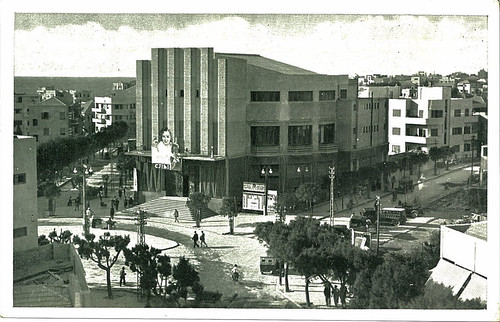
Moghrabi Cinema Tel Aviv - memories of the silver screen

Tel Aviv - former Mograbi Cinema by Yekkes

Israelis love film. The current world wide success of large numbers of Israeli films is well known with the likes of Ronit Elkabetz, Adir Miller, Ohad Knoller, Amos Gitai and many other actors and directors receiving international acclaim. But the Israeli love affair with film is not something new. In the years following independence when money was scarce, people went to the cinemas in thousands to be entertained. A 1954 UNESCO study showed that residents of Haifa went to the cinema an average of 30 times a year, Tel Aviv residents 24 times and Jerusalemites 18 times, giving Israel the highest number of cinema visits per capita of any country in the world at the time.  This began to change from the late 1960's onwards when television finally came to Israel and together with the decline in audiences, tragedy befell some of the country's best and most visually stunning cinemas.

The cinema pictured here - the Moghrabi, was perhaps the most famous of all. Designed by the eclectic style architect, Yosef Berlin for Syrian Jewish businessman Jacob Moghrabi and opened in 1930, not only did it sport many art deco features but after being roofless for the first few years, allowing screenings under the stars, a sliding roof was fitted in case of the odd rain shower. This feat of technology was not peculiar to the Mograbi and there was at least one other example of a sliding roof in Israel with the Armon Theatre in Haifa. But the Moghrabi seems to have left the most lasting impression.

Berlin was responsible for a number of Tel Aviv's buildings from this period including some stunning examples of the eclectic style. One of these was the Moghrabi House at 72-74 Herzl Street. I have been unable to find out if this is the same Moghrabi family as at the cinema - so if you have the answer please let me know!

As well as being a cinema, the Moghrabi staged plays and was the home of the Folk Opera in the 1940's. Trying to find out what the first film shown at the Moghrabi was, I came across a poster for sale on the internet, dating from 1930 and giving just that information. It reads "The gates of Opera Mugrabi will open soon and the pubic will come to see the wonderful building which was under construction for four years...the opening film will be the greatest of them all - Reo Rita". Another poster advertised the technological wonders of the Moghrabi "Which projector will screen films in the Moghrabi Opera? A Gaumont projector which is the most advanced of image projectors". Both posters were printed by  Etin and Shoshani printing press, and demonstrate the confidence of the new state and its belief in modernity.

As well as being a cultural and social attraction and meeting place, the Moghrabi also witnessed some key moments in the history of the State of Israel. When the United Nations took its vote on partition in November 1947, great crowds gathered in front of the Moghrabi to await the result and danced in the street when the UN voted in favour.

Tragically, an electric short-circuit in the summer of 1986 caused a major fire which eventually led to the building being demolished leaving a huge void at the junction of Allenby and Ben Yehuda streets. From time to time there are plans and proposals put forward to rebuild at least the wonderful facade of the Moghrabi, but I am not aware of any of these being very far advanced. The picture postcard shown above is an iconic image of the cinema with its almost Egyptian style pillars and columns and the steps leading up to the great temple of film. Photographer Rudi Weissenstein's images of the cinema illuminated at night shows an impossibly glowing, glamorous, glorious building lighting up the city through the early years of independence and austerity. Such a loss. How many young Israelis saw their first movie or had their first date here I wonder?  Memories and stories are welcome here!

You might also like this art deco cinema in Fiji or this post about Tel Aviv's eclectic architecture of the 1920's. Browse more photographs of Yosef Berlin's buildings here.

Thursday, 22 November 2012

Second week at the UK Jewish Film Festival - Holocaust stories, gangs in Bat Yam and a great Dutch movie

The second week of the UK Jewish Film Festival featured some great cinema. These were my highlights!

Here I Learned to Love is an extremely moving documentary about two brother - Avner and Izik, children in Poland during the Second World War. Separated from their parents, they were looked after first by their aunt Malka who managed to get them onto the controversial Kasztner train by throwing them on at the last minute before falling into the care of an unrelated young woman - Naomi who looked after them until they were liberated just before the end of the War.

The two men, both in their 70's had taken different paths to dealing with their history. Avner refused to talk about it and blocking it out in order to become a "Sabra" following their arrival in Israel just after the end of the War. Izik was more forthcoming and wrote about his experiences. The film takes them on a journey of terrible discovery, back to Europe, to Poland, to the death camps and on to Budapest from where they were taken to eventual safety - but not before a sojourn in Bergen-Belsen.

The love between the two brothers is obvious as is the trauma they feel at re-experiencing their childhood years. There is a particularly touching scene where we see them sitting talking and holding hands whilst in Europe and talking about their lives. Touching in a different way - devastating - is the moment when a Polish official manages to trace the records of their mother - Mindel - and Avner says "Mindele, there is so much I have to tell you".

Avner was present at the screening as was his niece and the film director - Avi Angel. A very dapper and sprightly gentlemen, Avi was clearly touched by the audience's reception and spoke clearly (and well, despite his protests!) in English in answer to questions from the floor. One member of the audience asked if he felt better now that he had spoken about his past and faced it head-on. He gave a hearty "yes" in response and it was easy to believe.


Security at this year's festival had been a little less obvious than in previous years. Until Saturday night that is, when following threats from Hamas to renew suicide bombings in Israel, security was more obvious and bag searches were carried out. Good, I like the idea of being safe in the cinema - but sad that its likely someone might want to blow me up because I've gone to see an Israeli film.

God's Neighbours, a new Israeli movie featured three young religious men living in Bat Yam. Avi, the most interesting character, is only recently religious but struggling with himself after the death of his mother and trying to find meaning in life through the Nachman, Breslov group of Hasidic Jews. His two friends are Kobi, the most extreme and who especially favours violence as a way of bringing people to religion and Yaniv, who is the least interesting and easily led of the three.

The film examines the clash between ultra religious and secular sections of Israeli society, Russian immigrants and to a lesser extent, the Arabs. Interestingly at least one of the panelists in the Q and A that followed the film seemed most interested in the short piece that featured the violence between the Hasidim and the Arabs, despite it being a relatively small part of the film and not the major issue.

Female characters are few and far between - this is a "a man's movie" but here is some love interest when Avi begins to fall for the very secular Miri and both begin to influence each other - perhaps indicating that there can be a dialogue and that there is something for both sides to learn - although the panelists (mostly) disagreed, instead viewing Miri's renewed interest in religion as capitulation.

One of the most interesting dimensions of this challenging and often violent film is that it focuses on a largely Sephardi community in Bat Yam, with the lead characters being of Turkish, Moroccan and Yemenite background. Avi and his father even exchange a few words in Ladino - I wonder how many others in the audience spotted this? Very interestingly we see that socially and culturally there is little difference between the different groups featured in the film with religious and secular Jews and Arabs all drinking coffee, playing shesh besh and eating Mizrachi food during the course of the film.

A great central performance from Roy Assaf as Avi. One for more general release please.


Suskind - by makers of Black Book is a heart breaking true story of Walter Suskind, a German Jew who had quit his home country to escape persecution only to get caught in the same trap following the German invasion of the Netherlands. We see the gradual erosion of  the rights of Jews and their separation from the rest of society. Suskind is faced with the challenge of co-operating with the oppressors or trying to subvert them, knowing it is unlikely either he or his family will survive.

There are some truly shocking scenes in this film. The vile collaborationist Dutch characters, (of whom there were many despite decades of telling a different story) - such as the "key man" who empties Jewish properties once the inhabitants have been deported and happily turns in anyone he finds hiding in return for money. There is the tacit collabariton of some of the leading members of the Judenrat whilst acknowledging whatever they did would be wrong - Suskind challenges them morally. And also the examples of those who didn't collaborate or stand by, like van Hulst who lived behind the theatre where Jews awaiting deportation were held or the "communist" policeman who helped spirit children away from the Germans.

Excellent performances from Jeroen Spitzenberger as Suskind, Nyncke Beekhuyzen as his wife Hannah and a suitably tortured performance from Karl Marcovics as SS boss Ferdinand Aus der Funten. Marcovits played the lead role in a film from the same period - The Counterfeiters, which was screened at the festival a couple of years ago.  It is still possible to visit the Hollandse Schouwberg (Dutch Theatre) which was the last stop for Dutch Jews and Jews who had fled to the Netherlands to escape Germany and Austria, before being transported to the holding camp at Westerbork and then, for the main part, to Auschwitz and death. 140,000 Jews lived in the Netherlands at the time of the German invasion. 75% of the total were murdered.


The Last Flight of Petr Ginz is a documentary telling the story of another Holocaust victim - talented Czech teenager, Petr Ginz. By the time he reached his early teens he had written a number of novels, (some of which survived the War) as well as being a talented young artist. Petr was deported to the Czech town (which became a camp) of Terezin, renamed Theresienstadt by the Germans and during his time there, managed to establish and edit a magazine for the other young prisoners. He was deported to Auschwitz in October 1942, where aged 16 he was gassed to death on arrival.

The documentary features his sister Chava (now Pressburger) who survived Theresienstadt. She speaks movingly about her older brother and how they played together and teased each other in the happy years before the Second World War. She spoke about Petr's passion for learning and for life, his talent for drawing, writing and inventing things and his desire to travel in space! Some of his art work has also survived and was featured in the film. His diary for 1941-42 resurfaced in Prague in 2003 when someone who had cleared a house in the Praha Mrodany area of the city discovered them in an attic and offered to sell them to Yad Vashem. Chava managed to acquire two of the notebooks and have been published as "The Diary of Petr Ginz".  An excellent documentary and another reminder of the great losses during that terrible period.


And so the festival comes to an end for another year. It passes by so quickly. My favourite films? I loved the documentary Life in Stills and I suppose my favourite drama was Yossi, although God's Neighbours and Suskind ran it very close. I missed some movies because of either clashes with other films or other commitments and particularly want to see Lea and Daria and the two old German ladies Oma and Bella so will be looking for opportunities to see them. 

Sunday, 11 November 2012

More from the Jewish Film Festival - Life in Stills and Lore


The UK Jewish Film Festival has now reached its half-way point and this weekend included some excellent screenings. I managed to see two of them.

Czech born Rudi Weissenstein is responsible for some of the most recognisable photographs in the history of pre-state and post independence Israel. Together with his wife, Miriam, also born in the former Czechoslovakia, he ran a successful photographic business - The Photo House in central Tel Aviv until his death in 1992, after which Miriam carried on until her death in 2011 at the age of 98. Life in Stills - a wonderful documentary made by Tamar Tal, records her fight to retain her shop in the face of a new development which would include demolition of the building it occupies.

The film is only partly about Miriam's struggle to ensure this piece of Tel Aviv's history is preserved. It is also a love story. Miriam's grandson, Ben runs the business with her, trying to modernise it with a website, overseas exhibitions and changing displays in the shop. Miriam is not keen on modernity. They often disagree, they sometimes row, but he remains infinitely patient and the love, mutual respect and the closeness between them is obvious.

There are moments of extreme sadness in the film. They find it hard to discuss the appalling tragedy that befell them a few years earlier, when Ben's father killed his wife (Miriam's daughter) before killing himself, yet both have an urgent need and desire to talk about it.

There are also many moments of humour. A great deal of Miriam's grumpiness is (I think) tongue in cheek and for her own entertainment, describing the customers as "pests" or "a pain in the ass" depending on which translation you prefer. She is particularly amusing when on a trip to Germany to promote an exhibition, she recreates a photograph of many years earlier - lying on her back in the snow (aged 96) - and when asked to say something, comes out with "hurry up". I can't think of many 96 year olds who would have been willing or able to lay down in the snow for any purpose but this illustrates the toughness and determination of the film's heroine - and also of many men and women of her generation who helped recreate the thriving modern state of Israel. Very few of them remain.

I am lucky enough to own a small number of prints of Rudi Wasserstein's photographs. I couldn't resist including my favourite of his images here - fishermen off the Jaffa coast in 1967, together with a picture of Rudi and Miriam outside their shop.


Life in Stills is a beautiful, bitter-sweet hour of cinema - the most enjoyable I have spent in some time and moves the viewer quickly from smile to tears and back again. I hope it gets a wider release. I want to see it again.

The other movie I saw this weekend was Lore - a German/ Australian production based on a story by award wining author Rachael Seifert. The story is that of a young German girl - Hannelore - the Lore of the title and her younger siblings making an epic journey across a devastated Germany in the dying days of the Second World War and in the aftermath. The children of committed Nazis, we see how effective the training of German children in this period was with the distasteful looks Lore gives to the son a farmer whom she is asking for food when she notices that he has a physical disability.


Lore fervently believes that a "total victory" for Germany is imminent, despite all of the evidence to the contrary, including the increasingly strange and frightening behaviour of her parents. This belief starts to fall apart as the children make their way across the country to find their grandmother. The portrayal of a society in total moral collapse is shocking as the actions of many Germans during the war period begin to be exposed, discussed and also denied. We see an elderly woman helping the children, although grudgingly and then wanting to keep Lore's youngest charge, baby brother, Peter, in order to receive more rations. We see sexual predators praying on the weak in return for the slightest help and we see those with entrenched views beginning the great denial of the Holocaust and other crimes that continues to today in some quarters.

Lore and the children meet a young man on their journey - Thomas - who may or may not be Jewish and although she at first rejects his offers of help, she comes to depend on them, struggling with the conflict between what she has learned about the Jews and what she is experiencing. There is a certain irony in this - but you will need to see the film to understand it!

Rachael Seiffert was present and took part in a question and answer session following the screening. She explained that her grandparents had been Nazi party members and had been interned following the war. Her grandmother appears to have been involved in looking after mothers and children who had lost their homes following heavy bombing raids. For a short time this was suspected to be part of the lebensborn programme of stealing "aryan" looking children fro the conquer countries. However, this was quickly disproved. Her grandfather was a doctor in the Waffen SS in Belarus. Ms. Seiffert described the conflict for many Germans of her generation, between the shame of knowing what their families had been involved in and the love they felt for them as relatives. She was extremely impressive - not flinching from or side stepping questions from what must have been a difficult audience for her. She was clearly affected by the experience and many in the audience obviously warmed to her.

Technically the film was excellent. The cinematography was beautiful - with several scenes of deep green valleys with delicate white clouds, as well as dark scenes of thick mud and devastation as the film progresses, perhaps showing both the journey that Germany had chosen, beginning with the romanticism of the 18th and 19th centuries and ending in dark mud and filth of the 1930's and 1940's.

Finally, a word about Saskia Rosendahl the young (born in 1993) German actress who played the lead role of Lore. She was excellent and totally convincing in the role, taking both her siblings and herself on both a physical and a moral journey. The film has already scooped awards and nominations. Definitely one to see if it gets a wider release.

Sunday, 4 November 2012

Ohad Knoller - a big hit at the UK Jewish Film Festival


A clip from Yossi - French subtitles here, but not in the UK!

It's November, so it must be the annual UK Jewish Film Festival! Once again the festival offers an eclectic mix of drama and documentary, full length movies and shorts, and films from a long list of countries including Uruguay, Croatia, Sweden and Russia. There are also many films from the more obvious places - Israel, USA, France and the UK. The festival centres on the Tricycle Cinema in Kilburn but also includes other London venues and some screenings in Glasgow, Leeds, Liverpool and Manchester.

So, to the films! I saw three films at the festival this weekend -two starring Ohad Knoller,  of Yossi and Jagger, the Bubble and Beaufort fame (not to mention Srugim - one of my favourite TV series ever). Ohad was present at screenings of both Yossi - the sequel to the aforementioned Yossi and Jagger as well as the rather offbeat (at least at first sight) We Are Not Alone.

Yossi and Jagger hit the screens ten years ago and won a string of awards, citations and critical acclaim. It touched on a number of issues - the Lebanon conflict, life in the Israeli army and an examination of being "on the outside" in this case through focusing on the relationship of two gay men. Most readers will know that Jagger dies in the movie, killed near the Lebanese border and Yossi finds the surviving partner (Knoller) a decade later, having left the army, qualified as a doctor and working as a cardiologist in Tel Aviv.

The Eytan Fox directed movie examines themes of loneliness, loss and also the crassness of some elements of modern living including the depersonalisation of the personal. Branded as a "gay" film in some quarters, Yossi addresses universal issues for the most part, through the medium of a gay character. The most specifically gay issue in the film is a discussion of the acceptance of gays in the Israeli Defence Force today compared to ten years ago when the first movie was released. There are moments of intense sadness that will move viewers to tears as well as some extremely funny scenes including a fair amount of poking fun at some of the tackier sides of Eilat!

There are some excellent performances - Knoller in the title role, Oz Zehavi as Tom one of a group of young soldiers Yossi meets and who have a significant impact on him and Orly Silbersatz as Jagger's mother who enters the story through a chance encounter at a hospital. There is also a brief appearance from Lior Ashkenazi of Late Marriage fame. A short Q&A followed the screening with Ohad fielding a range of questions on gay life in Israel (he is not gay incidentally!), a series of questions on the Srugim TV series and a bizarre question about honour killing of gays by Orthodox Jews which he dealt with cleverly and humorously. Nice one Ohad.

My other two films of the weekend were screened at the Phoenix Cinema in East Finchley. This was my first visit. It is a little art deco gem, with some original features retained and what look like restored (or replaced) panels in the auditorium showing symbols of the theatre and music. Its also very conveniently about three minutes walk from East Finchley Northern Line station. My second Ohad Knoller film of the weekend - We Are Not Alone - was a world away from Yossi. An offbeat romance between a security guard in Tel Aviv's Dizengoff Centre, played by Knoller and a young "lost" woman played by Efrat Ben Yaakov, nevertheless the film examines issues of belonging, the desire for closeness and the often frightening prospect of facing the world every day. Interestingly, during his introduction to the film, Knoller explained that he had once worked as as security guard and had felt "invisible" in that job. The film illustrates that feeling very clearly.

The same themes receive attention in Foreign Letters. This is a true story, set in the 1980's and based on the friendship between Ellie, a young Israeli girl recently emigrated to the United States with her family and Thuy, a Vietnamese girl of the same age from a refugee family. They have much in common - leaving their homelands to escape war, they are largely ignored by the majority of their very WASP classmates and to different extents are isolated through barriers of language and class. Language and words play a very big part in the story directed by Ela Thier (the Ellie of the film). If you get to see this, look out for a few scene stealing scenes from Ellie's little brother, I especially liked the door knocking episode and the shouting of "I have something, I have something" in Hebrew!

My favourite film of the festival so far? Yossi by a mile, but there are lots more to come including a Dutch war story - Susskind - by the same producers as Black Box. I can't wait.