Showing posts with label Bangladesh. Show all posts

Thursday, 20 July 2023

Beside the Buriganga

"Look over there on the other side of the river," said Mukal. "I grew up in a small house behind that tall blue building and my school was near the other, smaller yellow building you can see just a short distance away. After school and at weekends we would play in a small park nearby and sometimes swim in the river. The park is gone now. It's become a rubbish dump. The water wasn't filthy then and it didn't smell. People still drank from it. In the watermelon season we would swim out to the boats bringing fruit from Barisal. The workers would sometimes give us a watermelon which we'd take ashore and eat immediately". 

"How long ago was this?" I asked. "About twenty years" he replied. "The streets were not filled with rubbish, and I don't remember this amount of dust. It was a good place to live but it's all lost now."

As we walked along the riverbank, we waded through discarded household items, rotting vegetables from the market and other detritus. We passed a small boy, perhaps eight years old, maybe less. He was collecting plastic items from the garbage to take for recycling in return for a few taka*. He was alone.

Mukul had a persistent cough and regularly cleared his throat by spitting out phlegm in the street. "It's the dust," he said. As we turned to go back, he bought a bottle of water to combat the dryness. In the car, he took the water in three gulps and cleared his throat again. He opened the window, spat and threw the empty bottle out. As we pulled away, I noticed the small boy again. He'd seen the bottle hit the ground and was coming to collect it.

You might also like The rag-pickers of Sylhet

* taka = Bangladeshi currency. 100 taka = approximately £1. In Sylhet, collectors reported receiving 5 taka for one kilo of plastic. 

Monday, 10 April 2023

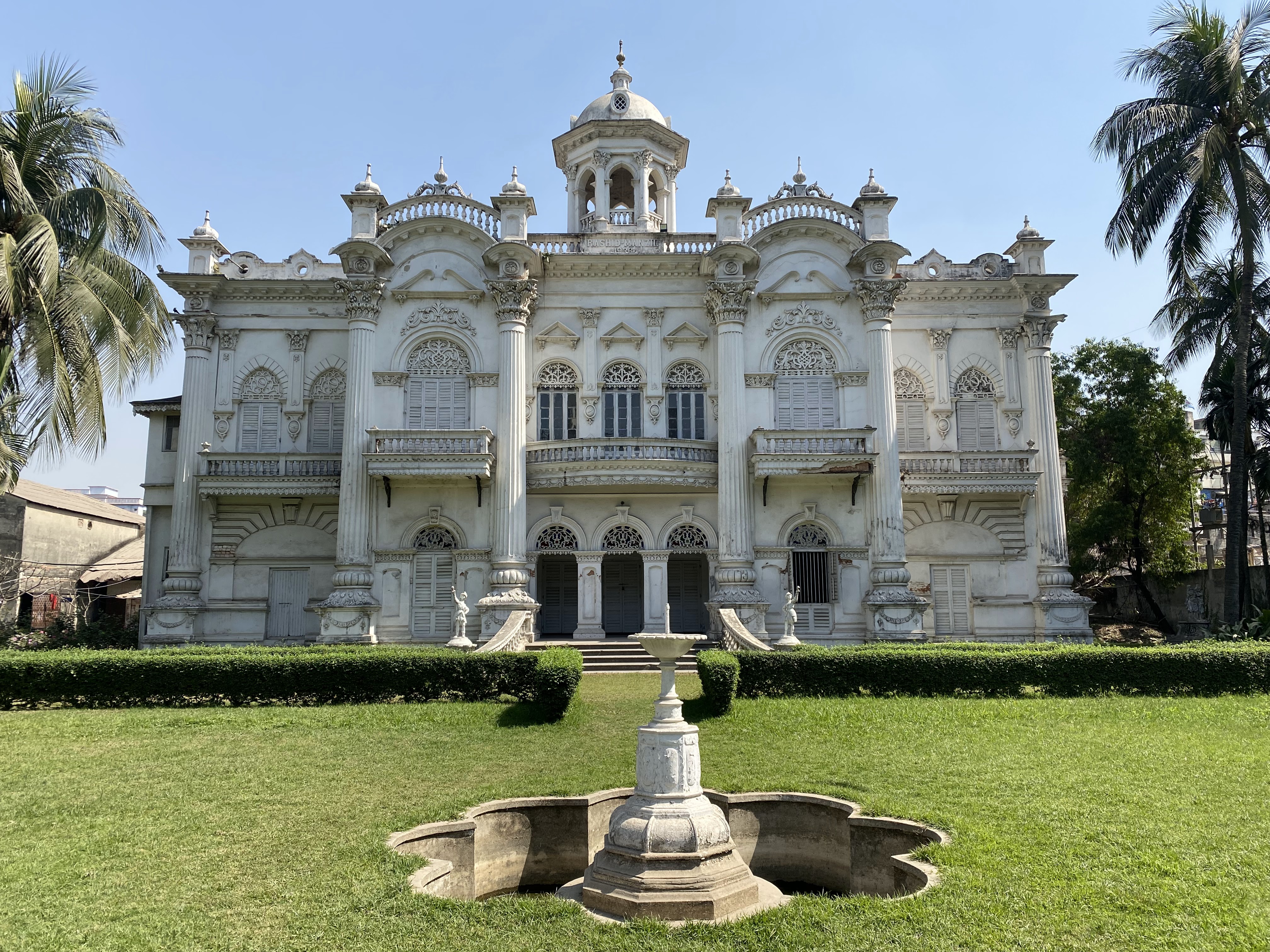
The Rose Garden Palace


The sign on the gate said, “Closed for renovation”. It gave no date for when the works might be completed. We got out of the car and Dev spoke to a bored looking uniformed security guard for a few minutes while I hung about unable to follow the conversation. The guard then disappeared through a small door set within the gate, emerging five minutes later to say he said he’d spoken to his boss and that we could go in.

The building under renovation was one of Dhaka’s most elegant - the Rose Garden Palace. It is said to be the result of an insult at a jalsa, a grand party, held in the Baldha Garden (today’s Botanical Gardens) in the 1830’s.  Narendra Narayan Chaudhury, owner of the garden mocked Hrishikesh Das, another rich Hindu zamindar (landowner) because of his low-caste status. Das was a banker who also dealt in brick and tile manufacturing and traded coal, lime and timber. He was so enraged that he vowed to build a bigger, better palace than Chaudhury’s and his Rose Garden became known for special musical performances attended by the city’s most prominent people. 

I was unsure in what condition I would find Das’ palace, but once inside the gate I could see that it had been better cared for than many other heritage buildings in Dhaka. The structure is intact and the decorative features on the façade in good condition. Gaining entry to the building was a step too far for the security guard’s boss and so I was unable to view the thirteen apartments spread over two floors.  There are (or were) two ballrooms, one at each level. The upper ballroom has what has been described as an “ostentatious dome”. Other internal features include decorative mosaics and coloured skylights, part of a design that combines western and local influences. 

"That's not a problem sir. It won't be allowed".

The rose garden that gave the palace its original name disappeared long ago, but the original marble statues have survived and there was evidence that some re-planting had taken place. The pond at the end of the garden had been drained, revealing large amounts of rubbish thrown from the high-rise flats on the other side of the wall. The guard said that there were plans to re-instate the pond. I asked him how they would prevent the neighbours from using it as a rubbish dump. “That’s not a problem sir. It won’t be allowed” he said.

Das’ extravagant lifestyle eventually brought him to bankruptcy and the palace was sold. Despite this he is not lost to history. A street in Old Dhaka still bears his name – Hrishikesh Das Road in the Sutrapur neighbourhood. In 1937 the palace passed to Khan Bahadur Kazi Abdur Rashid. Under Das’ ownership the building had primarily been used for entertaining, but Rashid chose to live there. He renamed his new home Rashid Manzil, and these words still appear on the façade.  He was a successful businessman with several interests including ownership of a publishing house. He was also involved in politics, eventually becoming a Member of the Pakistani Parliament following Independence and Partition. Rashid campaigned for the political rights of East Pakistanis (today’s Bangladeshis) and many liberals and social democrats spent time at the house discussing this issue. This culminated in June 1949 in the formation of the Awami League, a political party opposed to the governing Muslim League which many Bengalis believed no longer represented their needs.

In the 1960’s the palace was leased to the Bengal Motion Picture Studio Ltd. Several historical dramas were filmed there, the first of which was Harano Din (Lost Days), a 1961 film starring Shabnam and Ghulam Mustafa in the lead roles. Shabnam played the part of Mala, a snake charmer ‘s daughter who receives the unwanted attention of a rich landlord before finally managing to evade him. In 1989 the building was declared a national heritage monument and in 2018 was purchased by the Government. Plans were announced for the palace to become a museum, but the programme was disrupted by Covid, and it is not clear when the work will be complete.

After half an hour of admiring the exterior of the palace and trying, unsuccessfully to peek through the ground floor windows, the guard started to become uncomfortable. Not wishing to outstay our welcome we left the quiet of the garden to re-enter the noisy Dhaka streets, but not before thanking him in the usual way.

Sunday, 2 April 2023

The Hijras of Shyampur

It took a little time to find Miss Bobby’s home. It was behind one of Shyampur's main streets, down a narrow, litter strewn alley on a raised platform with several other houses. All of them consisted of a single room constructed from corrugated metal. I later learned that the platform is to protect the homes from the sewage that sometimes comes to the surface during the monsoon.

Miss Bobby was not feeling well. She sat on her bed, arms folded. Her hennaed hair was swept back and tied into an austere bun. She is the guru or leader of a group of Hijra (third gender) living in Dhaka’s Shyampur neighbourhood. She is also the founder of Susto Jibon – an NGO that focuses on health and human rights for third gender people. She greeted us with an almost imperceptible nod and said, “hello,” in English. Like Munaji in Delhi, she was at first a little cold and understandably suspicious but began to warm when I asked her about the NGO. She said, “I started it in 2000. I could see that the community needed somewhere to go for help and information. We began by offering advice on safe sex and giving out free condoms, lubricant and medicines. Our work has developed over the years and now we also do blood tests, run community workshops and teach craft skills.”

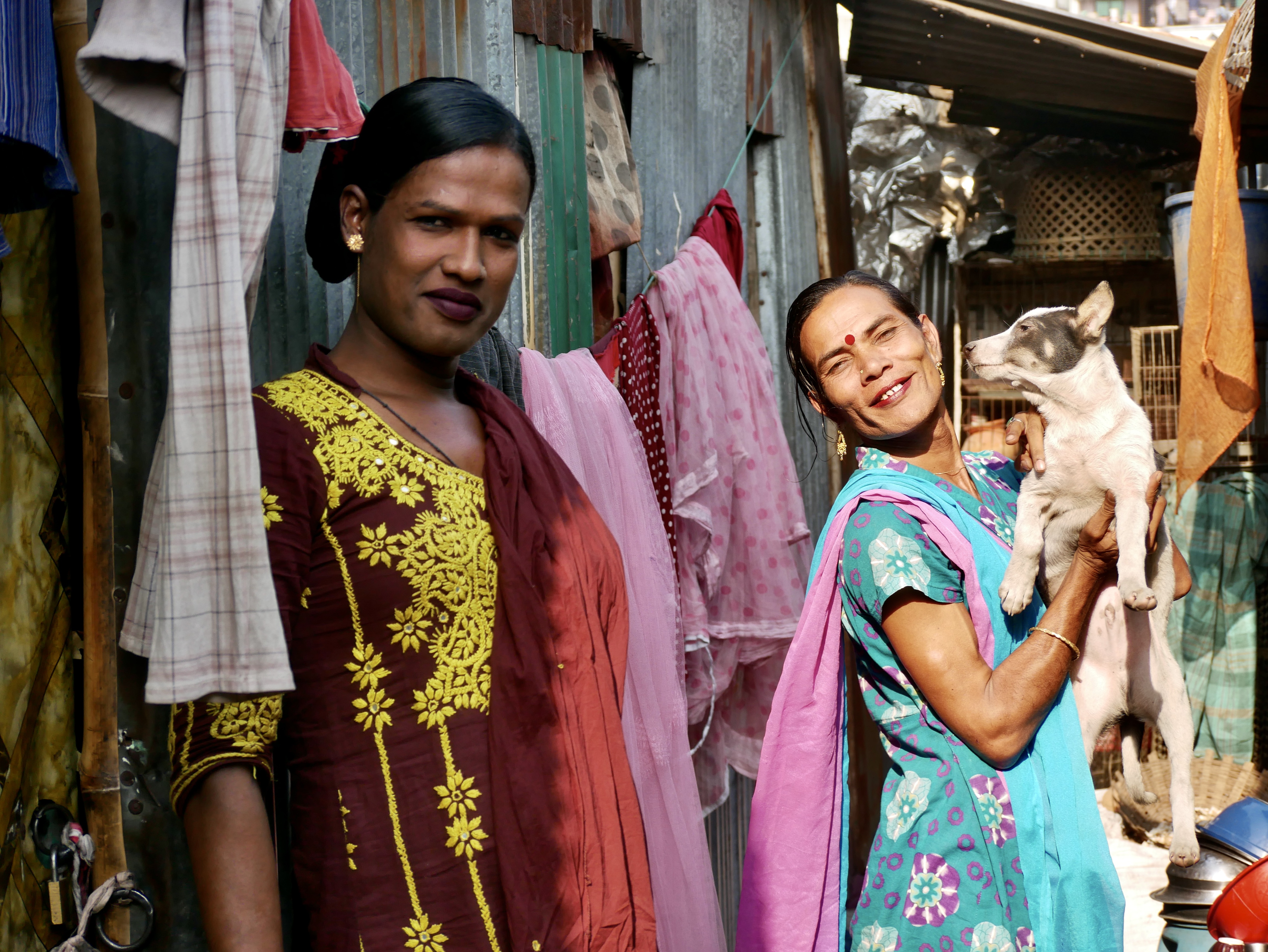
Sanjeeda and Meryl (holding her pet dog)

I asked her about her own story. She said, “I am 60 years old. I joined the community about 40 years ago and have been leading it for the last 15-20 years. I realised I was not like other boys when I was seven or eight. I didn’t need to tell my family as they could see it for themselves. They were not pleased. My father, who was a government worker would become very angry and beat me.” She paused briefly and then continued, “I felt very sad and lonely but then I saw a group of Hijra performing in the street, singing and dancing.  I wanted to join them. Now I am the leader of that community.”

While we were speaking two of her followers came into the room and listened to our conversation which was conducted in a mixture of English, Hindi and Bangla and with the help of a translator. Meryl and Sanjeeda are two of the 3-400 Hijras living in this area. I asked Miss Bobby if the neighbours are accepting of them. She said, “We have been here for ten years now, and our neighbours do not trouble us. It wasn’t like this in the past, but today we are accepted and sometimes we are called upon to make peace between couples who are fighting or quarrelling.” 

Meryl and Sanjeeda also shared their stories. Sanjeeda is 36 and was born in Shyampur. Like Miss Bobby, she understood that she was different at an early age and although her parents were accepting of her, the neighbours were not. She said, “they would come to our house and say to my father ‘we don’t want your son to play with our children, keep him away’.” She continued, “my father is dead now. My mother lives with me.” She eventually found her way to the Susto Jibon office, and after receiving help and advice, joined the community.

I asked about her experiences at school, but she said, “I only completed class one. I cannot read or write.” Like the other community members, Sanjeeda collects donations from shops and people in the street and performs and gives blessings at weddings and on the birth of a new baby. I wondered how people respond to their requests for alms. “Some people are kind and give money, but others shout at us and tell us to get work. We sometimes get attention from religious people. They say very bad things to us,” she said, and then added, “I usually collect as part of a group, so I am not afraid.” 

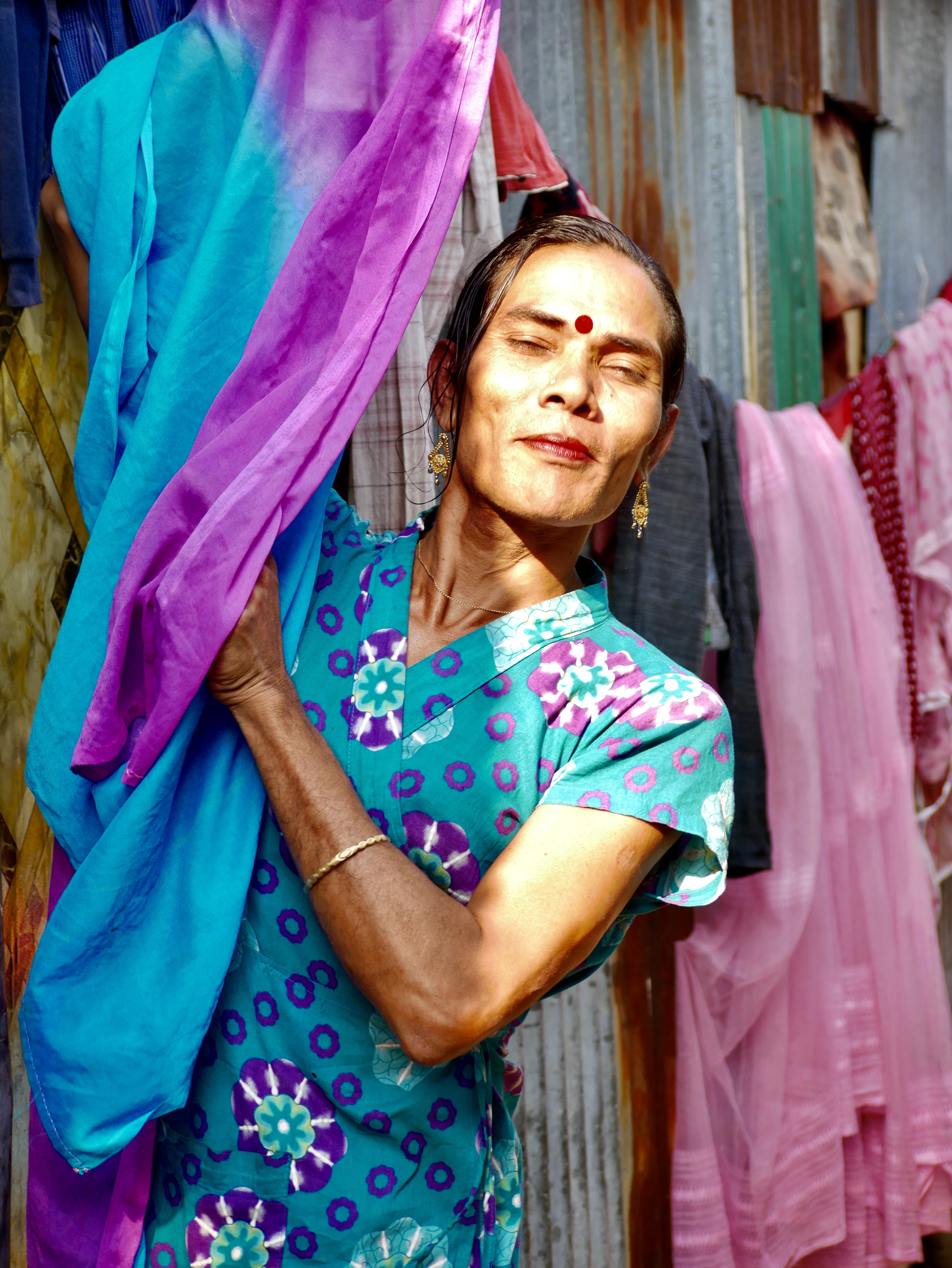
Meryl plays up for the camera

Meryl is 42 and of striking appearance. Her hair was pulled back, emphasising her high cheekbones and she wore a large bindi between her eyebrows. She was born in Old Dhaka, one of ten children in a family where the father had two wives. “My family were very kind to me and wanted me to stay with them, but I realised I had to leave and live with people like me,” she said. We stepped outside onto the platform to take some photographs and she immediately began playing up for the camera, spinning around, covering her face with a dupatta and picking up her pet dog and cat saying, “they are my babies.” Sanjeeda looked on, amused, clearly the more reserved of the two.

Meryl is known for her singing and dancing, and she wanted to perform for us. She prepared by brushing out her long hair and applying fresh make-up, all the time feigning shyness and laughing. She then stepped down from the platform into the narrow alley, picked up the neighbour’s baby and began to sing and dance in time to Sanjeeda’s tabla playing. The neighbour was unperturbed, and the baby seemed to enjoy the attention. At the end of the song, Meryl joined Sanjeeda on the platform and Miss Bobby re-appeared. I left a “tip” with her, and we made our way to another Hijra household.

Paakhi Islam and her friends were waiting in a room at the top of an unfinished apartment building. The room is accessed through a shared courtyard and a series of staircases lacking bannisters. Chickens roamed freely in the yard below and a woman was cooking on the walkway of one of the upper levels. Paakhi is 33 and has been a member of this group for 12 years. Her story is like that of Meryl and Sanjeeda. She said, “When I was ten, I thought ‘I am a boy, but I behave like a girl’. My parents couldn’t understand me. I know my mother loved me, but my father would beat me. The neighbours were also a problem and would say ‘you are half woman, don’t come around here’.” She eventually found her way to Miss Bobby’s NGO, made friends and received help. Her mother is dead now and her father lives in Spain, but she has no contact with him.

Paakhi is better educated than most of the other group members. She studied until she was 16 and completed class eight. She has also worked in the fashion industry. Her height and looks have attracted attention and she has appeared as a model in a professional fashion show. Bangladesh is one of the world’s major garment producers, but modelling opportunities are limited, and she still collects donations from shopkeepers once a week. She also gives blessings and dances to supplement her income. 

Paakhi Islam, model

While Paakhi sat on her bed talking to me, several members of her group, cross-legged on the floor, chatted and joked with each other. They were very different from Miss Bobby, Sanjeeda and Meryl. Two of them, perhaps in their twenties, wore male clothing, had short hair and had not shaved for a couple of days. When I asked about this, they explained that they only wear saris when they go collecting. One of the group, Imran (not his real name), had a full beard and a white topi or skullcap, as worn by some religious Muslim men.  When I entered the room, he - (I use the word “he” because Imran describes himself as a man. If I were able to write this in Bangla, this would not be an issue as the same word is used for “he” and “she” just as it is in Hindi)- gave a nervous laugh and covered the topi with a scarf in the way that some women wear hijab. His friend Palash said, “I began feeling different between the ages of eight and ten. My family understood what this meant and that it was not good. There were serious quarrels and I understood I needed to live somewhere else.”  

I asked Imran about his religious appearance and if he faces extra difficultires because of his faith. He said, “Yes, I am religious. I like to read the Koran. But I know I am different. I used to collect money and dance at weddings with my friends, but I didn’t enjoy it and so instead, I opened a small pharmacy to support myself. I hope God loves me and will help me with my business.” He continued, “I opened a second branch of my business in my village, but the religious people give me problems. When I’m in the village I try to behave like a man but sometimes I cannot control it.” He said, "there is a madrassa (religious school) in Dhaka that caters for third gender people and takes students of all ages. I haven’t had any trouble from extremists, but there are groups that threaten our community and some people have been killed.”

Imran has bravely tried to overcome a major problem for the Hijra community – that of earning a living outside of collecting alms, dancing and giving blessings, or working in prostitution. I told the group about a scheme in Karachi, Pakistan where Hijras are successfully employed to recover the tax arrears of small businesses. In India there have also been programmes to employ Hijras (and lesbian, gay and transgender people) in the Delhi Metro system. They listened with great interest but then cast doubt on such schemes ever being implemented in Bangladesh.

I was curious to know if there were any links between Hijras and gay and lesbian people. Homosexuality is illegal in Bangladesh. Although the laws are generally not enforced there is strong social disapproval of same-sex relationships and in recent years, high-profile gay rights campaigners have been murdered. When I asked about this, the mood changed and all denied any link. Paakhi explained that, “to be Hijra is legal, but these things are not. It is very dangerous for those people. We are not the same. We don’t know them”.

As I left, Paakhi and her friends asked me to visit again. In the courtyard one of her group asked me if I would spend a few minutes talking to a girl who lived on the ground floor of the building. She had not met a foreigner before and was curious about me. I spent a few minutes talking to her and was impressed by her English – she was just twelve but spoke confidently and with good pronunciation before shyness overcame her and she went back into her home.

Miss Bobby in yellow with Sanjeeda and Meryl

Friday, 24 March 2023

"Even if you are educated it is hard for Biharis to get work" - the Geneva refugee camp in Dhaka

"There's no space here. The children have nowhere to play or study and I have to cook in a small space under the stairs"said Shahana.  We were in her tiny home in in the Geneva refugee camp in Dhaka. More than 40,000 people live here in the dark, narrow alleys, in homes lacking basic services. Shahana was sitting on the steps that lead from a tiny ground floor room to two others of the same size. None of them have natural light. Fourteen people live in this house, including seven children. Her mother-in-law and her 97 year-old grandmother, Jamila, sat on the bed that fills most of the room, and her husband crouched down, talking to me through the narrow entrance to the floor above.

Early morning in Geneva refugee colony

Life in Bangladesh is often lived very publicly. It is not unusual to see people bathing in rivers or brushing their teeth in the street. In Geneva there is no choice and even the most basic human functions are carried out with little or no privacy. There are shared washing facilities and toilet blocks and water has to be queued for twice a day. Most of the residents arrived at the camp in 1971 after the War of Liberation when after a bloody conflict, what is now Bangladesh became independent from Pakistan. Many Bihari Muslims had left India in 1947 during Partition, opting for what was then East Pakistan. Their mother tongue is Urdu and during the war, most of them supported the Pakistani army against the majority Bangla (Bengali) speaking majority. Some took part in atrocities but others were also victims of violence. Figures for the number of casualties on each side vary wildly and are the subject of much dispute. After the war, and into the 1990's, many Biharis managed to leave for Pakistan. This process has now ceased, due in part to sometimes violent opposition from other Pakistani communities.

"The teachers are not friendly. We have to pay them bribes to get the children admitted"

Even in the middle of the day the camp streets are not light and are so narrow that it can be difficult to pass through them. Nazma was playing with her small grandson in one such alley. She was born in the camp and looked older than her 50 years. Before the War of Liberation, her father had a good job working for the railways. Her husband runs a small shop and her son has a car repair business. I asked her about problems with the outside community. She said "We had trouble in the past, but we don't really have those problems anymore". Then she added "But it can be difficult to get the children into outside schools. When they realise we are Bihari, they don't want them". Mohammed Ashore, a barber aged 36, expanded on this. "The teachers are not friendly. We have to pay them bribes to get the children admitted". He lives in a one room home with his wife and two children. They pay 4000 taka a month in rent. According to the World Salaries website a barber in Bangladesh can earn between 5,000 and 12,000 a month.

Nazma and her grandson

Nazma understood the importance of education as a way of breaking out of the camp. "I want my grandson to be an engineer" she said "but even if you are educated it is hard for Biharis to get work". Shahana said that her 11 year old daughter wants to be a doctor but that "my 14 year old son is not interested and doesn't want to study". For many years it was difficult for Bihari children to attend state schools. The community did not have citizenship and therefore lacked ID cards and other official documents necessary to secure employment and to access services. This changed in 2008 when the Government acknowledged their right to citizenship, perhaps recognising that the majority of people in the camp were not even born in 1971. Despite this positive step, long-standing suspicion and prejudice is harder to overcome.  

The camp has a small bazar running through one of the wider streets. Residents go there to buy fruit, vegetables, meat, fish, rice, paan and other consumables. They also go to visit the barber, get electrical items repaired and to seek advice at the office of the local community organisation. On the day of my visit a man selling rabbits from a wheeled cage was also trying to do business. I told my friend that rabbit was once a poor man's dish in the UK but is now served in expensive restaurants. He assured me that they were being sold as pets and not for consumption. 

Shahana, her mother-in-law and grandmother

"Yes, I am the malik"

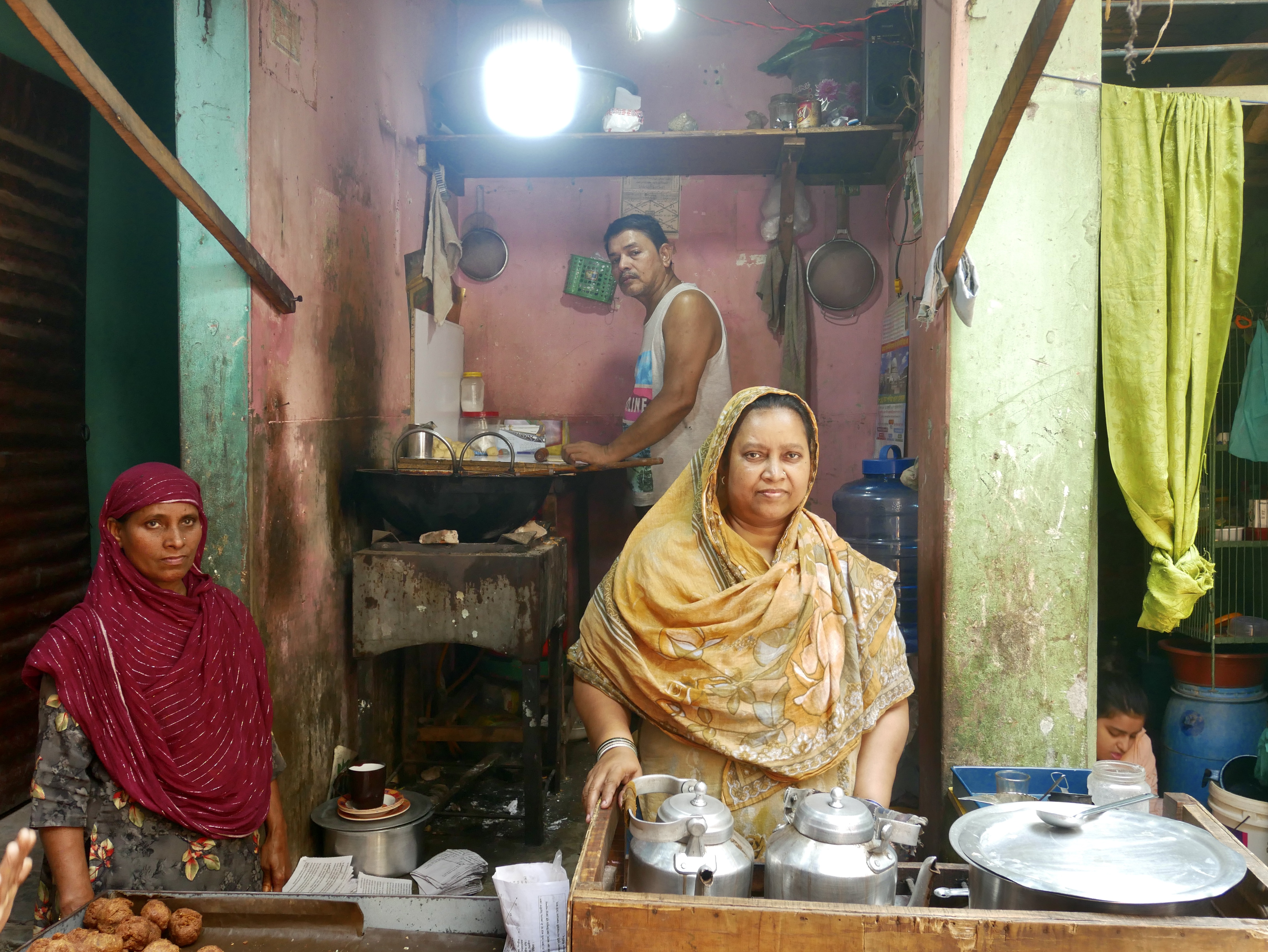
Shabanah is 45 and was born in the colony. She was doing brisk business at her tea shop. I asked her if she was the malik (boss/ owner) and what she did before opening the shop. "Yes, I am the malik" she told me, then added "my husband works here with me" as she turned to look at, and indicate the man preparing snacks on a raised platform behind her. "I used to work in textiles, but I set this shop up three months ago"  she added. The shop occupies a narrow hole in the wall with a stall set up on the pathway in front. The monthly rental is 2,500 taka (about £25). I ordered a tea and as I spoke to her in my limited Hindi, a small crowd gathered, curious to know what we were talking about and in some cases, anxious to join in the conversation. She told me "My grandfather's name was Mohammed Miah. He came from Bihar but I don't know exactly where". She agreed with Nazma, Shahana and Mohammed Ashore that the main problems of living in the camp were access to good water, space and facilities for children and the generally poor living conditions. She has two children and I asked about her ambitions for them. "I want them to be able to recite the Koran in full" she said. She agreed to a photograph and covered her head in preparation. When I got up to move on, she refused to accept any payment for the tea, saying I was her guest. 

Shabanah "I am the malik"

Despite Nazma's assertions that relations with the majority community are now better, one exchange I had in the bazar showed that there is still resentment about the events of 1971. A middle-aged man approached me and asked where I am from. When I told him I am British he became very enthusiastic, praising the UK and asking me if I had been following the cricket series between England and Bangladesh. I told him  cricket isn't really my sport, but I knew that Bangladesh had done very well and had seen people celebrating their victory over England. His manner changed instantly and raising his voice, he said that he was not happy, didn't want Bangladesh to win, hated the camp and that I should go to the community association to hear the truth about 1971. Then he stopped mid-sentence, shook my hand and left.

Many residents of the Geneva camp have spent their whole lives there. Others have lived there for more than 50 years, under what they hoped and expected to be a temporary arrangement. The ongoing problems with lack of space, poor access to water and other services can only cause more resentment and frustration. In the past, there have been occasional clashes with the majority community, including at another camp in Mirpur, where in 2014 at least nine people were burned to death in their homes during disturbances. Despite this, the angry man I met in the bazar was not typical of the people I spoke to in the camp, all of whom were ambitious for their children and grandchildren and recognised the importance of education in securing a better future for their community. 

Children going to school inside the camp

You might also like "The landowner refused to pay us...we had barely enough to live on" - Delhi's Sri Ram refugee colony

Friday, 17 March 2023

The rag-pickers of Sylhet

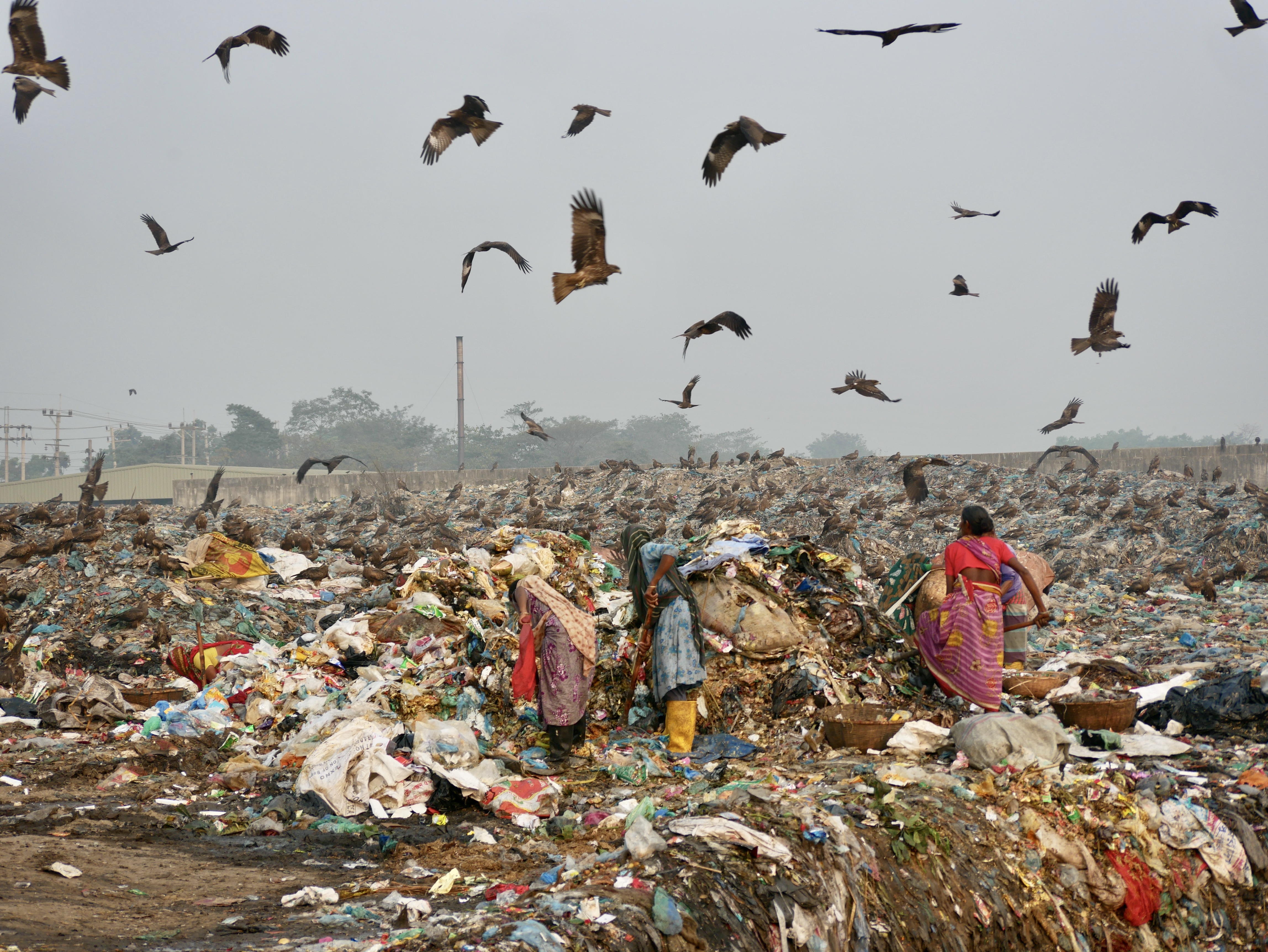
It's the birds that you notice first. They are everywhere, perched on the diggers, sitting amongst the rubbish and circling above the forty or so, mostly women, workers picking through the waste. Several women are at the summit of the dump, looking for plastic and other recyclables. It takes a moment or two to realise that there are other workers further down, surrounded by the rubbish, almost devoured by it. And all the time the birds watch.

This scene takes place near Sylhet, capital of the Bangladeshi province of the same name. The city has many modern shops, restaurants and hotels but to the rag-pickers, (the generic term applied to those doing this work) it is merely the pace they go to sell  items they salvage from the dump. I spoke to Rubi aged 56. She is originally from Moulvibazar, just south of Sylhet and has been here for ten years. I asked her what she did before she began this work. "We were not a rich family" she said. "I had no father and my mother had to do farm work. Then I got married and I was a housewife, but we needed more income to cover the cost of food and accommodation so I came to work here with my husband". Her daughter Fahima also works here. "She's 12 years old" said Rubi, "I'd like to send her to school but who will pay for her books and how will we cover the money she earns that helps to buy food and clothes?"  They sell the plastic items they collect to a recycling company in the city. For one kilo of plastic they receive just 5 taka, about five pence. This is substantially less than the amount the rag-pickers I met in Rajasthan receive for the same weight. Rubi says that on a good day the family can make 200 taka (£2). One kilo of lower quality rice in Sylhet ranges from 55 to 70 taka. Basmati is definitely off the menu at around 350 per kilo.

Fahima is not the only child working here. Johir Islam is also 12. He said "I began working here two years ago. I have no father and I need to earn money to help my mother". He only completed first grade at school and is unable to read or write. Johir was working with another boy, also aged 12. We had just begun talking when a truck arrived carrying new garbage. The boys broke off, picked up their plastic sacks and ran towards it, hoping to find the best items before the other workers got there.

Apart from the odd pair of wellingtons. no-one was wearing protective gear. Rubi, who had by now been joined by several of her colleagues, curious to know what we were talking about, claimed never to have been injured at work. She said that she had never had a skin disease from handling the garbage, despite not wearing gloves. She seems anxious to emphasise this and the others nodded in support of her assertion. I had not mentioned specific diseases. Despite Rubi's claim, a recent report says that as many as 80% of child rag-pickers in Bangladesh have been injured at work, mostly with cuts of different kinds. It also mentions the prevalence of dog and insect bites and respiratory problems from inhaling chemical fumes and airborne dust. Eczema, itching and fungal infection are listed as being widespread amongst this group. 

Although Rubi and her colleagues denied having accidents, they went on to list the various hazards of their workplace. These included dogs, "rats as big as cats", needle sticks and occasionally, snakes. I had a close encounter with four dogs when I arrived. They ran towards me growling and showing their teeth before one of the older women chased them away. They retreated to watch from a distance but did not bother me again.

From time to time, the authorities issue statements about banning rag-picking and then go quiet again. But as Rubi asked "what will we do if this happens? How will we survive?". It reminded me of the occasional proposals to end hand-pulled rickshas in Kolkata and the subsequent protests of the ricksha men, worried that they will be unable to find alternative employment. Rubi's final words before returning to work were "I would like the Government to do more to help people like us. We want to educate our children but we also need to feed ourselves".

As I prepared to leave I saw that the boys had gone into the distance, searching for items away from the main dump. I also noticed Fahima amongst a group of older women workers. She was looking into the distance, perhaps wishing to be somewhere else. But she was in the garbage, picking through the city's  waste under a dark, grey sky, with the sickly smell of decay and under the threatening gaze of those birds.

You might also like The rag-pickers of Jhalawar

Saunaya Roy's book Mountain Tales gives a detailed account of the lives of a community of rag-pickers in Mumbai.

Tuesday, 28 February 2023

Night train to Chittagong

The carriage was full and two men were occupying our seats. "Those are our seats" said Dev (my guide) in English, forgetting to switch languages after speaking to me. "Speak in Bangla" spat back the older of the two men, annoyed at having to move. Dev repeated himself in Bangla and reluctantly, very reluctantly they moved.  Seats secured, the next challenge was to find somewhere to put the luggage. Just like the train from Kings Cross to Darlington there was insufficient storage space. After much moving of other people's belongings Dev managed to force my suitcase on to the overhead rack. It was some way from our seats and about one third of it hung over the head of those sitting below.  I spent the first hour of the journey convinced the full 16kg (according to airline check-in) would come crashing down on their heads before eventually relaxing and then worrying again in case it disappeared if I slept.

We had arrived early at the station and sat in the waiting room where we found one man already sleeping - full-length on the metal seats, smelling of alcohol and grumbling in his sleep. Dev recognised him as one of Sreemangal's misfits, born to a rich family but spending much of his time drunk in the street. He wore trousers that looked a bit like a set of my checked pyjamas, a filthy once-white shirt and a tatty tie. After ten minutes or so he woke up and began trying to charm two very small children, members of a Hindu family waiting for the same train as me. The kids looked a bit scared, edged closer to their mother and pretended to not be there. Giving up, he wished me "good morning" in English and went outside. 

The 11pm train from Sreemangal to Chittagong didn't have sleeper accommodation but it boasted a dining car. At least that's what it said on the side of one of the carriages. If it did have one, much of its business was being taken by dozens of vendors who invaded the train at each station selling water, juice, cooked food, crisps (or chips as they insist here), nuts, boiled eggs and other items. Most of the vendors were older teenagers who carried their goods on their heads and ducked past each other as they tried to cover the whole train during the ten to twenty minutes spent in every station. Inevitably there were younger vendors too. One very small boy selling water at 1.30 in the morning can have been no older than ten and possibly less. 

There were also vendors who remained on the train for most of the journey, selling tea and coffee made from a large thermos flask, tea bags or jars of Nescafe. They appeared every 20-30 minutes, calling out "tea coffee tea coffee" until about 4 am by which time most of the passengers were at least pretending to be asleep. I was tempted by the astonishing selection of items on offer and the not displeasing aromas, but having just recovered from a bout of food poisoning decided it was best to resist. 

The seats have been designed to ensure maximum discomfort

I find it hard to sleep on trains and flights and I didn't expect to sleep on the eight hours journey to Chittagong. My expectations were fulfilled. The seats are designed to ensure maximum discomfort. They are angled - too sharp to be able to recline and too far back to be able to sit upright. They are not adjustable. I tried various positions, including resting my head on the drop down table on the back of the chair in front, but again the angle of the seat made it impossible.  I took my shoes off to feel a bit more cosy (and because my mam always says your feet swell at night if you keep your shoes on - I'm more like her than I care to admit) - and then I put them back on. I put them on again because I couldn't put my sock clad feet on the ground without stepping in detritus including discarded pieces of food, tissues, a comb and some cigarette ends. There were also several plastic bottles that rolled underneath my seat when the train hit a particular speed. The latter explained the presence of a young woman rag-picker on the middle part of the journey. It didn't explain the presence of two pairs of Hijra who got on at different stations to collect "donations". 

Hijra is the name given to the various third-gender communities found in India, Pakistan, Bangladesh and Nepal. Traditionally they have earned a living from giving "blessings" to newborn babies or at weddings, often demanding huge sums. They can be seen in the street soliciting money from passers-by or from the occupants of stationary vehicles. People generally give them a small amount of money in order to avoid any unpleasantness. If refused or otherwise upset they can sometimes become abusive and occasionally threatening. The first pair were good natured and received small notes from many the passengers. I usually "donate" and they were very happy with my 50 thaka, (about 50 pence) even providing me with change from a 100 thaka note and giving me a blessing which consisted of tapping me on the shoulder twice. 

"Na? Na? What is this na?"

When the second pair got on, they had a harder time as people didn't wish to give again. This led to some sharp exchanges, culminating in one with one of a group of inebriated young me sitting behind us. He  refused to give, offering a short "na" (meaning no) when asked. "Na? Na? What is this na?" asked the very offended taller of the pair, with her teased back hair and heavy make-up. He continued to refuse and things quickly deteriorated, him suggesting she take part in certain sexual practises and her alleging that his wife entertained other "husbands" when he wasn't there. The rest of the exchange escaped me, but it went on for a few minutes until the Hijra, satisfied she'd had her say went off to the next carriage.

Around 4am things quietened down a lot, though there were still occasional murmurings from behind. I dropped off shortly afterwards but woke at 5.45 just as the light began creeping through the window. An hour later we pulled into Chittagong and my fellow passengers alighted in a surprisingly orderly fashion. Dev and I agreed to wait until last so as to avoid struggling through the carriage to recover my suitcase which was still there and still partially hanging over the heads of the people sitting below. At about one, he'd put his cap on, taken out one of those neck-rest things and a blindfold that people use on flights and gone to sleep. Or at least I thought he had. As we wheeled our luggage along the platform I asked if he'd slept much. "No. Not at all" he said. "I heard everything all night". "Oh" I said, as while avoiding the touts and taxi drivers, we stepped out of the station and into the Chittagong traffic. 

Saturday, 19 March 2022

"There Is No Work Without Hard Work" - Stories From Bangladesh


"In Bangladesh, there is no work without hard work" said Omison, a day labourer at Mirpur, Dhaka. Just a few kilometres from the centre of the city, Mirpur is one of several places in Dhaka where goods are delivered for unloading and onward sale. All day, hundreds of labourers collect 30kg baskets of coal, place them on their heads and then walk up a steep narrow plank before emptying the goods onto a dark, dusty mountain. They repeat this process over and over again. For each load, a foreman hands them a plastic token. The tokens are collected at the end of the day and the workers are paid 3 thaka for each one. That's less than 3 pence. A  cup of street tea in Dhaka costs between 5 and 10 thaka. 

Omison is not sure of her age, but thinks she is about 60. She wore a purple and orange floral print sari, part of which she pulled up to cover her head in the way many Bangladeshi women do when talking to strangers. I asked her how she came to be working as a labourer. She said  "I've been doing this work for many years. I can't remember exactly when I started. It's very hard but I don't want to beg". I asked about her family. She said, "I am originally from Jamalpur. My father was a farm worker and my mother begged in the street. I live alone. I don't have a husband and my son is dead." I pressed a little, still curious about why she is doing this particular type of work. "I didn't go to school" she said. "I am not educated. I tried to get work in a garment factory or in the home of a wealthy lady but they wouldn't take me. What else can I do?"

As I stood and watched, the endless line of workers moved up and down the ramp, their motion regular and unchanging like the workings of a clock and their moving shadows reflected on the side of the barge. They have a short break in the morning and another one for lunch when, for a few thaka, they can buy rice and watery curry from one of the stalls that have sprung up to serve them. The breaks are taken in shifts. The line never stops.

"I have to take painkillers every day after work so that I can sleep"

Most of the workers are men, but there are also several women. Most of them younger than Omison, but at  a different location, I met a woman doing similar work who said she was 66. Male or female, they have similar stories. Most of their parents were day labourers either in rural areas or in the city. The majority had either never been to school or had received only a few years of education. Despite this, they were hopeful for their children and the younger workers I spoke to claimed to be sending their sons and daughters to school. This does not mean that they will complete their education and many Bangladeshi children leave the classroom before they reach their teens,  to start work and to help the family survive.

All of the workers I met told me they suffer from headaches, back pain and problems with their knees and shoulders. Krishna, aged 30 said "I have to take painkillers every day after work so that I can sleep". I asked if they had respiratory problems because of their exposure to the coal dust. All of them said the dust did not affect them. I hope that this is true but as Dhaka has recently been identified as having the  poorest air quality of any city in the world, it may be that they haven't noticed due to their constantly breathing in dust and other pollutants.

Most day labourers cannot afford to be ill. They are only paid for the work they do and there is no sick-pay. I asked how they had managed during Covid. Tinku, aged 48 said "It was a struggle. I have two children to feed. I had to buy food and pay the rent,  so I took a loan from an NGO". He is now making repayments at an interest rate of 15%. Omison had been able to stay at home. "Friends helped me" she said and then added "I didn't have to beg". She mentioned begging three times during our conversation. Financial security is precarious here and many live with the fear of having to ask for money in the streets. 

Dreaming of some other place

Bangladesh is full of surprises. In the midst of this hard labour, two Hijra, members of the country's third gender community, sat on the ground, one arranging the other's hair. They saw me, and start pulling faces and joking. They were quickly joined by two other Hijra who begin to dance, and to pretend to fight, as they staged a "scene" for the camera. They are also employed as labourers which is most unusual. I have met and interviewed several members of this community in India, but have never encountered or heard of Hijra working as labourers.

Beside the food stalls, there was, of all things, an ice-cream kiosk. A small boy, in a long-sleeved shirt and tatty shorts, stood a few feet away from it, slowly eating an ice-cream on stick. His legs and feet were covered in grey dust. I was certain that one, or both of his parents, were unloading coal. He briefly looked at the camera, but not in an excited or curious way like many children do. Rather, he had a detached air, as if he wasn't really there and was dreaming of some other place. He may well have been dreaming of better things, but the cruel truth is that when he reaches his teenage years, he is likely to be doing the same work as his parents.

You might also like The Rickshaw Woman of Kamalapur 

You can see more pictures from my Bangladesh trip here.

Follow me on instagram @adrianyekkes

Sunday, 13 March 2022

The Rickshaw Woman of Kamalapur - Stories From Bangladesh

I met Noor Jehan outside Kamalapur, Dhaka's main railway station. Not the Noor Jehan who was Pakistan's best-known actress and singer, but her namesake, who is one of the city's two known women rickshaw drivers. I asked her how she came to be doing this work. She said "I began six years ago when my drug-addicted husband finally left me. I need to support my two daughters and I want them to complete their education." Her girls are now aged 13 and nine and their photographs are displayed on the back of her rickshaw. 

"My name is Noor Jehan"

I went to Kamalpur, Dhaka's main station to admire the modernist architecture, and to look for pictures and stories. Kamalapur is a mini-version of Dhaka. Huge crowds flow in and out of the station. Hawkers, beggars and street kids take up residence under the external canopies, hoping to make enough money to feed themselves, and dozens of rickshaw and tuk-tuk drivers wait, anticipating customers. At night (and sometimes during the day) homeless people sleep here. The mood is often raucous as the drivers tease each other or minor disputes break out between the other occupants. The drivers drink tea  purchased from a street vendor and drive a hard bargain with commuters and shoppers before setting off on their next journey.

In the midst of this activity I noticed a woman standing beside a rickshaw, with a small crowd around her. She wore a gamcha (worker's towel) as a hijab and held the handle-bars of an electronic rickshaw. I have never seen a woman rickshaw driver in my travels around India and did not expect to meet one in Bangladesh. Together with Liton, my guide and interpreter, I drew closer and we began to talk to her. She was small and quietly spoken and understandably seemed a little suspicious at first. We introduced ourselves and she said "My name is Noor Jehan".

I wanted to know how she became a driver, and how people reacted to her. This was only my second day in Bangladesh but I had already learned that if I stop to speak to someone, a small  crowd will gather, follow the conversation and sometimes try to add to, or dispute, the answers I'm given. The canopy at Kamalapur was no exception and very quickly a large group gathered, including other drivers, passers-by and a couple of Hijra, all of them taking close interest in our conversation. It was clear that this wasn't the best place to talk, so we hired her, and she took us for a drive around central Dakha.

 "I am determined I will never beg and nor will my daughters".

Driving in Dhaka at four in the afternoon is not for the faint hearted. Actually, driving in Dhaka at any time is not for the faint-hearted. There are too many vehicles, not enough space and the rules of the road are interpreted very broadly. The rickshaw is a very fragile vehicle and when surrounded by cars, buses and overloaded trucks the driver and passengers are vulnerable. Despite this I love traveling this way, being close to the activity, and getting a different view of the street. But of course, I don't have to do this to earn a living. Noor copes with this every day.

She explained how the rickshaw system works. She rents the vehicle from the garage, for 300 thaka, per day, which  is about £3. By 4pm on the day I met her she had made 400 and so had only just cleared a profit. She would go on working until the evening while a neighbour looked after her daughters. 

I asked her how she managed to secure the job. "I needed work but didn't know what I could do. I thought maybe I could drive a rickshaw and so I went to a garage and asked to rent one. The owner laughed and told me to go away. He said the work is too hard for a woman and that I wouldn't be able to do it. But I didn't give up and eventually he agreed to rent an e-rickshaw to me". I wondered about the response of the other rickshaw drivers and how they treated her. "Some are pleasant and encourage me" she said, "others are not pleasant  and say bad things. It's the same with the customers". Shortly after starting our drive I saw an example of this less pleasant behaviour. While we were waiting at a traffic light, a man leaned out of a bus window, shouted something and leered at us. Liton shouted something back and the man quickly sat down. I asked him what had been said. "He was rude and asked us why we had chosen a woman driver. I told him to mind his own business" he said. From the expression on the man's face, I suspect it may have been something a little stronger than that. 

I asked if she was there were any other woman rickshaw drivers in the city. "I only know about one other" she replied. "I've seen a woman driving a rickshaw in the university area but I've never spoken with her". After twenty minutes we made our way back to the station. As we said goodbye we wished her and her daughters luck before insisting she accept the tip that she twice refused. "Remember me in your prayers" she said, "I am happy to work hard for my girls. I am determined I will never beg and nor will my daughters".

Logistics for my trip were managed by Native Eye and Bangladesh Eco Tours.

You can see more pictures from my Bangladesh trip here.

Follow me on instagram @adrianyekkes