Showing posts with label Design 1900 - 1939 (Latvia). Show all posts

Tuesday, 25 June 2013

Art in Riga - Janis Rozentals artist of the art nouveau age

I first visited Riga in 2005. One of my must see items was the Latvian National Museum of Art. Unfortunately most of the rooms were closed to allow the collection to be re-hung. I returned to Riga in March this year and found the entire museum closed for reconstruction until June 2015, incidentally missing Riga's year as European Capital of Culture next year. Maybe next time...

I was anxious to see the museum's collection for a number of reasons - the collection of works by the avant-garde Riga Artists Group that was active from 1920-1940; the symbolist works of Latvian heroes including Vilhelms Purvitis and Rihards Zarins and the expressionist works of Jazeps Grosvalds. Well, it was not to be, but I still saw some great art from these genres whilst in the city including from Latvia's best known artist from the turn of the century - symbolist and art nouveau painter, Janis Rozentals.

Symbolism was a style that developed at the end of the nineteenth century, originating in France, Belgium and Russia. The style was adopted by writers, musicians, the theatre and philosophers as well as by visual artists. In painting the style was to some extent a revival of the romantic tradition and some of its more mystical elements. The style had practitioners in many countries - the Armenian Matiros Saryan, Russian Mikhail Vrubel, Norwegian Edvard Munch and Dutchman Jan Toorop. The style varied between artists although most made use of mythological and dream imagery.
Riga, Latvia by Yekkes
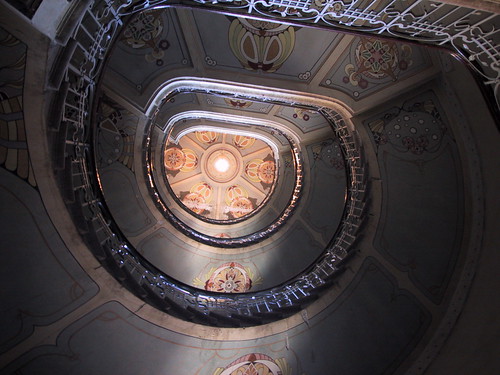
Staircase to the Rozentals apartment
There is a small museum to Rozentals in his former apartment at Alberta Iela 12-9. The apartment is located on the top floor of a renovated art nouveau building, the ground floor of which is home to a small Museum of Art Nouveau with reconstructed rooms from the turn of the twentieth century. The Rozentals museum has a couple of pictures of the artist on view, some of his furniture and artists paraphernalia but is a bit thin on exhibits. Its still worth a visit, not least for the staggeringly beautiful staircase but also to get an idea of the environment that Rozentals would have worked in during those creative and turbulent years at the beginning of the twentieth century.

Rozentals was born in 1866, the son of a blacksmith and was educated at an elementary school in Saldus. At the age of 15 he left for Riga before being accepted at the St. Petersburg Academy of Art where he graduated in 1894 with a first class degree. Rozentals was inspired by the Latvian countryside and its people and returned often to work there. In 1899 he acquired the plot of land where the museum to his name now stands, whilst in 1902 he met the Finnish singer, Elli Forselli, marrying her just three months later in February 1903. Together they had three children but their happiness was to be short lived. The First World War interrupted their family life and in 1915 they moved to Finland. Rozentals died suddenly in December 1916, at fifty years of age.  He was buried in Helsinki but was later re-buried in Latvia where an art high school is named after him.

His oeuvre was wide and included drawing and painting, portraits and landscapes as well as works inspired by biblical themes and by the Latvian countryside. He also produced altar pieces for churches, designed book and magazine covers, theatre sets and applied graphic art. However, painting was his preferred form  of expression and it is for his symbolist/ art nouveau style works that he is best known. The most prominent of these are the works he produced for the decorative frieze on the Riga Latvian Society building of 1910, consisting of seven compositions reflecting the main activities of the society. These can still be seen from the street. 

During the time he spent in his wife's homeland, Rozentals was influenced by the work of Finnish artists Akseli Gallen-Kallela and his devotion to the cause of Finnish nationalism. He became enchanted with Finnish culture and significantly influenced in this by his wife, became knowledgeable enough to write on the subject. This influence is reflected in the Riga Latvian Society frieze but also in our subject's participation in the Latvian national movement as a signatory of the "Demand of the Latvian intelligentsia for civil rights in Latvia" and a longing for freedom from Tsarist Russia.

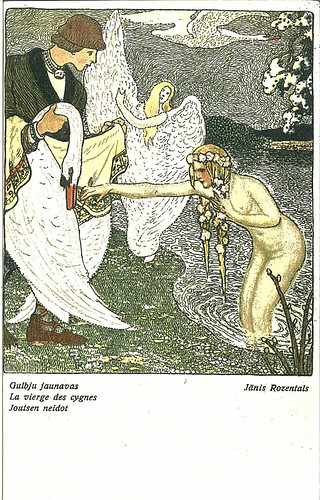
Much of his work shows folkloric influences, including Legende and La vierge des cygnes (pictured below) and Small Hours from 1905 which depicts a family of devils rushing back to hell as the cock crows for a third time. Devils appear in many Latvian folktales but usually as incompetent figures of fun, easily fooled by the clever peasants. The symbolists made extensive use of mythological and dream imagery and these works are particular examples of that.
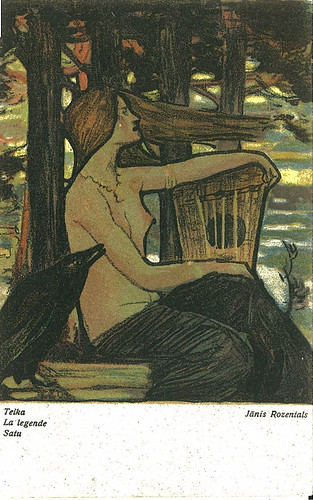
Janis Rozentals - La legende by Yekkes

Janis Rozentals - La vierge des cygnes by Yekkes

As well as symbolist paintings, Rozentals also produced art nouveau style works. One of his most well known is Princess and monkey, which he exhibited at the Munich Secession of 1913. The painting includes various classic  art nouveau features including the s-shaped female form, the ornamental carpet in the background, the thickly ringleted hair of the princess, her jewellery and the flow of her dress. This picture, which would not look out of place in an exhibition of Austrian secessionist art from the same period, demonstrates the interest in the east that was prevalent amongst many artists of this genre, as well as echoing the folkloric approach of Gallen-Kallela.   

Rozentals' versatility can be seen by comparing the mystical imagery of the Princess and monkey with the symbolic lithograph Archer, pictured below. Produced in 1914, this may well have been influenced by the events then unfolding across Europe that led to the First World War and ironically to a short period of the much longed for Latvian independence which Rozentals would not live to see. 

I have never understood why he is not better and more widely known - perhaps the long period of Soviet occupation meant that his work and that of his Latvian contemporaries fell from view. On the other hand he may have been lucky not to have been working during the Soviet period given the suppression of individualism, the strict "rules" of socialist realism and the terrible fate of many leading artists. I know of few publications detailing more of his life and work, but the art nouveau shop opposite the apartment building that houses his museum sells postcards of some of his works together with a small but well illustrated book about his life. The National Museum of Art of Luxembourg produced an excellent catalogue in English and French for its exhibition The Age of Symbolism in Latvia, and this can sometimes be found on Amazon. 

Princess and monkey, Janis Rozentals, 1913
Archer - poster by Janis Rozentals, 1914
You can read more about Riga here and here and browse photographs of this beautiful city here.

Saturday, 23 March 2013

Modernist Riga - architectural treasures from the 1930's

Riga is well known for its wonderful collection of art nouveau treasures, but less well known are its modernist buildings from the 1930's that are scattered throughout the city. On my recent visit to Riga, I was lucky enough to be able to have a close look at a number of the city's modernist gems and to make a photographic record of them.

1940 saw the end of Latvia's first short period of independence and the first of three occupations - the Soviets, the Germans and then the Soviets again. The Soviets stayed until 1991. Latvia had gained its independence in 1918 following the collapse of the Tsarist Russian empire. During those 21 years of freedom, like many countries in eastern and central Europe, there was an explosion of creative activity with artists, architects, musicians and writers all making contributions to this artistic flowering.

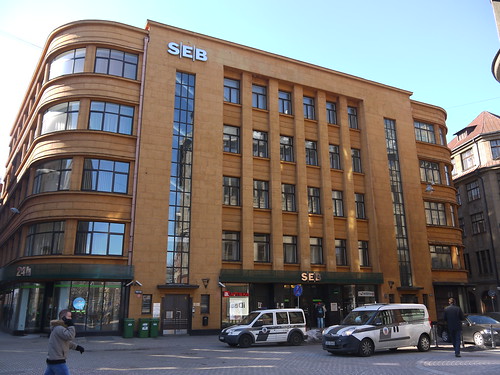
There is still a built legacy from the 1930's, some of it in exceptionally good condition, especially the buildings in the centre of the city. One of my favourites is located on the busy Valnu Street at number 11, (pictured below) just a short walk from the main Dom square. It was built in 1930-31 by the German architects, Alfred Karr and Kurt Betge, with the Bank of Latvia taking up residence in 1931. This excellent example of functionalist architecture underwent partial reconstruction in 1996 but luckily many original features and decorative elements were retained. I love the colours, the clean lines and the feeling that it looks so good it could have been built yesterday! It also reminds me a little of my beloved Ibex House in London.

Riga, March 2013 by Yekkes

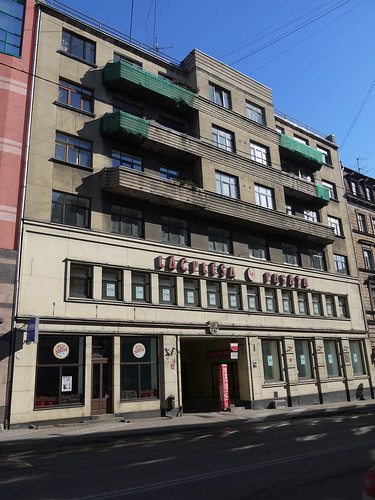
Another great building by these architects is the Office of the Trade Union for Publishers at Lacplesa Street 43-45, built in 1930 (pictured below). The Trade Union commissioned a whole complex of facilities including offices, shops and apartments in this six storey masonry building. The shops and communal spaces occupy the two lower floors with apartments above. There is a through drive way at ground floor level. As with some of the other 1930's buildings in Riga, I was reminded of the Marcel Janco apartments I saw in Bucharest last year, whilst those winged balconies on the apartment levels of the block would not be out of place in Tel Aviv. Karr and Betge did not win the original commission for this building - it went to another German, Dresden based firm but their practice was the most successful in promoting the modern movement in Latvia during the 1920's and 1930's and they eventually saw the project to completion.

Riga, March 2013 by Yekkes

I came upon a number of modernist buildings by chance. However, I had to make a concerted effort to visit two particularly interesting examples of this style as they are located a good twenty minutes drive from the centre of Riga in an extremely run down and visibly poor part of the city. I decided to hire a taxi to make best use of my time and soon realised that there was no way I could have found these buildings using public transport. The driver was happy to wait whilst I had a good look and must have done this before, but the locals stared uncomprehendingly at the odd foreigner taking pictures of old and in some cases decaying buildings. The most interesting response came from an elderly woman who cranked open the door of the Institute of Organics to shriek at me (in Russian?) that photography was not allowed. I smiled and said I was English which provoked a twisted facial expression, not unlike tha of someone struggling with indigestion, a sound that went something like "ugh" and a banging of the door in disgust as she went back in.

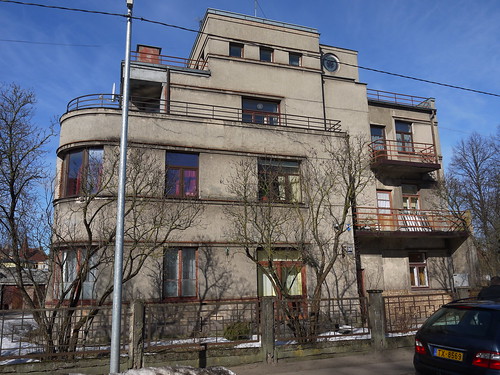
Back to the buildings. The architect for the 1930's villa at Laimdotas 30, pictured below, was one E. Betkher. It reminds me very strongly of Janco's work in Bucharest and again has more than a passing resemblance to some of Tel Aviv's Bauhaus treasures due to its curves, balconies and the decorative porthole window on the upper floor which contributes to its somewhat nautical appearance. I am not sure when the surrounding houses were built but if they came afterwards, I suspect that the residents of Laimdotas 30 would not have been impressed.

Riga, March 2013 by Yekkes

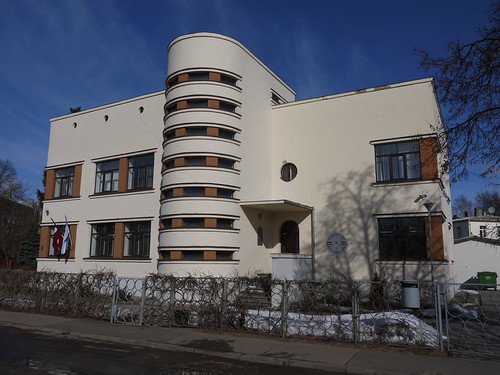
A short drive away is another structure with a distinctly Bauhaus look. In much better shape than its near neighbour at Laimdotas. Zamgalu Street 1(pictured below) has clearly been renovated and seriously cleaned. The driver explained to me that this former private home is now used as a wedding venue. It stands out from the drab housing surrounding it both because of its design and its brightness. It was built in 1936, the work of architect N. Makedonskis.

Riga, March 2013 by Yekkes

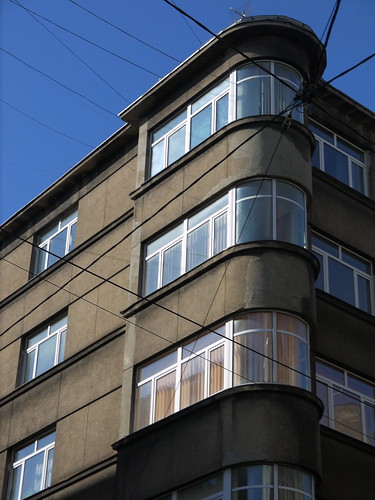
Heading back to the centre of the city, there are many more modernist survivors, including two I found quite by chance in Gertrudes Street. This is a typical Riga street where it is possible to find rationalist architecture from the 1930's next door to ornate art nouveau structures, just 25 years older. This not only demonstrates how quickly styles and tastes change and develop but also shows the richness of Riga's built heritage. Number 20 (pictured below) began life as a tenement building but today is home to a spa on the ground floor. It has a number of features found in the streamline version of modernism with accentuated windows, corner curves, horizontal rows of windows and small balconies. The exterior would benefit from a  good clean but this is a building that could have graced any European capital in the 1930's and as a tenement block it must have been pretty high class.

Riga, March 2013 by Yekkes

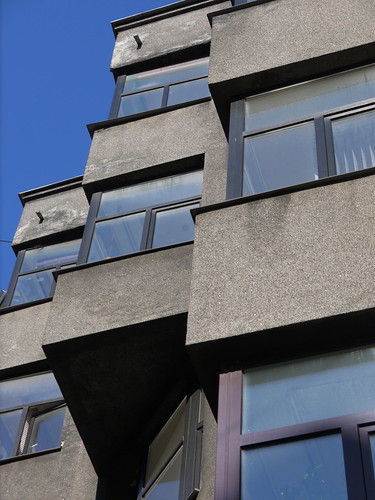
Just across the road at number 27 is another tenement block. Adjacent to a beautiful art nouveau palace currently undergoing restoration, this is an extremely striking building, due primarily to the accentuated triangular shaped windows at all levels above ground floor. I had great fun playing with the angles of this building and taking pictures from beneath the protruding windows. Built in 1934 and designed by architect Teodors Hermanovskis, I am advised that this use of geometric heavily cubist shapes, was typical of his work (detail pictured below). This six storey block with granite plastering makes clever use of design details to give an impression of high quality design. As with many buildings from the 1930's commercial use was made of the ground floor, which still has a cafe. Interestingly, Hermanovskis was also a leading Latvian politician during the brief first period of independence, whilst his son later became an architect in the United States.

Riga, March 2013 by Yekkes

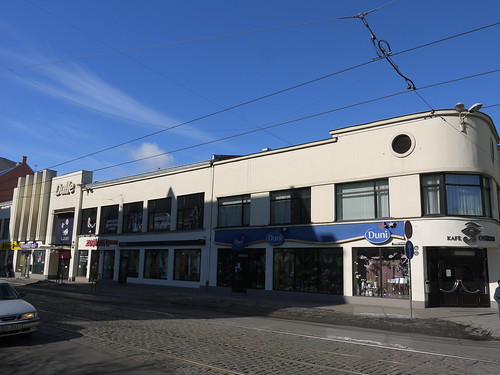
Finally, a little touch of Miami! The Daile restaurant and cinema (pictured below) is another Hermanovskis building, dating from 1936 and located at Barona 31, just a short walk from my hotel and one of Riga's busiest thoroughfares. It is closer to art deco than the other buildings considered here and has contrasting arrangements of vertical and horizontal elements. There is still a cinema and a cafe as well as numerous shops inside this large complex. It is not difficult to imagine Riga's citizens dressing up in 1936 to attend the grand opening. Riga was desperately cold during my stay, but this  building brings a touch of sunshine to the Latvian winter!

Riga, March 2013 by Yekkes

I must note my thanks to Ilza Martinsone of the Latvian Museum of Architecture for her help in providing some of the details for this posting as well as to Gali-Dana for helping find out more about Valnu 11. Thanks very much!

Monday, 18 March 2013

Return to Riga - art nouveau, national romanticism and some pretty good cakes

It is eight years since I was last in Riga. Much has changed and much has remained the same. The city will be Europe's Capital of Culture in 2014 and compared to eight years ago it is not difficult to see why. Much of Riga's architectural legacy has been, or is being restored or cleaned up - although much more remains to be done; there are many more good quality restaurants than in 2005 and service generally is better - although scratch a little and its still relatively easy to find a fair amount of grim, glum Soviet style service.

I spent last weekend in Latvia's capital city, with the intention of having another look at the wonderful collection of art nouveau buildings, of sniffing out as much modernist architecture as possible and seeing some of the art I hadn't known about before. Despite seriously cold weather - minus 16 at one point during the weekend, I managed to achieve almost all of this. Oh, and kudos to the city council for clearing the footpaths of snow, all of which has been moved to the gutter in what has become a huge black glacier made of compacted snow and which will be interesting once it melts. Great for walking but maybe a little more attention to the ice on the cobbles in the old town. Losing my footing, I managed a passable version of River Dance trying to stay upright before crashing to the ground. Ouch! Those cobbles are hard. Good thing I had lots of extra clothes on.

So, about the art nouveau. The city has hundreds of such buildings as well as many in the local Baltic/ Scandinavian version - national romantic architecture, which I also like very much. During the four full days I was there I managed to complete four well planned self-guided walks that I found on this website. For this post, I will concentrate on some of my favourite examples of the city's art nouveau and national romantic buildings.

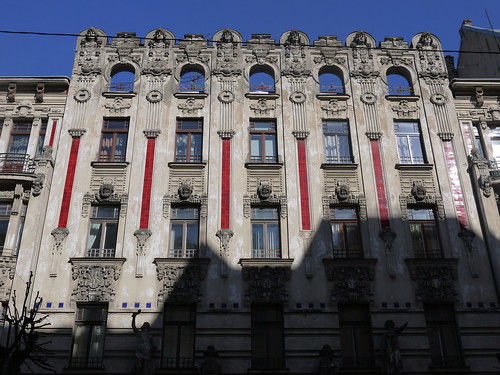
What better place to start than Alberta Street, a treasure trove of the two styles and home to one of my absolute favourites, the wonderful Boguslavsky apartment building at number 2 (pictured below) dating from 1906 and designed by none other than Mihails Eizensteins, who was responsible for some of Riga's most outstanding examples of art nouveau.  The building is guarded by two sphinxes at it's entrance whilst the exterior of the apartment block is decorated with geometric and stylised ornaments with the facade boasting bands of glazed red tiles. The upper parts of the facade, through which the sky can be seen,  feature mascarons and assorted geometric ornaments emphasising the self-importance of this stunning building. To add to its grandeur, the historian of ideas and philosopher Isaiah Berlin once lived here and there is a plaque to commemorate this.

Riga, March 2013 by Yekkes

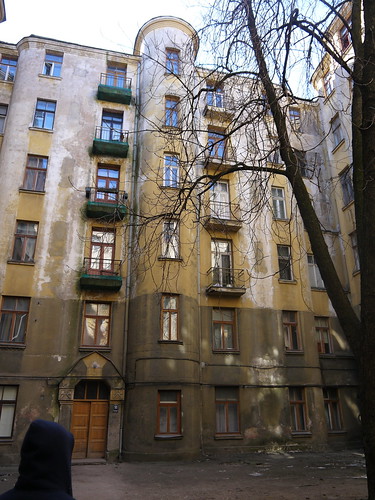
The apartment building at Alberta Street 11 is an outstanding example of the more locally influenced national romantic school of architecture. Designed by another superstar architect of his time, Eizens Laube and built in 1908, it is not in good shape. Neglected, paint peeling and in need of a blooming good clean, this must have been a stunner when it was first built.  Its facade has decorative detail that would be at home in Helsinki or Stockholm, as well as screw like turrets, whilst the amazing cylindrical towers in the rear courtyard (pictured below) were an unexpected find as I wandered in to this slightly forbidding space. I hope someone comes up with a sensitive plan to restore this gem before it deteriorates further. 

Riga, March 2013 by Yekkes

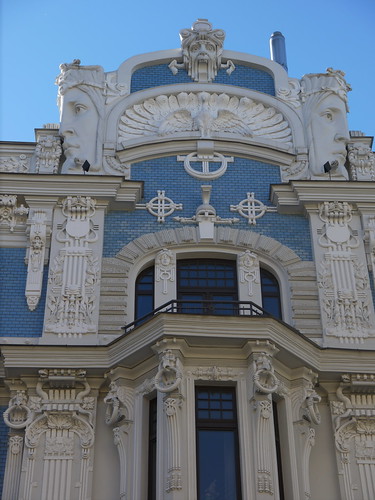
Just around the corner from Alberta Street is Elizabetes Street, one of Riga's main boulevards and home to two more buildings associated with our Mr. Eizensteins. Number 10a (pictured below) is perhaps the best known of all of his buildings and the one that features on many of the postcards being sold around the city. It really is a stunner. Actually, the original architect for this building was Konstantins Peksens, another big name for the genre and the time, but it was Eizensteins who decorated the facade. The aloof, stylised female figures at the peak, the serpents and the screaming male heads refer to themes explored in symbolist art - conflicts between the calm and the chaotic and between good and evil. In the excellently illustrated book"Mikhail Eisentsein themes and symbols of art nouveau in Riga 1901-1906", Solveiga Rasa compares these figures and symbols to those that appear in the art of Knopff and Munch. I see the link. This is one of the better condition Riga art nouveau treasures and the facade has received tender love and care, its blue and white colours remaining crisp and clean.

Riga, March 2013 by Yekkes

Eizensteins was an interesting character. If the name is familiar it might be because his son was one Sergei who became one of the all time great directors or Russian (and world) cinema  famous for that Odessa steps scene with the baby in the pram and the massive crowd scenes in the movie Battleship Potemkin. Sergei described his father as good natured and jovial with a sense of humour but also as pedantic with a passion for order, hard working and authoritarian. Despite the family name the Eizensteins were not Jewish - although Mihails' paternal grandparents had been German Jews who converted to Orthodox Christianity. 

There are a number of places for the hungry traveller to refuel here. I really liked one of the new cafes that have sprung up - VinoMetr at Antonijas 13. Very cool and "modern Baltic" in its style and approach, it offers a business lunch from 12-4 on week days - 1, 2 or 3 courses for 3, 4 or 7 lats which is a little more than those numbers in sterling for good portions of good quality food. I had a very tasty leek and potato soup followed by raspberry cottage cheesecake and strong coffee. Recommended. 

The area around Elizabetes Street and Alberta Street is the main focus for visitors wishing to experience art nouveau but there are also some excellent examples of the style in the old town - the other magnet for most visitors. As in many places, you have to look up to notice them as in many cases the ground floor has been altered to accommodate shops and other businesses. One such example is the lovely building at Skunu Street 10/12 (pictured below). Designed by architects Heinrihs and Fridrihs Sels and built in 1902, this highly decorative building was originally owned by a successful local businessman called Detmann, one of the owners of the Union stock company. Mr. Detman's initials can be seen on the facade, which is decorated with stylised plants including reeds, poppies, narcissus and chestnut leaves. The show stopper here though is the magnificent two storey bay window again decorated with floral motifs. Skunu is a very narrow street and it can be dark there even during the day. You need to stand a little way down the street and on the opposite side to look up and see a humorous feature - a dog above the bay window, obviously on guard duty!   

Riga, March 2013 by Yekkes

For those inclined towards the finer things of life, such as great coffee, cakes and (passable) hot chocolate, there is a great pit stop just around the corner from Skunu Street -  the Rigensis bakery, patisserie and cafe at Tirgonu Street 8. Don't be put off by the slightly grumpy Kat Slater look-a-like, who was actually very nice after some initial frostiness and do try the excellent cheese pastry, cheese cake or cherry strudel. Nice surroundings too. I went twice.

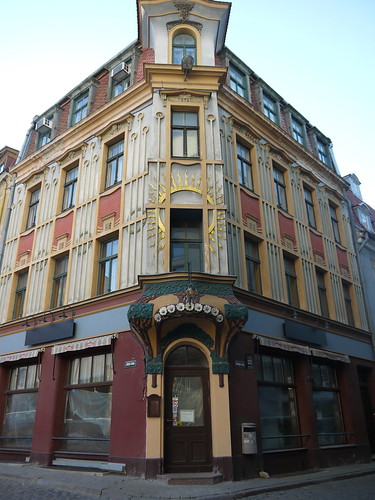
Back to the buildings. Still in the old town centre at Kaleju 23 (pictured below), you can find possibly the most colourful building in the city. Designed by Jewish architect Paul Mandelstam as a rental building with shops and built in 1903, it stands out from its neighbours due to its ornate facade which includes a bay window encircled with flora, a gilded representation of the sun symbolising life and restoration and a riot of colour above the doorway. Mandelstam designed many buildings in the city. Born in Lithuania, he was murdered during 1941 together with several other Jewish notables - a precursor to the devastation that the occupying Germans would inflict on Latvia's Jews. The building is currently undergoing some internal renovation and is therefore not in use. The ground floor was previously a cafe.

Riga, March 2013 by Yekkes

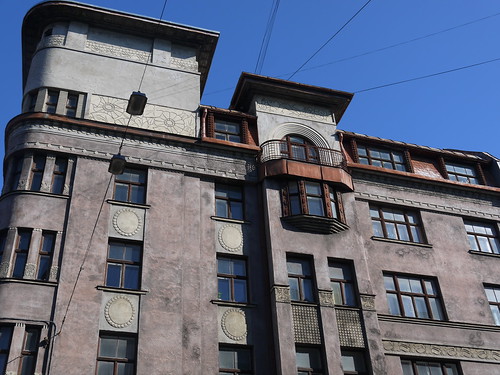
There are yet more examples of art nouveau and national romanticism in the streets running from the opera house beyond Elizabetes Street including Lacplesa Street. My favourite example of the national romantic style can be found in this street at number 51 (pictured below). A huge, imposing corner building by Eizens Laube dating from1909, it has a riot of decorative features on each facade including geometric designs and balconies. I especially like the wedge shape on the corner of the building that has more than a passing resemblance to some of the modernist buildings that were to come in the following decades. Nice one Mr. Laube!

Riga, March 2013 by Yekkes

The city really does has a magnificent, possibly the best collection of this much loved genre, but Riga has a lot more than that. More posts to follow on my modernist discoveries, some fantastic artists from the 1920's and 1930's and a little about the former glories of Jewish Riga. You know I might even go back next year for the Capital of Culture celebrations! 

You can see many more examples of Riga's art nouveau, as well as other pictures of the city here. Riga