Showing posts with label Northern England. Show all posts

Friday, 5 February 2016

Darlington Majestic - an art deco cinema restored

Apart from the national rail interchange, the last time I visit Darlington must have been more than 40 years ago when I went to the outdoor market with my mum. I bought a seven inch vinyl single of the Monkees singing A Little Bit Me, A Little Bit You. I still have it. I went to Darlington again this week, this time to visit the former Majestic Cinema, which after decades of mixed fortunes is being restored to its former glory. Designed in the art deco style by Darlington born architect Joshua Clayton, it was completed in 1932. Amazingly it is unlisted.


Built for an independent operator, it opened on 26th December 1932 with Nancy Brown starring in Maid of the Mountains. British cinemas in the 1930's were built to accommodate huge numbers and the Majestic could seat 1,039 in the stalls and 541on the balcony. As well as the screen there was a cafe, five dressing rooms and a Compton 3M organ which rose up from beneath the stage. We will return to the organ.

The cinema changed hands several times over the years, going to the Union chain of cinemas in late 1935 before returning to the original owners two years later. Oscar Deutsch's Odeon chain took it over in 1943 and changed the name to the Odeon in 1945 before eventually passing to the Rank chain who owned the cinema when it finally closed on October 24th 1981. The final screening was of  Cannonball Run with Burt Reynolds. There is evidence that the cafe continued until the 1950's, whilst the organ was retained until 1968 when it was sold and removed from the building. Further changes were made in the later 1960's when metal strips were added to the front of the building in an attempt at modernisation. Yuck. After closure the building lay unused until 1986 when it was converted into a snooker club.


Those nasty metal additions have now been removed, revealing the beautiful cream facade with its art deco motifs and double height stained glass windows on the stairwells.The removal of the nasty metal strips was part of a programme of ongoing restoration which is being funded through private means. On my visit earlier this week I was able to see the beautifully restored lobby with its decorative doors, chandelier, original ticket office and the balustrade on the stairs leading to the first floor cafe. Whilst admiring the lobby I was lucky enough to meet Paul, one of the key people driving the restoration of the building. He very kindly showed me around the upstairs cafe, allowed me a look into the auditorium which is still being worked on and shared with me some of the ideas for the Majestic's future.  


The cafe has two fabulous art deco bars, furniture in the style of the 1930's and gorgeous stained glass windows looking over the main road - Bondgate. Who would have thought that such a room exists in Darlington? It could easily be in Prague, Budapest, New York or one of the other cosmopolitan centres from the art deco period. I can only imagine what the response of the locals must have been when the cinema first opened. The cafe is already popular with local people for afternoon tea and Paul told me that it has already received visitors dressed in 1930's clothes! It has an alcohol license which always helps.

The auditorium was a hive of industry with several workmen busy toiling to bring it back into use perhaps as early as April this year. Many original features appear to have survived although some are in better condition than others. There are already plans in place for a programme of events and activities once these works are finished including "Battle of the bands", stand up comedy, concerts and perhaps theatre. Much needed rehearsal space may also be offered. Some events have already taken place in the cafe. You can keep up to date with developments by following the Majestic's own Facebook group here.

I was also able to have a quick look at the former projection rooms and see the enormous original bulb that was left behind when all of the other cinema equipment was disposed of when the cinema closed. Paul told me that there are some exciting ideas for using these spaces including opening up onto a roof terrace and using the bulb as part of the lighting for another cafe space at this level. These ideas are at present unfunded and the priority is the auditorium, but how wonderful it would be to be able to realise them. 


The restoration and bringing back into use of the Majestic will be a much needed boost to Darlington's cultural scene, especially at a time when other facilities in this small unitary authority are under threat with the potential closure of its two libraries and removal of the mobile service and the closed market also being under threat . I said we'd return to the organ. After much searching, it turned up in Manchester. Not playable but it can be rescued…once the money has been found.

Friday, 1 January 2016

Bringing St. Hilda's back to life - more from Middlesbrough

I was born and brought up in Teesside. Redcar is my hometown and I went to secondary school in Middlesbrough. I spent many Saturday afternoons in the town centre, browsing the boxes in Alan Fearnley's record shop on Linthorpe Road, Hamilton's on Newport Road and Dean Wycherley's in the Cleveland Centre. Much time was also spent in the Wimpy Bar with my mates during my early teens before we graduated to drinking in the town centre pubs and then Mandy's and one or two other town centre clubs. It is many years since I lived in the north-east, 31 to be exact and every single one of these places is now gone. 

The River Tees - clean at last!
Despite spending lots of time wandering around the town, there was one place that we never went to - St. Hilda's. Known as "over the border" due to its being on the opposite side of the railway line from the rest of the town. It was a tough area, home to many people who worked in the ship building and steel industries or in jobs connected to the port and the river generally. There were a number of pubs and at least one club - The Bongo - that had what my friend describes as a "fearsome reputation" and people generally gave the area a wide berth. That friend and I both worked for the Council's library service and she reminded me recently that when the small local library housed in the original town hall (once painted by none other than L.S. Lowry) needed relief staffing, that male staff were usually sent because we "didn't send young girls to work there". 

The Transporter Bridge seen from the former salt works wall.
Middlesbrough has changed tremendously over the last few decades and like many northern towns has struggled to recover from the economic downturns of the 80's, 90's and recent years. It has also not been able to secure the kind of investment and regeneration that some of the larger northern cities have benefitted from. The haunts of my teen years and early twenties have disappeared but so has almost the whole of St. Hilda's - demolished in stages over a long period, in some cases to provide better housing (which was then in turn demolished) or to make way for developments that sometimes never happened. On a recent visit to Middlesbrough I decided to take  a stroll through this part of the town to see the changes and was pleasantly surprised at what I found - although there is still much to do to bring this area back to life.

In his great little book St. Hilda's, Araf Chohan sets out the history of the area and also details some of the developments that were proposed and never realised including a fantastic master plan adopted in 2004, partly the work of architect Will Alsop, which would have delivered what Araf describes as "…iconic structures, unique for this part of the world…" and which would have included offices, shops, hotels and restaurants as well as many new homes. Sadly only one set of offices and one residential block were built before the master plan stalled due to failure to secure enough investment.

The old Town Hall
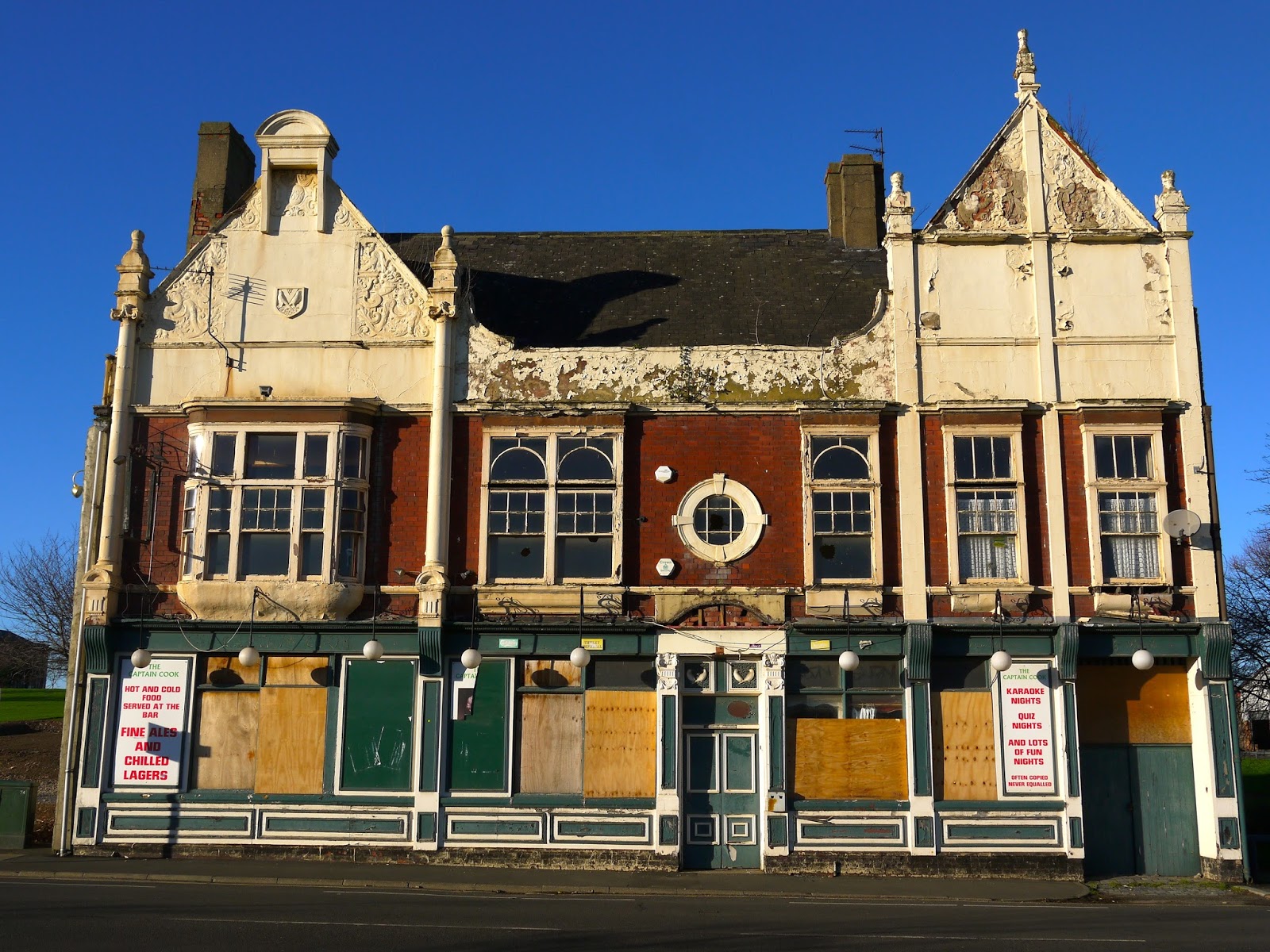
The Captain Cook pub
Former port building
In 2014 another plan appeared, reinventing this part of town as "Middlehaven" and pretty much the whole area was cleared in preparation for this. Some progress has been made with Middlesbrough College and the 6th Form College now having substantial presence as well as the Riverside Stadium, home of Middlesbrough FC. This is all good but perhaps the most encouraging thing is that a number of heritage features have been retained including the once notorious (but apparently listed - hooray!) Captain Cook pub, the former Town Hall (which I am told is to be brought back into some use - although it is currently boarded up), the old Dock Clock Tower and other buildings connected with the river. I love the idea of the pub being brought back into use, which will hopefully include cultural activity as well as drinking whilst the old Town Hall would also be a great venue for music, exhibitions and other activity. Progress has already been made with the "Boho" project which has created space for business start-ups and digital business in a number of both heritage sites and new builds including the beautiful former bank close to the Albert Railway Bridge.

Former bank now used as part of the Boho project
Wall of the former salt works
The Transporter Bridge
As well as having links with steel, docking and shipbuilding, St. Hilda's was also home to a salt works that closed in 1946 and was then  demolished. Part of the wall of the works has been restored in Vulcan Street. The barred windows make for great views through to the iconic and much loved Transporter Bridge - a real symbol of the town. It would be great to see the local authority take advantage of the remaining, rich heritage of St. Hilda's to attract both visitors and serious investors to really bring this part of town back to life. And on the subject of being brought back to life, I was amazed at how clean the once filthy River Tees now is at Middlesbrough. The loss of the heavy industries meant many people lost jobs but it has also meant that industrial waste no longer goes into the river. I was surprised and delighted to see a group of three swans on the river in the red coloured reflection of a visiting ship. Beautiful - and unthinkable not so many years ago. Here's hoping new life can come to the rest of the area too.


Visiting ship and installation by Anish Kapoor
Swans on the River Tees at Middlesbrough

Friday, 12 June 2015

Redcar - how I remember it.

Laurel and Hardy keep watch from the Regent Cinema
Redcar is my home town. I was born there and spent the first 20 years of my life living, studying and working there. I have happy childhood memories of the town including visits to the paddling pool on the "stray"(the grassy area that runs adjacent to the coast), being taken to the boating lake with its rowing boats and ice cream vendors, and speaking of ice cream, there was also our annual visit to Pacitto's ice cream parlour - to which we will return and to which I have returned.

As I grew a little older I would play tennis with the other kids from my street in Locke Park or Zetland Park, frequent Tony's Records, a small shop adjacent to the bus station, packed with the latest dance music, and secretly continue to buy coconut ice and chocolate cherry cocktail sweets from Maynards sweet shop on the High Street. The High Street was very different then and boasted bakeries, a couple of wet fish shops, old fashioned butchers, a couple of "boutiques" - I can remember Apache opposite the old Swan Hotel but not the name of the other trendy little shop opposite the bus station - and of course Marks and Spencer, Woolworth and several other dependables.


I finally moved away from Teesside in 1984 and until 18 months ago rarely visited. Some family matters have meant that I have spent a lot more time there recently and of course, there have been many changes. Tony's, Maynards, Marks and Spencer, Woolworth, Apache and the other boutique, the Swan Hotel and several other shops have gone as have a number of pubs to be replaced for the most part by charity shops, pound shops, catalogue shops and at least one pawnbrokers. In recent weeks the old general post office has also closed with a counter service being squeezed into WH Smith to compensate.

During my childhood, Redcar was to some extent dependant on what we then called holiday makers and day trippers and what would now be referred to as tourism. Its a seaside town and people used to come from Bradford, Leeds, Sheffield and other northern cities and towns to spend a cheap and cheerful week by the seaside in a caravan. And when they'd had enough of the beach there were a couple of cinemas, a few places offering live music (the famed Redcar Jazz Club in the Coatham Hotel, also long gone- although I was too young ever to have been there), some rough and ready night spots (including the legendary Top Deck which I wasn't young enough to attend!), the aforementioned parks, an indoor swimming baths, a library, a Lifeboat Museum and inevitably a seafront filled with trashy seaside amusements. Much of this is also long gone.

I am certain that I remember things as being better than they really were but Redcar does seem only a shadow of what it once was. Of course, recession always hits the north-east very hard and many of the former major employers including British Steel and ICI no longer provide jobs for the thousands that once worked there. But when times are hard, its wise to make the most of what you have and Redcar still has a cinema (which many towns of this size no longer have), it has a great new leisure centre (albeit replacing a swimming baths closed and demolished in the late 1990's, leaving the site derelict, good parks, its Lifeboat Museum, and for goodness sake - the beach! You can get a good coffee in the library cafe (although I have to admit the new library seems very pedestrian and uninspiring - and it closes on Saturday afternoons) and Pacitto's is still there too.

The Regent Cinema
The new leisure centre
I said we would return to Pacitto's. Our annual visit was one of the highlights of the year. My mam would have a cup of coffee - very sophisticated then -  and I would have an ice cream gloriously named a cherry temptation, clean white vanilla ice cream with maraschino cherries on top and the tiniest bit of syrup. The ice cream was served in a silver coloured goblet style dish and we sat on whicker chairs at glass and chrome tables. Very Italian and a very big treat. I returned in 2013 for the first time in at least 30 years with my own daughter and grandchildren. You can still get a cherry temptation but today its served as a huge glass of synthetic tasting stuff full of gooey stuff. A bit disappointing. It wouldn't be hard to bring the old quality back in Pacitto's and it wouldn't be that hard to emphasise what the town still has to attract people. The Council might want to consider what nearby Saltburn has done to revitalise itself with quality eating places and encouraging small scale cultural activity to bring life back to the town. Anyone from the Council reading this?
Pacitto's - never mind the lemon top, bring back the cherry temptation!
You might also like Saltburn- a Victorian town rejuvenated and Picture Post 41- Middlesbrough's Iconic Transporter Bridge

Wednesday, 15 April 2015

Picture post 41 - Middlesbrough's Iconic Transporter Bridge


Middlesbrough's transporter bridge is one of just three of its kind remaining in the UK and is both a much loved iconic image of the town and a reminder of the area's industrial past.  

The idea for a bridge was first mooted in 1872 by one Charles Smith, manager of the Hartlepool Iron Works, who suggested a scheme to Middlesbrough Corporation. His idea was rejected and it was not until 1911 that the bridge was built as a result of an Act of Parliament passed in 1907. It cost 68,026 pounds, six shillings and eight pence to build which translates to about 6,300,000 pounds today. Construction was completed by Sir William Arrol and Co. of Glasgow using steel made by local company Dorman Long (forerunners of British Steel) and replaced ferry services across the river. Local labour employed at Dorman Long also produced the steel used to construct the Sydney Harbour Bridge. The foundation stones were laid by Mayor of Middlesbrough Thomas Gibson-Poole and Alderman Joseph McLauchlan, whilst the towns citizens turned out in huge numbers to welcome Prince Albert of Connaught on 17th October 1911 when he came to open the bridge.

The bridge is 851 feet long - the longest remaining transporter bridge in the world. The cantilever construction has three main bridge parts and a gondola which runs on a wheel and rail system 160 feet above the Tees. The transporter has seen some drama over the years. It was hit by a bomb in the Second World War, whilst in 1953, the gondola became stuck half way across and was lashed by gale force winds that brought the river to within inches of the platform. It has also featured in films and TV series including Billy Elliot and the Boys from the Backstuff, whilst scenes of its apparent dismantling and transportation to Arizona during Auf Wiedersehen Pet resulted in calls from worried citizens  to the Council, protesting the seeming loss. The TV company had to include a clarification at the end of the series that the scenes were purely fictional! A real drama occurred in 1974 when actor Terry Scott thought he was crossing a toll bridge and drove off the edge, landing in the safety netting below - and I just about remember this from the local newspaper - the Evening Gazette. 

The bridge straddles the river Tees between the former St. Hilda's area of Middlesbrough and Port Clarence on the Stockton-on-Tees side of the river. St. Hilda's was home to a range of industries connected to the docks as well as to a residential community. Almost all of both are now gone, cleared by the demolition ball over a number of years with only a few exceptions -  two pubs (one derelict), the old dock clock and the former town hall, the latter of which was famously painted by L.S. Lowry in 1959. Referred to as "over the border" due to being on the riverside of the railway line, St. Hilda's had a reputation for being a bit scary during my younger days as well as being a bit risqué due to the (possibly assumed) activities that took place in some of the pubs! 

The area has been renamed "Middlehaven" and is now home to part of the town's university campus, it's college and Middlesbrough FC's stadium. There are also plans to redevelop the area with housing, shops and cafes, re-connecting the town to the river and bringing new life to this historic area. I like the idea of bringing it back to life - but its a shame that so much of what was there before has gone. The transporter bridge was given grade II* listed status in 1983, protecting it from a similar fate, but its real protection comes from its continued use and more importantly from the attachment that locals continue to feel for this example of engineering ingenuity.


The transporter bridge seen through the remaining wall of the former salt works.
You might also like Picture Post 28 - Middlesbrough Empire Palace of Varieties and Memories of Middlesbrough and days long gone

Sunday, 4 January 2015

Saltburn - a Victorian town rejuvenated


Saltburn is a small North Yorkshire town perched on a cliff overlooking the North Sea. Developed during Victorian times as a seaside resort, it still attracted visitors when I was a child in the 1960's and I have memories of being taken there to walk on the beach, eat ice cream and go for a ride on the miniature railway in the Valley Gardens at the bottom of the cliff. I also seem to remember biting cold winds coming off the sea, but perhaps this was in the winter.  

That was all a long time ago but I have more detailed memories of spending time in Saltburn during my late teens in the 1970's. Saltburn had a strong Methodist tradition which at least anecdotally was responsible for the dearth of pubs in the town. Locals either descended the cliff to the Ship Inn right beside the sea, or coped by drinking in the bars of the several hotels that still operated then. The two most popular were the Zetland which overlooked the sea on the cliff top and the Queens, just a few streets away in the main square. The Zetland was my favourite and the place I joined several other underage drinkers on a regular basis from the age of 16. The smooth running of the bars and the hotel was overseen by a large beaded character in a black frock coat who bore more than a passing resemblance to an ageing Orson Welles. So, of course he was referred to as Orson, not Welles, but cart. Work it out for yourself. 

An hour in the Zetland was a Friday and Saturday night pre-cursor to walking part way down the cliffside to Philmore, a nightclub also popular with underage drinkers. From 9 until 2 it was possible to dance to slightly out of date disco music, a smattering of surprisingly left-field tracks and from time to time see live acts that included the Real Thing, Billie Ocean and Jesse Green. Not bad for a tiny provincial town. There was also a coach service at closing time to take revellers home for a small fee. 

Philmore was not always a nightclub. Built in 1884 and designed by one Alfred Waterhouse of London it started life as the Assembly Rooms and I remember being taken there to see a pantomime - Aladdin - at the age of seven or eight. During the interval, three ladies sang operetta songs. The adults seemed to like it but the kids smirked  at the soprano style singing. In the 1990's the building was extensively damaged in a fire, rebuilt and is now a hotel.


After a gap of many years, I have recently been spending more time in the north-east of England and a Saturday morning visit to Saltburn has become part of my routine when in that part of the world. I have been very pleasantly surprised at what I have found. Whilst my own home town, Redcar, has lost many of its independent shops (in fact many of its shops) and cafes, Saltburn seems to be thriving with several cafes, restaurants and an interesting selection of independent traders - avoiding to a large extent the takeover of the charity shop/ pound shop that has swept across many neighbouring towns. The main attractions are clustered around the railway station which is fitting since the town's growth was stimulated by the arrival of the train in August 1861. 

The station itself is host to a couple of galleries, one of which The Saltburn Framing Company sells contemporary art work with a vintage twist - divers, classic cars, etc and of course frames pictures. The image at the top of this post is a reproduction of a piece purchased there. Until recently there was also an excellent independent health food shop which gave off spiced and medicated smells each time the door opened. There is also a farmer's market here on the second Saturday of every month where you can buy great breads, cheeses, meat, cakes, jams, pickles and a range of other home made food items. I enjoyed the piece of flour-less orange cake I bought from the Spanish food stall!


Around the corner on Milton Street, there are several good quality food stores, cafes and one of my favourites - Lloyd-Scott and Beatty Confectionary. Housed in a small shop with a restored Victorian facade, this den of delights is filled with the sweets of yesteryear - sherbet dabs, flying saucers, gobstoppers, old fashioned sweets sold from glass jars, chocolates in vintage packaging and much more. Its one of my regular stops when in Saltburn. Real Meals is my other Milton Street favourite. A family run business, Real Meals is not only a great cafe but also an excellent delicatessen with a surprising range of products. I often eat here on Saturday lunchtime. There are some great soups and  I also like the Greek pasta with sun dried tomatoes and cheese.  You can get Fentiman's drinks here - I can't resist the dandelion and burdock - something I haven't tasted since being a child. And on the subject of drinks, if you get the chance to visit try the Grumpy Mule coffee too - thanks to my nephew for introducing me to it! The cafe's website incudes some recipes if you want to try things out for yourself.

Back in the square, there is a great little independent book shop - the Book Corner. It may be small, but the stock is well chosen with an interesting balance of well-known authors, more edgy material, local interest publications and a good selection of children's titles. The shop offers an ordering service and also has occasional author appearances and book signings. Opening an independent book shop is always a brave move and the obvious success of the Book Store is one of the most encouraging things about a rejuvenating Saltburn.  

After browsing the bookstore, I usually cross the square to Windsor Road and make a pilgrimage to Chocolini's to sample the locally produced ice cream and to buy "continental" style chocolates made in the shop's small factory unit. This is a real treat and even if you don't eat chocolate, its fascinating to look at the different items which include chocolate shoes, dolphins and even dinosaurs!


For a small town Saltburn has some great shops and cafes, but the main attraction has always been the beach. To get there from the town, you can either walk down the very steep and very twisty Saltburn Bank or in the "season" you can take the famous lift. The first lift was built in 1870 and could carry 20 people down to the pier but this was condemned as unsafe in 1883 and replaced by a funicular or "inclined tramway" which seats 10-12 people and operates between March and October. There is a small fee to use the lift which is powered by a combination of water and gravity. The two cars have beautiful stained glass windows which were restored in 1979 having been removed in the 1950's.

Once at the bottom of the cliff, there is a clean open beach where its not unusual to see surfers on their way to the waves, people on horseback and dogs of all sizes being exercised. The pier is much loved and won the national Piers Society best pier award in 2009. It is well maintained but one of my favourite features is the beautiful mould growing on some of the wooden structure with its different patterns and shades.


Saltburn is a very different place from the town I have memories of and although the grand old hotels have gone, converted into luxury flats or care homes for the most part, it is a more lively, vibrant place than it has been for decades. Of course, it has the advantage of some of the most beautiful coastline in the north-east with those stunning views across the bay, but the combination of niche retail and quality eating places give it that bit of edge. You can read more about old Saltburn on this very detailed website.

A former Saltburn hotel, now flats.
You might also like Memories of Middlesbrough and days long gone

Monday, 9 June 2014

Picture post 28 - Middlesbrough Empire, Palace of Varieties


I was brought up in the north east of England and between the ages of 13 and 18, I went to school in Middlesbrough. One of my delights was to visit the town centre every Saturday to scour Alan Fearnley's record shop, buying up imported American jazz-funk albums and 12" singles (remember those) before meeting friends to go and eat burger ands chips in the Wimpy Bar and sometimes sneaking into the Masham or Lord Raglan pubs for a sneaky pint of scotch - that's bitter beer in the north-east, not whisky. I recently returned after many years and discovered most of these old haunts (and several others) gone or being used as a sweet shop in the case of the Masham. That's for another post but it was good to see Middlesbrough's glorious Empire Theatre still standing. Amazingly I had somehow managed to forget about the theatre. 

Standing proud on Corporation Road in the centre of the town, and originally called the Empire Palace of Varieties, this imposing pile had its foundation stone laid in 1897 and opened two years later. Designed by architect Ernest Runtz in what has been described as the Spanish Renaissance style  it had seating for 450 people in the stalls, 150 in the grand circle and a whopping great 750 in the gallery. Not only was the theatre impressive in size and style it also attracted top notch performers. Singer and friend of royalty Lily Langtry and comedienne Kitty Beresford were amongst the 17 acts who took part in the opening night's programme as well as contortionists, acrobats, musicians, dancers and singers. In later years Charlie Chaplin, Stan Laurel and Harry Houdini all appeared at the Empire!

The stage was destroyed by bombing during the Second World War and later, like many theatres, the Empire came on hard times. From the late 1980's it was used as a bingo hall before becoming a nightclub and live music venue in 1991. The Empire is a grade two listed building. I particularly like the red exterior and the colours from the stained glass signs hanging from the canopy which carry the original "Theatre of Varieties" name. Its good to see the Empire still standing and still in use. It would be great to see theatre, dance and other music forms showcased here, complementing the current nightclub use and widening Middlesbrough's cultural offer. 


You can read more about the theatre on the Empire website.

Friday, 23 August 2013

Liverpool - another take

I spent last weekend in Liverpool. The main purpose of my visit was to see the Chagall exhibition at Tate Liverpool and that will be the subject of a separate post. For many people Liverpool is the city of the Beatles and a rather good football team, but it has many other attractions and they will be the focus of this article.

Arriving on the Friday evening, I decided to eat in Liverpool's Chinatown - the oldest in the UK. The city's shipping connections brought many Chinese sailors and workers to Liverpool from the 1850's onwards and over time, some began to settle and establish homes and businesses. There was also a significant degree of inter-marriage between Chinese men and local women which we will pick up again a little later.

Liverpool's Chinatown has the tallest Chinese ceremonial gate in Europe leading to a number of restaurants offering different styles of Chinese cuisine. I ate at the New Capital which was cheap and cheerful with large portions of vegetables, rice and the not very traditional lemon chicken that I embarrassed my dinner partner by ordering. Well, I like it. Liverpool's Chinatown is less bustling than London's and has a much more "local" feel to it, with people popping out for dinner rather than making the effort to travel a long way. 

Walking back to the hotel I got a taste of Liverpool's night life when I heard a woman singing with a loud nasal whine the old Lyn Anderson song (I never promised you a)"Rose Garden" . It was the voice of a public house singer but she was ably accompanied by what sounded like the entire pub who were singing along. I was sorely tempted to go in...but Saturday was going to be a busy day.

Royal Liver Building, Pier Head
I had a full programme for Saturday beginning with the wonderful Chagall exhibition which I followed with a walk around nearby Pier Head which forms part of Liverpool's World Heritage status, listed by UNESCO in 2004 as "The supreme example of a commercial port at the time of Britain's greatest global influence". The highlight of the docks area, Pier Head boasts three magnificent buildings, the Mersey Docks and Harbour Board(NDHB) built from 1903 to 1907, the Royal Liver Building (1908-1911) and the Cunard Building (completed in 1916). All three are a testament to Liverpool's former standing as a port of world importance. My favourite is the Royal Liver Building designed by Walter Aubrey Thomas, a magnificent office block claimed to be the tallest in the world when built. It defies stylistic definition but includes traces of baroque, byzantine (according to Pevsner), references to Hawksmoor's churches and to early Chicago skyscrapers. Far too big for the needs of the Royal Liver Friendly Society for which it was built, the building provided a great deal of lettable space. It displeased the owners of the smaller, older neighbour which had wanted a complementary structure rather than the attention grabber this is.
George's Dock Ventilation and Contro Station
Just behind this architectural ensemble stands another Liverpool landmark - the George's Dock Ventilation and Control Station. Designed by Herbert J. Rowse and built in the 1930's it served the first Mersey road tunnel. Having sustained damage during the Second World War it was rebuilt in 1951.  Its Portland stone face features sculptures by Edmund C. Thompson has figures representing speed, day and night (an allusion to the ever-open tunnel) and four panels illustrating civil-engineering, construction, architecture and decoration. I love its quiet elegance and I especially love that central tower, visible from some distance.

Pier Head has become a popular location for monuments and memorials to various individuals. These include the Memorial to the Heroes of the Marine Engine Room by William Goscombe John, completed in 1916. Paid for by international subscription and originally conceived as a memorial to the engineers on the Titanic who remained on the ship to the end, it is a granite obelisk topped by a gilded flame. It also has figures representing earth, air, fire and water and pairs of engineers on two sides. An early monument to ordinary working people it is a wonderful tribute to unsung heroes. 

Detail, Memorial to the Heroes of the Marine Engine Room, Pier Head
The Museum of Liverpool is just a few steps from Pier Head and it is easy to combine a visit. The   Museum tells the story of the city and its development as a major port, its many communities and the lives of its citizens. I especially enjoyed the top floor which includes the memories and lives of ordinary Liverpudlians. It includes a focus on the struggle for decent housing that has gone on (and continues today) for many years, the city's often difficult political history, its long association with music of many kinds and a number of videos of its citizens talking about their lives. 

The ground floor of the Museum includes a section on the history of Liverpool's Chinese community including the until recently untold story of the round-up and deportation of hundreds of Chinese men at the end of the Second World War, many of whom were tricked into boarding ships thinking they had signed up to work on them. Many of these men were married to local non-Chinese women and had families with them who until very recently did not know what had happened to their husbands, fathers and grandfathers. The testimony of women who spent years searching for their husbands and wondering if they had been deserted is one of the most poignant elements of the Museum and a little known part of history.

On a lighter note, a series of video interviews about Liverpool style and fashion includes an amusing contribution from a local man who refers to some of the many young women in the city with extreme tans or the "orange" look. He says "seeing ten Liverpool girls coming towards you on a night out looks like the terracotta army in stilettos". This sense of humour and tendency to self-deprecation is one of many reasons to love Liverpool. 

No visit to another city is complete for me without searching out examples of art deco architecture. I spent Saturday evening enjoying my best theatrical experience for some time at the final performance in the run of John Godber's"Bouncers" at the Royal Court Theatre. This art deco building dates from 1938 and was designed by James B. Hutchins of Wainwright and Sons. A more subdued style of art deco, it has a red brick facade which makes use of different types of brick to break the solid face as well as numerous art deco motifs and a beautiful curve at one end of the theatre. Originally built to face Queen Square, the square itself has not survived and today the Royal Court faces a row of bus stops and neighbours a very ugly shopping precinct. 

The play was excellent - a look at the lives of ordinary Liverpudlians working in or frequenting a Liverpool nightclub in the 1980's. Filled with local, often dark humour that had me laughing more than I have in a theatre for ages, there were also moments of amazing poignancy as the sad, darker side of the lives of some of the characters and their communities were alluded to. There is a Royal Court Theatre in London too - in Sloane Square, frequented by the bien pensant frightfully PC brigade. Liverpool's Royal Court has a different audience, largely working class  and able to laugh at and with itself at things the Sloane set might struggle with. Give me the Liverpool lot any time. All four actors gave good performances each with three roles - a bouncer, a Liverpool man on the pull and a Liverpool woman similarly engaged. However, the star of the show was former Brookside actor, Michael Starke. His "plain Elaine" was fantastic and he surprised us with his skills as a "mover" too! Nice one.

Royal Court Theatre, Liverpool

The other art deco lovely I found was the former Forum Cinema just opposite Lime Street Station. Dating from 1931 with the exterior designed by E. A. Shennan, the cinema is also a somewhat subdued example of art deco with an almost plain Portland stone facade, interrupted by vertical windows in threes set in panels and by simple motifs. The interior was by W. R. Glen and has a flat auditorium with a central rosette feature. There are also ornamental boxes and a range of other art deco features. The cinema closed in 1998 and was acquired by a brewery. Proposals in 2007 to turn it into a boutique hotel were eventually withdrawn and so, rather shamefully, it stands empty on this very prominent spot - one of the first things visitors see as they leave Lime Street station.
Former Forum CInema, Lime Street/ Elliott Street
On Sunday morning I managed to squeeze in a visit to the Walker Gallery to see the amazing Alive in the face of death exhibition of photographer Rankin and a look at the Gallery's excellent collection of British art from the first half of the twentieth century which includes ceramics and other crafts as well as paintings. Right next door to the Walker Gallery stands the City Library which has recently been partially demolished, rebuilt and the Victorian special collection rooms lovingly restored. It is a spectacular achievement and what a city library should look lie. Heaving with customers at midday on a Sunday - studying, browsing, using the IT, relaxing in the cafe or on the roof viewing platform - it is clearly the heartbeat of the city. Some readers will know I work in this field. I want a building like this!
And I suppose this revitalised library sums up the very best of Liverpool - preserving the history, building a future, and everything based around the people. 

And I didn't mention football or the Beatles once!
Entrance and atrium to the City Library
New developments on the Docks - the white box in the background is the Museum of Liverpool